How To Become More Self-Sufficient Without Starting a Full-Blown Farm…
Want to start preserving your harvest, making your own soap, or building a backyard root cellar — but not sure where to begin? “Homesteading Advice” gives you instant lifetime access to 35+ practical homesteading books on food preservation, veggie gardening, DIY natural cleaning products (save over $250 per year with this skill alone), brewing, off-grid energy, and a whole lot more…
Click Here To Check It Out Now!
Stop trading your weekends for fuel prep – there is a way to heat your home using wood you never have to split. Most people spend 40+ hours every fall swinging an axe just to make their wood ‘stove-ready.’ But strategic homesteaders have stopped splitting altogether. By using a vertical gravity-feed system, the fire does the work of ‘shortening’ the wood for you. Save your back, save your time, and let physics handle the fuel prep.
The traditional image of the self-reliant woodsman involves a massive pile of split logs and a sore lower back. While there is a certain nostalgia in the rhythmic strike of a maul, the reality of wood heating often turns into a part-time job. You spend your summer cutting, your fall splitting, and your winter hauling heavy loads into the house. Strategic heating systems turn this cycle on its head by changing the way we think about fuel geometry.
Gravity-fed rocket heaters represent a shift toward efficiency and anatomical common sense. Instead of forcing wood to fit the stove, these systems are designed to consume wood in its natural, round state. Long branches and small-diameter logs that would normally be discarded as “slash” become the primary fuel source. This approach respects the wood’s natural form and the homesteader’s limited time.
Understanding the mechanics of a vertical feed is the first step toward reclaiming your weekends. It is not just about a different shape of stove; it is about a different relationship with fire and physics. Once you see how a few simple proportions can turn a pile of “junk” wood into a clean, roaring heat source, you will likely never look at an axe the same way again.
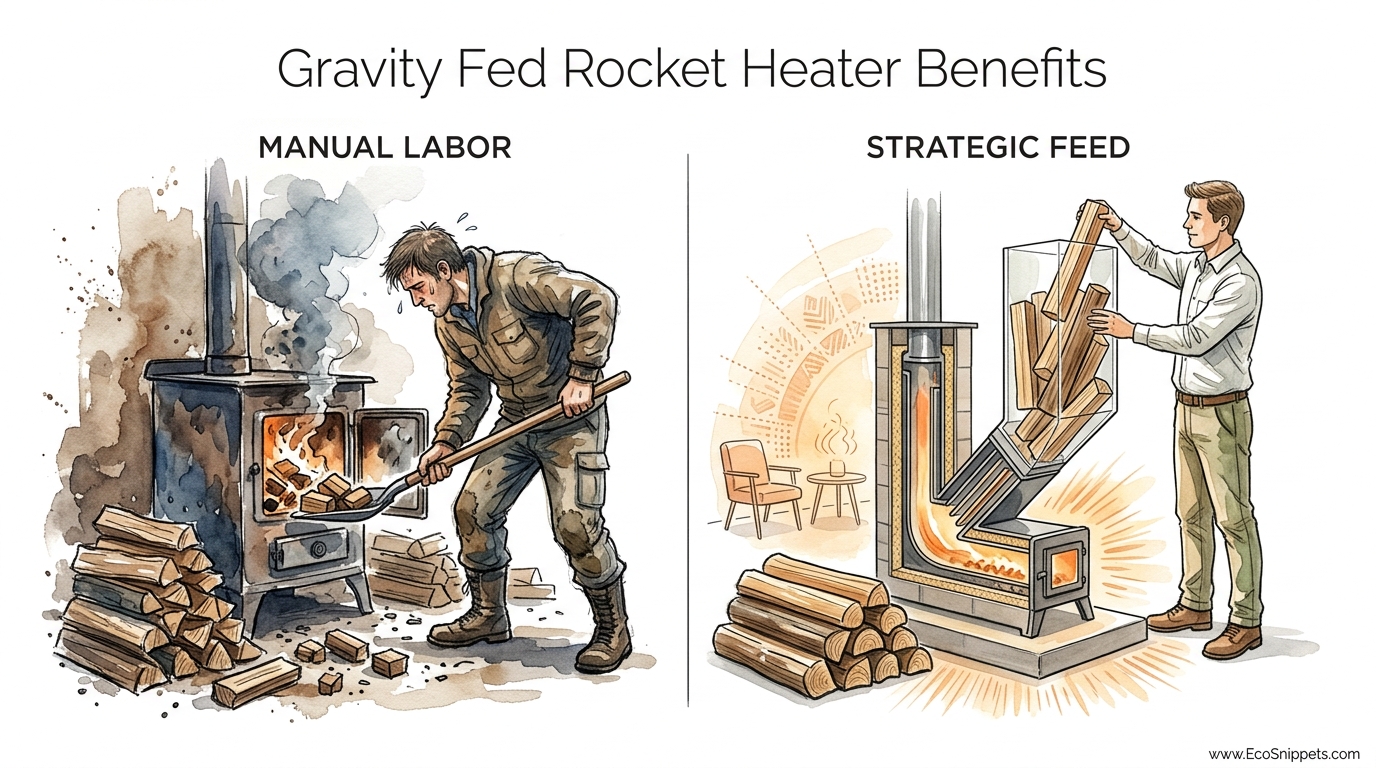
Gravity Fed Rocket Heater Benefits
A gravity-fed rocket heater is a high-efficiency combustion system designed to burn wood at extremely high temperatures while automatically feeding fuel into the fire. It is a specific variation of the rocket stove, characterized by a vertical “feed tube” where wood is placed upright. As the bottom of the wood burns away, the weight of the remaining material pushes it downward into the combustion zone. This creates a self-regulating fire that maintains a consistent burn without the need for mechanical augers or constant human intervention.
These systems are primarily used in homesteading environments, off-grid cabins, and workshops where fuel efficiency and low labor are prioritized. In the real world, this means you can take a 4-foot (1.2-meter) long branch, drop it into the feed tube, and walk away. The stove “shortens” the wood as it burns, effectively doing the work of a saw and an axe while it heats your living space. This is a radical departure from the standard wood stove, which requires every piece of fuel to be cut to a specific length and split to a specific thickness.
Visualizing the system is straightforward if you think of a “J” shape. The short arm of the J is the feed tube where the wood sits. The curve of the J is the burn tunnel where the primary combustion happens. The long vertical arm of the J is the insulated heat riser, which acts as the engine of the stove. This vertical riser creates a powerful upward draft, which in turn sucks air and flames sideways away from the fuel, preventing the fire from climbing up the wood and into the room.
Practical application of this technology often extends into “Rocket Mass Heaters” (RMH). In these setups, the hot exhaust from the rocket stove is channeled through a long masonry or cob bench before exiting the building. The thermal mass of the bench absorbs the heat, storing it for 12 to 48 hours. This allows you to burn a small amount of wood for a few hours in the evening and remain warm throughout the following day, even in sub-freezing climates.
How the Physics of Gravity and Draft Work Together
The core of a gravity-fed system is the relationship between the vertical heat riser and the vertical feed tube. These two columns of air must be balanced perfectly to ensure the fire goes “down and over” rather than “up and out.” When you light a fire at the base of the insulated heat riser, the air inside heats up rapidly. Because hot air is less dense than cold air, it surges upward, creating a low-pressure zone at the bottom of the stove.
This low-pressure zone acts like a vacuum, pulling fresh air down through the feed tube and across the burning tips of the wood. The insulation surrounding the heat riser is critical; it keeps the internal temperatures high enough (often exceeding 1,000°F or 540°C) to facilitate secondary combustion. At these temperatures, the smoke and volatile gases that usually escape up a traditional chimney are instead incinerated, producing more heat and leaving almost no creosote or visible smoke.
Fuel moves downward purely through the force of gravity. As the portion of the wood in the burn tunnel is consumed, it turns to ash and glowing coals. The structural integrity of the branch or log vanishes at the burn line, allowing the unburned portion above to slide down. To ensure this happens smoothly, the feed tube must be slightly wider than the wood being used. A 6-inch (15-cm) system typically works best with branches up to 4 inches (10 cm) in diameter, leaving enough room for air to flow around the fuel.
Managing the airflow is the key to controlling the burn rate. Most gravity-fed designs use a “feed cover” or a simple brick placed over a portion of the opening to tune the draft. If the opening is too large, the fire may lack the velocity needed to keep the heat riser primed. If it is too small, the fire may starve for oxygen. Finding the “sweet spot” ensures the roar of the rocket stays consistent and the fuel descends without jamming.
The Structural Components of a Vertical Feed System
Building a successful gravity-fed heater requires sticking to proven ratios. Deviation from these proportions is the most common reason for smoky restarts and poor performance. The industry standard, popularized by pioneers like Ernie and Erica Wisner, follows a 1:2:3 or 1:2:4 ratio depending on the specific goal. This means if your feed tube is 1 unit tall, your burn tunnel should be approximately 2 units long, and your heat riser should be at least 3 to 4 units tall.
The Feed Tube
The feed tube is the “fuel tank” of your heater. It is usually constructed from heavy-gauge steel or firebrick. A standard height for a 6-inch (15-cm) system is about 12 to 15 inches (30 to 38 cm). Making the tube too tall can lead to “bridging,” where wood hangs up on the sides, while making it too short can allow smoke to “curl” out of the top if the draft is weak. The top of the feed tube should always be lower than the top of the heat riser to maintain the pressure differential.
The Burn Tunnel
This horizontal section connects the feed to the riser. It is where the “primary” burn occurs. For a 6-inch (15-cm) system, the tunnel is usually about 12 inches (30 cm) long. This length provides enough space for the flames to stretch out and mix with the incoming air. It is often lined with high-density firebricks to withstand the intense thermal cycling and the abrasive nature of sliding wood and ash.
The Insulated Heat Riser
This is the most vital component. The riser must be insulated to keep the gases hot as they travel upward. Common materials for the riser include stainless steel flue liners or ceramic fiber tubes, surrounded by a larger pipe filled with perlite or vermiculite. The insulation ensures the gases stay above the “flash point” of smoke, resulting in the characteristic clean burn. The riser is typically 32 to 48 inches (81 to 122 cm) tall for a standard residential-scale system.
The “No Splitting” Strategy for Fuel Selection
Switching to a gravity-fed system changes how you interact with your woodlot. You no longer need to look for massive “monsters” that require a hydraulic splitter. Instead, you look for “pole wood”—limbs and saplings between 2 and 5 inches (5 to 12 cm) in diameter. This type of wood is often abundant, easier to harvest with a small chainsaw or handsaw, and seasons much faster than large split logs.
Round wood has a higher bark-to-wood ratio, which can actually improve the burn in a rocket heater. The bark acts as a natural tinder, while the round shape allows air to circulate around the entire piece. In a traditional stove, round wood often smolders because the air can’t reach the center. In a vertical feed, the fire only attacks the bottom end of the log, so the air has direct access to the “face” of the fuel.
Preparation is reduced to simply cutting limbs into 3-to-4-foot (0.9 to 1.2-meter) lengths. You don’t even need to be perfectly precise with the length; as long as the wood can stand up in the feed tube without tipping the stove, it will burn. This allows you to process a year’s worth of fuel in a fraction of the time. You are essentially using the stove as your final “processing” step.
Moisture content remains the only non-negotiable factor. While you save time on splitting, you cannot skip the seasoning process. Wood for a rocket heater must be below 20% moisture, ideally closer to 15%. Because the combustion chamber is so efficient, wet wood will sap the energy needed to maintain the “rocket” draft, leading to steam production and potential smoke-back into the room.
Practical Benefits of the Vertical Gravity Feed
The primary benefit is, of course, the reduction in manual labor. By eliminating the splitting phase, you reclaim dozens of hours. Beyond labor, there is a significant increase in fuel efficiency. Traditional wood stoves typically operate at 30% to 50% efficiency, with much of the heat escaping up the chimney. A well-built rocket mass heater with a gravity feed can reach 80% to 90% efficiency, meaning you need significantly less wood to achieve the same temperature.
Cleanliness is another major advantage. Because the fire burns so hot, there is almost no visible smoke once the system is up to temperature. This makes it an excellent choice for sensitive neighborhoods or areas with strict air quality regulations. The exhaust leaving the building is mostly water vapor and CO2, with none of the heavy particulates or creosote-forming gases associated with conventional wood smoke.
The safety profile of a vertical feed is also noteworthy. In a traditional stove, you open a large door to add fuel, which can let sparks or smoke into the room. In a gravity-fed system, the opening is relatively small and the draft is so powerful that air is constantly being sucked into the hole. Sparks and flames are pulled away from the operator. Furthermore, the “fuel tank” (the wood in the feed tube) is not actually on fire; only the very bottom tips are burning, which minimizes the risk of a runaway fire.
Common Challenges and How to Avoid Them
The most frequent issue with gravity-fed heaters is “smoke-back.” This occurs when the smoke travels up the feed tube and into the living space instead of down the burn tunnel. This usually happens during start-up when the heat riser is still cold. To prevent this, you should always “prime” the riser by burning a small piece of paper or a handful of shavings directly at the base of the riser through the clean-out port. This establishes the upward draft before you light the main fuel.
Another common mistake is “over-stuffing” the feed tube. If you pack the wood too tightly, you block the airflow. The fire needs a “curtain” of air to move past the wood and into the burn tunnel. If the air can’t get through, the fire will starve, temperatures will drop, and the draft will fail. Always leave at least 25% to 30% open space in the feed tube for air passage.
Fuel “bridging” is a mechanical challenge where branches with side-nubs or crooked shapes get stuck halfway down the tube. When the bottom burns away, the rest of the log stays suspended, leaving a gap between the fire and the fuel. This causes the fire to die out. To avoid this, you should trim off any side branches flush with the main limb and avoid using wood with extreme curves. If a jam does occur, a simple “poker” can be used to nudge the wood downward.
Ash management is the final hurdle. Because these stoves burn so efficiently, they produce very little ash, but that ash has nowhere to go but the bottom of the burn tunnel. If ash builds up too high, it will eventually block the air path. Most designs include an “ash pit” or a clean-out T-joint at the base of the riser. Regular maintenance involves scooping out a handful of ash every few days of continuous burning.
Limitations and Environmental Constraints
Gravity-fed rocket heaters are not a “plug-and-play” solution for every home. One significant limitation is the building’s air pressure. In modern, airtight homes with powerful kitchen exhaust fans, the house can develop a “negative pressure” that is stronger than the stove’s draft. This can pull smoke into the room. If you are installing a rocket heater in a tightly sealed house, you must provide a dedicated exterior air intake specifically for the stove.
Insurance and building codes can also be a barrier. Because rocket mass heaters are often site-built from local materials like cob and recycled barrels, they rarely carry the UL (Underwriters Laboratories) certification required by many insurance companies. While some commercial versions like the Liberator Rocket Heater are UL-listed, DIY versions may require extensive conversations with your local building inspector or a specialized insurance carrier.
The size of the fuel is a physical constraint. While you save on splitting, you are limited by the diameter of your feed tube. You cannot burn a 12-inch (30-cm) oak log in a 6-inch (15-cm) rocket stove. This means you must have a reliable source of smaller-diameter wood. If your land only produces massive old-growth timber, you might find yourself doing more work to downsize the logs than you would with a traditional stove.
Comparison: J-Tube vs. Batch Box vs. Traditional Stove
Choosing the right system depends on your goals for labor and heat duration. The following table compares the three most common wood-heating options for the modern homesteader.
| Feature | J-Tube (Gravity Feed) | Batch Box Rocket | Traditional Wood Stove |
|---|---|---|---|
| Fuel Prep | None/Minimal (long rounds) | Moderate (cut to length) | High (cut and split) |
| Efficiency | 80% – 90% | 85% – 95% | 30% – 60% |
| Tending Frequency | Every 45-60 mins | Every 2-4 hours | Every 4-8 hours |
| Heat Storage | Thermal Mass (Bench) | Thermal Mass (Bench) | Air-based (Quick cool) |
Practical Tips and Best Practices
Mastering a gravity-fed heater requires a few subtle adjustments to your daily routine. Start by organizing your woodpile by diameter rather than just species. Having a “tinder” pile of 1-inch (2.5-cm) sticks and a “main fuel” pile of 3-to-4-inch (7 to 10-cm) branches makes loading the stove much more efficient. You can mix species, but remember that softwoods like pine will burn faster and require more frequent loading than hardwoods like oak or maple.
The “Brick Trick” is a must-know technique for J-tube operators. If you find the fire is getting too aggressive or smoke is threatening to back up, place a heavy firebrick over the back half of the feed opening. This constricts the air, increasing its velocity as it enters the burn tunnel. This higher velocity “pins” the fire to the floor of the tunnel and reinforces the draft, making the stove run more predictably.
Regular maintenance of the thermal mass is also essential. If you are using a cob bench, check for cracks every autumn. Small “hairline” cracks are normal due to thermal expansion, but larger cracks can allow exhaust to leak into the room. These can be easily patched with a simple mixture of clay, sand, and chopped straw. A well-maintained mass will feel like a warm, gentle battery for your home.
Advanced Considerations for the Serious Builder
For those looking to push the boundaries of performance, consider incorporating a “P-channel” or a secondary air intake. A P-channel is a small metal tube that delivers fresh air directly to the top of the burn tunnel, right where the gases enter the riser. This “pre-heated” air provides an extra boost of oxygen to the hottest part of the fire, ensuring that even the most stubborn wood gases are fully combusted. This can increase efficiency by another 5% to 10%.
Scaling the system is another advanced topic. Most DIY plans are for 6-inch (15-cm) systems, which are ideal for heating about 1,000 square feet (93 square meters). If you have a larger space, you might be tempted to jump to an 8-inch (20-cm) system. However, keep in mind that the cross-sectional area nearly doubles when you go from 6 to 8 inches. This means you will need twice as much wood and a significantly larger thermal mass to absorb the extra heat. Larger systems are also more prone to draft issues if the chimney height isn’t scaled up accordingly.
Material choice for the core can drastically affect the lifespan of your heater. While mild steel is cheap and easy to weld, it will eventually oxidize and “flake away” under the extreme heat of the burn tunnel. Serious practitioners often use “super-duty” firebricks or castable refractory cement for the internal core. These materials can withstand thousands of hours of high-heat cycles without degrading, ensuring your heater lasts for decades rather than just a few seasons.
Example Scenario: The Weekend Workshop Burn
To see how this works in practice, imagine a cold Saturday morning in a 20’x30′ (6×9 meter) workshop. Instead of starting a massive wood stove and waiting three hours for the air to warm up, you head to the rocket heater. You light a small wad of paper in the clean-out to start the draft. Once the “roar” begins, you drop three 4-foot-long (1.2-meter) maple branches into the feed tube.
Within 15 minutes, the insulated riser is up to temperature, and the top of the barrel is radiating intense heat. You go about your woodworking or mechanical tasks. Every 45 minutes, you glance at the feed tube. The branches have shortened by a foot. You simply drop in another branch on top of the others. There is no opening of doors, no smoke in your face, and no need to stop your work to split more wood. By mid-afternoon, the cob bench surrounding the exhaust is warm to the touch, and you can let the fire die out, knowing the mass will keep the shop above freezing all night long.
Final Thoughts
Gravity-fed rocket heaters are more than just a clever way to burn wood. They represent a fundamental shift toward self-reliance that honors both the laws of physics and the value of human time. By removing the most labor-intensive part of wood heating—the splitting and constant tending—you free yourself to focus on more productive aspects of homesteading or creative life. This is “ancestral wisdom” applied through modern thermal dynamics.
The transition from traditional heating to a vertical feed system requires a willingness to experiment and a commitment to precision. While the construction is accessible to any competent DIYer, the ratios and insulation must be respected. Once you experience the clean, roaring heat of a properly tuned rocket, the sight of a traditional wood stove feels like looking at a relic of a less efficient era. Embrace the gravity, save your back, and let the fire do the work.
For those interested in going further, the world of rocket mass heaters offers endless opportunities for customization. From heated beds to indoor greenhouses, the ability to store and direct high-intensity heat is a foundational skill for anyone seeking a truly resilient home. Start with a small outdoor prototype, get a feel for the draft, and soon you will be ready to transform your indoor heating experience forever.
