How To Become More Self-Sufficient Without Starting a Full-Blown Farm…
Want to start preserving your harvest, making your own soap, or building a backyard root cellar — but not sure where to begin? “Homesteading Advice” gives you instant lifetime access to 35+ practical homesteading books on food preservation, veggie gardening, DIY natural cleaning products (save over $250 per year with this skill alone), brewing, off-grid energy, and a whole lot more…
Click Here To Check It Out Now!
When the internet goes down, does your power go with it? Modern ‘smart’ solar systems are amazing—until the server goes down or the Wi-Fi glitches. A truly resilient homestead doesn’t rely on a cloud connection to turn the lights on. Discover why the most secure power systems in the world use the ‘old-school’ analog method: physical switches and manual overrides.
In an era of high-tech convenience, we often trade true security for a slick interface. We have become accustomed to checking our battery levels on a smartphone app that routes data through a server thousands of miles (or kilometers) away. But when the grid falters or the digital web untangles, that convenience becomes a liability. A resilient power system is one that you can touch, see, and repair with your own two hands, regardless of what is happening in the digital world.
This guide is about returning to the foundations of self-reliance. We are looking at the “heavy iron” of the solar world: systems designed to last decades, not just until the next software update. If you want a power plant that functions as a silent, steadfast guardian of your home, you need to understand the art of analog resilience.
Off Grid Solar System Resilience
Off grid solar system resilience is the measure of a power system’s ability to maintain its primary function—providing electricity—under adverse conditions without external support. In practical terms, this means your system should continue to work if the internet is cut, if a specific computer chip fails, or even if a localized high-voltage surge occurs.
Historically, the pioneers of the 1970s “back-to-the-land” movement built systems out of necessity that were entirely manual. These systems used heavy-duty copper, lead-acid batteries, and simple analog meters. Today, we have the benefit of far more efficient panels and batteries, but we have introduced “digital fragility.” A resilient system today combines modern efficiency with the fail-safe logic of the past.
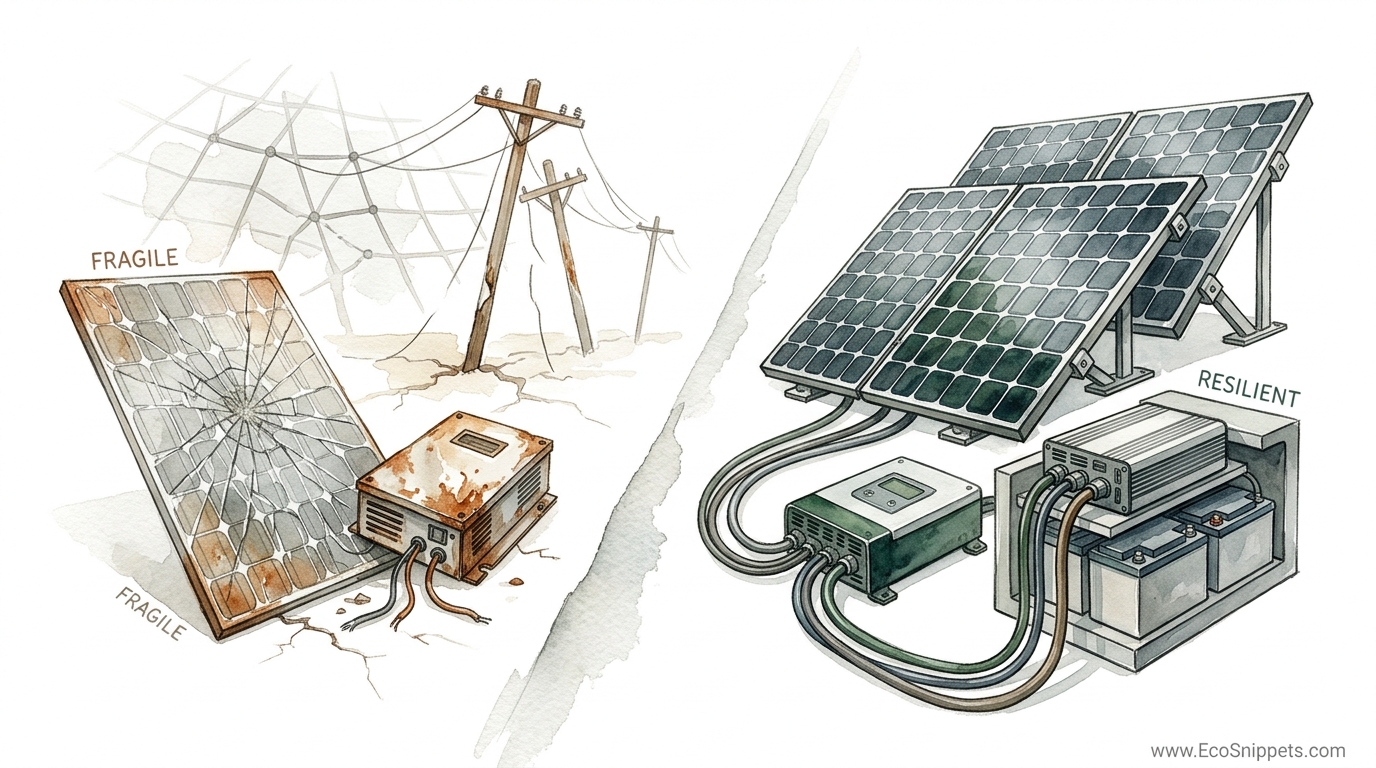
Think of resilience as a ladder. On the bottom rung are grid-tied systems that shut down the moment the utility power fails. In the middle are “smart” off-grid systems that provide backup but require a functional app or cloud server for configuration and monitoring. At the top of the ladder is the resilient homestead: a system with local-only controls, physical bypass switches, and “heavy iron” components that can handle the grit of real-world use.
How to Build an Analog-First Resilient System
The goal of a resilient setup is to ensure that no single failure—whether a software bug or a blown circuit board—can leave you in the dark. This requires a shift in how we wire and think about our power.
1. Implementing Physical Bypass Switches
A bypass switch is a manual transfer switch (MTS) or a Double Pole Double Throw (DPDT) switch that allows you to route power around a failed component. If your inverter dies, a bypass switch lets you plug a generator directly into your home’s critical circuits or pull power from an alternate source without rewiring the whole house.
For most homesteads, this involves a manual transfer panel. These panels use physical “interlock” kits—metal plates that prevent two breakers from being on at the same time. This is a “dumb” system, and that is its greatest strength. It cannot be hacked, it doesn’t need a firmware update, and it works every time you throw the lever.
2. Low-Frequency vs. High-Frequency Inverters
The heart of your system is the inverter, which turns DC battery power into the AC power your appliances need. Modern, “high-frequency” inverters are light and cheap, using small transformers and complex electronics. However, they are prone to failure from “dirty” power or high starting surges from motors.
Resilient systems favor **low-frequency inverters**. These are easily identified by their weight; they contain massive copper-wound toroidal transformers. They can handle surge loads (like starting a well pump or a saw) up to 300% of their rated capacity for short bursts, whereas high-frequency units often trip or fail under such stress.
3. Redundant Charge Controllers
Instead of one giant solar charge controller, use two or three smaller ones. If you have 2,000 Watts of solar, two 60-Amp controllers are more resilient than one 120-Amp unit. If one controller fails, you still have 50% of your charging capacity. This modularity is a hallmark of a system designed to survive.
Benefits of the Analog Approach
Choosing physical switches and manual overrides over cloud-connected automation offers several measurable advantages for the serious practitioner.
- Zero Dependency: Your system functions the same way whether the internet is up or the entire global network is down.
- Longevity: Heavy-duty analog components, such as low-frequency inverters and manual breakers, often have a service life of 15–20 years, far exceeding the 5–7 year lifespan of many “smart” gadgets.
- Repairability: When a system uses physical switches and standard breakers, a person with a basic understanding of electricity can diagnose and fix it. There are no “black box” algorithms to fight.
- Surge Tolerance: Analog-heavy systems are naturally more resistant to electromagnetic interference and voltage spikes that would fry the delicate microprocessors in a smart inverter.
Challenges and Common Mistakes
While the analog approach is more resilient, it is not without its hurdles. The most common mistake is assuming “manual” means “no maintenance.”
The “Set It and Forget It” Trap: Modern smart systems often hide problems behind the scenes. In an analog system, you are the monitor. If you forget to check your battery levels or water your lead-acid cells, the system won’t send an email to warn you. You must build a rhythm of manual inspection.
Overcomplicating the Bypass: Some DIYers try to build complex “auto-switching” relays. While convenient, every relay is a point of failure. A physical lever (a manual transfer switch) is almost always more reliable than an automatic one in a long-term survival scenario.
Wiring Gauge Neglect: Because resilient systems often deal with high surge currents, using thin wiring is a recipe for disaster. Always over-spec your DC cables. For a 12V or 24V system, the voltage drop across a small wire can shut your system down even if your batteries are full.
Limitations: When This May Not Be Ideal
It is important to acknowledge that a manual, resilient system requires a specific kind of owner. It is not ideal for everyone.
If you are someone who travels frequently and needs to manage a home remotely, a purely analog system offers no way to check in. Furthermore, manual systems take up more physical space. A 5kW low-frequency inverter might weigh 100 lbs (45 kg), while a high-frequency equivalent might weigh only 20 lbs (9 kg).
Cost is another factor. High-quality manual switches, copper busbars, and transformer-based inverters are significantly more expensive than their mass-produced digital counterparts. You are paying for the “iron,” and that comes at a premium.
Comparing System Philosophies
| Feature | Modern ‘Smart’ Solar | Resilient ‘Analog’ Solar |
|---|---|---|
| Monitoring | Cloud-based App | On-device Display / Manual Meters |
| Inverter Type | High-Frequency (Lightweight) | Low-Frequency (Heavy Transformer) |
| Control | Software/Firmware | Physical Switches/Breakers |
| Failure Point | Single Microchip / Wi-Fi | Human Error (Neglect) |
| Repairability | Unit Replacement | Component Replacement |
Practical Tips for Immediate Resilience
You don’t have to rewire your entire house tomorrow to start building resilience. Here are a few actionable steps:
- Install a Battery Monitor with a Local Screen: Don’t rely on your phone. Install a Shunt-based monitor (like a Victron BMV-712 or a simple AiLi monitor) that has a physical screen on the wall.
- Keep a “Dumb” Spare: If you have a high-tech all-in-one inverter, buy a cheap, “dumb” 1,000W low-frequency inverter and keep it in a Faraday box. If the main unit fails, you can swap it in to keep the fridge and lights running.
- Map Your Circuits: Physically label every breaker. In a dark, stressful situation, you don’t want to be guessing which switch controls the well pump.
- Learn to Use a Multimeter: This is the single most important tool for the resilient homesteader. Learn how to check DC voltage at the battery and AC voltage at the outlet.
Advanced Considerations: EMP and Direct DC
For those looking to go beyond the basics, consider the threat of high-altitude electromagnetic pulses (EMP) or severe solar flares. While rare, these events can induce massive currents in long wires.
Faraday Protection: Keep your critical spares (charge controllers, small inverters, and handheld radios) inside a nested Faraday cage—essentially a metal box with a non-conductive lining. This prevents the pulse from reaching the delicate circuits of your backup gear.
Direct DC Lighting: Every time you convert DC (battery) to AC (wall outlet) and back to DC (the LED bulb’s internal driver), you lose efficiency and add a failure point—the inverter. A truly resilient homestead uses 12V or 24V DC lighting circuits. These lights connect directly to the battery bank. If your inverter blows up, your house stays bright.
Example Scenario: The Winter Grid Failure
Imagine a severe ice storm hits. The grid is down, and the internet is out. In a modern smart-home, the owner is blind; they cannot see their battery percentage, and if the inverter has a software glitch, they cannot reset it without a connection.
Contrast this with the resilient homesteader. They walk to their power room and see the battery voltage on a hard-wired analog meter. They notice the inverter has tripped due to the heavy load of a space heater. They manually flip the bypass switch to the “Generator” position, pull-start their small backup generator, and within 60 seconds, the house has power. They aren’t waiting for a server in California to come back online; they are the master of their own domain.
Final Thoughts
Building for resilience is about more than just buying the right gear; it is a philosophy of independence. It is an acknowledgment that the systems we rely on are often more fragile than we care to admit. By choosing physical switches, heavy-duty transformers, and manual overrides, you are reclaiming control over your most basic needs.
True security doesn’t come from a faster processor or a prettier app interface. It comes from the “grit” of a system that is built to endure. Whether you are just starting your off-grid journey or looking to harden an existing setup, remember that the simplest path is often the most reliable.
Invest in the copper, understand the chemistry of your batteries, and never trust a cloud to keep your lights on. The peace of mind that comes from a truly resilient power system is worth every extra pound of iron and every manual turn of a switch.
