How To Become More Self-Sufficient Without Starting a Full-Blown Farm…
Want to start preserving your harvest, making your own soap, or building a backyard root cellar — but not sure where to begin? “Homesteading Advice” gives you instant lifetime access to 35+ practical homesteading books on food preservation, veggie gardening, DIY natural cleaning products (save over $250 per year with this skill alone), brewing, off-grid energy, and a whole lot more…
Click Here To Check It Out Now!
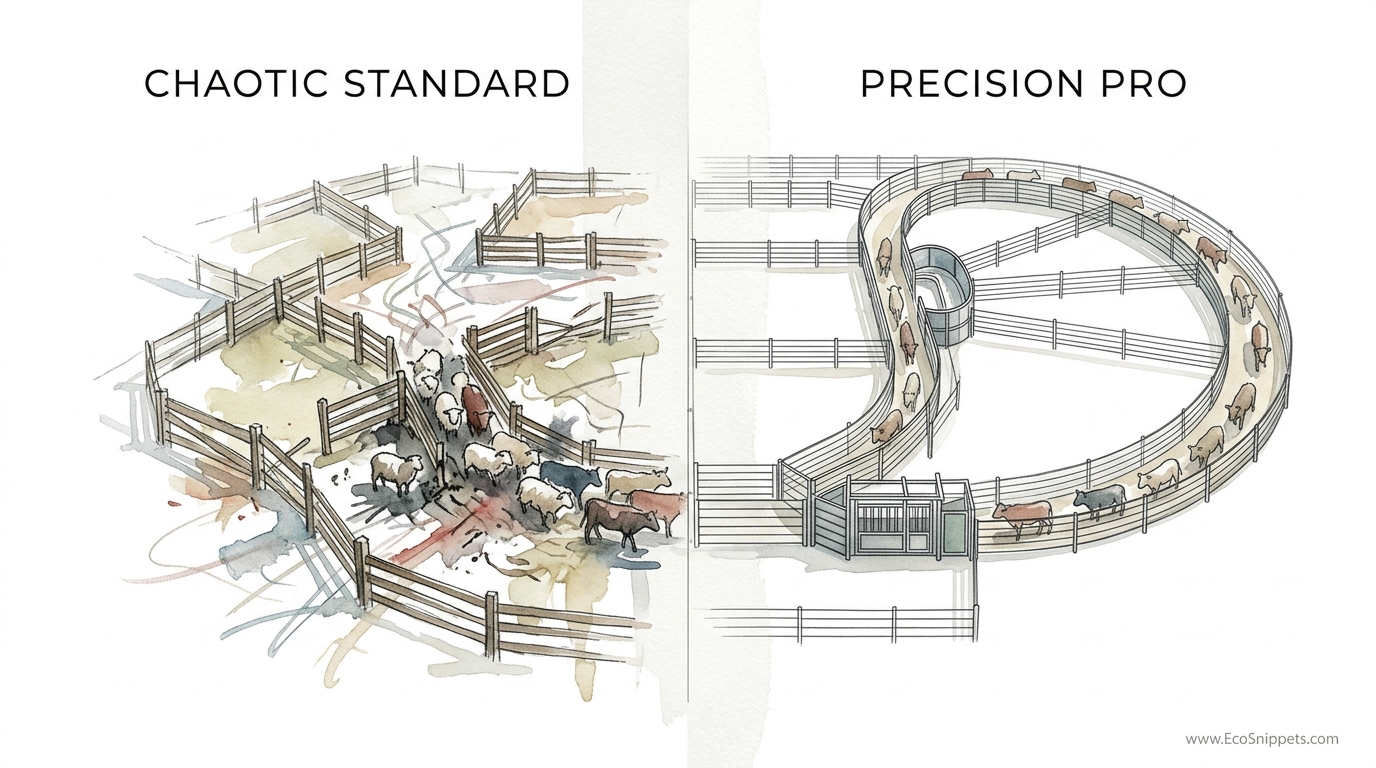
Four hours of chasing versus ten minutes of flow – the difference is in the geometry of your gates. If ‘working the cows’ involves a triple-digit heart rate and a broken gate, you’re doing it the standard way. Professional homesteaders don’t fight the animal; they use Temple Grandin-inspired geometry to let the animal’s own instincts do the work. See how a simple change in fence angles can turn a day of chaos into a morning of quiet efficiency.
Working livestock is an exercise in applied psychology as much as it is physical labor. For generations, the image of the stockman was one of sweat and struggle, a constant battle of wills between man and beast. But those who have mastered the craft know that the most effective tool in the corral isn’t a whip or a prod; it is the fence line itself. When a handling system is designed correctly, the animals move not because they are forced, but because they believe it was their idea to go that way in the first place.
The transition from a chaotic standard setup to a precision professional system requires a fundamental shift in perspective. You must stop seeing a pen as a cage and start seeing it as a series of pathways and pressure points. By aligning the physical structure of your farm with the natural instincts of your herd, you eliminate the friction that leads to injuries, stress-induced weight loss, and the exhaustion of the handler.
Professional Livestock Handling System Designs
A professional livestock handling system is a specialized set of pens, alleys, and gates designed to safely restrain animals for medical treatment, sorting, or transport. While a standard backyard pen might just be a square of wire or wood, a professional design is a machine made of stationary parts. It serves as the interface between the open range and the controlled environment of a squeeze chute or loading ramp.
These systems exist to manage the “flight zone” of the animal. In the wild, a cow or sheep survives by maintaining a certain distance from predators. When a human enters that bubble, the animal moves. A well-designed system directs that movement into a productive channel. Whether you are managing five head or five hundred, the principles remain the same: minimize distractions, leverage the herd instinct, and provide a clear path forward.
In the real world, these designs are used everywhere from small-scale regenerative homesteads to massive commercial feedlots. On a homestead, a professional-grade layout allows a single person to vaccinate or sort a herd safely. In a commercial setting, it ensures that thousands of animals can be processed with minimal bruising or stress, which directly translates to better meat quality and higher profitability. Think of it as the difference between a rough trail and a high-speed highway; both get you to the destination, but one does it with far less wear and tear on the vehicle.
How It Works: The Science of Animal Flow
The “why” behind a professional system is rooted in ethology—the study of animal behavior. Cattle and sheep are prey animals with wide-angle vision. They are hardwired to look for threats and to follow their peers. Understanding three core principles will explain why specific gate angles and chute curves are necessary.
The Flight Zone and Point of Balance
Every animal has a “flight zone,” or personal space. If you stand outside this zone, the animal stays still. If you step into it, they move. The “point of balance” is typically at the animal’s shoulder. If you stand behind the shoulder, they move forward. If you stand in front of the shoulder, they back up or turn away. Professional systems are designed so the handler can walk along a catwalk and “tap” the flight zone of each animal to keep them moving through a chute without ever having to touch them.
The “Return to Source” Instinct
Livestock almost always want to return to where they just came from. They feel safer in the territory they just traveled. Many professional designs, such as the Temple Grandin sweep tub, use this by making the cattle perform a 180-degree turn. As they circle around the tub, they think they are heading back to the pasture, but they are actually being funneled into the single-file alley. This is the “geometry of the gate” in its most elegant form.
Visual Distractions and Solid Sides
Because cattle have a visual field of over 300 degrees, they are easily distracted by a coat hanging on a fence, a shadow across the path, or a person standing where they shouldn’t be. Professional systems often use solid-sided chutes. This acts like blinders on a horse, narrowing the animal’s focus to the single escape route: the exit of the chute. If they can’t see the truck or the squeeze chute until the last moment, they won’t balk.
Benefits of a Precision System
Investing the time to build a precision system pays dividends in safety and health. When animals are stressed, their bodies produce cortisol, which suppresses the immune system and reduces weight gain. A low-stress environment keeps the herd healthy and the handler out of the hospital.
- Increased Safety: Most handler injuries occur when an animal panics or feels trapped. A professional system provides clear escape routes for the animal and safety “man-gates” for the human.
- One-Man Operation: A properly balanced system allows one person to move a large group of animals efficiently. This self-reliance is the hallmark of a true professional.
- Better Medical Outcomes: When an animal is calm, it is easier to administer vaccinations or perform hoof trimmings. A panicked animal in a squeeze chute is a danger to itself and can easily break a leg or hip.
- Higher Market Value: Stress and bruising during loading can lead to “dark cutters” or damaged meat. Animals handled quietly through a professional system retain more value at the point of sale.
Challenges and Common Mistakes
The most common mistake in building a handling system is “over-building” without understanding the flow. A heavy steel gate in the wrong place is worse than a light wooden one in the right place. Many people build their crowding pens too large, thinking more space is better. In reality, a crowding pen should only hold about 8 to 10 head of cattle at a time (or a small group of sheep). If you put 50 cows in a tub, they will pile up, turn around, and become agitated.
Another pitfall is the “dead-end” chute. If a curved chute is bent too sharply, an animal at the entrance cannot see the animal ahead of it. If they see a wall of metal or wood, they will stop. You must ensure they can see at least two body lengths of clear path ahead of them. This is why the radius of a curve is critical; for cattle, a 12-foot to 17-foot (3.6m to 5.2m) radius is standard for a sweep.
Shadows and lighting are often overlooked. Cattle will often refuse to walk into a dark building or across a harsh shadow on the floor. If your facility is indoors, you must have uniform lighting. If it is outdoors, the orientation of the sun during your typical working hours should be considered so the animals aren’t walking directly into a blinding glare.
Limitations and Environmental Constraints
While these systems are highly effective, they are not universal. A system designed for cattle will be largely useless for sheep without significant modifications. Sheep require narrower alleys—typically 10 to 12 inches (25cm to 30cm) wide—and shorter fence heights. If you are a multi-species homesteader, you will need adjustable-width alleys or separate facilities.
Space and terrain also dictate your design. On a steep slope, you must ensure the animals are moving uphill into the chute. They naturally move better uphill than down. If your land is swampy or prone to mud, the high-traffic areas of your handling system must be reinforced with gravel or grooved concrete. A professional system on a muddy base becomes a hazard for both animals and humans very quickly.
Cost is the final constraint. A full-scale, powder-coated steel hydraulic system can cost tens of thousands of dollars. However, the principles of geometry can be applied to wooden posts and rails for a fraction of the cost. The “precision” is in the layout, not necessarily the material.
Comparison: The Sweep Tub vs. The BudBox
Two major philosophies dominate professional livestock handling: the Temple Grandin Sweep Tub and the Bud Williams BudBox. Choosing between them depends on your skill level and your facility’s footprint.
| Feature | Temple Grandin Sweep Tub | Bud Williams BudBox |
|---|---|---|
| Core Principle | Uses curved, solid walls to direct movement automatically. | Uses a rectangular pen and handler positioning to trigger instincts. |
| Complexity | Higher construction cost; requires precise curves. | Lower cost; simple rectangular shape. |
| Skill Level | Lower; the facility does most of the work. | Higher; relies heavily on handler’s “stockmanship” skills. |
| Visibility | Solid sides to block out distractions. | Open sides to allow the animal to see the handler. |
| Best For | Inexperienced labor or high-volume processing. | Experienced stockmen who prefer a “dialogue” with the herd. |
Practical Tips for Best Results
Before you hammer a single nail or weld a single joint, walk through your proposed site. Visualize being the animal. Look for anything that might cause a “balk”—a shiny piece of metal, a flapping tarp, or a drain hole in the middle of the path. These small details are the difference between a system that flows and one that fails.
- Non-Slip Flooring: This is non-negotiable. If an animal slips once, it will be terrified of that spot forever. Use grooved concrete with a diamond pattern or a thick layer of crushed stone.
- Gate Latches: Use latches that can be operated with one hand and that make minimal noise. The “clanging” of a heavy gate can trigger a flight response.
- Alley Length: A single-file alley should be at least 20 feet (6.1m) long. This allows the “following” instinct to kick in. If it’s too short, the animals won’t line up correctly.
- Back-Stops: Install “no-back” gates in your alley. These are one-way flipper gates that prevent an animal from backing up once they have moved forward. They should be “see-through” so the animal behind can see the leader.
Advanced Considerations for the Serious Practitioner
As you become more comfortable with your livestock, you might consider advanced modifications like the “V-Chute.” This is an alley where the sides are wider at the top than the bottom. This accommodates both large bulls and small calves without them being able to turn around. A bottom width of 16 inches (40cm) and a top width of 28 inches (71cm) is a common standard for cattle.
Consider the “Sorting Alley” as well. This is a section of the system after the squeeze chute where you can divert animals into different pens based on weight, sex, or health status. A well-placed “Y-gate” here can save hours of work later. If you are working with sheep or goats, you might look into “decoy pens”—small cages at the end of a race that hold a “buddy” animal to encourage the others to run toward them.
Finally, think about accessibility for equipment. If you need to bring in a vet truck or a trailer, your turning radii must be wide enough. A 130-foot (40m) diameter circle is the professional standard for allowing a truck and trailer to turn around without backing up.
Example Scenario: The Morning Sort
Imagine you have 20 head of cattle that need to be vaccinated and sorted. In a standard square pen, you would spend an hour running around, shouting, and swinging a paddle. By the time the first cow is in the headgate, she is panting and wild-eyed.
In a professional precision system, you move the group into a large holding pen. You open the gate to the sweep tub, and 8 head walk in. You swing the solid sweep gate shut behind them. Following their natural circling instinct, the cows move toward the only light they see—the entrance to the alley. Because the walls are solid, they don’t see you. They only see the tail of the cow in front of them. You walk along the inside catwalk, staying just behind the lead cow’s shoulder. She steps forward into the squeeze chute. The entire process for the first group takes five minutes. No one has shouted. No one has been kicked. This is the geometry of efficiency in action.
Final Thoughts
Professional livestock handling is not about dominance; it is about communication. When you build a system based on the principles of Temple Grandin or Bud Williams, you are speaking to your animals in a language they understand. You are removing the fear and replacing it with a predictable flow that respects the nature of the beast.
Building such a system is an investment in your farm’s future. It reduces the physical toll on your body and the psychological toll on your animals. Whether you are building from scratch or retrofitting an old barn, focus on the curves, the light, and the flight zones. A quiet morning in the corral is the greatest reward for a job well done in the design phase.
As you master these concepts, you may find that other areas of your farm benefit from the same observant approach. The way you move water, the way you rotate pastures, and the way you manage your time all have their own “geometry of flow.” Start with your gates, and the rest will follow.
