How To Become More Self-Sufficient Without Starting a Full-Blown Farm…
Want to start preserving your harvest, making your own soap, or building a backyard root cellar — but not sure where to begin? “Homesteading Advice” gives you instant lifetime access to 35+ practical homesteading books on food preservation, veggie gardening, DIY natural cleaning products (save over $250 per year with this skill alone), brewing, off-grid energy, and a whole lot more…
Click Here To Check It Out Now!
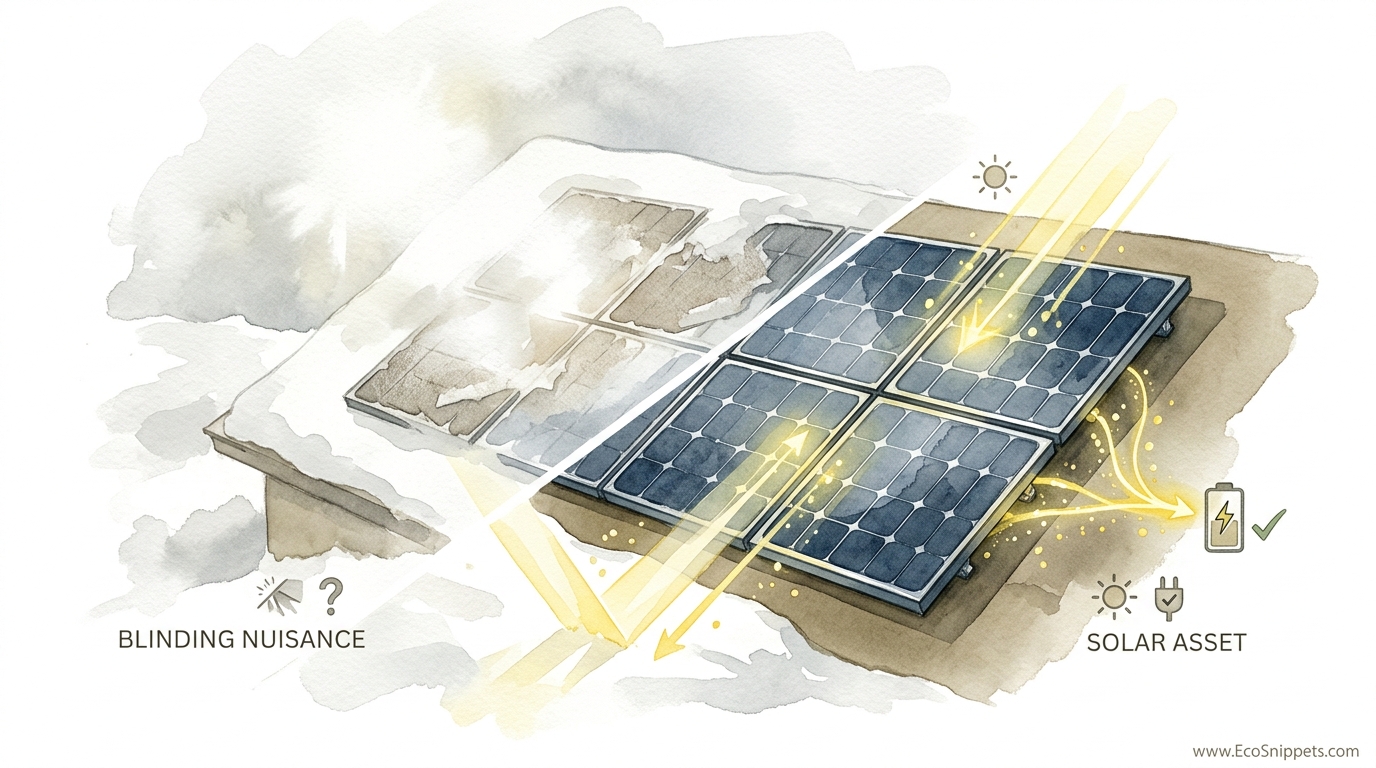
Most people see a winter glare as a headache; smart homesteaders see a natural mirror that doubles their winter energy yield. Snow isn’t just something to shovel; it’s a high-efficiency reflector. Switching from flat-mounted to vertical solar arrays turns that blinding nuisance into a ‘solar mirror’ that can actually outperform summer production during the brightest winter days.
Winter often feels like a season of scarcity for those living off the grid or striving for energy independence. Traditional solar wisdom suggests tilting panels toward the equator at an angle equal to your latitude. This works well for the average homeowner, but for the homesteader facing heavy snow and low-hanging sun, the old rules fall short. You need a system that doesn’t just survive the frost but thrives because of it.
Vertical solar installations represent a shift back to a more observant way of living. Ancestral builders knew that the low winter sun could penetrate deep into a south-facing home if the eaves were designed correctly. Modern energy systems can apply that same logic. You are no longer fighting the elements; you are inviting the environment to do the heavy lifting for you.
Solar Panel Snow Albedo Hack
Albedo is a term derived from the Latin word for “whiteness,” and it measures how well a surface reflects solar energy. A perfectly black surface has an albedo of 0.0, meaning it absorbs all light, while a perfectly white surface has an albedo of 1.0, reflecting everything. Most natural surfaces like grass or bare soil sit at the lower end of the scale, usually between 0.15 and 0.25.
Fresh snow is a different beast entirely. It boasts an albedo of 0.8 to 0.9, meaning it reflects up to 90% of the sunlight hitting it. This creates a massive secondary light source that remains completely untapped by traditional roof-mounted panels. When you mount panels vertically, you position them to capture this reflected light directly.
This hack relies on the physics of “diffuse” and “specular” reflection. Specular reflection is like a mirror, where light bounces off at the same angle it arrived. Diffuse reflection happens when light hits a rough surface like snow and scatters in all directions. Vertical panels are perfectly situated to soak up this scattered light from the ground while simultaneously catching the direct rays of the sun hanging low on the horizon.
Real-world application of this concept is most visible in high-latitude regions like Scandinavia, Canada, and the Northern United States. Research from the National Renewable Energy Laboratory (NREL) and European institutions shows that snow-covered ground can boost the output of bifacial solar systems by 20% to 30% over the course of a winter. In some extreme cases where fresh snow is maintained, the yield increase can spike even higher.
How It Works: The Vertical Bifacial System
Standard solar panels are monofacial, meaning they only have one active side. Light hits the front, generates power, and any light hitting the back is wasted. To truly exploit the snow albedo hack, you must use bifacial panels. These modules are designed with glass on both sides or a clear backsheet, allowing the cells to capture photons from the front and the rear.
Vertical mounting changes the geometry of your energy production. Instead of a single peak at noon, an east-west oriented vertical array creates two distinct peaks: one in the mid-morning and one in the late afternoon. This often aligns better with the actual energy needs of a homestead, such as morning chores and evening cooking.
The vertical orientation serves a dual purpose. First, it ensures that snow cannot accumulate on the face of the panels. Gravity is your maintenance crew. Even a few inches (about 5-10 cm) of snow on a tilted panel can shut down an entire string. Vertical panels remain clear, ensuring that as soon as the sun breaks through the clouds after a storm, your batteries start charging immediately.
Second, the vertical angle is nearly perpendicular to the sun’s path during the winter solstice. In many northern regions, the sun never rises more than 15 or 20 degrees above the horizon in December. A panel tilted at 30 degrees is poorly positioned for this light, but a 90-degree vertical panel catches those low-angle rays at a near-perfect strike.
Benefits of the Solar Mirror Strategy
Vertical arrays offer a “set it and forget it” reliability that tilted arrays lack in harsh climates. Self-cleaning is perhaps the most immediate benefit. You won’t find yourself standing on a slippery roof with a long-handled brush at 6:00 AM. Snow simply slides off the vertical glass surfaces before it can bond.
Thermal efficiency also plays a significant role. Solar panels actually perform better when they are cold. The electrical resistance within the cells decreases as the temperature drops. Because vertical panels are exposed to more airflow on both sides, they stay cooler than roof-mounted panels that might be trapped against a hot shingle or an insulating layer of snow. This cold-weather efficiency boost can add another 0.4% to 0.5% of output for every degree Celsius below the standard 25°C (77°F) testing temperature.
Land use becomes more efficient with this setup. You can install vertical solar “fences” along the perimeter of a garden or pasture. This allows the panels to produce power while the ground remains available for growing crops or grazing livestock. The shadows cast by vertical panels move quickly across the ground, preventing the long-term shading that can stunt plant growth under traditional arrays.
Structural longevity is another advantage often overlooked. Heavy snow loads can put thousands of pounds of pressure on roof-mounted racking systems. Vertical panels don’t carry that weight. The snow falls directly to the ground, distributing the load evenly across the earth rather than concentrating it on your home’s rafters or the solar mounting rails.
Challenges and Common Mistakes
Wind load is the primary enemy of any vertical structure. A solar panel is essentially a giant sail. When you stand it upright, it catches the full force of the wind. Failing to account for local wind speeds is the most frequent mistake DIYers make. You cannot use standard roof-mount racking for a vertical ground array; you need heavy-duty posts, often driven several feet (over a meter) into the ground or secured in concrete piers.
Shading from the panels themselves must be managed carefully. Because vertical arrays are often installed in rows, the shadow from the front row can easily clip the bottom of the second row, especially when the sun is very low. This “inter-row shading” can cripple your output. Wide spacing is required, which may not be possible on smaller properties.
Wiring and grounding require a different approach for vertical arrays. You are often running wires across open ground or along a fence line. Protecting these cables from rodents, lawnmowers, and the elements is vital. Using high-quality conduit and ensuring every panel frame is properly grounded according to local codes will prevent a host of electrical headaches later.
Many people also forget about the “ground clearance” needed for bifacial panels. If the bottom of the panel is too close to the ground, it won’t be able to “see” the reflected light effectively. A clearance of 12 to 18 inches (30 to 45 cm) is generally recommended to allow light to bounce up onto the rear of the cells and to keep the panels clear of drifting snow.
Limitations: When This May Not Be Ideal
Geographic location is the biggest constraint. If you live near the equator, the sun is high in the sky for most of the year. In these regions, a vertical panel will significantly underperform compared to a flat or slightly tilted one. The vertical “winter hack” is specifically for those living above 35 or 40 degrees latitude, where the seasonal sun shift is dramatic.
Lack of consistent snow cover also negates many of the benefits. If your winters are mostly grey, wet, and muddy, the albedo of the ground will stay low. Without that “white mirror” effect, a vertical array is just a panel that’s poorly angled for the sun. Properties with dark soil or heavy evergreen forest cover may find traditional mounts more effective.
Initial cost can be higher for bifacial technology. While prices are reaching parity with monofacial panels, you are still paying a premium for the dual-sided cells and the specialized racking needed to handle wind loads. If your energy needs are low and you have plenty of roof space, the extra investment might not justify the winter gains.
Strict local zoning laws or HOA regulations can also be a hurdle. A 6-foot (1.8 m) tall solar fence is a visible structure that some neighbors or local boards might find objectionable. Always check your local ordinances before committing to a vertical ground mount.
Comparison: Conventional Flat-Mounts vs. Vertical Bifacial Arrays
| Feature | Conventional Flat-Mount | Vertical Bifacial Array |
|---|---|---|
| Snow Management | Manual clearing required; prone to buildup. | Self-cleaning via gravity; zero accumulation. |
| Winter Yield | Low; incident angle is often poor. | High; optimized for low sun and albedo. |
| Wind Resistance | Aerodynamic; low wind profile. | High sail effect; requires robust racking. |
| Land Use | Occupies significant ground area. | Dual-use (fencing, gardening, livestock). |
| Production Profile | Single peak at solar noon. | Double peaks (morning and afternoon). |
Practical Tips for Success
Selecting the right location is the first step toward a high-yielding winter system. You need a clear, flat area in front of and behind the vertical array to maximize the snow’s reflection. Obstacles like tall grass, shrubs, or discarded equipment will block the reflected light and create “shadow pockets” that reduce the albedo effect.
Maintaining the “white mirror” is a pro tip that few people consider. If your solar array is near a driveway or road where salt and dirt are kicked up, the snow can become grey and dingy. This “dirty snow” has a much lower albedo than fresh powder. Clearing a path so that only clean, white snow remains around your panels can significantly boost your mid-winter numbers.
Orientation is flexible but crucial. While south-facing vertical panels are great for catching the sun at high noon, an East-West orientation is often superior for bifacial arrays. This allows one side to catch the sunrise and the other to catch the sunset, while both sides benefit from the ground reflection throughout the day. This spreads the power generation more evenly across the daylight hours.
Inverters should be chosen with bifacial gains in mind. A bifacial panel rated at 400 watts might actually produce 480 watts or more on a bright, snowy day. Ensure your micro-inverters or string inverters can handle this “over-production” without clipping or overheating. Checking the “short-circuit current” (Isc) and “open-circuit voltage” (Voc) specs against the inverter’s maximum input is a mandatory step.
Advanced Considerations
Serious practitioners might look into “albedo enhancement” during the non-snowy months. While this article focuses on winter, you can keep the benefits going by using light-colored gravel, white clover, or specialized reflective membranes under your panels during the summer. These materials can keep your bifacial panels producing 10% to 15% more than their monofacial counterparts even when the snow has melted.
Grounding and soil conditions for vertical racking require specialized knowledge. In areas with high frost heave, your posts need to be set deep enough to reach below the frost line—often 4 feet (1.2 m) or more. If you are using ground screws, ensure they are rated for the lateral force of the wind pushing against the vertical surface of the panels.
Micro-grids and battery storage pairing is the final piece of the puzzle. Because vertical arrays produce power earlier and later in the day, they can reduce the depth of discharge on your battery bank. Instead of waiting until 10:00 AM for a tilted array to start “pouring” power into the batteries, a vertical East-West array might start charging as soon as the sun peeks over the horizon. This shorter discharge cycle can significantly extend the lifespan of your expensive lithium or lead-acid batteries.
Modeling your expected yield with tools like PVWatts or PVSyst can help you dial in the exact spacing. These programs allow you to input different albedo values for different months. You can run a simulation with an albedo of 0.2 for the summer and 0.8 for the winter to see exactly how much of a “winter bonus” your specific location will provide.
Examples and Scenarios
Consider a homesteader in Vermont, USA, or Alberta, Canada. In late January, the sun might only reach a peak height of 22 degrees. A traditional 30-degree tilted array would face the sun at a 52-degree angle, which is decent but not optimal. However, if a blizzard dumps 12 inches (30 cm) of snow, that tilted array is buried. It produces zero power until someone climbs out to clear it.
A vertical bifacial fence in the same scenario remains 100% clear. As the sun hits the 90-degree panels, it does so at a near-optimal angle for the low-hanging winter light. Simultaneously, the 12 inches of fresh, white snow on the ground acts as a high-intensity reflector. Light bounces off the snow and hits the back of the bifacial panels.
The math for this scenario is compelling. A 10kW vertical bifacial array might produce 15-20 kWh on a clear winter day, while the buried tilted array produces nothing. Even if the tilted array is cleared, the vertical system often matches its total daily output because it captures the morning and evening light that the tilted panels miss. Over a week of snowy weather, the vertical array can easily double the total energy yield of a standard system.
Another scenario involves “Agrivoltaics.” A farmer uses vertical solar panels as a windbreak for a winter wheat crop. The panels provide electricity for the farm’s water pumps and lighting while simultaneously protecting the soil from wind erosion. The snow drifts that form between the rows of panels actually help insulate the soil, and the reflected light from those drifts keeps the energy production high throughout the dormant season.
Final Thoughts
Rethinking how we harvest the sun requires looking past the conventional “rules” of solar installation. Winter glare is not an enemy; it is a resource that has been hiding in plain sight. By aligning your technology with the natural behavior of light and snow, you create a system that is more resilient and more productive when you need it most.
Self-reliance is built on the ability to turn challenges into advantages. Vertical bifacial arrays are the embodiment of that spirit. They take the coldest, brightest, and most difficult parts of the winter season and transform them into a steady stream of clean energy.
Experimenting with a small vertical string or a solar fence is a great way to start. Watch how the snow behaves around the panels and track your production during the darkest weeks of the year. You may find that the “solar mirror” effect is the missing link in your quest for year-round energy independence. Apply these principles, build for the wind, and let the snow do the work for you.
