How To Become More Self-Sufficient Without Starting a Full-Blown Farm…
Want to start preserving your harvest, making your own soap, or building a backyard root cellar — but not sure where to begin? “Homesteading Advice” gives you instant lifetime access to 35+ practical homesteading books on food preservation, veggie gardening, DIY natural cleaning products (save over $250 per year with this skill alone), brewing, off-grid energy, and a whole lot more…
Click Here To Check It Out Now!
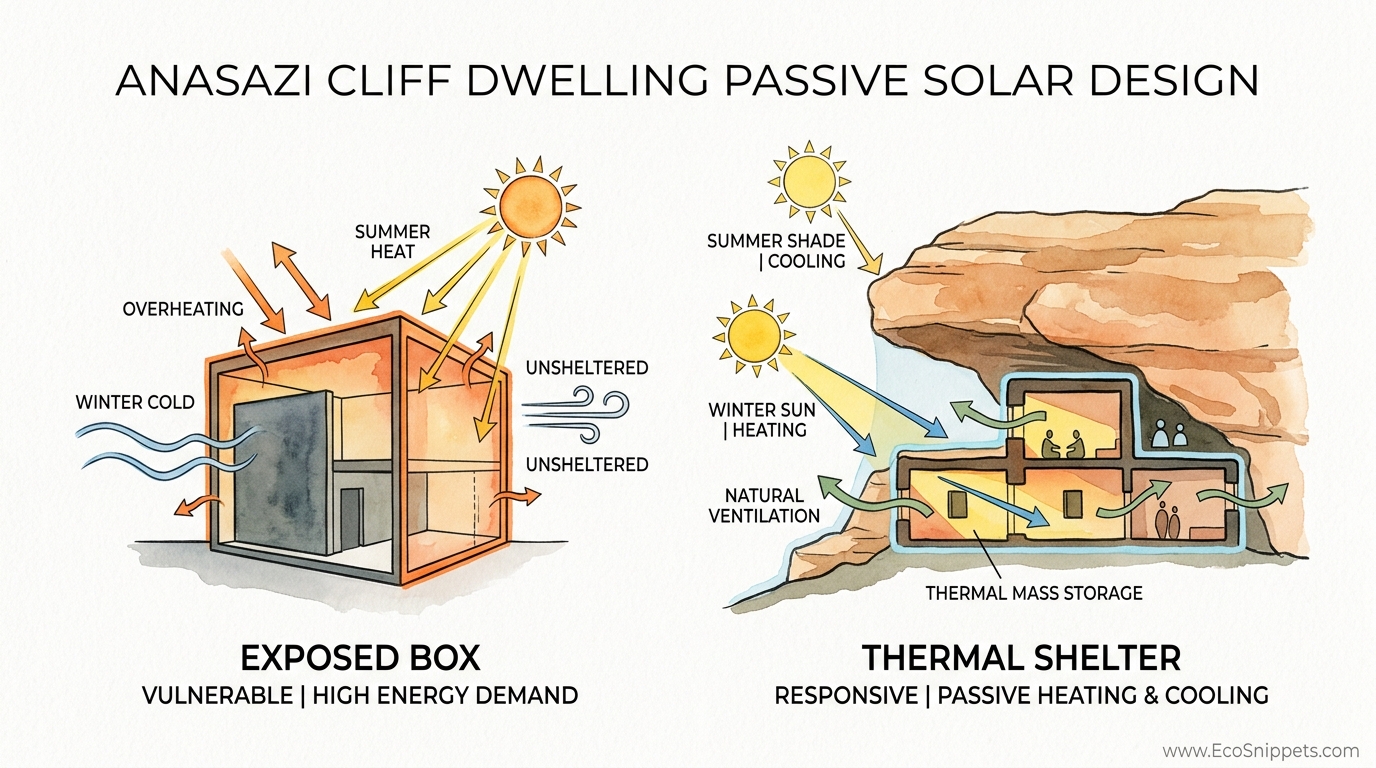
Ancient ‘Cliff Dwellers’ built the world’s most efficient thermostat into the landscape itself. The Ancestral Puebloans of Mesa Verde didn’t build ‘on’ the land; they built ‘into’ it. By using a deep sandstone alcove, they created a ‘sheltered’ microclimate that stays 20 degrees cooler in summer and 20 degrees warmer in winter. Most modern homes are ‘exposed’ boxes that require a constant fight against the weather. We need to relearn how to hide from the wind and hold the sun.
Modern architecture often treats the environment as an enemy to be excluded with high-powered machinery. We seal ourselves in thin-walled containers and pump electricity into them to maintain a fragile comfort. The ancient residents of the Four Corners region—the intersection of what we now call Colorado, Utah, Arizona, and New Mexico—took the opposite approach. They treated the earth as a partner, leveraging the physics of the sun and the density of stone to create a permanent, passive climate control system.
Understanding these principles is not just a history lesson. It is a blueprint for self-reliance. As energy costs rise and the climate becomes more erratic, the wisdom of the cliff dwellings offers a path back to stability. This is about more than just “going green.” This is about the “pioneer-grit” mentality of building something that works without a power grid, using the very ground beneath our feet.
Anasazi Cliff Dwelling Passive Solar Design
The term “Anasazi” is a Navajo word often translated as “ancient enemies,” which is why modern descendants prefer the term Ancestral Puebloans. However, the architectural legacy of these people remains one of the most sophisticated examples of passive solar design in human history. Between approximately 1100 and 1300 AD, these communities transitioned from living on top of the mesas to building elaborate cities within the deep alcoves of the canyon walls.
Passive solar design is a system that collects, stores, and distributes solar energy without the use of mechanical or electrical devices. In the context of a cliff dwelling, the entire structure acts as a thermal collector. The primary goal was to survive the high desert, a landscape of extremes where summer temperatures can soar to 113°F (45°C) and winter nights can plunge well below freezing (0°C).
These dwellings were not haphazardly placed. Most of the largest and most successful sites, such as Cliff Palace and Spruce Tree House, were situated in south-facing alcoves. This orientation was a deliberate choice. It allowed the residents to capture the low-angled winter sun while remaining shielded from the high-angled summer sun. The cliff face itself functioned as a massive, natural awning, regulating the temperature of the entire village.
How It Works: The Mechanics of the Cliff
The efficiency of a cliff dwelling relies on three fundamental pillars of physics: solar orientation, the geometry of the overhang, and the thermal mass of the materials. When these three elements align, the result is a home that “breathes” with the seasons.
1. Solar Orientation and Angle of Incidence
The earth’s tilt means that the sun follows a different path across the sky depending on the season. In the Northern Hemisphere, the winter sun stays low in the southern sky. Because the Ancestral Puebloans built their homes facing south, the winter sunlight could reach deep into the alcove. The rays would hit the stone walls and the floors of the kivas (circular subterranean rooms), providing natural heating during the coldest months of the year.
Conversely, during the summer, the sun passes almost directly overhead. The massive brow of the sandstone cliff acted as a permanent shade structure. The residential blocks remained in deep shadow during the hottest parts of the day, preventing the interiors from overheating. This seasonal shift in sun exposure is the foundation of the “thermostat” mentioned earlier.
2. Thermal Mass and the 12-Hour Lag
The walls of these dwellings were constructed from sandstone blocks held together with adobe mortar (a mixture of clay, sand, and water). Sandstone is a high-density material with excellent thermal mass properties. Unlike a modern wooden wall that allows heat to pass through quickly, sandstone is a “thermal battery.” It absorbs energy slowly and releases it even more slowly.
A wall approximately 2 to 3 feet (60 to 90 cm) thick creates what is known as a “thermal lag.” In the high desert, the peak heat occurs around midday. However, it takes roughly 12 hours for that heat to migrate through the thickness of the stone wall. This means that the heat absorbed during the blistering afternoon doesn’t actually reach the interior living space until the middle of the night, when the outside air is at its coldest. The stones literally keep the family warm at night using the sun they gathered during the day.
3. Natural Ventilation and the Kiva System
Cooling was just as important as heating. The Ancestral Puebloans utilized the “stack effect” to move air. The kivas, which were the heart of social and ceremonial life, were built underground. They featured a sophisticated ventilation system consisting of a vertical air shaft and a “deflector” wall.
Fresh, cool air was drawn down the shaft from the plaza level. As it entered the kiva, it hit a low masonry wall (the deflector) which prevented the incoming breeze from blowing out the central fire pit. The air would then circulate through the room and exit through the hole in the roof. This created a constant cycle of fresh, moving air, even in an underground space with no windows.
Benefits of Passive Thermal Shelters
Choosing to build into the earth rather than on top of it offered numerous practical advantages that modern “exposed box” homes struggle to replicate.
- Energy Independence: The most obvious benefit is the total lack of reliance on external fuel sources for temperature regulation. The sun provides the heat, and the shadows provide the cooling.
- Unmatched Durability: Many of these structures have stood for over 800 years. Sandstone and adobe are fireproof, rot-proof, and, when sheltered under a cliff, largely protected from the erosion of rain and snow.
- Acoustic Insulation: The density of the earth and stone creates a silent living environment. The thick walls dampen the sound of high desert winds and external noise, providing a sense of psychological security and calm.
- Stable Microclimates: By building in alcoves, the residents also gained access to “seep springs.” Water would filter through the porous sandstone until it hit a layer of impermeable shale, where it would emerge as a spring. This provided a reliable water source within the safety of the home.
Challenges and Common Mistakes
While the principles are simple, execution requires a deep understanding of the local environment. Modern attempts to replicate these designs often fail because they ignore the nuances of the site.
One common mistake is failing to account for solar geometry. If an overhang is too shallow, it won’t provide enough shade in the summer. If it is too deep, it will block the winter sun entirely, leaving the home cold and damp. The Ancestral Puebloans didn’t have computers, but they had generations of observation to get these angles perfect.
Another pitfall is moisture management. Adobe and sandstone are porous. If water is allowed to pool at the base of a wall or seep into the mortar without a way to evaporate, the structure will eventually “melt” or crumble. The cliff dwellers used complex drainage systems and often plastered their walls with multiple layers of fine clay to shed water and protect the structural core.
Finally, many people underestimate the need for active participation. Passive solar homes are not “set and forget.” They often require the inhabitants to open or close vents and coverings depending on the time of day. The ancients used hides or stone slabs to seal small T-shaped doors and ventilation holes, actively “tuning” their homes to the weather.
Limitations: When the Earth Isn’t Enough
As incredible as these structures are, they are not a universal solution for every environment. There are realistic constraints that a serious practitioner must acknowledge.
First, site specificity is the biggest hurdle. You cannot build a cliff dwelling without a cliff. These designs are intimately tied to the geology of the Colorado Plateau. In a flat, humid environment, building into the ground can lead to flooding and mold issues. Passive solar principles must always be adapted to the local “bioregion.”
Second, there is the issue of light. Living in a deep alcove means the back of the house is often quite dark. The Ancestral Puebloans used the front plazas for most of their daily work and utilized the interior rooms primarily for sleeping or storage. Modern homeowners often find the lack of natural light in earth-sheltered homes to be a significant psychological drawback.
Lastly, thermal mass has its limits. In regions where the temperature does not drop significantly at night (such as tropical or humid climates), thermal mass can actually work against you. If the walls never have a chance to “offload” their heat to a cool night sky, the house will eventually become a permanent oven.
Comparing Modern Homes to Ancient Thermal Shelters
To understand why the Ancestral Puebloan model is so efficient, we have to look at the numbers. The following table compares a standard modern frame house to a traditional cliff-style thermal shelter.
| Feature | Modern “Exposed Box” | Ancient “Thermal Shelter” |
|---|---|---|
| Primary Insulation | Fiberglass/Foam (R-Value focus) | Thermal Mass (Heat Capacity focus) |
| Temperature Regulation | Active (HVAC systems) | Passive (Solar angles/Shading) |
| Lifespan | 50–100 years | 800+ years |
| Energy Cost | High monthly utility bills | Zero fuel cost |
| Environmental Impact | High (Synthetic materials/Waste) | Low (Local earth/Stone/Timber) |
The “Exposed Box” is designed for convenience and quick construction, but it is fragile. If the power fails, the house becomes uninhabitable within days. The “Thermal Shelter” is designed for resilience. It is harder to build, but it offers a level of security that no machine can provide.
Practical Tips for Modern Applications
You don’t need to move into a cave to use these principles. You can apply “pioneer-grit” wisdom to any modern homestead or home build.
- Prioritize Orientation: If you are building or buying, always look for south-facing exposure. This is the single most important factor in passive solar success. Ensure that the south side of the home has the most windows.
- Calculate Your Overhangs: Use a solar angle calculator for your specific latitude. Design eaves or awnings that are long enough to block the sun during the summer solstice but short enough to let the sun hit your windows during the winter solstice.
- Add Interior Mass: If your home is a lightweight frame structure, you can add “thermal batteries” inside. A dark-colored stone floor, a massive brick fireplace, or even large water barrels in a sunroom can absorb daytime heat and release it at night.
- Use Natural Ventilation: Create “cross-breezes” by placing windows on opposite sides of the house. If possible, install a high-altitude vent or window to allow hot air to escape, drawing cooler air in from lower, shaded windows.
Advanced Considerations: The Physics of Density
For those looking to go deeper into the science, the key is understanding Specific Heat Capacity. Sandstone has a specific heat capacity of roughly 0.8 to 0.9 kJ/kg·K. This means it can hold a significant amount of thermal energy. When you combine this with a high density (roughly 2,200 kg/m³ or 137 lbs/ft³), the resulting material is an incredible energy stabilizer.
To optimize a modern “cliff dwelling” style home, one must balance insulation with mass. In many modern passive solar designs, we use high-mass materials (like concrete or stone) on the *inside* of a well-insulated shell. This keeps the stored heat from escaping through the walls to the outside air. The Ancestral Puebloans used the earth itself as their insulation, which is why their homes were so incredibly stable.
Examples: Walking Through Cliff Palace
If you were to stand in Cliff Palace at Mesa Verde during a July afternoon, the outside air might be a dry 95°F (35°C). However, as you step back into the shadow of the alcove and touch the stone walls of a residential room, the temperature drops significantly. The air feels crisp and cool, much like stepping into a basement or a wine cellar.
At night, the situation reverses. As the desert air plunges toward 50°F (10°C), the sandstone walls—having spent the day absorbing solar radiation and the ambient heat of the alcove—begin to radiate a gentle warmth. This is not the “forced air” heat of a furnace; it is a radiant, “bone-deep” warmth that keeps the space comfortable until dawn.
This isn’t theory; it is a functioning system that supported a population of hundreds for generations. It only failed when the water ran out during the Great Drought of the late 1200s, proving that even the best thermostat cannot save a society from a lack of resource management.
Final Thoughts
The Ancestral Puebloans remind us that comfort is not something that should require a monthly subscription to a utility company. By understanding the rhythms of the sun and the properties of the earth, they built homes that were more than just shelters; they were extensions of the landscape. They mastered the art of hiding from the wind and holding the sun.
We don’t need to abandon modern technology, but we should stop using it as a crutch for bad design. A house that is an “exposed box” is a liability. A house that is a “thermal shelter” is an asset. Whether you are building a new homestead or retrofitting an old suburban home, look to the cliffs.
Start small. Observe where the sun hits your floor in January. Feel the temperature of your walls at midnight in July. The earth is ready to help you regulate your life, but you have to be willing to build with it, not just on it. Experiment with these principles, and you will find that the most efficient thermostat in the world isn’t made of silicon and wires—it’s made of stone and shadow.
