How To Become More Self-Sufficient Without Starting a Full-Blown Farm…
Want to start preserving your harvest, making your own soap, or building a backyard root cellar — but not sure where to begin? “Homesteading Advice” gives you instant lifetime access to 35+ practical homesteading books on food preservation, veggie gardening, DIY natural cleaning products (save over $250 per year with this skill alone), brewing, off-grid energy, and a whole lot more…
Click Here To Check It Out Now!
We spend more energy on social media arguments than some countries consume annually – is AI the first time we’re actually getting a return on our gigawatts? Everyone is panicking about the ‘staggering’ power use of AI, but we’ve been quietly burning through 450+ TWh a year just to keep social media feeds refreshed.
On one side, we have energy spent on social media digital noise (every asshole has an opinion); on the other, energy spent on solving nuclear fusion and curing diseases (amongst many other things). Let’s take a look at the hard statistics of Energy ROI and see why AI might be the most efficient ‘fuel’ humanity has ever burned.
For decades, we have treated the internet like an infinite resource, a digital well that never runs dry. We have poured billions of kilowatt-hours into scrolling, liking, and bickering, often without considering the physical cost of the infrastructure humming behind the screen.
Now, as artificial intelligence begins to draw its own significant share of the global power grid, the conversation has shifted toward a frantic concern for the environment.
This concern is valid, but it often lacks a sense of proportion.
To understand where we are going, we must look at where we have been and what we are actually buying with our electricity. We are at a crossroads where the tools we build might finally pay back the massive energy debts we have accrued through years of digital consumption.
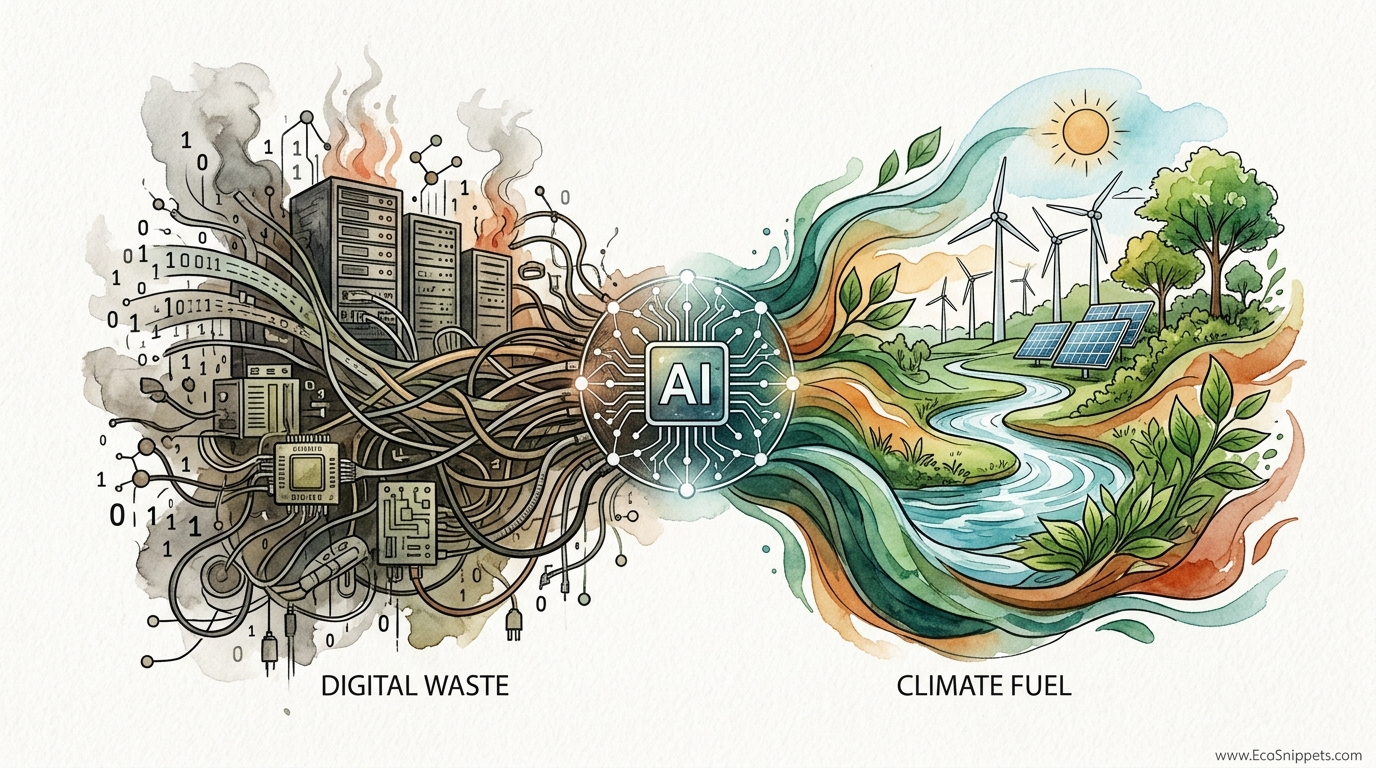
Every watt of electricity tells a story of human labor, natural resources, and engineering grit. If we are going to spend it, we should spend it on things that help us steward the planet and secure our future. This is the difference between digital waste and climate fuel.
AI Solutions For Climate Change & Global Power Consumption
Artificial intelligence is often framed as a problem for the climate, but it is increasingly proving to be one of our most potent solutions. At its core, AI is a machine for finding patterns and optimizing systems. When applied to the complex, messy problems of global energy and environment, it acts as a lever, magnifying the impact of every decision we make.
Current estimates suggest that machine learning and data centers account for roughly 1.5% to 2% of global electricity use. While this is a substantial amount – totaling hundreds of terawatt-hours – the potential return on this investment is enormous. Research indicates that AI-driven insights could help reduce global greenhouse gas emissions by 5% to 10% by the year 2030.
Think of it like the transition from a traditional hand-plow to a modern tractor. The tractor requires more fuel to operate, but it produces exponentially more food and manages the land with a precision the hand-plow could never achieve. AI provides that same leap in efficiency for our global power grids and industrial processes.
Real-world applications of these solutions are already in the field. From predicting droughts to managing the delicate balance of renewable energy on the grid, these systems are doing the heavy lifting that human operators alone cannot handle. They are not just consuming energy; they are working to save it.
The Return on Energy Investment (EROI)
The concept of Energy Return on Investment is a fundamental law of survival.
In the old days, you wouldn’t spend more energy hunting an animal than you would gain from eating it. The same logic applies to our digital tools. If a model uses 1 GWh of power to train but eventually saves 100 GWh through better grid management, the math is undeniably in our favor.
We are seeing this play out in the energy sector right now.
For example, AI-driven grid optimization has the potential to save an estimated $300 billion in efficiency gains over the next decade. These are not just numbers on a spreadsheet; they represent real energy that is no longer being wasted as heat in aging transmission lines.
How AI Efficiency Works in the Real World
Understanding the “how” requires looking at two distinct phases of the technology: training and inference.
Training is the heavy lifting, the period where a model is fed massive datasets to learn the rules of its world. This is where the headline – grabbing energy numbers come from – millions of dollars worth of electricity spent over weeks to create a single brain.
Inference is the second phase, where the model is actually used to answer questions or optimize a system. While a single prompt might use only 0.3 to 2.9 Wh of energy, the real power comes from how those small queries scale. When an AI manages a city’s traffic lights to reduce idling time, it is using a tiny amount of electricity to prevent tons of carbon emissions.
The process of optimizing a power grid, for instance, involves analyzing millions of data points from smart meters, weather sensors, and historical usage patterns.
The AI identifies exactly when the wind will blow and the sun will shine, adjusting the “spin” of traditional turbines to match the incoming renewable load in real-time. This prevents “curtailment,” which is essentially throwing away clean energy because the grid isn’t ready for it.
Another critical technique is predictive maintenance.
In the past, we fixed things when they broke, or we replaced parts on a schedule that was often wasteful. AI monitors the vibrations of a bridge or the heat signatures of a transformer to predict a failure weeks before it happens.
This keeps our infrastructure running longer with fewer resources, a practice our ancestors would have recognized as simple common sense.
Or, we could abandon AI entirely and continue as we currently do, using more power and resources on social media than AI currently costs the global economy, just to keep doom scrolling cat memes.
Liquid Cooling and Hardware Grit
As these models get larger, the hardware they run on gets hotter. Traditional air cooling is becoming insufficient, leading to the rise of liquid cooling systems. Water is 3,000 times more effective at absorbing heat than air, allowing data centers to operate with far higher density and lower overall power waste.
Modern “cold plate” systems circulate non-conductive fluids directly over the processors, capturing heat at the source. This heat can then be repurposed to warm nearby buildings or greenhouses, turning a waste product into a valuable resource. It is a closed-loop mentality that mirrors the self-reliance of a well-run homestead.
Measurable Benefits of High-Performance Computation
The benefits of spending our gigawatts on intelligence rather than entertainment are becoming increasingly clear. In the realm of energy production, AI is the primary reason we are finally seeing “the light at the end of the tunnel” for nuclear fusion. By controlling the turbulent plasma inside a reactor at microsecond speeds, AI is helping researchers achieve stable, net-positive energy gains.
In materials science, the speed of discovery has increased by orders of magnitude. Systems like Microsoft’s MatterGen can simulate and predict the properties of millions of new materials in days – a task that would have taken traditional lab scientists decades. This leads to better batteries, more efficient solar panels, and carbon-capture technologies that actually work.
Agricultural resilience is another front where the return is tangible. AI-powered “Growing Degree Days” (GDD) trackers and yield forecasts allow farmers to adapt to changing climates on a field-by-field basis. They use less water, fewer fertilizers, and achieve higher yields, staving off food insecurity with the precision of data.
Industrial decarbonization is perhaps the most immediate win. The production of cement, steel, and chemicals is incredibly energy-intensive. AI-driven optimization of these processes can reduce fuel consumption and emissions intensity by 5% to 15% without requiring a complete overhaul of the factory floor. It’s about getting more out of what we already have.
Challenges and Common Pitfalls of the AI Transition
Despite the potential, the path is not without its traps.
The most common mistake is focusing solely on energy efficiency while ignoring water consumption. A single training run for a large model can evaporate hundreds of thousands of liters of water for cooling. In water-stressed regions, this can place a heavy burden on local communities.
There is also the risk of “Jevons Paradox.”
This is an economic principle where increasing the efficiency of a resource actually leads to more of it being used, not less. If we make AI queries incredibly cheap and efficient, we might simply use them billions of times more often, negating the original savings. We must be careful that our tools don’t become another form of mindless consumption.
Another pitfall is “data poisoning” or poor data quality. An AI is only as good as the information it is fed. If we use flawed models to manage our power grids, we risk creating instabilities that could lead to blackouts. This transition requires a high level of technical rigor and a refusal to cut corners in the name of speed.
Finally, we must consider the hardware waste.
The chips required for AI have a short shelf life in a rapidly evolving field. Manufacturing these semiconductors requires massive amounts of “ultrapure” water and rare earth minerals. If we don’t build robust recycling systems for this hardware, we are simply trading one environmental problem for another.
Limitations and Realistic Constraints
It is important to remain grounded in reality: AI is not a magic wand.
There are physical limits to how much we can optimize.
For instance, no amount of computation can overcome the basic laws of thermodynamics. If a battery has a certain energy density, AI can help us use it better, but it cannot create energy from nothing.
Geopolitical constraints also play a role.
The infrastructure needed to support advanced AI is concentrated in a few wealthy nations. If the benefits of AI-driven climate solutions are not shared globally, we will fail to solve a problem that knows no borders. A smart grid in Seattle does little to help a drought in sub-Saharan Africa.
We must also acknowledge the “Cold Start” problem. Training the models that will eventually save us energy requires a massive upfront investment of power that we are currently generating with fossil fuels. There is a “carbon debt” that must be paid off before we see the net-positive results. This creates a tension between our long-term goals and our immediate emissions targets.
Climate change is also moving faster than our deployments.
Even if AI can reduce emissions by 10% by 2030, we are still on track to cross critical temperature thresholds. AI is a tool for mitigation and adaptation, but it cannot stop the wind from blowing or the rain from falling. We must use it as part of a broader strategy of self-reliance and conservation.
Digital Waste vs. Climate Fuel: The Comparison
To put the energy return in perspective, we can compare how we currently “spend” our global electricity. Not all terawatt-hours are created equal in terms of their value to humanity.
| Activity | Typical Energy Use | Primary Outcome | Long-term Value (ROI) |
|---|---|---|---|
| YouTube Streaming (1 hr HD) | ~144 – 288 Wh | Entertainment / Ad Revenue | Low (Ephemeral) |
| AI Prompt (1 query) | ~0.3 – 2.9 Wh | Information / Problem Solving | High (Durable) |
| Social Media Scrolling (1 hr) | ~100+ Wh (Device + Server) | Social Interaction / Noise | Very Low |
| AI Grid Management (per day) | High Cluster Power | Waste Reduction / Renewables | Massive (Cumulative) |
The numbers show a clear divide.
Watching a single hour of high-definition video can consume as much energy as hundreds of AI prompts.
While streaming is a passive consumption of energy, an AI query is often an active attempt to produce a result, find a solution, or automate a task. This is the difference between spending and investing.
Best Practices for a More Efficient Digital Future
If we want to maximize our energy ROI, we need to change how we interact with these tools. Efficiency starts with the user and ends with the engineer. Here are some actionable steps for moving toward a “Green AI” future.
- Use Smaller Models: Not every question requires a trillion-parameter model. For simple text tasks, smaller, specialized models use a fraction of the energy while providing the same utility.
- Optimize Prompts: Being clear and concise with your requests reduces the number of “tokens” processed, which directly translates to lower energy use per query.
- Support Green Hosting: When choosing digital services, prioritize companies that use 100% renewable energy for their data centers and implement advanced cooling techniques like liquid immersion.
- Demand Transparency: We should advocate for “Energy Labels” on AI models, similar to the efficiency ratings on refrigerators or cars, so we know the footprint of the tools we use.
On the industrial side, companies should implement “Edge Computing.” By processing data locally on the device rather than sending everything to a central cloud server, we can drastically reduce the energy used by global networks. This is the digital equivalent of growing your own food rather than having it shipped across the country.
Advanced Considerations: The Horizon of Intelligence
Looking further ahead, we are moving toward “neuromorphic” computing. These are chips designed to mimic the human brain, which is the most energy-efficient computer in existence. While a modern GPU might use hundreds of watts to process a task, the human brain runs on about 20 watts – the power of a dim lightbulb. Neuromorphic chips could eventually offer a thousand-fold increase in efficiency.
We are also seeing the rise of “Self-Correcting Grids.”
In these systems, AI doesn’t just predict the load; it manages a decentralized network of millions of home batteries and electric vehicles. Your car could feed power back into the grid during a peak period and charge when wind power is in surplus. This level of coordination is only possible with advanced machine learning.
The “Materials Genome” project is another advanced frontier. By using AI to map the properties of all possible chemical combinations, we are discovering catalysts that could make hydrogen fuel production or carbon capture 50% more efficient. These are the breakthroughs that change the trajectory of civilizations.
Case Study: The AI Pilot for Nuclear Fusion
In 2024, researchers at Princeton and DeepMind demonstrated a breakthrough that exemplifies the ROI of AI. Nuclear fusion has always been “30 years away” because managing the superheated plasma inside a tokamak reactor is like trying to hold a sun in a bottle made of magnets. The plasma is incredibly unstable and can collapse in milliseconds.
By training a reinforcement learning model on years of experimental data, the team created an “AI Pilot” that could predict and suppress plasma instabilities before they happened. The AI adjusts the magnetic coils 10,000 times per second, maintaining the reaction longer than any human operator ever could.
The energy cost to train this model was significant, perhaps equivalent to the annual power use of a few dozen homes. However, the result is a massive leap toward a future of limitless, carbon-free energy. This is a perfect example of spending a few gigawatts today to unlock a billion gigawatts tomorrow. It is the grit of the laboratory meeting the power of the chip.
Final Thoughts
We are currently witnessing a massive reshuffling of the world’s energy priorities.
The panic over AI’s power usage is a healthy sign that we are finally starting to value our electricity, but we must not let it blind us to the potential benefits.
If we are willing to burn 450 TWh a year on social media and streaming, we should be more than willing to invest in a technology that can actually solve the problems those platforms only bicker about.
True self-reliance in the 21st century means building tools that make our resources go further. AI is the ultimate leverage – a way to apply human intelligence to physical systems at a scale and speed that was previously impossible. It is the modern version of the well-sharpened axe; it takes effort to maintain, but it makes every swing of our labor count for so much more.
The goal is not to stop using energy, but to stop wasting it. By moving from a culture of digital consumption to one of digital investment, we can use our gigawatts to build a world that is more efficient, more resilient, and more sustainable.
Let’s get to work and make every watt count.
Lots of love,
Duncan.
If you enjoy the articles you see here, you can get the daily newsletter.
You can subscribe from the home page.
…it’s free.
Sources
1 ourworldindata.org (https://ourworldindata.org/energy-production-consumption) | 2 iea.org (https://www.iea.org/reports/global-energy-review-2025/key-findings) | 3 yale.edu (https://cleanenergyforum.yale.edu/2025/11/12/power-hungry-power-smart-can-ai-reduce-the-grid-strain-its-fueling) | 4 aiforclimateandnature.org (https://www.aiforclimateandnature.org/wp-content/uploads/2024/05/AI-for-Climate-and-Nature-Grand-Challenge_Power-grid-optimization.pdf) | 5 tribe.ai (https://www.tribe.ai/applied-ai/ai-in-energy-efficiency-and-smart-grids) | 6 netzeroinsights.com (https://netzeroinsights.com/resources/solutions-cutting-data-center-water-consumption/) | 7 airsysnorthamerica.com (https://airsysnorthamerica.com/how-much-water-does-a-data-center-use/) | 8 sundayindependent.co.za (https://sundayindependent.co.za/news/environment/2026-02-10-ai-vs-social-media-which-really-uses-more-water-and-energy/) | 9 iea.org (https://www.iea.org/reports/energy-and-ai/executive-summary) | 10 eesi.org (https://www.eesi.org/articles/view/data-centers-and-water-consumption)
