How To Become More Self-Sufficient Without Starting a Full-Blown Farm…
Want to start preserving your harvest, making your own soap, or building a backyard root cellar — but not sure where to begin? “Homesteading Advice” gives you instant lifetime access to 35+ practical homesteading books on food preservation, veggie gardening, DIY natural cleaning products (save over $250 per year with this skill alone), brewing, off-grid energy, and a whole lot more…
Click Here To Check It Out Now!
The space directly under your fruit trees is either a death trap or a nursery for your garden’s protectors. When beneficial insects fall from the canopy to complete their life cycle, a mowed lawn is a death sentence. By creating ‘Soft Landings’ with native debris and mulch, you provide the sanctuary needed for the army that eats your pests. It’s time to let the wild back into your backyard farm.
A backyard orchard represents more than just a source of food; it is a complex, living ecosystem that begins beneath the surface. Many growers focus entirely on the branches and the fruit, neglecting the very foundation that sustains the tree. This oversight often leads to a cycle of chemical dependency and disappointing yields. Real success in the orchard comes from understanding the ancient relationship between trees, soil biology, and the insects that keep the balance.
Managing the ground under your fruit trees requires a shift in perspective. Instead of seeing a tidy lawn, imagine a vibrant floor of organic matter, fungal networks, and native plants. This approach mimics the forest edge where most of our beloved fruit trees originated. It is here, in the duff and the shade, that the most important work of the orchard happens.
Managing Soil Under Fruit Trees For Better Yields
Soil management is the art of feeding the soil so the soil can feed the tree. In a natural forest, trees drop their leaves, branches fall, and everything decomposes where it lies. This continuous cycle creates a rich, spongy layer of organic matter that regulates moisture and provides a steady stream of nutrients. Most modern yards, however, are treated like golf courses, with every leaf raked away and every weed pulled.
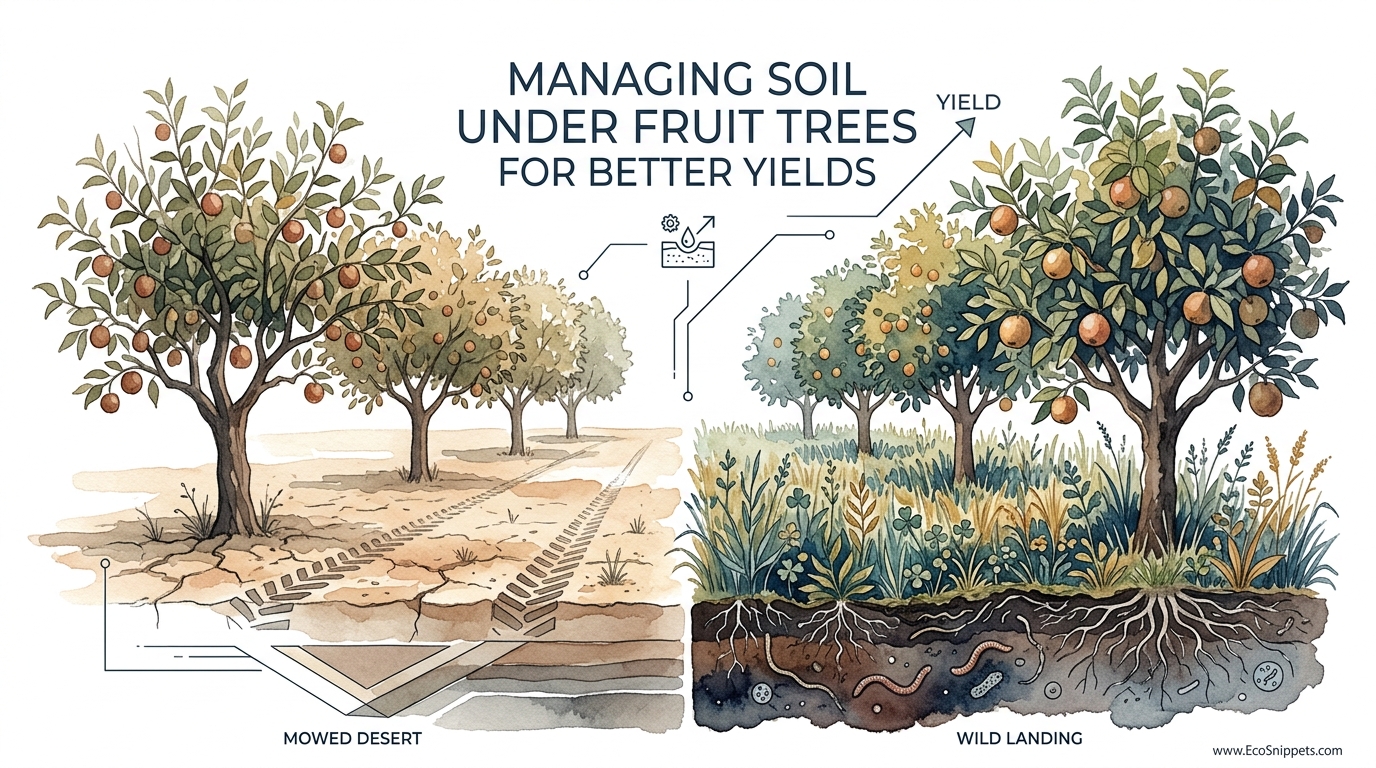
Trees in these “mowed deserts” are forced to compete with aggressive turfgrass for water and nitrogen. Grass is a bacterial-dominated system that creates a tight, compacted surface. Fruit trees, on the other hand, evolved in fungal-dominated soils. When we force a tree to grow in a lawn, we are essentially asking it to survive in a foreign environment. This mismatch causes stress, makes the tree more susceptible to disease, and ultimately reduces the quality and quantity of the fruit.
Better yields are the direct result of a healthy fungal-to-bacterial ratio. In a thriving orchard, the soil should ideally have a ratio of 10:1 in favor of fungi. These fungal networks, known as mycorrhizae, act as an extension of the tree’s root system. They reach out into the soil to grab phosphorus, zinc, and other micronutrients that the tree cannot access on its own. In exchange, the tree provides the fungi with sugars produced through photosynthesis. This ancient trade is the secret to heavy harvests and resilient trees.
How to Create a Soft Landing Under Your Fruit Trees
Establishing a “soft landing” or a fruit tree guild involves a few simple, intentional steps that transform the area from a mowed hazard into a biological haven. The goal is to create a zone that extends at least to the drip line—the outermost circumference of the tree’s canopy.
First, you must address the existing grass. Digging up turf can damage the shallow, sensitive feeder roots of your fruit tree. Instead of digging, use the sheet mulching technique. Lay down a thick layer of plain brown cardboard or several layers of wet newspaper directly over the grass. This smothers the lawn without disturbing the soil structure. Ensure the cardboard overlaps by several inches to prevent grass from peeking through the gaps.
Next, cover the cardboard with 4 to 6 inches (10 to 15 centimeters) of organic mulch. Arbourist wood chips are the gold standard for this task because they contain a mix of wood, bark, and leaves. This variety of material provides a diverse diet for the soil fungi. Avoid using “dyed” mulches or finely shredded barks that can mat down and prevent oxygen from reaching the roots. Keep the mulch at least 6 inches (15 centimeters) away from the trunk of the tree to prevent rot and rodent damage.
Once the mulch is in place, you can plant a guild of supporting species. Use a sharp spade to cut through the cardboard and tuck your plants into the soil beneath. These supporting plants should serve specific functions, such as attracting pollinators, repelling pests, or accumulating nutrients. Over time, these plants will grow together, creating a living mulch that suppresses weeds and provides the “soft landing” for beneficial insects falling from the canopy.
Benefits of the Wild Landing Approach
Transitioning to a wild landing system offers immediate and long-term advantages for both the grower and the environment. One of the most measurable benefits is water conservation. A thick layer of mulch and a diverse groundcover act as a sponge, holding moisture in the soil far longer than exposed turf. This resilience is critical during hot summers or periods of drought, ensuring the tree never experiences the water stress that leads to fruit drop or stunted growth.
Pest management becomes significantly easier when you provide habitat for the “good guys.” Many beneficial insects, such as ground beetles and certain species of spiders, spend their lives on the soil surface. They are the frontline defense against pests like the plum curculio or apple maggot, which must drop to the ground to pupate in the soil. In a mowed lawn, these pests find easy access to the dirt. In a soft landing, they must navigate a gauntlet of predators and thick organic matter.
Nutrient cycling is another major benefit. As the mulch and leaf litter break down, they release a slow, steady supply of organic fertilizer. Deep-rooted “dynamic accumulator” plants like comfrey or yarrow reach into the subsoil to pull up minerals that are otherwise inaccessible. When these plants are pruned or die back in the winter, those minerals are deposited on the surface, feeding the fruit tree from above. This mimics the self-fertilizing nature of a wild forest.
Challenges and Common Mistakes
One frequent error is the creation of “mulch volcanoes.” This happens when mulch is piled high against the trunk of the tree. This practice traps moisture against the bark, leading to crown rot and providing a hidden highway for borers and other trunk-damaging pests. Always ensure the “root flare”—the area where the trunk meets the roots—is visible and free of debris.
Rodent management is a valid concern for many orchardists. Thick mulch and groundcover can provide cover for voles and mice that might chew on the tree’s bark during the winter. Using hardware cloth tree guards can protect the trunks of young trees. Maintaining a small “no-mulch” zone immediately around the base of the tree also helps, as it leaves the rodents exposed to predators like hawks and owls if they try to approach the trunk.
Aesthetics can sometimes be a challenge for those living in strictly managed neighborhoods. A wild landing can look “messy” to the uninitiated eye. This can be mitigated by using intentional borders. A clean edge made of stones, logs, or even a mowed strip of grass around the soft landing area signals to neighbors that the space is a deliberate garden rather than a neglected patch of weeds.
Limitations and Environmental Constraints
Certain environments may require adjustments to the soft landing strategy. In extremely wet climates, heavy mulching can sometimes keep the soil too saturated for certain fruit trees, such as peaches or cherries, which are prone to root rot. In these cases, using lighter mulches like straw or focusing on living groundcovers that can transpire excess moisture is often a better choice.
Small urban spaces may also present limitations. If a fruit tree is planted in a tiny patch of soil surrounded by concrete, there may not be enough room to establish a full guild. In these situations, focusing on a high-quality fungal inoculation and a thin layer of compost topped with wood chips is the best way to maximize the available biology.
Regional timing is also a factor. In the southern hemisphere, the cycle of insect pupation and leaf drop will be the opposite of the northern hemisphere. Always observe your local climate. If your region experiences heavy spring rains, wait until the soil has warmed and dried slightly before applying thick mulch to avoid “sealing in” cold, soggy conditions that can delay the tree’s spring wake-up call.
Mowed Desert vs. Wild Landing
| Feature | Mowed Desert (Turf) | Wild Landing (Guild) |
|---|---|---|
| Soil Biology | Bacterial dominant; low fungal life. | Fungal dominant; rich mycorrhizae. |
| Pest Pressure | High; fewer natural predators. | Lower; high predator biodiversity. |
| Maintenance | High (weekly mowing/fertilizing). | Low (seasonal pruning/mulching). |
| Water Needs | High; grass competes for moisture. | Low; soil stays cool and hydrated. |
Practical Tips for Success
Start small if you are overwhelmed by the idea of converting an entire orchard. Focus on one or two trees each season. This allows you to observe how the local insect population responds and which plants thrive in your specific microclimate.
Choose native plants that have co-evolved with your local beneficial insects. For example, in many parts of North America, wild ginger, violets, and ferns are excellent shade-tolerant choices for the understory. In drier regions, consider drought-tolerant herbs like oregano or thyme, which provide both groundcover and aromatic confusion for pests.
The “Chop and Drop” method is a gardener’s best friend. When your guild plants get too large or finish flowering, simply cut them back and leave the foliage on the ground. This instantly adds organic matter back to the soil and saves you the labor of hauling materials to a compost pile. Over time, this builds a “duff” layer that is essentially a self-renewing mulch.
Advanced Considerations for Experienced Growers
Serious practitioners may want to experiment with biochar in their soft landing zones. Biochar is a highly porous form of charcoal that acts as a permanent “coral reef” for soil microbes. Mixing a small amount of “charged” biochar (charcoal soaked in liquid fertilizer or compost tea) into the soil before mulching can significantly boost the long-term fertility of the site.
Monitoring the fungal-to-bacterial ratio can be done through a professional soil lab or by observing “bio-indicators.” The presence of small mushrooms or fungal threads (mycelium) under the mulch is a clear sign of success. If the soil remains hard and no fungal life is visible after a year, consider applying a high-quality fungal inoculant or a drench of aerated compost tea.
Scaling this concept to larger orchards requires a different approach to plant selection. Instead of individual perennials, you might use a “living mulch” cover crop like Dutch white clover. Clover is a nitrogen-fixer that stays low to the ground and can tolerate occasional foot traffic, making it a bridge between a traditional orchard and a wild guild.
Example: The Apple Tree Sanctuary
Imagine an Enterprise apple tree growing in a zone 6 garden. Instead of a circle of grass, the area out to the drip line is a lush tapestry of life. A 4-inch (10-centimeter) layer of arbourist chips blankets the ground. Pushing back the mulch reveals a network of white fungal threads and hundreds of tiny “crawlers”—the ground beetles and spiders that guard the tree.
On the sunnier southern edge of the tree, a clump of comfrey grows vigorously. Every year, the grower chops the comfrey leaves three times and drops them directly under the tree. To the east, a patch of perennial garlic and chives sends up aromatic scents that confuse the codling moth. Beneath the shadiest part of the canopy, wild violets form a thick, green carpet that prevents weeds from germinating.
This tree requires significantly less supplemental water than its neighbors in the grass. During a mid-summer heatwave, the soil beneath the violets remains cool to the touch. The fruit produced is larger and has fewer “stings” from pests because the local ecosystem is doing the work of protection. This is the power of a soft landing in action.
Final Thoughts
Building a sanctuary under your fruit trees is an act of restoration. It is a commitment to working with nature rather than against it. By moving away from the mowed desert and embracing the wild landing, you are not just growing fruit; you are cultivating a legacy of soil health and biodiversity.
The transition may take a few seasons to fully establish, but the rewards are profound. You will see more birds, more butterflies, and a noticeable increase in the vitality of your trees. Most importantly, you will find that the orchard becomes a place of peace and discovery rather than a list of chores.
Experiment with the plants that grow best in your soil. Observe the cycles of the seasons. Let the leaves fall where they may and trust in the ancestral wisdom of the forest. Your fruit trees—and the army of protectors they host—will thank you for it. Self-reliance starts at the roots.
