How To Become More Self-Sufficient Without Starting a Full-Blown Farm…
Want to start preserving your harvest, making your own soap, or building a backyard root cellar — but not sure where to begin? “Homesteading Advice” gives you instant lifetime access to 35+ practical homesteading books on food preservation, veggie gardening, DIY natural cleaning products (save over $250 per year with this skill alone), brewing, off-grid energy, and a whole lot more…
Click Here To Check It Out Now!
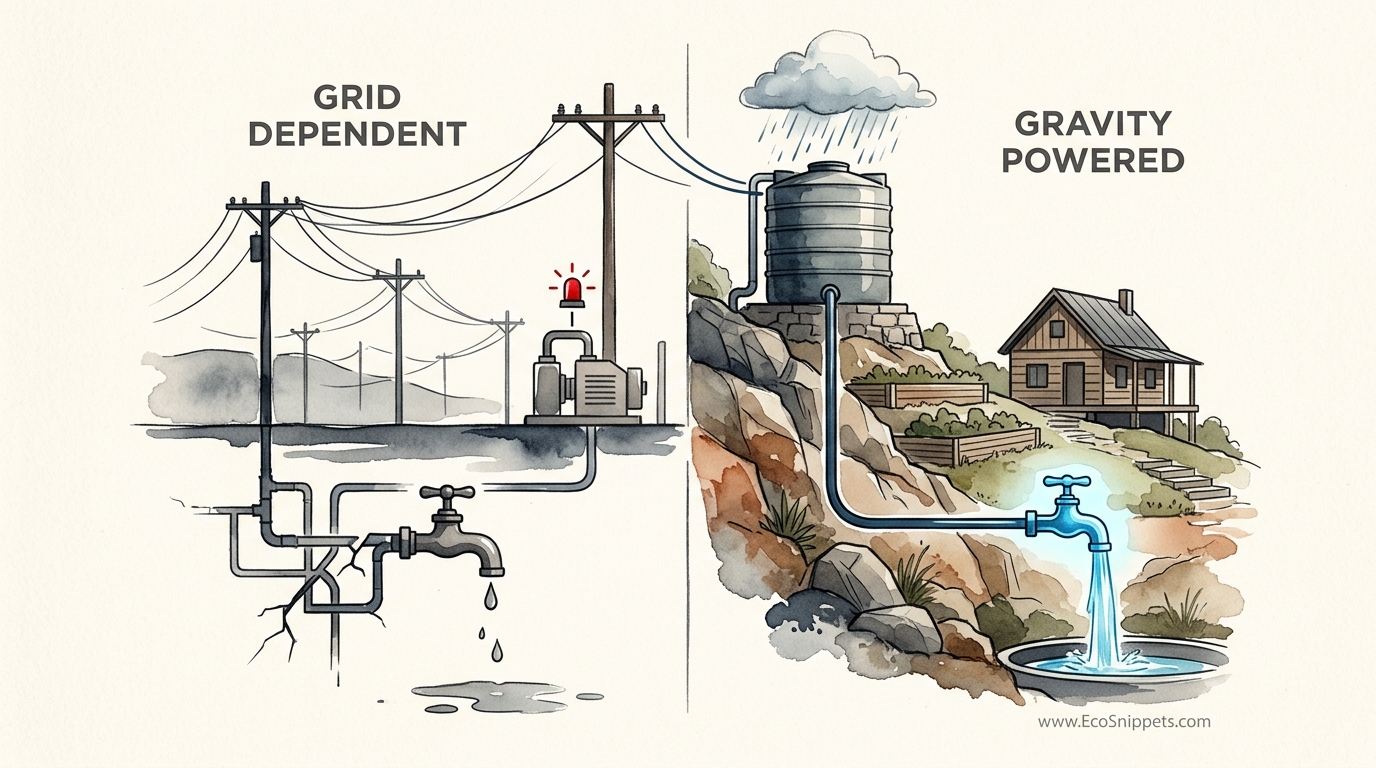
When the power grid fails, does your water supply stop with it, or is it powered by the unbreakable laws of physics? Most modern homes are one transformer explosion away from total dehydration. We’ve traded the simple reliability of gravity for the complex fragility of the electric pump. Learn how a hillside cistern creates a water system that never sleeps, even when the lights go out.
The reliance on an electric well pump is a silent vulnerability that few homesteaders address until the tap runs dry during a storm. A gravity water system, however, relies on the constant pull of the earth. If you have any significant elevation on your property, you have the potential for a water system that functions with the same steady persistence as the sun rising in the east. This guide will walk you through the transition from a grid-dependent existence to a gravity-powered one.
Reliable Homestead Gravity Water Systems
A homestead gravity water system is a setup that uses the natural elevation of the land to move and pressurize water. Instead of relying on an electromechanical pump to push water into a pressure tank and then through your pipes, you use a holding tank—often called a cistern—placed at a higher elevation than your home. The water flows downhill through pipes, gaining pressure as it descends.
These systems are the bedrock of ancestral homesteads and remote mountain villages. They exist because they are functionally eternal. While a modern pump has a lifespan of 10 to 15 years and requires a steady diet of kilowatts, a well-constructed gravity system can last for generations with minimal intervention. It is used in real-world situations ranging from off-grid cabins to large-scale organic farms where reliability is more valuable than high-tech convenience.
Visualize a bucket of water held over your head. When you poke a hole in the bottom, the water pours out because of gravity. If you attach a 100-foot (30-meter) hose to that bucket and run it down a steep hill, the water at the bottom of the hose will come out with significant force. This force is “head pressure,” and it is the heart of every gravity system.
The Physics and Engineering of Gravity Water
To build a system that actually works, you must understand the relationship between elevation and pressure. In the world of hydraulics, this is known as “static head.” Every foot of vertical drop creates a specific amount of pressure, regardless of the pipe’s diameter.
Calculating Pressure
The math for a gravity water system is simple but unforgiving. For every 1 foot of vertical drop, you gain 0.433 pounds per square inch (PSI). Conversely, it takes 2.31 feet of vertical drop to create 1 PSI. In the metric system, every 10 meters of vertical drop provides approximately 1 bar (14.5 PSI) of pressure.
If your cistern is located 100 feet (30.5 meters) above your house, you will have a static pressure of 43.3 PSI. This is comparable to the pressure found in many municipal water systems, which typically range between 40 and 60 PSI. However, if your hill only provides 20 feet (6 meters) of drop, you will only have 8.6 PSI. While this is enough to flow water into a sink, it will not run a modern washing machine or provide a satisfying shower.
Sizing the System
A gravity system usually consists of four main parts: the source, the intake, the storage, and the distribution.
- The Source: This could be a mountain spring, a creek, or a well that you pump into an uphill tank during sunny hours (using solar power).
- The Intake: A spring box or intake screen designed to keep out debris, salamanders, and sediment.
- The Storage (Cistern): A tank that holds enough water to meet your peak needs. For a single-family home, a 1,000-gallon (3,785-liter) to 2,500-gallon (9,463-liter) tank is standard.
- The Distribution: The pipeline running from the tank to your home.
How to Design and Build Your Gravity System
The first step is a topographic survey. You do not need expensive equipment; a simple sight level or even a long clear hose filled with water can help you determine the elevation difference between your house and your potential tank site.
Step 1: Locating the Tank
Find a site that is at least 60 to 80 feet (18 to 24 meters) higher than your highest faucet if you want “normal” water pressure. If you only need water for livestock or a garden, 20 to 30 feet (6 to 9 meters) is sufficient. Ensure the site is accessible for construction and that the ground is stable enough to support the weight of a full tank. Remember, 1,000 gallons (3,785 liters) of water weighs roughly 8,340 pounds (3,783 kilograms).
Step 2: Installing the Mainline
The pipe running from the tank to the house should be sized to minimize “friction loss.” Friction loss occurs when water rubs against the inside of the pipe as it flows. The faster the water moves, the more pressure you lose. To combat this, use a larger pipe than you might think necessary. A 1.25-inch (32mm) or 1.5-inch (40mm) HDPE (High-Density Polyethylene) pipe is ideal for most homestead runs.
Step 3: Managing the Intake
If you are tapping a spring, you must build a “spring box.” This is a sealed concrete or plastic box that captures water as it emerges from the ground, allowing sediment to settle before the water enters your pipe. The intake pipe should be elevated a few inches off the bottom of the box to avoid sucking in mud.
Step 4: Dealing with Air and Sediment
Air is the enemy of gravity flow. If an air bubble gets trapped in a high spot in your pipe, it can create an “airlock” that stops the flow entirely. Always bury your pipe with a consistent downward slope. If you must go over a small rise, install an air release valve at the highest point. Similarly, install a sediment “T” or cleanout at the lowest points of the system to flush out any grit that accumulates over time.
Benefits of Gravity-Powered Water
The most immediate benefit is absolute reliability. When the power goes out, your water continues to flow. There are no capacitors to burn out, no pressure switches to fail, and no dependency on a complex electrical grid or a sensitive solar inverter.
Another advantage is low maintenance. Once the pipes are buried and the cistern is sealed, the system has no moving parts. You are not replacing a $1,500 submersible pump every decade. Your only task is a semi-annual inspection of the intake and a periodic flushing of the sediment traps.
Furthermore, gravity water provides a silent environment. There is no humming of a pump in the basement or the clanging of a check valve. The water arrives at your tap with a quiet, steady persistence that feels more in tune with the natural world. It also allows for “passive” water treatment. Because the water is stored in a tank, you can use slow sand filters or gravity-fed UV systems that don’t require the high-pressure boost of a traditional pump.
Challenges and Common Mistakes
The most common mistake is underestimating friction loss. A homesteader might calculate that they have 30 PSI of static pressure and assume that is what they will get at the tap. However, if they use a 1/2-inch (13mm) pipe for a 500-foot (152-meter) run, the friction of the water moving through that small pipe will “eat” almost all that pressure as soon as a faucet is opened. The pressure is there when the water is still, but it disappears when the water flows.
Another pitfall is freezing. Because gravity systems often have low flow rates, the water can sit stagnant in pipes for long periods. If your mainline is not buried below the frost line—which varies from 18 inches (45cm) in mild climates to over 6 feet (1.8m) in the north—it will freeze and burst. In extremely cold regions, the cistern itself must be buried or heavily insulated with earth and straw.
Airlocks are the third great challenge. A single high spot in the pipe can trap a bubble of air that acts like a solid plug. This is why a consistent grade is vital. If your terrain is “rolly,” you must be diligent about installing manual air bleed valves at every peak in the pipeline.
Limitations: When Gravity Is Not Enough
Gravity systems are not a universal solution. If your property is flat, you simply cannot generate the pressure needed for a standard home without building a massive, expensive water tower. While a 55-gallon (208-liter) drum on a 10-foot (3-meter) platform is great for a camp sink, it won’t run a modern household.
Environmental constraints also play a role. If your water source is lower than your home, you must use a pump. In these cases, many homesteaders use a “pump-to-gravity” hybrid. They use a solar pump to move water from a low well to a high hillside tank during the day. This provides the reliability of gravity storage while overcoming the limitation of a low-elevation source.
Finally, water quality can be a concern with surface sources like springs or creeks. Unlike deep well water, which is naturally filtered by hundreds of feet of earth, spring water is susceptible to surface runoff, bacteria, and parasites like Giardia. A gravity system requires a robust, multi-stage filtration plan to ensure the water is potable.
Comparing Water Systems
Understanding the trade-offs between different setups helps in making the right choice for your land.
| Feature | Grid-Dependent Pump | Gravity-Powered System | Solar-to-Gravity Hybrid |
|---|---|---|---|
| Initial Cost | Medium | High (Excavation/Tanks) | Very High |
| Reliability | Low (Zero during outage) | Absolute | High |
| Maintenance | Frequent (Mechanical) | Minimal (Cleaning) | Medium (Electrical) |
| Complexity | Moderate | Simple Physics | High |
| Power Cost | Monthly Bill | Zero | Zero (After Solar) |
Practical Tips and Best Practices
If you are serious about installing a gravity system, follow these field-tested strategies:
- Use a “Two-Tank” System: Place a small 50-gallon (190-liter) “settling tank” between your source and your main cistern. This allows heavy sand and grit to drop out before entering your primary storage.
- Install a Float Valve: If you are pumping water up to your tank, use a mechanical float valve (like those in a toilet tank, but heavy-duty) to shut off the flow when the tank is full. This prevents erosion from overflow around your tank foundation.
- Bury Your Pipes Deep: Do not guess at the frost line. Go 12 inches (30cm) deeper than the local building code suggests. The earth is your best insulator.
- Use HDPE Pipe: Unlike PVC, HDPE is flexible and comes in long rolls. This means fewer joints, and fewer joints mean fewer places for leaks to develop over the decades.
- Screen Every Opening: Use 1/16-inch (1.5mm) stainless steel mesh on all vents and overflows to keep out mosquitoes and mice. A single dead rodent in a cistern can ruin thousands of gallons of water.
Advanced Considerations: The Hydraulic Ram Pump
For those with a flowing water source (like a creek) that is lower than their storage tank, there is a piece of “magical” 18th-century technology called the Hydraulic Ram Pump. This device uses the “water hammer” effect to use the energy of falling water to lift a small portion of that water much higher than the source—without any electricity or gasoline.
A ram pump requires a “drive pipe” where water gains momentum. When a valve snaps shut, the momentum forces a small amount of water into a pressure chamber and up a delivery pipe. It is loud, rhythmic, and incredibly efficient for off-grid applications. While it wastes about 80-90% of the water to “power” the lift, the remaining 10-20% is delivered to your uphill tank 24 hours a day, 7 days a week.
Adding a ram pump to a gravity system creates a completely autonomous loop: the creek powers the pump, the pump fills the hill tank, and gravity feeds the house. This is the pinnacle of homestead self-reliance.
Example Scenario: Designing for a 100-Foot Drop
Let’s walk through a practical example. Suppose you have a spring located 150 feet (45.7 meters) vertically above your home, and the distance is 600 feet (183 meters) of pipe run.
Step 1: Calculate Static Pressure.
150 feet * 0.433 = 64.95 PSI. This is excellent pressure.
Step 2: Account for Friction Loss.
If you use a 3/4-inch pipe and try to pull 10 gallons (38 liters) per minute, you will lose about 12 PSI for every 100 feet of pipe. Over 600 feet, you would lose 72 PSI—more than you have! Your water would practically stop if you opened more than one faucet.
However, if you upgrade to a 1.5-inch pipe, the friction loss at 10 GPM drops to less than 1 PSI per 100 feet. Your “dynamic” pressure (pressure while water is flowing) would stay around 58 PSI, providing a high-performance system.
Step 3: Storage Capacity.
An average person uses 50-100 gallons (190-380 liters) of water per day. A family of four needs roughly 400 gallons (1,514 liters). A 1,500-gallon (5,678-liter) tank provides nearly a four-day reserve, which is essential if the spring slows down during a dry spell or if you need to perform maintenance on the intake.
Final Thoughts
Building a gravity water system is an investment in peace of mind. It is a return to a way of living where the essentials of life are governed by geography and physics rather than utility companies and complicated machinery. When you stand at your sink and hear the steady, silent flow of water that traveled from a hillside you own, powered by the earth itself, you realize what true independence feels like.
Do not be intimidated by the math or the labor of trenching. The work you do today to bury those pipes and set that cistern will pay dividends for decades. It is one of the few projects on a homestead that truly grows more valuable with age, eventually becoming a seamless part of the landscape.
Start by measuring your slopes. Find your high ground. Whether you are capturing a mountain spring or simply creating a solar-fed reservoir, the laws of gravity are waiting to work for you. Apply what you have learned here, and secure your family’s most vital resource with the unbreakable reliability of the hillside.
