How To Become More Self-Sufficient Without Starting a Full-Blown Farm…
Want to start preserving your harvest, making your own soap, or building a backyard root cellar — but not sure where to begin? “Homesteading Advice” gives you instant lifetime access to 35+ practical homesteading books on food preservation, veggie gardening, DIY natural cleaning products (save over $250 per year with this skill alone), brewing, off-grid energy, and a whole lot more…
Click Here To Check It Out Now!
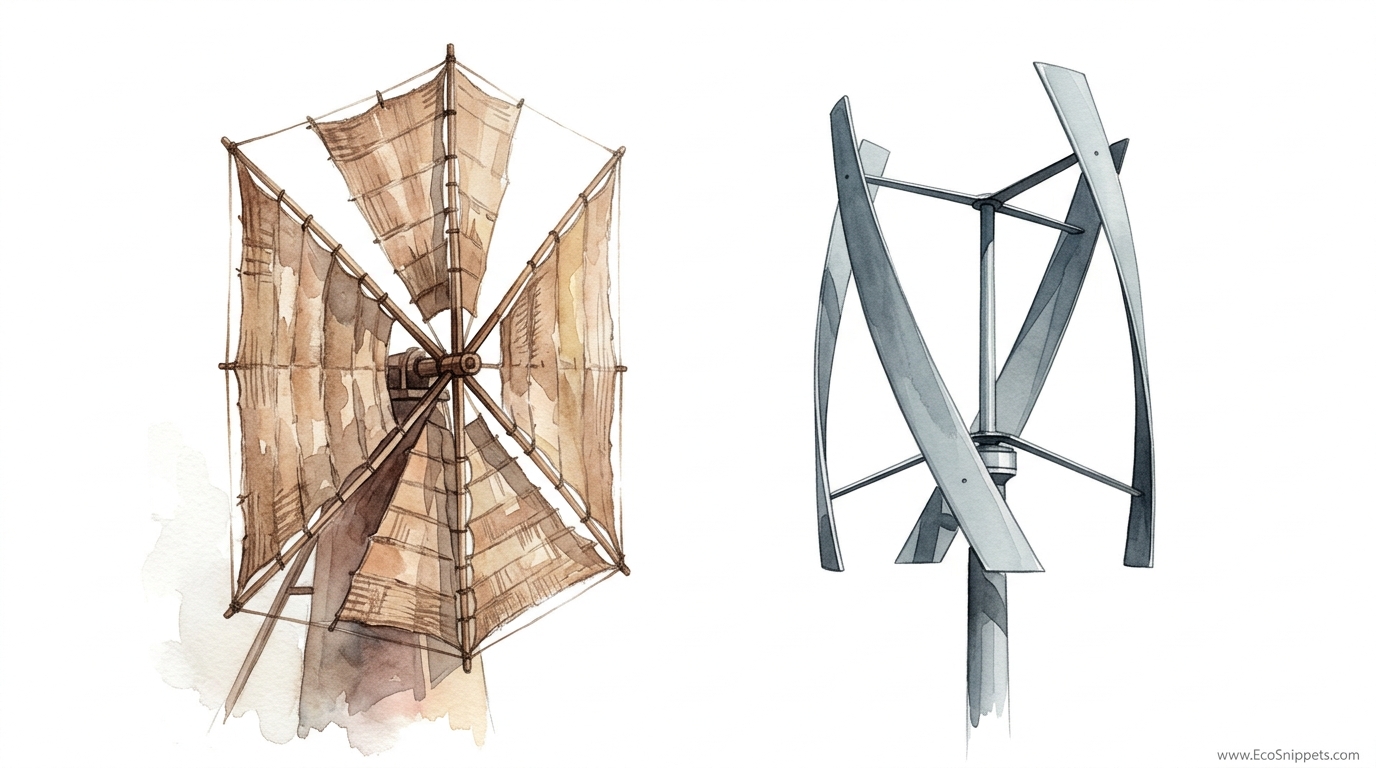
Why settle for just electricity when this ancient vertical design provides direct mechanical torque for your entire homestead? Most wind turbines are ‘single-use’ gadgets that only make electricity. The Persian Panemone is a multi-use beast. Using a vertical axis, it generates massive torque that can grind your flour, pump your well, and charge your batteries at the same time—all while being built from materials found in your woodlot.
Harnessing the wind is a tradition nearly as old as civilization itself, yet modern society has largely forgotten the raw, mechanical power of the vertical axis. We have become obsessed with thin, high-speed blades designed for one thing: spinning an alternator at thousands of revolutions per minute. While that is fine for powering a lightbulb, it lacks the crushing force needed for real homestead labor.
The Panemone offers a different path. It is a slow-turning, high-torque machine that thrives on the very winds that would snap a modern turbine in half. It relies on the simple principle of drag rather than complex lift, making it easier to build, easier to maintain, and far more versatile for the self-reliant practitioner.
This guide will walk you through the logic and construction of this ancient powerhouse. You will learn how to turn timber, stone, and wind into a mechanical engine that works for you day and night, regardless of whether the grid is up or down.
Persian Panemone Windmill DIY Guide
The Persian Panemone is the oldest recorded windmill design in human history, originating in the Sistan region of modern-day Iran and Afghanistan as early as the 7th century AD. Known locally as “Asbads,” these structures were designed to survive and exploit the “120-day winds” that scour the desert plains from May to September. These winds can reach speeds of 100 kilometers per hour (62 miles per hour), carrying abrasive sand that would erode modern composite blades in weeks.
At its core, a Panemone is a vertical-axis wind turbine (VAWT) that uses a series of rectangular sails arranged around a central vertical shaft. Unlike European windmills that use a horizontal shaft and require complex gearing to transfer power to a ground-level millstone, the Panemone sends its power straight down the mast. The vertical alignment means the torque is delivered exactly where it is needed—directly to the heavy stones below.
These machines were traditionally built in two levels. The upper level, or “blade house,” captures the wind, while the lower level, or “mill room,” houses the machinery and the grain. This separation keeps the dust and debris of the wind away from the food processing area. For a modern homesteader, this same design allows you to keep your electrical components or water pumps protected in a ground-level shed while the sails work high above.
The most distinctive feature of the Persian design is the protective wall or “scoop.” Because a Panemone relies on drag, half of its sails are always moving against the wind. Without a shield, the wind would push on both sides of the axis, resulting in zero rotation. The ancient Persians solved this by building a three-sided mud-brick wall that funnels wind into the “working” side of the rotor while shielding the “returning” sails.
The Mechanics of Drag: How a Panemone Harnesses the Storm
Understanding the difference between lift and drag is essential for anyone building a wind machine. Modern turbines use lift, similar to an airplane wing, which allows them to spin faster than the wind itself. This is great for electricity but requires high-tech materials and precise airfoils. The Panemone uses drag, which means the wind literally pushes the sails out of its way.
A drag-based system is naturally limited to the speed of the wind. While this might seem like a disadvantage, it provides a level of stability and torque that lift-based machines cannot match. Because the sails have a large surface area, they can begin turning in relatively light breezes, yet they possess enough mass to carry their momentum through turbulent gusts.
The vertical spindle is the heart of the system. In a traditional build, this is a massive timber log, often 5 to 10 meters (16 to 33 feet) tall. The sails are attached to horizontal struts that radiate from this central mast. When the wind enters the “blade house” through a narrow opening in the wall, it strikes the sails on one side of the shaft. This creates a powerful rotational force that is transmitted directly to the base.
To maximize efficiency, you must consider the “solidity” of your rotor. Solidity refers to how much of the rotor’s swept area is actually filled with sail material. High-solidity rotors, like the Panemone, are excellent for starting under heavy loads. This makes them ideal for pumping water or grinding grain, where you need a lot of initial force to get the machinery moving.
Direct Torque: The Benefits of a Vertical Axis
Choosing a vertical axis design offers several practical advantages for the homestead. The most immediate benefit is the elimination of the yaw mechanism. Horizontal turbines must always face the wind, requiring a tail vane and a complex bearing system to rotate the entire head. A Panemone is omnidirectional or, in the traditional Persian style, optimized for a prevailing wind direction without needing to move the heavy mast.
Maintenance is significantly easier because the heaviest components are at ground level. In a horizontal system, the generator, gearbox, and main bearings are at the top of a tower. If something breaks, you are performing dangerous work at height. With a Panemone, the “business end” of the machine is at your feet. You can grease the bearings, adjust the millstones, or swap out an alternator while standing on solid ground.
The direct-drive nature of the vertical shaft saves energy and reduces mechanical failure. Every gear or belt you add to a system introduces friction and a potential point of breakage. By connecting the vertical spindle directly to a water pump or a low-RPM alternator, you ensure that every ounce of wind energy is used for work rather than being lost to heat and vibration.
Durability is another hallmark of this design. Because Panemones do not spin at the high RPMs of modern turbines, they do not suffer from the same centrifugal stress. A traditional Panemone sail, made of wood and reed mats, can last for decades with minor repairs. For a modern builder, this means you can use heavy, salvaged materials like steel pipe, old lumber, and canvas without worrying about the precise weight balance required for high-speed blades.
Mechanical Versatility at a Glance
- Grain Milling: The vertical shaft turns a heavy runner stone against a stationary bed stone, perfect for small-scale flour production.
- Water Pumping: By adding a simple crank or cam to the bottom of the shaft, you can drive a piston pump to lift water from a well.
- Battery Charging: Large-diameter Panemones provide enough torque to turn permanent magnet alternators even at low speeds.
- Wood Sawing: A larger build can be geared to run a reciprocating saw for processing lumber from your own woodlot.
Avoiding the Grind: Challenges and Common Design Pitfalls
Building a Panemone is straightforward, but it is not without its traps. The most common mistake is neglecting the “returning sail” problem. If you do not provide an adequate wind shield, the wind will hit the sails that are trying to move upwind, creating counter-torque that slows or stops the machine. You must ensure your wall or shroud covers exactly 180 degrees of the rotor’s rotation.
Friction is the silent enemy of low-speed, high-torque machines. Because the Panemone doesn’t spin fast, any resistance in the bearings will dramatically reduce your useful power. Ancient millers used stone-on-stone bearings lubricated with animal fat. For a modern homesteader, heavy-duty pillow block bearings or salvaged truck hubs are much more efficient. Ensure the base bearing is rated for the significant axial load (the weight of the entire mast and sail assembly).
Another pitfall is using sails that are too heavy. While the Panemone is a “beast,” it still needs to be able to start in a 10-15 km/h (6-9 mph) breeze. If your sails are made of heavy solid timber, the “start-up” inertia might be so high that the machine only turns in a gale. Aim for lightweight frames covered in durable fabric or thin slats of wood.
Weatherproofing the “mill room” is often overlooked. The vertical shaft must pass through a roof or a ceiling. If this hole is not properly flashed, water will run down the spindle and rot the internal wooden components or rust your machinery. A simple “rain hat” or a conical metal flange attached to the spindle just above the roofline will deflect water away from the opening.
Environmental Constraints: When a Panemone Might Not Be Your Best Bet
The Panemone is a specialist machine. It was born in a region with consistent, high-velocity winds. If you live in an area with very light, variable breezes, a drag-based turbine may leave you disappointed. These machines require a certain “threshold” of wind to overcome their own mass. If your average wind speed is below 12 km/h (approx. 7.5 mph), you might be better served by a high-lift, horizontal turbine or a solar array.
Space is another consideration. Because the Persian design relies on a shielding wall, it takes up a larger footprint than a slender modern tower. You also need to be aware of “wind shadows.” The wall itself creates turbulence. If you plan to build a row of these (as they do in Nashtifan), you must space them so that the wake of one does not starve the next of clean air.
Terrain matters significantly for a vertical axis machine. They are best suited for flat plains or the crests of hills where the wind is laminar (smooth). In heavily wooded areas or dense urban environments, the wind is too turbulent. The large surface area of the Panemone sails will catch every “eddy” and “vortex,” leading to jerky rotation and increased wear on the bearings.
Finally, consider the visual and auditory impact. A Panemone is a large, rustic structure. While many find them beautiful, they do not blend into a modern suburban landscape. They also produce a distinct “thumping” sound as each sail passes the edge of the shield wall. This infrasound can be annoying to neighbors if the machine is built too close to property lines.
Ancient Wisdom vs. Modern Tech: A Comparison of Systems
Comparing the Persian Panemone to a modern horizontal-axis wind turbine (HAWT) reveals a fundamental divide in philosophy. The HAWT is a product of the industrial age—built for efficiency, speed, and centralization. The Panemone is a product of the homestead—built for durability, torque, and self-reliance.
| Feature | Persian Panemone | Modern HAWT |
|---|---|---|
| Primary Force | Drag | Lift |
| Axis Orientation | Vertical | Horizontal |
| Main Benefit | High Torque / Simple Build | High RPM / Efficiency |
| Maintenance | Ground-level / Easy | Tower-top / Difficult |
| Materials | Wood, Stone, Fabric | Composites, Steel, Electronics |
| Gearing | Optional / Direct Drive | Usually Required |
While the modern turbine wins on pure aerodynamic efficiency (the “Betz Limit”), the Panemone often wins on “practical efficiency.” If you can build a Panemone from $500 worth of salvaged timber and it lasts 50 years, it is far more efficient for your wallet than a $5,000 high-tech turbine that needs a specialized technician every time a circuit board fries.
Best Practices for Homestead Scaling
If you are serious about building a Panemone, start by observing your local wind patterns. Use a simple anemometer to track wind speed over several months. Look for a prevailing direction. If your wind always comes from the North, you can build a permanent, fixed shield wall. If your wind shifts frequently, you will need to design a “floating” shroud that can rotate around the central mast.
Foundation work is non-negotiable. A 6-meter (20-foot) tall Panemone acts like a giant lever in a storm. Your base bearing must be anchored into a significant mass of concrete or pinned directly into bedrock. The lateral loads on the top bearing are also immense; ensure the upper frame of your “blade house” is cross-braced with heavy timber or steel cable.
Use “sacrificial” sail covers. Instead of using expensive, permanent materials for the sails, use heavy-duty canvas or woven reed mats that are tied to the wooden frames. In an extreme storm, it is better for the fabric to tear away than for the entire wooden structure to be ripped out of the ground. This acts as a natural “fuse” for your system.
Material Selection Tips
- The Spindle: Use a straight, rot-resistant log like Cedar or Black Locust. If using steel, a 10-cm (4-inch) diameter schedule 40 pipe is a good starting point for a mid-sized mill.
- The Bearings: Scour scrap yards for large truck wheel hubs. They are designed to handle thousands of pounds of pressure and are perfectly suited for the base of a windmill.
- The Shield: Mud-brick (adobe) is traditional and provides excellent thermal mass for the mill room below, but a simple timber frame with plywood siding works just as well.
Advanced Considerations: Sizing Your Sails for Maximum Work
The power of a Panemone is proportional to the area of its sails and the cube of the wind speed. This means doubling the size of your sails gives you double the power, but doubling the wind speed gives you eight times the power. When sizing your machine, you must find a balance between having enough surface area to start in low wind and not so much that the machine destroys itself in a gale.
For a homestead-scale flour mill, aim for a rotor diameter of 3 to 4 meters (10 to 13 feet). Each sail should be roughly 1 meter wide and 2 to 3 meters tall. This provides enough “swept area” to turn a 50-kg (110-pound) millstone in a moderate breeze. If your primary goal is pumping water from a deep well, you may need to increase the height of the sails to capture more air.
Consider the “aspect ratio” of your sails. Long, narrow sails are generally more efficient than short, wide ones because they minimize “tip loss” where air spills over the edge. However, they also put more stress on the horizontal struts. Reinforce your sail frames with diagonal bracing to prevent them from “parallelogramming” under heavy load.
For those looking to generate electricity, the challenge is the low RPM. Most alternators need 500+ RPM to charge a 12V battery. A Panemone might only spin at 20-60 RPM. You will either need a large-diameter “pancake” alternator with many poles or a simple belt-drive system to “gear up” the speed. Keep in mind that every stage of gearing reduces your available torque.
The 120-Day Wind Scenario: A Practical Application Example
Imagine a homestead located on a windy ridge. The owner needs to pump water for a small orchard and grind corn for a flock of chickens. Instead of buying a solar pump and an electric mill, they build a Persian Panemone using local pine and salvaged truck parts.
The build uses an 8-meter (26-foot) vertical spindle made from two 4-meter logs joined with a steel sleeve. The “blade house” is built on top of a stone-walled shed. Six sails, each 1.5 meters wide, are covered in heavy 18-ounce canvas. A fixed adobe wall faces the prevailing West wind, funneling the air into the right side of the rotor.
In a 20 km/h (12 mph) wind, the spindle rotates at 30 RPM. At the bottom of the shaft, a simple cam pushes a rod down into a 25-meter (82-foot) well, driving a piston pump that delivers 10 liters (2.6 gallons) of water per minute. Simultaneously, the main weight of the shaft sits on a 40-cm (16-inch) granite millstone, which grinds 5 kg (11 pounds) of corn every hour.
During the stormy winter months, the owner simply unties the canvas sails and stores them in the shed. The wooden skeleton of the windmill remains, offering very little wind resistance and surviving gusts that would topple a horizontal turbine. This is the essence of “pioneer” engineering: a system that is powerful when needed and indestructible when not.
Final Thoughts
The Persian Panemone is more than just a relic of the past; it is a blueprint for a resilient future. By shifting our focus from high-speed electricity to low-speed mechanical torque, we open up a world of possibilities for true self-reliance. Whether you are grinding grain, lifting water, or simply marveling at the power of the wind, this ancient design offers a level of reliability that modern gadgets simply cannot match.
Building one of these machines requires grit, a bit of scavenging, and a deep respect for the elements. It is not a project for those looking for a “plug-and-play” solution. It is for the practitioner who wants to understand the “why” behind the “how” and who values a machine that can be repaired with a hammer and a chisel rather than a laptop and a soldering iron.
Take the time to study the winds on your land. Start small with a prototype if you must, but do not be afraid to scale up. The wind is a free, limitless resource, and the Panemone is the most honest way to harvest it. As you watch the heavy timber arms begin to turn for the first time, you will feel a connection to the millers of Sistan who, over a thousand years ago, looked at the storm and saw not a threat, but a partner.
