How To Become More Self-Sufficient Without Starting a Full-Blown Farm…
Want to start preserving your harvest, making your own soap, or building a backyard root cellar — but not sure where to begin? “Homesteading Advice” gives you instant lifetime access to 35+ practical homesteading books on food preservation, veggie gardening, DIY natural cleaning products (save over $250 per year with this skill alone), brewing, off-grid energy, and a whole lot more…
Click Here To Check It Out Now!
Stop wrestling your livestock every month when the ground beneath their feet could be doing the work for you. Hoof trimming doesn’t have to be a back-breaking chore. By strategically placing a rough stone walkway between the barn and the water trough, your goats will file their own hooves to perfection every single day.
Natural goat husbandry often feels like a constant battle against biology. In the wild, these nimble creatures navigate jagged mountain cliffs and coarse desert sands that act as a giant, perpetual emery board. Their hooves never stop growing, but the constant friction of the landscape keeps the keratin wall in check. On a modern farm with lush, soft pastures and straw-filled stalls, that natural wear disappears entirely. This leads to the dreaded “elf shoe” overgrowth, where the hoof wall curls under the sole, trapping bacteria and inviting infection.
This guide explores a system that bridges the gap between the wild and the paddock. Implementing a rocky path doesn’t just save your back; it restores a fundamental piece of goat biology that domesticity has stripped away. You can transform a muddy high-traffic area into a functional health center for your herd with a little bit of planning and a few tons of aggregate.
Natural Goat Hoof Care: The Rocky Path Method
The Rocky Path Method is a strategy designed to mimic the abrasive environment of mountain-dwelling caprines within a domestic setting. This approach relies on the principle of continuous attrition. Rather than allowing hooves to grow for six to eight weeks before a stressful manual trimming session, the goat files down a microscopic layer of hoof wall every time it walks to get a drink or a bite of hay.
In the wild, goats are built for verticality and stone. Their cloven hooves are comprised of a hard outer shell of keratin and a softer, flexible inner pad that provides grip [1.1]. As they scramble across granite and basalt, the hard edges of the stone shave off the growing horn. The Rocky Path Method recreates this by replacing soft mud or grass in “choke points”—areas where goats must travel multiple times a day—with rough, durable stones.
This method is used by homesteaders and commercial farmers alike to maintain hoof health in climates where soft ground is prevalent. It is particularly effective for those raising goats on clay-heavy soils or in areas with high rainfall, where the ground provides almost zero resistance to hoof growth. By installing these paths, you are essentially installing a passive maintenance system that works 24 hours a day.
Visualizing this is simple. Think of your goat’s hoof like a human fingernail. If you never used your hands and lived on soft sponges, your nails would grow long and brittle. If you spent your days working with stone and soil, your nails would naturally stay short and blunt. The rocky path is simply the “work” your goat’s hooves need to stay fit.
The Science of Abrasion and Hoof Anatomy
Understanding why this works requires a look at the anatomy of the goat’s foot. The hoof is made of keratin, the same protein found in your hair and nails [1.4]. The outer wall, known as the horn, is the primary weight-bearing structure. Inside this wall is the sole, which is softer and slightly concave to allow for better traction [1.6].
When a goat stands on soft grass, the weight is distributed across the entire foot, but there is no friction to stop the downward growth of the horn. Over time, the horn grows past the level of the sole and begins to fold over. This creates a pocket where manure and moisture get trapped, providing a breeding ground for Fusobacterium necrophorum and Dichelobacter nodosus, the bacteria responsible for foot scald and hoof rot [1.4, 1.20].
Abrasive surfaces target the outer wall specifically. As the goat walks across a fractured rock surface, the sharp edges of the stone create friction against the horn. This friction generates enough heat and pressure to wear away the keratin at a rate that matches the growth cycle. In a well-designed system, the wall remains flush with the sole, preventing the overgrowth that leads to lameness and infection [1.5].
Climate plays a massive role in how hard or soft that keratin is. In warm, humid environments, hooves absorb moisture and become softer, which often leads to faster growth but easier wear if the surface is right [1.20, 1.21]. In dry, arid regions, the hoof becomes dense and hard as a rock, requiring much more aggressive abrasion to keep it in check. A goat’s hoof in a Louisiana summer (30°C / 86°F and high humidity) will feel vastly different under a pair of shears than a goat’s hoof in a Montana winter.
Designing Your Natural Filing System
Success with the Rocky Path Method depends entirely on placement. You cannot simply throw a pile of rocks in the corner of a field and expect the goats to use them as a manicure station. Goats are efficient creatures; they will always take the path of least resistance unless forced otherwise.
Strategic placement involves identifying the “desire lines” of your herd. Look for the bare dirt paths your goats have already worn into the grass. These usually connect three main hubs: the barn or shelter, the water source, and the feeding area. Placing your abrasive materials here ensures every goat in the herd must cross the “file” multiple times daily.
A common setup involves creating a 3-meter (10-foot) long “abrasion zone” around the water trough. Since every goat must drink, every goat will get their hooves filed. Another effective design is the “bridge” entrance to the barn. If the goats must walk over a 1.5-meter (5-foot) section of concrete blocks or crushed granite to enter their sleeping quarters, they will maintain their hooves every evening and morning.
Dimensions matter. For a path to be effective, it should be wide enough that the dominant goats cannot “gatekeep” it and prevent lower-ranking herd members from passing. A width of 1.2 to 1.8 meters (4 to 6 feet) is usually sufficient for most small to medium herds. The length of the path determines the amount of wear; a longer path provides more steps and thus more filing action.
Selecting the Right Materials
The geological makeup of your stone will dictate its effectiveness. Smooth river rocks are beautiful, but they are poor at filing hooves. Their rounded surfaces provide almost no friction and can even be dangerous, as they shift underfoot like a pile of marbles [1.24].
Fractured Igneous Rocks
Crushed granite or basalt is the gold standard for hoof wear. These are igneous rocks, meaning they were formed from cooled lava or magma. They are incredibly hard and, when crushed, they break into sharp, angular fragments [1.24, 1.26]. These edges are what perform the filing action. A “3/4-minus” (19mm) or “1-inch” (25mm) crushed granite works best, as it packs down into a stable surface while leaving enough exposed edges to be abrasive.
Sedimentary Flagstone
Limestone and sandstone are softer than granite but still effective. These are often available as large, flat slabs known as flagstone. They are excellent for creating “platforms” around hay feeders. While they wear down over time, they are much more comfortable for the goat to stand on for long periods. Limestone has the added benefit of being alkaline, which can help create an environment less hospitable to certain bacteria [1.25].
Concrete and Masonry
Inexpensive concrete “pavers” or cinder blocks placed cap-side up are fantastic tools. The rough, sandy texture of cured concrete is highly abrasive. Some owners build “stairs” into their goat playgrounds using concrete blocks, forcing the goats to use their hooves to grip the rough surface as they climb.
Table: Comparison of Common Materials
| Material | Abrasion Level | Stability | Best Use Case |
|---|---|---|---|
| Crushed Granite | High | High (if packed) | Main walkways and gates |
| Limestone Flagstone | Medium | Very High | Feeding platforms |
| River Rock | Low | Low | Drainage areas only |
| Concrete Blocks | High | High | Barn entrances and climbing areas |
Step-by-Step Installation Guide
Properly building a rocky path requires more than just dumping stone on the ground. Without a solid foundation, your expensive granite will simply sink into the mud within a single season.
First, you must excavate the area. Dig out 10 to 15 centimeters (4 to 6 inches) of soil in your chosen path location. Removing the topsoil and organic matter prevents the “sinking stone” phenomenon. Ensure the bottom of your trench has a slight slope—about 2 percent—to allow water to run off toward a lower area.
Second, lay down a heavy-duty non-woven geotextile fabric. This fabric is the “secret sauce” of a long-lasting path. It allows water to pass through but prevents the stones from mixing with the soil beneath. This keeps your abrasive surface clean and functional for years.
Third, add a base layer of “road base” or “crusher run.” This is a mix of small stones and fine stone dust. Spread this about 7 centimeters (3 inches) thick and compact it using a plate compactor or a heavy hand tamper. A solid base ensures the path doesn’t shift or develop potholes.
Fourth, apply your top layer of abrasive stone. Spread a 5-centimeter (2-inch) layer of your chosen crushed granite or fractured rock. Do not compact this top layer too tightly; you want some of the stones to be slightly loose so they can work into the crevices of the goat’s hoof wall as they walk.
Fifth, finish the edges. Use larger rocks or timber borders to keep the stone in place. This prevents the goats from kicking the aggregate into the grass where it can damage lawnmower blades.
Benefits of the Self-Filing System
The most immediate benefit is the reduction in labor. For a farmer with fifty goats, trimming hooves can take an entire weekend and result in significant physical strain. A rocky path reduces the frequency of these sessions from every six weeks to perhaps twice a year for minor touch-ups [1.9, 1.14].
Healthier hooves are the second major advantage. Manual trimming is an invasive process that can sometimes result in “quicking” the goat (cutting into the live tissue). The rocky path is a gradual, natural process that avoids the sudden changes in weight distribution caused by heavy trimming. This leads to better joint health and fewer instances of lameness [1.16].
Stress reduction for the animals cannot be overstated. Most goats despise being restrained on a milking stand or “flipped” for hoof care. These stressful events can lead to decreased milk production in dairy goats or even miscarriage in pregnant does if handled too roughly. The Rocky Path Method is entirely hands-off, allowing the goats to maintain their health during their normal daily routine.
Furthermore, this system promotes dryness. Bacteria that cause hoof rot thrive in anaerobic, wet environments [1.4]. A well-drained stone path acts as a “dehydration station,” wicking moisture away from the hooves every time the goat crosses it. This is a powerful preventative measure against scald and rot in wet climates [1.3, 1.8].
Challenges and Common Mistakes
One frequent error is using stone that is too large or too small. Pea gravel (3-10mm) is too small to provide significant abrasion and often gets stuck in the interdigital cleft (the space between the toes), causing irritation [1.25]. Conversely, large “rip-rap” stones (over 10cm) are difficult for goats to walk on and can lead to twisted pasterns or bruised soles.
Failure to manage drainage is another pitfall. If your rocky path is at the bottom of a hill and collects standing water, it becomes a bacterial soup. The stones must stay relatively dry to be effective. If the gaps between the rocks fill with mud and manure, the abrasive quality is lost. Regular maintenance is required to keep the “grit” exposed.
Avoidance is a behavioral challenge. If the rocks are too sharp or unstable, goats may find ways to walk around them. You must use “fencing-in” techniques to ensure the goats cannot bypass the path. This might involve narrow alleyways or using the barn’s natural architecture to funnel movement.
Finally, do not assume that a rocky path replaces the need for inspection. While it files the walls, it doesn’t check for abscesses or treat existing rot. You must still look at your goats’ feet regularly. Neglecting the herd because “the rocks are doing it” is a recipe for a hidden disaster.
Limitations and Environmental Constraints
The Rocky Path Method is not a universal “cure-all.” Environmental limitations often dictate its success. In regions with constant, heavy rain, even the best stone path can become clogged with silt and organic matter, requiring frequent power-washing or “top-dressing” with fresh stone to remain abrasive.
Genetics and nutrition also play a role that stones cannot overcome. Some goats have genetically poor hoof structure—weak walls or overly fast growth—that no amount of rock will ever fully manage [1.2, 1.7]. Similarly, a diet too high in grain can lead to “founder” or laminitis, causing the hoof to grow at an explosive, abnormal rate that outpaces natural wear [1.5, 1.20].
In very cold climates where the ground is covered in snow for six months, the rocky path is useless for half the year. The goats will be walking on a soft, frozen white carpet, and their hooves will grow unchecked until the spring thaw. Farmers in these regions must rely on manual trimming during the winter months.
Furthermore, kids and older goats have different needs. The tender hooves of a young kid can be over-abraded by very sharp granite, leading to soreness. Conversely, a geriatric goat with arthritis may find a rough stone path painful to navigate. You must monitor the most vulnerable members of your herd to ensure the “file” isn’t too aggressive for them.
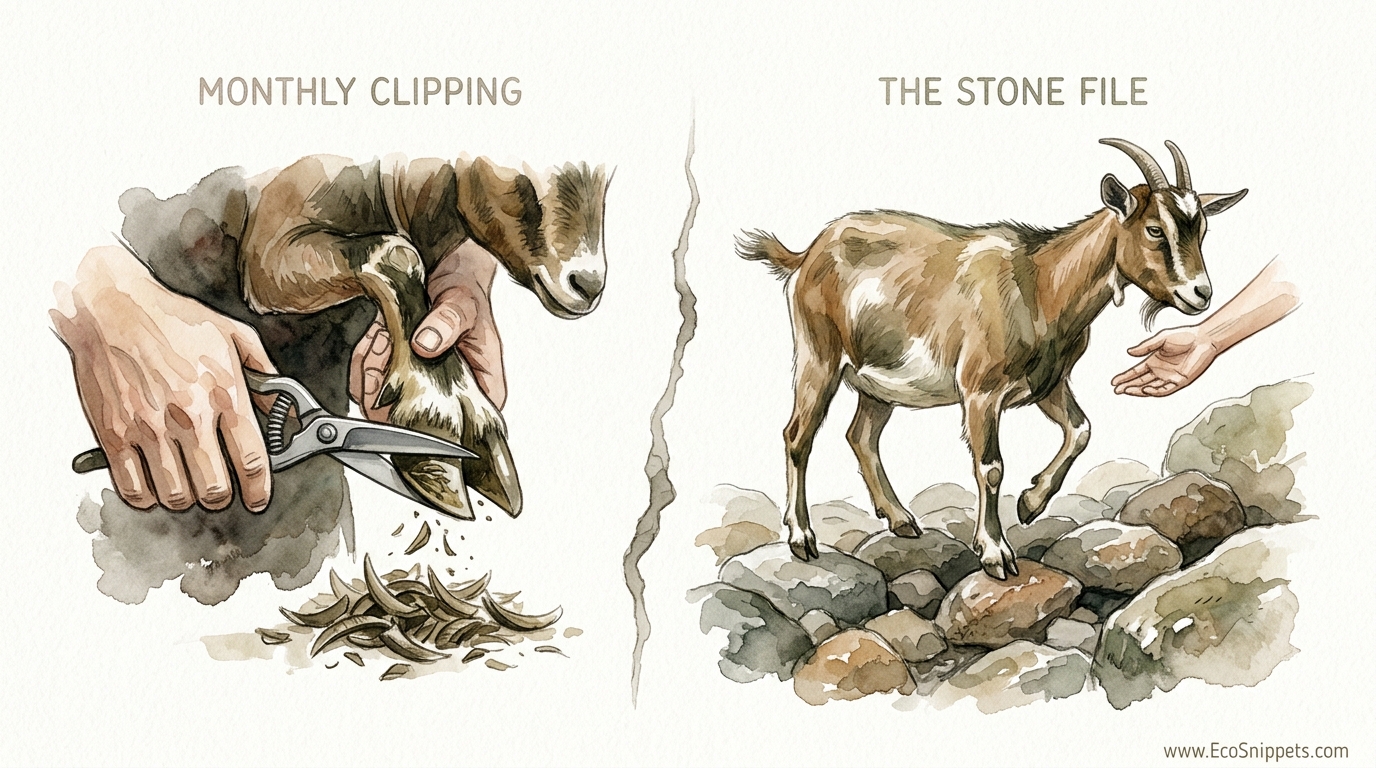
Manual Clipping vs. The Stone File
Deciding whether to rely on manual clipping or a natural filing system often comes down to a trade-off between upfront cost and long-term labor.
Manual clipping requires almost zero initial investment—a $20 pair of shears and a $10 rasp [1.5]. However, the “cost” is paid in hours of labor and the physical toll on your body. It is a precise task that requires skill; an improper cut can cause lameness that takes months to heal [1.10].
The Stone File system requires a significant upfront investment in materials and machinery. Depending on the length of the path and the cost of stone in your area, you might spend $200 to $2,000 on installation. However, once built, the system’s “operating cost” is nearly zero.
| Factor | Manual Clipping | Rocky Path (Stone File) |
|---|---|---|
| Upfront Cost | Very Low ($30) | High ($200 – $2,000+) |
| Monthly Labor | High (1-2 hours per 10 goats) | Near Zero |
| Skill Level | Moderate to High | Low (after installation) |
| Animal Stress | High | Very Low |
| Long-term Health | Variable (depends on trimmer) | Consistently High |
Practical Tips for Success
Start small to test your materials. Buy a few bags of different aggregates and place them in a small area to see how your goats react and how the hooves respond. Every breed has slightly different hoof hardness; what works for a Boer goat might be too much for a Nigerian Dwarf.
Keep the rocks clean. A stiff-bristled outdoor broom or a leaf blower can be used weekly to clear away hay scraps and manure from the path. If the rocks are buried under “barn waste,” they can’t do their job. Once or twice a year, use a pressure washer to deep-clean the stone and restore its abrasive texture.
Incorporate “mineral stations” into your path design. Goats love to linger near their loose minerals. If you place the mineral feeder on a large concrete pad or a section of flagstone, the goats will shift their weight and move their feet constantly while they lick the minerals, providing extra filing time.
Don’t forget the dewclaws. These are the small, vestigial hooves higher up on the leg [1.1]. While a rocky path files the main hooves, it rarely touches the dewclaws because they don’t usually hit the ground. You will still need to check these and occasionally clip them with shears if they grow too long and begin to snag on brush [1.13].
Advanced Considerations: The Hillside Method
Serious practitioners of natural goat care often take the Rocky Path Method a step further by integrating it into the pasture’s topography. If you have a sloped property, you can create a “switchback” path made of stone. This forces the goats to use their hooves at different angles as they climb and descend, ensuring the heels and the toes are worn down evenly.
Consider the “Feed High, Water Low” strategy. Place your hay feeders at the highest point of a rocky hill and your water troughs at the lowest point. This creates a mandatory “commute” over abrasive terrain multiple times a day. This not only maintains the hooves but also builds incredible muscle and cardiovascular health in your herd.
Advanced owners also look at the relationship between stone types and mineral leaching. Some limestone paths can actually leach calcium into the soil, which might be beneficial for certain pasture grasses but could affect the mineral balance of the goats if they lick the stones. Always provide a balanced, free-choice mineral supplement to ensure the goats aren’t trying to “eat” their walkway to satisfy a nutritional deficiency [1.2, 1.5].
Lastly, consider the “sacrificial” nature of your path. Over several years, even the hardest granite will lose its sharp edges as it “sands down” the hooves. You should plan to “re-surface” the path every three to five years by adding a fresh 2-centimeter (1-inch) layer of new, angular stone to keep the filing action sharp.
Real-World Example: The 20-Goat Homestead
Imagine a homestead with twenty goats living on 2 acres of lush, often muddy pasture in a temperate climate. The owner previously spent four hours every six weeks wrestling goats into a headgate to trim their hooves. The stress was high, and many goats suffered from “scald” during the wet spring months.
The owner installed a 6-meter (20-foot) path made of crushed basalt between the barn and the waterer. They used 4 tons of aggregate and spent a weekend on installation. They also placed a 2-meter by 2-meter (6ft x 6ft) concrete pad under the hay feeder.
After three months, the results were visible. The goats’ hooves, which used to have a 1-centimeter (0.5 inch) wall overgrowth, were now flush with the sole. The “elf shoes” had disappeared. More importantly, the goats were spending more time standing on the dry stone rather than in the mud, and the instances of foot scald dropped to zero. The owner now only spends thirty minutes every three months doing a quick visual inspection of the herd’s feet while they eat, rarely needing to pick up a pair of shears.
Final Thoughts
Relying on nature’s own mechanisms is the hallmark of a resilient and self-reliant farm. The Rocky Path Method takes the wisdom of the wild—where goats have thrived for millennia without human intervention—and applies it to the modern homestead. It is an investment in infrastructure that pays dividends in the form of healthier animals and a lighter workload for the keeper.
While the upfront labor of hauling stone and digging trenches may be significant, the long-term benefits are undeniable. You are not just building a path; you are building a system that respects the biological needs of your livestock. By aligning your management practices with the evolutionary history of the goat, you eliminate one of the most tedious chores in animal husbandry.
Encouraging your goats to maintain themselves is the ultimate goal of any holistic system. Start with a single high-traffic area, observe the results, and expand as needed. You may soon find that your hoof trimmers stay in the toolbox, gathering dust, while your goats’ feet remain as perfect as they would be on a mountain peak.
