How To Become More Self-Sufficient Without Starting a Full-Blown Farm…
Want to start preserving your harvest, making your own soap, or building a backyard root cellar — but not sure where to begin? “Homesteading Advice” gives you instant lifetime access to 35+ practical homesteading books on food preservation, veggie gardening, DIY natural cleaning products (save over $250 per year with this skill alone), brewing, off-grid energy, and a whole lot more…
Click Here To Check It Out Now!
Are you accidentally killing the world’s best sanitation crew with your monthly deworming routine? Most farmers see a pile of manure and see a chore. The smart ones see a biological engine. When you stop using toxic dewormers that kill your soil life, the dung beetles return to do the work for you—aerating your soil and burying parasites before they can hatch.
Stepping out onto a pasture that is truly alive feels different. Underneath every cow pat or sheep dropping, a hidden workforce is waiting to spring into action. These insects, often dismissed as lowly “bugs,” are the unsung heroes of regenerative agriculture. They are the frontline soldiers in the battle against soil compaction and internal parasites. If you are tired of the endless cycle of buying expensive chemicals only to watch your livestock’s parasite resistance grow, it is time to look at the ground beneath your boots.
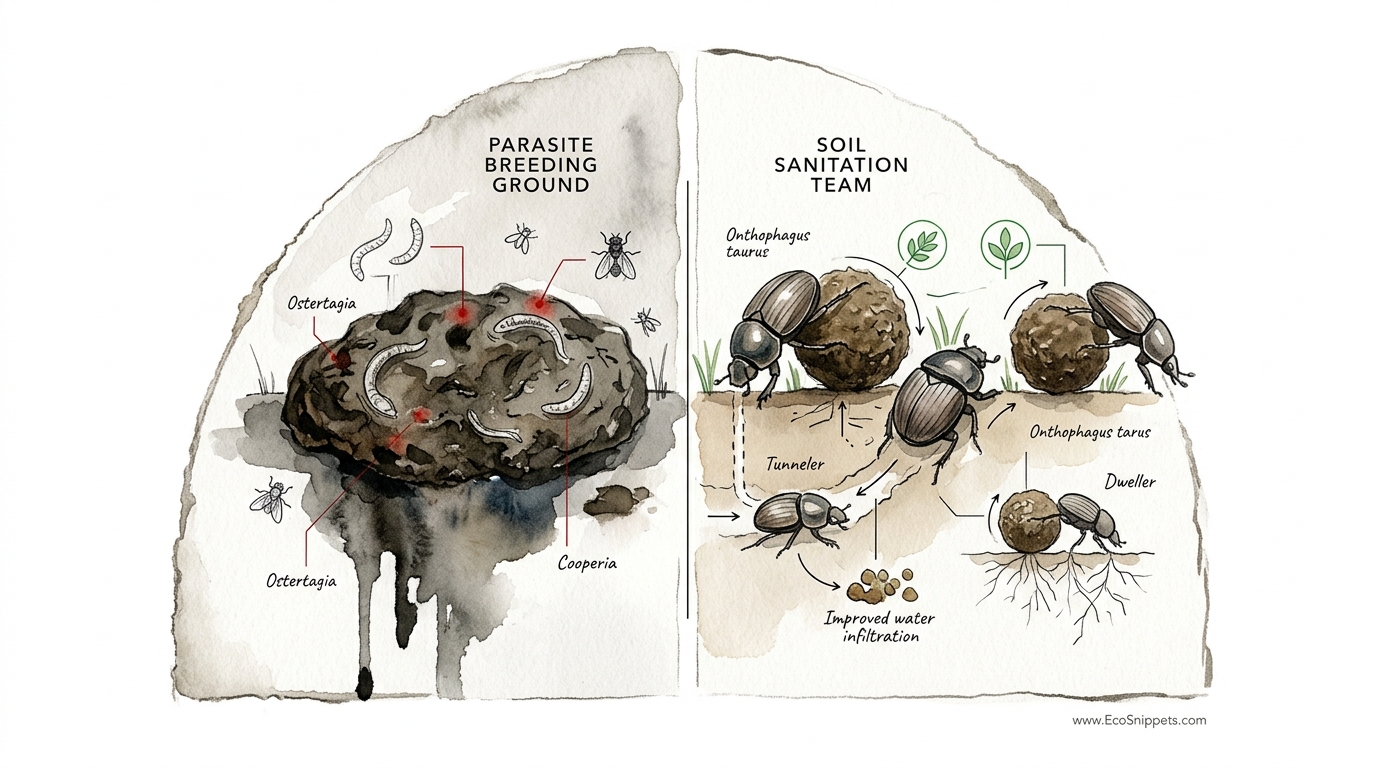
Managing a pasture is not just about the forage above the surface; it is about the ecological balance below it. For decades, the standard advice has been to treat every animal with broad-spectrum anthelmintics on a rigid schedule. However, we now know that this “scorched earth” policy does more than just kill worms. It effectively wipes out the soil sanitation team, leaving your land a stagnant parasite breeding ground. Transitioning to a system that prioritizes dung beetle health is one of the most profitable and sustainable shifts a land manager can make.
How To Attract Dung Beetles To Your Pasture
Attracting dung beetles is less about “bringing them in” and more about “stopping the killing.” These insects are incredibly mobile and have evolved to find fresh manure from miles away—sometimes up to 10 miles (16 km) depending on the species and wind conditions. They use specialized, sensitive antennae to detect the scent of fresh dung within seconds of it hitting the ground. If they are not present on your farm, it is usually because the environment has become toxic or the food source is inconsistent.
The most effective way to attract and keep these beetles is to provide a clean, chemical-free food source. When livestock are treated with certain macrocyclic lactones, particularly ivermectin, the residues in their manure act as a lethal trap for dung beetle larvae. Adult beetles may still land on the pat, but their offspring will not survive to maturity, leading to a population collapse. By switching to more selective deworming practices or using “beetle-safe” alternatives, you immediately send a green light to the local beetle population.
Establishing a reliable grazing rotation is the second critical step. Dung beetles thrive when there is a steady “pulse” of manure across the landscape. High-density, short-duration grazing—often called mob grazing—is particularly attractive to them. This method concentrates a large amount of manure in a small area for a short time, creating a concentrated “dinner bell” effect that draws beetles in from surrounding areas. Once the livestock move on, the beetles have a quiet window of 21 to 30 days or more to complete their life cycles in the soil without being stepped on or disturbed by constant re-grazing.
Finally, maintaining a diverse pasture with plenty of organic matter provides the structural habitat beetles need. They require soil that is not too compacted to dig into, as many species are “tunnelers” that bury dung up to 2 feet (60 cm) deep. If your soil is like concrete from years of overgrazing and chemical use, it may take a season or two for the biological activity to loosen the ground enough for the more significant species to return in force.
Understanding the Three Guilds of the Soil Sanitation Team
Not all dung beetles work the same way. To appreciate the complexity of the soil sanitation team, you must understand the three distinct behavioral groups, often referred to as guilds. Each plays a unique role in transforming a parasite breeding ground into a productive biological engine.
The Rollers (Telecoprids)
These are the famous beetles that most people recognize from nature documentaries. A male and female pair will collaborate to carve out a perfect sphere of manure, which they then roll away from the pat. They use the sun, moon, or even the Milky Way to navigate in a straight line, finding a soft spot in the soil to bury the ball. This “nuptial gift” serves as the nursery for their eggs. Rollers are excellent at dispersing nutrients away from the high-concentration area of the manure pat, spreading fertility across the wider pasture.
The Tunnelers (Paracoprids)
Tunnelers are perhaps the most valuable players for soil health. Instead of rolling the dung away, they dig deep, vertical shafts directly beneath the manure pat. They carry fragments of dung down into these tunnels to create “brood balls.” This action provides immediate aeration to the soil and places nitrogen and carbon directly into the root zone of the grasses. Some species can bury hundreds of times their own weight in a single night. This deep burial is a primary reason why beetle activity can reduce parasite reinfection, as the larvae are trapped too deep to ever reach the surface again.
The Dwellers (Endocoprids)
Dwellers are the specialists of the surface. They do not dig deep or roll balls; instead, they live, eat, and breed entirely within the manure pat itself. While they do not provide the same level of aeration as tunnelers, they are essential for the rapid breakdown of the pat’s physical structure. Their movement and feeding activity help the manure dry out faster, which kills the eggs and larvae of flies and parasites that require a moist environment to survive.
The Hidden Impact of Toxic Dewormers
The modern reliance on synthetic dewormers has created an invisible crisis in pasture ecology. Many of the most popular pour-ons and injectables belong to a class of chemicals called macrocyclic lactones. While these are highly effective at killing internal worms, they are excreted almost entirely in the feces of the animal. Research has shown that ivermectin residues can remain toxic to dung beetle larvae for 14 to 28 days after the animal has been treated.
When a beetle lands on a treated pat, the adult might survive, but the eggs it lays will hatch into larvae that die almost immediately upon feeding. This creates a “population sink,” where the very thing that should support life—the manure—becomes a toxic trap. Over time, this eliminates the beetle population, leading to what many farmers call “mummified manure.” These are the hard, white pats that sit on the pasture for months or even years without breaking down.
Without beetles to bury the manure, the nitrogen in the dung (up to 80%) is lost to the atmosphere through volatilization. Even worse, the manure remains a moist, protected incubator for horn flies and intestinal parasites. A single untreated cow pat can produce thousands of flies. When the beetles are present, they can reduce fly emergence by up to 95% simply by outcompeting the fly larvae for food and destroying their habitat.
The Benefits of a Living Biological Engine
Transitioning away from a chemical-only approach to a beetle-supported system offers measurable, long-term advantages for both the livestock and the land. These benefits scale as the population of the soil sanitation team increases and diversifies.
- Dramatic Parasite Reduction: By burying manure or drying it out rapidly, dung beetles break the lifecycle of gastrointestinal nematodes. Research indicates that active beetle populations can reduce the number of infective larvae on the pasture by 50% to 90% depending on the species and climate.
- Improved Soil Structure: Tunnelling beetles create millions of tiny pores in the soil. This “bio-tilling” increases water infiltration, allowing the ground to act like a sponge during heavy rains. This reduces runoff and erosion, keeping valuable nutrients on your farm instead of in the local watershed.
- Natural Fertilization: A dung beetle is essentially a free fertilizer injector. They move nitrogen and carbon from the surface into the rhizosphere—the area around plant roots—where it can be immediately utilized by the grass. This can lead to pasture growth increases of 25% to 30% over several years.
- Pest Control: Beyond internal parasites, beetles are the primary enemies of horn flies and face flies. By shredding the manure, they remove the environment flies need to breed, significantly reducing the stress on your livestock and the need for insecticidal ear tags or sprays.
Challenges and Common Mistakes
The road to a beetle-friendly pasture is not without its hurdles. Many producers struggle during the transition phase because they expect immediate results without changing their underlying management.
One common mistake is “cold turkey” deworming without monitoring. If you stop all deworming on a heavily infected herd without using tools like Fecal Egg Counts (FEC), you may face a health crisis before the beetle population has had time to recover. The goal is integrated management, not total neglect. You must use diagnostic tools to identify which animals actually need treatment, rather than treating the whole herd by the calendar.
Another pitfall is improper grazing management. If animals are left in the same paddock for too long (overgrazing), the beetles cannot keep up with the manure load, and the soil may become too compacted from hoof traffic. Conversely, if the rest period between grazing is too short, you may disturb the beetles during their critical nesting phase. Finding the “sweet spot” for your specific climate and stocking rate is essential.
Limitations and Environmental Constraints
It is important to acknowledge that dung beetles are not a “silver bullet” that works the same in every environment. Their activity is heavily influenced by temperature and moisture. In very cold climates, beetle activity may be limited to a few months of the year. In extremely arid regions, the manure may dry out too quickly for even the beetles to process it effectively.
Furthermore, different livestock species attract different beetles. While there is overlap, the beetles that prefer horse manure are often different from those that seek out cattle or sheep dung. If you only have one type of animal on your farm, you may only support a narrow range of beetle species. Diversity in livestock, where possible, usually leads to a more robust soil sanitation team.
Finally, soil type matters. Heavy clay soils can be difficult for smaller beetle species to penetrate, while very sandy soils may not hold the structure of the tunnels well. While beetles exist in almost every soil type, the speed of dung burial will vary.
Comparison: Chemical Reliance vs. Biological Engine
| Feature | Conventional (Chemical Reliance) | Regenerative (Biological Engine) |
|---|---|---|
| Parasite Control | Short-term kill; breeds resistance over time. | Long-term reduction; breaks the biological cycle. |
| Cost Factor | High annual expense for chemical inputs. | Low cost; focuses on management and observation. |
| Soil Health | Stagnant; manure “mummifies” on the surface. | Active; nutrients are buried and soil is aerated. |
| Labor | Periodic high labor for mustering and treating. | Ongoing observational labor and fence moving. |
| Resilience | Vulnerable to chemical resistance and droughts. | High; soil retains more water and builds organic matter. |
Practical Tips for Immediate Action
If you want to start seeing the soil sanitation team return to your land, follow these steps immediately. You do not need to wait for a new season to begin making changes.
- Stop Blanket Deworming: Treat only the animals that show signs of distress (anemia, rough coat, poor weight gain) or those with high Fecal Egg Counts. This leaves a “refugia” of untreated parasites and keeps the manure of most of your herd safe for beetles.
- Choose “Beetle-Safe” Chemicals: If you must deworm, research the active ingredients. Moxidectin, for example, is generally considered much less toxic to dung beetles and other soil life than ivermectin or doramectin.
- Shorten Your Grazing Periods: Move your animals more frequently. Aim for “pulse” grazing where they are in a paddock for 1–3 days and then gone for at least 30. This concentrates the manure and gives the beetles a quiet environment to work.
- Observe the Pats: Go out into your pasture 24 to 48 hours after the cows have moved. Kick over a few pats. If you see holes like Swiss cheese or find beetles scurrying underneath, your management is working. If the pat is solid and undisturbed, you still have work to do.
- Provide Winter Refuge: In colder climates, leave some areas of taller grass or “banked” forage. These areas provide the thermal cover that overwintering beetles need to survive until spring.
Advanced Considerations for Serious Practitioners
For those who have already established a basic beetle population, the next step is maximizing diversity. A healthy pasture should have species from all three guilds—rollers, tunnelers, and dwellers—active at different times of the year. In some parts of the world, such as Australia and the United States, programs have successfully introduced non-native species to fill “gaps” in the seasonal activity of native beetles.
Consider the “carbon-to-nitrogen” (C:N) ratio of your manure. Beetles are highly attracted to high-nitrogen manure, which usually comes from animals grazing on lush, high-protein forages. If your animals are eating very dry, lignified “standing hay,” the manure will be high in carbon and less attractive to many beetle species. Balancing your forage quality can actually influence the rate of dung burial.
Another advanced strategy is “multi-species following.” Having sheep follow cattle, or chickens follow both, creates a complex ecosystem where different dung-dwelling organisms work together. Chickens, in particular, will scratch apart manure pats to find the beetle larvae and fly maggots, further aerating the manure and spreading it across the soil surface.
Example Scenario: The Three-Year Transition
Let’s look at a realistic transition for a 100-acre (40-hectare) cattle farm. In **Year One**, the farmer stops all routine deworming and begins using Fecal Egg Counts. They discover that only 20% of their herd is carrying 80% of the parasite load. They treat only those individuals with a beetle-safe product and move them to a “quarantine” paddock for 48 hours. By the end of the first summer, they notice the first “Swiss cheese” holes in the manure pats.
In **Year Two**, the farmer implements a daily rotation. The concentrated manure attracts a massive influx of tunnelers. Soil tests show that water infiltration has improved—where water used to pond after a 2-inch (50 mm) rain, it now disappears into the ground within minutes. The need for fly sprays is reduced by half because the horn fly population has plummeted.
By **Year Three**, the “biological engine” is in full gear. The manure pats are often completely buried within 48 to 72 hours. The farmer notices that the grass is darker green and more resilient during dry spells. The money saved on chemicals and commercial fertilizers has been reinvested into better fencing and water systems, making the daily moves easier. The farm is no longer a parasite breeding ground; it is a thriving soil sanitation factory.
Final Thoughts
Relying on nature’s sanitation crew is not a sign of “lazy” farming; it is a sign of sophisticated ecological management. The dung beetle is a primary indicator of a healthy, functioning pasture. When you prioritize these insects, you are choosing a path of self-reliance over chemical dependence. You are building soil that can withstand droughts and floods, and you are raising livestock that are naturally more resilient to the challenges of the environment.
The transition from a parasite breeding ground to a soil sanitation team takes time and observation. It requires a shift in mindset from “how do I kill the pests?” to “how do I support the life that manages the pests for me?” The results—clearer water, greener grass, and healthier animals—are worth every bit of effort.
Next time you are walking through your fields, stop and look at a manure pat. If it is alive with activity, know that you have thousands of tiny employees working for you around the clock, free of charge. Respect the beetle, protect the soil, and let the biological engine drive your farm toward a more sustainable and profitable future.
