How To Become More Self-Sufficient Without Starting a Full-Blown Farm…
Want to start preserving your harvest, making your own soap, or building a backyard root cellar — but not sure where to begin? “Homesteading Advice” gives you instant lifetime access to 35+ practical homesteading books on food preservation, veggie gardening, DIY natural cleaning products (save over $250 per year with this skill alone), brewing, off-grid energy, and a whole lot more…
Click Here To Check It Out Now!
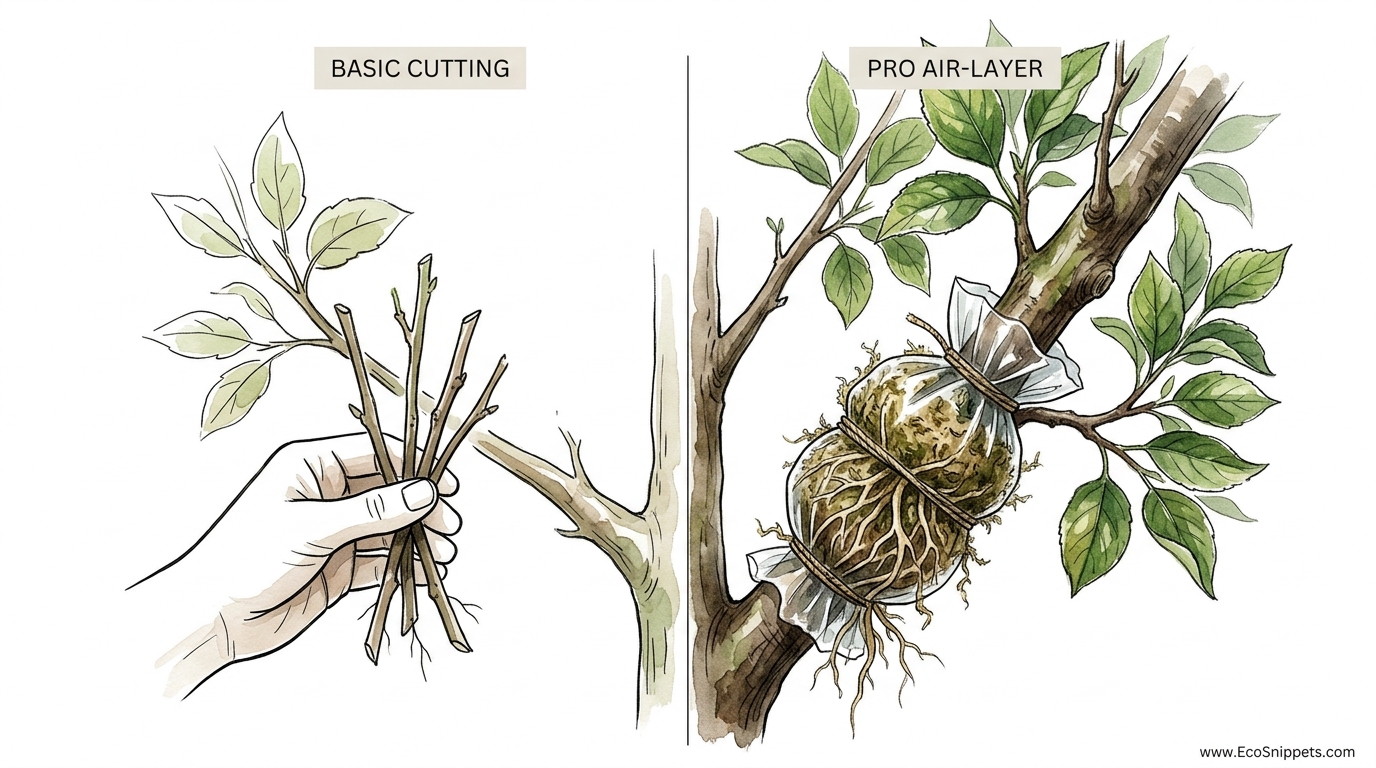
Why wait years for a nursery tree to grow when you can ‘clone’ a mature, fruit-bearing branch in just six weeks? Most gardeners take a cutting and pray for a single root. The pros use ‘Air Layering’ to force the parent tree to grow a massive root system directly on the branch. You aren’t just starting a plant; you’re harvesting a ready-to-fruit tree for $0.
Imagine walking through an ancestral orchard and spotting a heavy-limbed fig or a citrus tree dripping with sweet, sun-ripened fruit. Instead of trying to grow a tiny seedling or hoping a cutting survives the shock of separation, you can harness the life-force of that mature tree. This method is a botanical shortcut that has been whispered through generations of orchardists because it works with surgical precision.
This is self-reliance at its finest. You don’t need a degree in horticulture or an expensive greenhouse. You only need a sharp knife, a handful of moss, and the patience to let nature do what she does best.
How To Air Layer Fruit Trees
Air layering, also known as marcottage or Chinese layering, is an ancient technique that dates back over 2,000 years. It is a form of vegetative propagation where a new plant is created while the branch is still physically attached to the parent tree. This connection is the “secret sauce” because the parent tree continues to provide water and nutrients to the branch while it develops its own independent root system.
Think of it as a botanical heist. You are essentially “tricking” the branch into thinking it has been severed, which triggers its survival instinct to grow roots, yet you are still providing it with a safety net of hydration. Unlike traditional cuttings that are at the mercy of their own stored energy, an air layer has the full weight of the mother tree’s root system backing it up.
In the real world, this is how professionals quickly multiply rare or expensive fruit trees. It is commonly used for species that are notoriously difficult to root from simple cuttings, such as lychee, mango, and certain citrus varieties. Because the resulting tree is a genetic clone, it will produce fruit that is identical in taste, size, and quality to the parent, often years sooner than a seedling would.
How It Works: The Science of the Girdle
The magic of air layering happens in the thin, invisible layers just beneath the bark. To do it correctly, you must understand the difference between the two main “highways” of a tree: the xylem and the phloem.
The xylem is the inner wood that transports water and minerals from the roots up to the leaves. The phloem is the soft layer just under the bark that carries sugars and hormones (like auxin) from the leaves down to the roots. When you perform a “girdle” or a ring-cut, you are severing the phloem but leaving the xylem intact.
This means the branch still gets its water from the mother tree, but the sugars produced in the leaves have nowhere to go. They accumulate at the top of your cut, creating a concentrated “power zone” of energy and rooting hormones. When this zone is kept moist and dark, the branch begins to push out adventitious roots to reclaim its connection to the earth.
The Step-by-Step Process
1. Select Your Branch: Look for a healthy, upright branch from the previous year’s growth. It should be roughly the thickness of a pencil (about 1–2 cm or 0.4–0.8 inches). Ensure the branch is 12–24 inches (30–60 cm) long and free of pests.
2. The First Cut: Using a sterilized, sharp knife, make two parallel circular cuts around the branch, about 1 to 1.5 inches (2.5 to 3.8 cm) apart. These cuts should penetrate the bark and the soft green cambium layer, but stop before you hit the hard inner wood.
3. Removing the Bark: Peel away the ring of bark between your two cuts. Once the bark is gone, use the back of your knife to gently scrape the exposed white wood. This step is critical; if you leave any of the green cambium layer, the tree will simply bridge the gap and heal the wound instead of growing roots.
4. Apply Rooting Hormone (Optional): While not strictly necessary for many species like figs, applying a rooting hormone (specifically one containing Indole-3-butyric acid or IBA) to the upper edge of the cut can significantly speed up root development.
5. The Moss Wrap: Take two handfuls of long-fiber sphagnum moss that has been soaked in water and squeezed until it is damp but not dripping. Wrap this moss tightly around the wounded area until it forms a ball roughly the size of a lemon.
6. Sealing the Layer: Wrap the moss ball in clear plastic film (like kitchen wrap). Secure both ends tightly with electrical tape or zip ties to prevent moisture from escaping. Finally, wrap a layer of aluminum foil over the plastic to block out sunlight and prevent the roots from getting too hot in direct sun.
Benefits of Air Layering
Choosing air layering over other methods offers several distinct advantages that make it a favorite for those seeking high-quality results with minimal risk.
The primary benefit is the success rate. Because the branch remains attached to its life-support system, the mortality rate is significantly lower than that of cuttings. If the environment inside the moss remains moist, the branch is almost guaranteed to survive the process.
Another major draw is the speed to harvest. When you air layer a mature branch, you are starting with “old” wood. This branch already knows it is a fruit-bearing adult. Once it is severed and potted up, it can often produce fruit in its very first year. A seedling, by contrast, might take 7 to 10 years to reach reproductive maturity.
Lastly, air layering allows you to create genetic clones. If you have a specific citrus tree that produces the perfect Meyer lemon or a fig tree that withstands your local winters better than any nursery stock, air layering preserves those exact traits. There is no guesswork involved, as there is with cross-pollinated seeds.
Challenges and Common Mistakes
Even though the success rate is high, there are a few ways to sabotage your efforts. Most failures come down to moisture management and poor wounding technique.
One common mistake is incomplete cambium removal. If you aren’t thorough when scraping the white wood, the tree’s natural healing process will kick in. It will form a “callus bridge” over the wound, reconnecting the phloem. If this happens, the branch will look healthy, but it will never grow a single root.
Another frequent error is drying out. If the seal on your plastic wrap isn’t airtight, the sphagnum moss will eventually lose its moisture. Roots cannot survive or grow in dry moss. Conversely, if you soak the moss too much, you can create a swamp-like environment that invites rot and fungal pathogens.
Timing also plays a role. Attempting to air layer during a period of dormancy or extreme drought can lead to disappointment. The tree needs to be actively “pushing” sap and energy for the hormones to accumulate at the wound site properly.
Limitations: When This May Not Be Ideal
While air layering feels like magic, it isn’t a universal solution for every tree in the orchard. Some species are simply genetically predisposed against it.
Stone fruits, such as peaches, apricots, and plums, are notoriously difficult to air layer. While some people have reported success with persistent effort, the success rate for these trees is significantly lower than for figs or pomegranates. For these varieties, traditional grafting onto a vigorous rootstock is often more efficient.
There is also the issue of root structure. Trees grown from air layers lack a taproot—the deep, vertical root that provides stability and access to deep-water tables. Instead, they have a fibrous, radial root system. While this makes them excellent for pots and containers, it means they may be more susceptible to being blown over in high winds or suffering during severe droughts if planted in a field.
Lastly, there is a limit to how many “clones” you can take from a single parent. Each air layer is a physical burden on the tree. Taking too many at once can stress the mother tree, reducing its overall fruit yield and potentially inviting disease.
Comparing Propagation Methods
Understanding where air layering fits into the broader world of horticulture helps you choose the right tool for the job.
| Method | Success Rate | Time to Fruit | Complexity | Cost |
|---|---|---|---|---|
| Air Layering | High | 1–2 Years | Moderate | Near Zero |
| Seedling | High | 5–10 Years | Low | Zero |
| Grafting | Moderate | 2–3 Years | High | Moderate |
| Cuttings | Low/Moderate | 3–4 Years | Low | Zero |
As the table illustrates, air layering is the champion of “speed to fruit” for the home gardener. While grafting is powerful for combining varieties, it requires specialized skills and often involves purchasing rootstock. Air layering is self-contained and utilizes what you already have.
Practical Tips and Best Practices
For the best results, start your air layers in the mid-to-late spring. This is when the sap is flowing most vigorously, and the tree is in its peak growth phase. The “bark slip” stage—when bark peels away easily without sticking—is the perfect window.
Use black plastic or aluminum foil to cover your transparent wrap. While it is tempting to use clear plastic so you can watch the roots grow, roots naturally avoid light. Keeping the root zone in total darkness encourages a more robust and faster-growing root system.
When it comes time to harvest your new tree, don’t just hack it off and stick it in the ground. Use the two-stage cut method. Cut the branch halfway through, wait a week, and then finish the cut. This allows the new plant to slowly adjust to the loss of nutrients from the mother tree before it is fully on its own.
Hardening Off Your Clone
The moment you cut the branch, the new tree enters a state of shock. It has a full canopy of leaves but a relatively small root system.
Immediately prune back about 30% to 50% of the foliage. This reduces the amount of water the leaves “demand” from the new roots. Keep the potted plant in a shaded, humid area for at least two weeks before slowly introducing it to direct sunlight.
Advanced Considerations for Serious Growers
For those looking to scale their efforts, consider the chemical concentration of your rooting aids. Different trees require different levels of IBA. For example, citrus and hard-wooded tropicals often benefit from a stronger “gel” hormone, whereas soft-wooded figs can root in plain water.
Pay close attention to the vertical orientation of the branch. Upright branches tend to have higher concentrations of natural growth hormones than horizontal or drooping branches. If you have a choice, always pick a branch that is reaching for the sky.
If you are working in a particularly dry climate, consider using a perforated container instead of plastic wrap. Some pros use a modified plastic bottle filled with a mix of peat and perlite. This allows them to use a syringe to inject water into the medium every few weeks, ensuring it never dries out without having to unwrap the entire assembly.
Example: The Six-Week Fig Tree
Let’s look at a real-world scenario involving a common fig tree. Figs are the “gateway” tree for air layering because they are incredibly resilient.
In May, an gardener selects a branch 3/4 inch (2 cm) thick. They perform a 1-inch (2.5 cm) ring cut, scrape the wood, and wrap it in moist sphagnum moss. By mid-June, through the clear plastic, thick white “vines” (the roots) are visible throughout the moss ball.
By the end of June, the roots have begun to turn a light brown—a sign they are maturing. The gardener cuts the branch from the tree, reduces the foliage by half, and pots it in a well-draining soil mix. By August, this “new” tree is already putting out new growth and potentially ripening a small crop of late-summer figs. This is how you bypass years of nursery waiting time.
Final Thoughts
Air layering is more than just a gardening trick; it is a way to claim a piece of history and carry it forward. It allows you to preserve heritage varieties and share the best of your garden with friends, family, and neighbors without spending a dime at a commercial nursery.
Mastering this skill connects you to the rhythms of your orchard in a way that buying a tree never can. You begin to see your trees not just as producers of fruit, but as a source of endless new life. The ability to look at a single, perfect branch and see a future orchard is the mark of a true steward of the land.
Take a stroll through your yard this week. Look for that one branch that seems perfect—the one that always bears the sweetest fruit. Give air layering a try. You might just find that the most rewarding tree you ever grow is the one you “borrowed” from itself.
