How To Become More Self-Sufficient Without Starting a Full-Blown Farm…
Want to start preserving your harvest, making your own soap, or building a backyard root cellar — but not sure where to begin? “Homesteading Advice” gives you instant lifetime access to 35+ practical homesteading books on food preservation, veggie gardening, DIY natural cleaning products (save over $250 per year with this skill alone), brewing, off-grid energy, and a whole lot more…
Click Here To Check It Out Now!
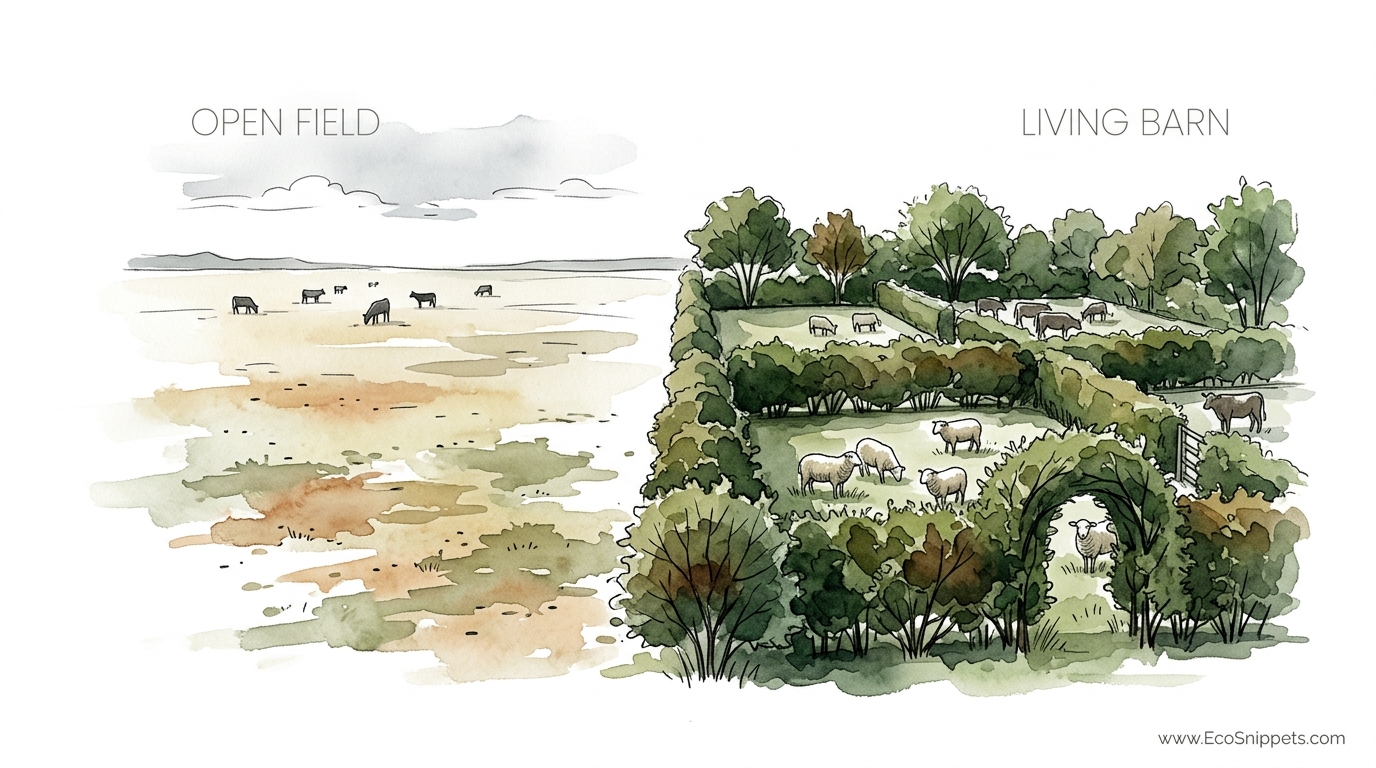
Nature’s barn never needs a roof and never rots. When the wind-chill drops, a wire fence is just a psychological barrier. But a living hedgerow is a biological shield. It provides emergency fodder, blockades the gale, and creates a microclimate ten degrees warmer than the open field. Stop building with steel and start planting for shelter.
The iron rod of a fence post will eventually rust, and even the best galvanized wire will sag under the weight of time. Wood rot is an inevitability for any dead timber driven into the damp earth. Yet, a living fence—a carefully managed line of trees and shrubs—grows stronger and more impenetrable with every passing winter. It is a legacy project, a piece of infrastructure that pays dividends in shelter, security, and nutrition for generations.
Modern agriculture has largely forgotten the wisdom of the hedgerow in favor of the quick fix. We trade biological complexity for the ease of a tractor and a roll of high-tensile wire. But as the costs of synthetic materials rise and the climate becomes increasingly unpredictable, the “Living Barn” concept offers a path back to true self-reliance. This article explores how to design, plant, and maintain these living structures to protect and nourish your livestock.
How To Plant Living Fences For Livestock
A living fence is the strategic use of woody perennials to create an animal-proof barrier. Unlike a standard ornamental hedge, a livestock hedge must withstand the physical pressure of heavy animals like cattle and the persistent curiosity of sheep and goats. It is a multi-layered system designed to be both a physical wall and a source of secondary agricultural products.
In historical contexts, these were the primary boundaries of the landscape. In the United Kingdom, the “bocage” landscape of the 19th century was defined by thick, laid hedges that kept cattle in and the wind out. In the American Midwest, before the invention of barbed wire, pioneers used Osage Orange (Maclura pomifera) to create fences that were famously “horse-high, bull-strong, and hog-tight.”
Today, living fences are used in silvopasture systems to provide windbreaks that reduce livestock calorie loss during cold snaps. They serve as “fodder banks,” where animals can browse on mineral-rich leaves that their ancestors once relied upon. For the serious practitioner, planting a living fence is an act of land stewardship that transforms a simple boundary into a thriving ecosystem.
The Architecture of the Barrier
Designing a living fence begins with understanding the specific needs of your animals. Cattle require height and thickness to prevent them from leaning against the structure. Sheep need density at the ground level to prevent them from “piping” or pushing through the base of the hedge. Goats, the most challenging of all, require a combination of thorns and extreme density to deter climbing and excessive browsing.
Successful planting usually involves a double-staggered row. This creates a thick “zig-zag” pattern that leaves no direct gaps for an animal to see through or push past. By using a mix of “backbone” species for strength and “filler” species for density and fodder, you create a barrier that is as functional as it is beautiful.
The Mechanics of the Biological Shield
A living fence works by using the natural growth habits of trees to your advantage. Most deciduous trees, when cut or pruned heavily, respond with a burst of “epicormic” growth—new shoots that emerge from the trunk or base. By managing this growth through techniques like coppicing or hedgelaying, you can force a tree to grow sideways and knit together with its neighbors.
Soil preparation is the foundation of the shield. You should till a strip roughly 2 feet (60 cm) wide along your intended fence line to remove grass competition. Incorporating well-rotted manure or compost into this strip provides the young saplings with the nutrients they need to establish a deep, resilient root system in their first two years.
The planting density for a stock-proof hedge is significantly higher than for a garden hedge. For a barrier that will eventually hold sheep and cattle, aim for 4 to 6 plants per linear meter (approximately 1 plant every 8 to 12 inches). This close spacing forces the plants to compete for light, driving them upward, while frequent pruning encourages the lateral branching necessary for a tight mesh.
Microclimate Management
The true power of the living fence lies in its ability to manipulate the environment. A mature hedge can reduce wind speed for a distance up to 30 times its own height. In practical terms, a 6-foot (1.8-meter) hedge creates a protected zone that can be up to 10 degrees Fahrenheit (5.5 degrees Celsius) warmer than the open field. This “Living Barn” effect reduces the metabolic stress on livestock, meaning they require less hay to maintain their body temperature during the winter months.
The Living Arsenal: Species Selection
Choosing the right species is a balance between defense, nutrition, and environmental fit. You want “backbone” plants that are hardy, fast-growing, and preferably thorny if you are dealing with larger livestock. You also want “fodder” species that can be safely browsed to supplement the animals’ diet.
The Defensive Backbone
- Hawthorn (Crataegus monogyna): The gold standard for livestock hedging. It is incredibly hardy, tolerates heavy pruning, and has stout thorns that deter even the most stubborn bull. It also produces “haws” that provide winter food for birds.
- Osage Orange (Maclura pomifera): Best suited for North American climates. It is practically rot-proof and grows into a tangled, impenetrable thicket of thorns. Historically used to fence in the entire Great Plains.
- Blackthorn (Prunus spinosa): Even more aggressive than Hawthorn, it spreads via suckers to fill gaps. Be warned: the thorns can cause infections in humans and horses, so use with caution in high-traffic areas.
- Honey Locust (Gleditsia triacanthos): A powerful nitrogen-fixer. While the “thornless” varieties are common in landscaping, the wild varieties have massive, multi-branched thorns that make them a formidable barrier. The seed pods are also highly nutritious for cattle.
The Fodder and Filler
- Willow (Salix spp.): Extremely fast-growing and easy to propagate from “live stakes” or cuttings. The leaves contain salicylic acid (natural aspirin) and are a favorite medicinal browse for sheep and goats.
- Mulberry (Morus spp.): Provides high-protein foliage that rivals alfalfa in nutritional value. It can be coppiced regularly to keep the leaves within reach of the animals.
- Tagasaste (Chamaecytisus palmensis): Also known as Tree Lucerne, this is an incredible fodder plant for drier climates. The foliage is 20-27% protein and remains green year-round.
- Siberian Pea Shrub (Caragana arborescens): A hardy, drought-tolerant legume. It produces small “peas” that can be a supplement for poultry, while the foliage is suitable for ruminants.
Toxic Plants to Avoid
When planting for livestock, you must be vigilant about toxicity. Avoid Yew (Taxus), as even a small amount of the foliage is fatal to most livestock. Privet (Ligustrum) and Laurel are also common hedging plants that can be toxic if ingested in large quantities. Always research the local native species and ensure no poisonous weeds like Water Hemlock or Ragwort are allowed to establish within the hedge line.
Mastery of the Blade: Hedgelaying and Pleaching
Simply planting a row of trees is not enough to create a fence. Left to their own devices, trees will grow tall and thin, leaving large gaps at the bottom that sheep can easily trot through. To create a true “biological shield,” you must master the ancient art of hedgelaying or pleaching.
Hedgelaying is the process of partially cutting through the base of a sapling—enough to let it bend but not enough to kill it—and laying it over at an angle, typically 30 to 45 degrees. The tree remains alive because the sap continues to flow through the remaining bark and wood on the underside. The horizontal stem (now called a “pleacher”) then sends up new vertical shoots all along its length, creating a dense, woven wall from the ground up.
This work is traditionally done in the dormant season (late autumn to early spring) when the sap is low and the structure of the hedge is visible. In the UK, different regions developed specific styles: the “Midland Bullock” style uses a single row of stakes and binders to hold cattle, while the “Welsh Border” style is double-brushed to protect against sheep.
Step-by-Step Hedgelaying
- Clear the Base: Remove any briars, dead wood, or weeds from the bottom of the stems so you can see the “stools” (the base of the plants).
- The Cut: Using a billhook or a small chainsaw, make a long, sloping cut into the trunk about 2 to 4 inches (5-10 cm) above the ground. You are looking to leave a “hinge” of wood and bark.
- The Lay: Gently bend the tree over into the line of the hedge. If it resists, deepen the cut slightly until it yields.
- The Stakes: Drive hazel or ash stakes into the ground every 20 inches (50 cm) to provide a framework.
- The Binding: Weave long, flexible rods (binders) of willow or hazel along the top of the stakes to lock the pleachers in place. This prevents the wind or heavy snow from pulling the new hedge apart.
The Practical Advantages of Living Structures
The most immediate benefit of a living fence is cost over time. While the initial labor is higher than driving t-posts, the material cost is negligible if you propagate your own cuttings or buy bare-root saplings in bulk. Once established, the fence regenerates itself. If a branch dies, the surrounding branches fill the void. If a tree is damaged, it sends up new shoots.
Longevity is the second major advantage. A well-maintained Hawthorn hedge can live for several centuries. There are hedges in Europe today that have been managed since the Middle Ages. Compare this to a modern wire fence with a lifespan of 20 to 30 years before a total replacement is required. You are not just building a fence; you are building a land feature that will outlive you.
Furthermore, the environmental benefits are massive. Living fences act as corridors for wildlife, supporting pollinators and pest-eating birds that help keep your pastures healthy. They sequester carbon in their woody biomass and deep root systems, and they prevent soil erosion by breaking the force of surface water runoff on sloped land.
The Cost of Growth: Challenges and Common Mistakes
The greatest challenge is the establishment period. A living fence is not a fence on day one. It takes between 3 and 7 years of growth and management before it becomes truly stock-proof. During this window, you must protect the young plants from the very animals they are intended to eventually contain. If cattle or sheep are allowed to browse the leading shoots of a year-old sapling, they will stunt its growth and ruin the future structure of the hedge.
A common mistake is neglecting weed control in the first two years. Grass is a fierce competitor for moisture and nutrients. If you allow thick sod to grow right up to the base of your new saplings, they will struggle and many may die. Using a heavy mulch of woodchips, straw, or even old wool can suppress weeds and keep the roots cool and damp.
Another error is improper pruning. Many people are afraid to cut their young trees, wanting them to get “tall” as quickly as possible. However, the secret to a good fence is thickness, not just height. In the first few years, you should prune the vertical growth heavily to force the plant to bush out at the base. A hedge that is 6 feet tall but “leggy” at the bottom is useless for containing livestock.
Realistic Boundaries: When Living Fences Fall Short
Living fences are not a universal solution. They require significant space. A mature, stock-proof hedge can easily be 6 to 10 feet (2 to 3 meters) wide. If you are working on a very small acreage where every square inch of pasture counts, the footprint of a living fence might be too large.
Environmental constraints also play a role. Most hedging species require at least 6 hours of direct sunlight. If you are trying to plant a fence in the deep shade of a woodlot, the plants will grow spindly and fail to create a dense barrier. Similarly, in extremely arid regions, the water required to establish a 500-meter hedge may be prohibitively expensive or labor-intensive unless you use specific desert-adapted species like certain Acacias or Prosopis.
Finally, there is the labor trade-off. A wire fence requires a lot of work for one week and then very little for 20 years. A living fence requires moderate work every year for eternity. If you do not enjoy the process of pruning, laying, and managing woody plants, the “biological shield” will eventually become a messy line of trees with gaps large enough for a cow to walk through.
The Eternal Debate: Open Field vs. Living Barn
The choice between conventional fencing and a living system often comes down to the farmer’s philosophy and long-term goals. Below is a comparison of the key factors involved in each approach.
| Factor | Open Field (Wire/Steel) | Living Barn (Hedgerow) |
|---|---|---|
| Initial Cost | High (Materials) | Low (Saplings/Cuttings) |
| Time to Utility | Instant | 3–7 Years |
| Maintenance | Periodic repairs/Replacement | Annual pruning/Lay every 15 yrs |
| Lifespan | 15–30 Years | 100–500+ Years |
| Shelter Value | Zero (Wind passes through) | High (10° warmer microclimate) |
| Additional Yield | None | Fodder, Fruit, Fuelwood |
Seasonal Rhythm: A Best Practices Guide
Managing a living fence is a dance with the seasons. If you align your work with the natural cycle of the plants, the labor becomes much lighter.
- Late Autumn/Winter: This is the time for hedgelaying and major structural pruning. The plants are dormant, meaning there is less stress on the tree and no nesting birds to disturb. It is also the best time to plant bare-root saplings.
- Spring: Monitor for new growth. This is the time to replace any saplings that didn’t survive the winter. Mulch heavily now to lock in spring moisture before the summer heat arrives.
- Summer: Focus on “training.” If you aren’t laying the hedge, a light trim of the soft new growth (the “green prune”) helps maintain the shape and encourages the hedge to fill in. Ensure young plants are watered during drought periods.
- Late Summer: This is when you might harvest “fodder” branches. If the pasture is dry and the grass has stopped growing, you can prune sections of the hedge and let the livestock eat the leaves and soft twigs.
Advanced Silvopasture Strategies
For those who want to take the concept further, consider inosculation. This is a technique where you tie the branches of neighboring trees together where they cross. Over time, the bark wears away and the trees literally grow together, grafting into a single, solid piece of living lattice. This creates a structural strength that no amount of animal pressure can break.
Another advanced technique is the “Fodder Bank” design. Instead of a single hedge, you plant a wide strip with an inner row of thorny Hawthorn and an outer row of high-protein Mulberry or Willow. You can then use a simple electric strand to control when the animals have access to the “outer” row, allowing it to regrow between grazing periods while the “inner” row remains the permanent, impenetrable barrier.
Finally, consider the use of Dead Hedging as a nursery. While your living fence is growing, you can pile the prunings from other parts of the farm into a long, tight mound along the fence line. This “dead hedge” provides immediate protection for the young saplings growing inside it, shielding them from wind and small grazers while they establish their roots.
Example Scenario: The 100-Meter Sheep Guard
Imagine you have a 100-meter (328-foot) boundary on a windy hillside that you want to secure for a flock of sheep. Following these principles, your setup would look like this:
The Planting Plan: You order 500 bare-root Hawthorn saplings and 100 Willow cuttings. You till a 2-foot wide strip and plant the Hawthorn in a double-staggered row, with 10 inches (25 cm) between plants. Every 5 meters, you tuck in a Willow cutting.
Year 1-3: You install a temporary, cheap electric polywire 3 feet away from the hedge to keep the sheep from nibbling the new growth. You mulch the base with woodchips. By the end of Year 3, the Hawthorns are 5 feet tall but a bit thin.
Year 4: You perform your first “lay.” You spend two weekends with a billhook, laying the stems over and staking them. The following spring, the hedge explodes with new growth from the base. It is now so thick that you can no longer see through it.
The Result: By Year 6, the temporary electric wire is removed. The sheep now have a permanent windbreak where they huddle during winter storms. In the heat of August, they graze on the Willow branches you prune for them. You have spent less than $300 on plants and created a structure that will serve the farm for the next century.
Final Thoughts
Building with nature requires a different mindset than building with steel. It requires patience, observation, and a willingness to work with the slow, steady pace of the seasons. A living fence is not a product you buy; it is a relationship you cultivate with your land. It is the ultimate expression of pioneer grit—the realization that the most durable solutions are often the ones that grow.
As you stand by your newly planted saplings, they may look insignificant compared to the heavy timber and wire of a modern fence. But remember that while the timber is dying, the sapling is just beginning. In a few years, those tiny stems will be a biological shield, a source of medicine, and a testament to your foresight. Stop fixing fences and start growing them.
