How To Become More Self-Sufficient Without Starting a Full-Blown Farm…
Want to start preserving your harvest, making your own soap, or building a backyard root cellar — but not sure where to begin? “Homesteading Advice” gives you instant lifetime access to 35+ practical homesteading books on food preservation, veggie gardening, DIY natural cleaning products (save over $250 per year with this skill alone), brewing, off-grid energy, and a whole lot more…
Click Here To Check It Out Now!
Imagine a grain crop that you plant once and harvest for a decade, with roots that reach ten feet (3 meters) deep to survive any drought. We’ve been trapped in the ‘annual cycle’ of tilling and replanting every year. Perennial grains are the future of the resilient backyard farm. These plants stay in the ground, hold your soil together, and provide a harvest every year without a single bag of new seed.
For generations, the standard practice has been to clear the land, disturb the soil, and sow seeds that live for only a few months. This cycle of fragile annuals requires constant attention, heavy watering, and external fertilizers. Modern gardening has forgotten the wisdom of the prairie, where plants thrive for years on end, building their own fertility.
Transitioning to perennial grains means shifting your focus from the surface to the soil. You are no longer just a gardener; you are a steward of a multi-year ecosystem. This guide will walk you through the world of grains that don’t quit, helping you build a food supply that grows stronger with every passing season.
Low-Maintenance Grain Gardening For Beginners
Low-maintenance grain gardening is the practice of growing cereal crops that return every year from the same root system. Unlike traditional wheat, corn, or rice, which are annuals that die after harvest, perennial grains go dormant in the winter and regrow in the spring. This mimics the way natural grasslands function, creating a self-sustaining food source in your backyard.
In the real world, this approach is often called “Natural Systems Agriculture.” It is currently being pioneered by organizations like The Land Institute to solve the problems of soil erosion and water pollution. For the home gardener, it means you can have a “perennial pantry” where the labor of tilling and reseeding is replaced by simple observation and occasional maintenance.
Think of it like a fruit tree or a berry bush, but for your bread and cereal. You put in the work to establish the patch in the first year, and in return, the plants provide for you for five, ten, or even twenty years. This method is used in regenerative homesteading to minimize fossil fuel use and maximize soil health.
These grains are not just a theory; they are active, living varieties like Kernza, perennial rice, and perennial sorghum. They are designed to be “tough-as-nails” plants that can handle temperature swings and inconsistent rainfall. Because they don’t need to be replanted, they are the ultimate choice for a self-reliant gardener looking to reduce their dependence on the commercial seed industry.
How Perennial Grains Build a Permanent Pantry
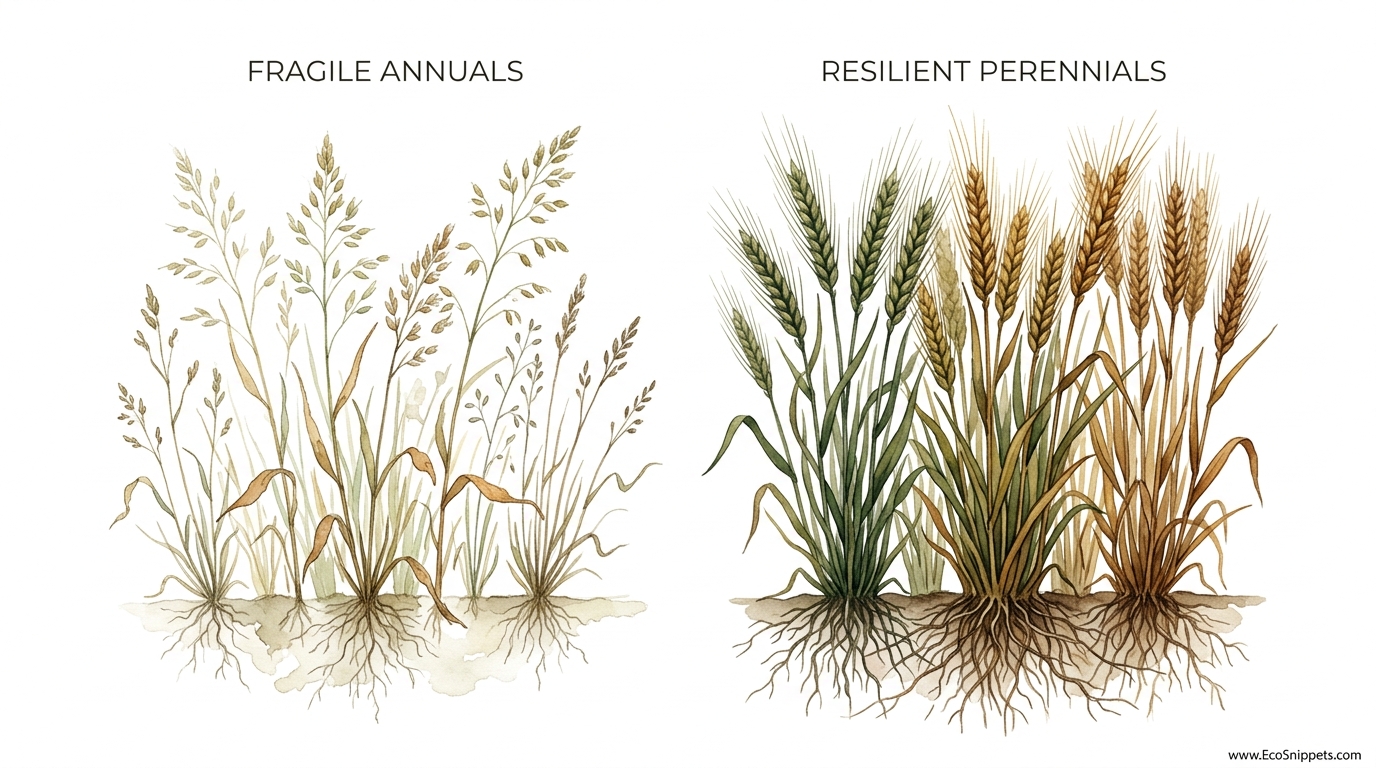
The secret to these plants lies beneath the surface. While a standard annual wheat plant might have roots that reach only 12 inches (30 cm) into the earth, a perennial grain like Kernza extends its roots 10 feet (3 meters) or deeper into the subsoil. This deep architecture allows the plant to find water and nutrients that annuals simply cannot reach.
To start your own patch, you must first prepare a clean seedbed. Even though these plants are resilient, they need a fair chance to establish themselves without competing against aggressive weeds in their first few months. Many practitioners recommend a “stale seedbed” technique where you clear the soil, let the first flush of weeds germinate, and then lightly hoe them away before sowing your grain.
Once the seeds are in the ground, they focus heavily on root development. You might notice that above-ground growth seems slower than annual varieties in the first season. This is normal. The plant is investing its energy into building a permanent “foundation” that will support it for years.
In subsequent years, these grains are among the first plants to turn green in the spring. They use the established root biomass to jump-start their growth, often outcompeting weeds before the soil is even warm enough for annuals to germinate. When the grain is ripe, you harvest the seed heads, and the plant remains in place, ready to go dormant and return again.
The Major Benefits of Perennial Cereal Crops
Choosing perennials over annuals offers measurable advantages for both the gardener and the environment. One of the most immediate benefits is the drastic reduction in labor. After the initial planting, you no longer spend your weekends tilling, leveling, and reseeding the same patch of dirt every year.
The environmental impact is equally significant. Because the soil is never left bare, erosion is virtually eliminated. The permanent root systems act like “biological rebar,” holding the soil structure together and preventing the loss of topsoil during heavy rains.
- Water Efficiency: Deep roots allow these plants to survive through intense heat and drought periods that would wither a standard garden.
- Nutrient Retention: Research shows that perennials can reduce nitrate leaching into groundwater by up to 96% compared to annual crops.
- Carbon Sequestration: These plants pull carbon from the atmosphere and store it deep in the soil, helping to build organic matter year after year.
- Natural Weed Suppression: Once a stand of perennial grain is established, the dense root mats and early spring growth leave very little room for weeds to take hold.
Beyond the ecological wins, there is a nutritional advantage. Many perennial varieties, such as Salish Blue wheat, have been found to contain higher levels of protein, antioxidants, and minerals than their annual counterparts. The smaller seed size often results in a higher ratio of nutrient-dense bran and germ to starchy endosperm.
Common Challenges and Pitfalls to Avoid
Despite their resilience, perennial grains are not a “set it and forget it” crop. One of the most common mistakes is failing to manage weeds during the first year of establishment. If weeds overwhelm the young seedlings, the perennial grain may never develop the root mass needed to survive its first winter.
Another hurdle is the “yield gap.” Currently, most perennial grains produce less seed per acre (or per square meter) than highly bred industrial annuals. A patch of Kernza might only yield 25% to 50% of what a modern annual wheat field produces. Gardeners who expect massive harvests in the first year may find themselves disappointed.
Processing these grains at home can also be a challenge. Many perennial varieties have “tight hulls,” meaning the edible grain is encased in a protective layer that doesn’t fall off easily during threshing. Without a small-scale de-huller, you may need to use traditional methods like pounding the grain in a mortar and pestle or using a specialized blender technique to free the seed.
Finally, seed availability remains limited. You cannot always walk into a local hardware store and find perennial wheat or rice. Most growers must source their seeds from specialized organizations or research labs, which requires a bit more planning and investigation.
When Perennials Might Not Be Ideal
Perennial grains require a long-term commitment to a specific piece of land. If you are a renter or plan to move within a year or two, you will not see the full benefits of these plants. It takes at least two to three seasons for the root systems to reach their peak and for the yields to stabilize.
Environmental constraints also play a role. While many grains like Kernza are incredibly cold-hardy, they may struggle in regions with extremely high humidity and no clear dormant season. Similarly, perennial rice requires consistent moisture and may not thrive in arid environments without supplemental irrigation.
If your primary goal is the absolute maximum caloric yield in the shortest amount of time, annuals are still the superior choice. Annuals are “live fast, die young” plants that put all their energy into seed production. Perennials are “slow and steady” growers that prioritize survival and longevity over immediate output.
Resilient Perennials vs Fragile Annuals
Understanding the trade-offs between these two systems helps you plan a more balanced farm or garden.
| Feature | Fragile Annuals (Standard Wheat/Corn) | Resilient Perennials (Kernza/Perennial Rice) |
|---|---|---|
| Planting Frequency | Every single season | Once every 5–10 years |
| Root Depth | 12 inches (30 cm) | 10+ feet (3 meters) |
| Labor Level | High (Tilling, Sowing, Weeding) | Low (Occasional Mulching, Harvesting) |
| Drought Resistance | Low (Requires regular irrigation) | High (Accesses deep subsoil water) |
| Seed Yield | High (Bred for maximum output) | Moderate to Low (Bred for survival) |
Practical Tips for Small-Scale Grain Processing
Harvesting your own grain is a rewarding experience, but it requires a few simple tools and techniques. For a backyard patch, you do not need a combine harvester. A simple pair of garden shears or a hand scythe will suffice to cut the stalks once the seed heads are dry and the kernels are hard.
Once harvested, you must “thresh” the grain to separate the seeds from the stalks. A common low-tech method is to place the dried bundles in a large, clean plastic bin and beat them with a wooden dowel. This knocks the grain loose. Afterward, you can use a process called “winnowing” to remove the “chaff” (the papery husks).
Using a household fan is the easiest way to winnow. Set the fan on a medium speed and slowly pour the grain from one bucket to another in front of the airflow. The heavy grain will fall straight down into the bottom bucket, while the light chaff will be blown away. This should be done outdoors or in a garage to avoid a mess.
To turn your clean grain into flour, a high-powered blender can work in a pinch, but a dedicated stone or burr grain mill is much better. Freshly milled flour contains all the natural oils and nutrients that are often stripped away in store-bought versions. Remember to store your whole grains in airtight glass jars in a cool, dark place to keep them fresh for years.
Advanced Considerations for the Serious Practitioner
For those looking to push their grain production further, consider “polycultures.” In nature, grasses rarely grow alone. They are often found alongside legumes like clover or alfalfa. These legumes “fix” nitrogen from the air and share it with the soil, providing a natural fertilizer for your grains.
Sowing white clover beneath your perennial wheat can create a living mulch. The clover stays low to the ground, protecting the soil from the sun and suppressing weeds, while the tall grain stalks rise above it. This mimicry of a natural prairie reduces the need for any external fertilizer and increases the biodiversity of your garden.
Managing the “stand life” is another advanced skill. Over several years, the grain plants may become crowded, which can lead to a dip in seed production. Every few seasons, you might need to “renovate” the patch by thinning out some of the older plants or grazing them with small livestock like sheep or goats. This mimics the natural disturbance of wild herbivores and encourages the plants to send up fresh, vigorous shoots.
Scenario: The 1,000 Square Foot Backyard Harvest
To visualize the potential of this system, imagine a standard backyard plot of 1,000 square feet (about 93 square meters). This is roughly the size of a small driveway or a large patio. If you planted this entire area with a perennial wheat variety, what could you expect?
In the first year, as the plants establish, you might harvest only 20 to 30 pounds (9 to 13 kg) of grain. However, by the second and third years, a well-managed patch can produce a full bushel of wheat, which weighs approximately 60 pounds (27 kg). This is enough grain to bake roughly 90 loaves of sourdough bread.
With traditional annual wheat, you would have to spend hours tilling that 1,000 square feet every single autumn or spring, purchasing new seeds, and carefully monitoring moisture levels. With a perennial stand, your “work” consists of a single harvest weekend in the summer and perhaps a light mulching in the fall. The rest of the year, the “grain field” serves as a beautiful, carbon-sequestering landscape that requires almost no intervention.
Final Thoughts
Perennial grains represent a return to a more stable and wise way of feeding ourselves. By choosing plants that stay in the ground, we stop fighting against nature and start working with it. We move away from the frantic, high-input cycle of annual farming and toward a system of resilience and self-reliance.
While the yields may be smaller today, the “profit” is found in the health of your soil, the lack of labor, and the security of knowing your food will return next year regardless of what happens at the seed store. These plants are a legacy you plant once and enjoy for years to come.
If you are ready to break the annual cycle, start small. Find a corner of your garden, source some resilient seeds, and watch as those deep roots begin to transform your land into a permanent pantry. The wisdom of the past is the technology of the future.
