How To Become More Self-Sufficient Without Starting a Full-Blown Farm…
Want to start preserving your harvest, making your own soap, or building a backyard root cellar — but not sure where to begin? “Homesteading Advice” gives you instant lifetime access to 35+ practical homesteading books on food preservation, veggie gardening, DIY natural cleaning products (save over $250 per year with this skill alone), brewing, off-grid energy, and a whole lot more…
Click Here To Check It Out Now!
Stop paying a monthly bill to fix your dry air when the sun and gravity can do it for free. Modern homes use electricity to fight the symptoms of bad design. If your winter air is bone-dry, don’t buy another plastic machine that breeds mold. A passive solar water wall uses ‘thermal mass’ to store heat during the day while naturally regulating your home’s humidity. It’s silent, beautiful, and powered entirely by the sky.
DIY Water Wall For Passive Solar Humidity Control
A water wall is essentially a thermal battery for your home. It consists of large, water-filled containers placed directly in the path of winter sunlight, typically behind a south-facing window. While most modern heating systems rely on the rapid combustion of fuels or the heavy draw of the electrical grid, a water wall works on the principle of slow, steady radiation. It collects solar energy during the day and releases it as gentle warmth throughout the night.
Beyond simple heating, these systems act as natural humidifiers. In the depths of winter, forced-air furnaces strip the moisture from the air, leading to dry skin, irritated sinuses, and static shocks. A water wall provides a steady source of evaporation. Whether through semi-permeable container lids or the natural migration of moisture through certain plastics, the system maintains a comfortable humidity level without the buzzing, gurgling, or white dust associated with mechanical units.
Ancestral builders understood these cycles intuitively. They used thick stone walls or adobe to buffer the heat of the day. Water, however, is far more efficient than stone. It has a high specific heat capacity, meaning it can store significantly more energy per pound than masonry or wood. In a world increasingly reliant on fragile technology, the water wall is a return to a more resilient way of living—one that relies on the dependable laws of physics rather than a technician’s visit.
How It Works: The Science of Solar Flow
The core of a water wall’s operation is the absorption of short-wave solar radiation. Sunlight passes through your window glass and strikes the surface of the water containers. To maximize this, the side of the container facing the sun should be painted a dark, flat color—usually black or deep forest green. This dark surface converts the light into long-wave heat energy, which is then conducted into the water.
Inside the container, a process called convection takes over. As the water nearest the sunward side warms, it becomes less dense and rises, while cooler water from the shaded side sinks to take its place. This internal movement ensures that the entire volume of water is heated evenly. This is why water is often more effective than solid masonry; in a brick wall, the heat moves slowly through conduction, often getting “stuck” on the outer surface, whereas water effectively “stirs” its own heat.
Humidity control occurs through natural evaporation. Even in a sealed container, microscopic amounts of water vapor can escape through gaskets or the material itself. Many DIYers choose to leave the top of the wall slightly vented. This creates a “Solar Flow” of moisture. As the water warms during the day, the rate of evaporation increases, precisely when the home’s air is most likely to be dried out by a running furnace. It is a self-regulating system: more sun leads to more heat, which leads to more moisture.
Thermal lag is the final piece of the puzzle. It takes time for several hundred gallons of water to cool down. A properly sized water wall will reach its peak temperature around sunset and then slowly radiate that warmth back into the living space for the next 8 to 12 hours. This smooths out the “temperature spikes” that plague modern homes, creating a stable, cave-like environment that feels more natural to the human body.
Benefits of Passive Water Systems
One of the most immediate benefits is the reduction in energy costs. By capturing free energy from the sun, you reduce the load on your primary heating system. In well-insulated homes, a water wall can provide a significant portion of the total heating needs, especially in regions with clear, sunny winters. This isn’t just about saving money; it’s about autonomy and reducing your dependence on the grid.
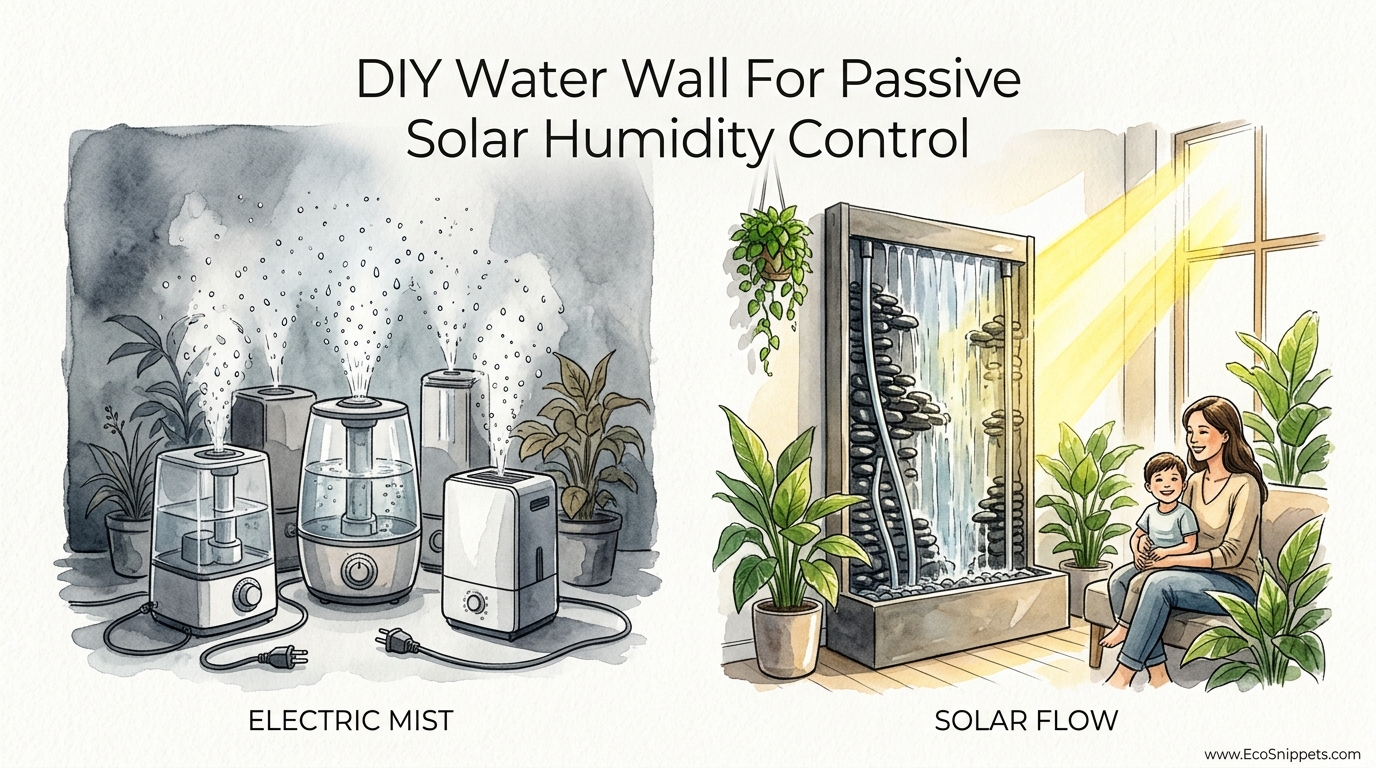
Health and comfort are equally important. Unlike mechanical humidifiers—often referred to as “Electric Mist” machines—water walls don’t atomize minerals into the air or create localized damp spots. The humidity they provide is “passive,” meaning it enters the air as a true vapor. This prevents the “white dust” problem caused by ultrasonic humidifiers and makes the air feel soft and easy to breathe. Because the system has no moving parts, it is completely silent, which contributes to a more peaceful home environment.
Low maintenance is another hallmark of this approach. A mechanical humidifier requires constant cleaning to prevent mold growth and regular filter changes. A water wall, once set up, requires very little attention. Aside from occasionally topping off the water or checking for algae, the system manages itself. It is a “set it and forget it” solution for those who value longevity over convenience.
Aesthetic value shouldn’t be overlooked. A wall of translucent polycarbonate tubes or even neatly stacked blue barrels can be a striking architectural feature. Some practitioners use colored dyes or underwater lighting to turn their thermal mass into a piece of living art. It serves as a visual reminder of the home’s connection to the seasons and the sun.
Challenges and Common Mistakes
Weight is the most frequent oversight for DIY builders. Water is heavy, weighing approximately 8.34 pounds per gallon (1 kilogram per liter). A 500-gallon water wall weighs over two tons. Most standard residential floors are not designed to support this kind of concentrated load. Placing a water wall on a second floor or over a crawlspace without additional structural reinforcement is a recipe for disaster. Always ensure the system is placed on a concrete slab or that the floor joists have been professionally braced.
Algae growth is another common pitfall. Since the water is exposed to both warmth and light, it becomes a perfect breeding ground for microscopic life. If the water turns green, it loses its aesthetic appeal and can eventually smell. Many people try to fix this with heavy bleach, but this can damage plastic containers over time. A better approach is to use distilled water or a small amount of copper sulfate, or simply ensure the containers are opaque enough to block most of the light from reaching the interior of the water volume.
Improper sizing often leads to disappointment. If you have too much glass and not enough water, the room will overheat during the day and be cold by midnight. If you have too much water and not enough glass, the “thermal battery” will never fully charge, and you’ll end up with a cold, damp mass in your living room. Achieving the right balance is key to a successful installation.
Condensation can also be an issue if the wall is placed too close to the window without proper airflow. If the glass stays cold while the water wall gets warm, moisture will collect on the window, potentially leading to rot in wooden frames or mold on the sills. Leaving a gap of at least 4 inches (10 centimeters) between the glass and the wall allows for a “convection loop” that prevents moisture buildup.
Limitations and Environmental Constraints
Climate is the biggest limiting factor. A passive solar water wall requires direct sunlight to function. If you live in a region with constant winter cloud cover, the system will never receive enough energy to provide meaningful heat. While it may still help with humidity, it could actually make the room feel colder by acting as a “heat sink” that draws warmth away from the air if the water temperature remains lower than the room temperature.
Orientation is non-negotiable. For those in the Northern Hemisphere, your windows must face south (within about 15 to 20 degrees of true south). Windows facing east or west receive too much heat in the summer and not enough in the winter, leading to massive seasonal imbalances. If your home’s layout doesn’t allow for south-facing glazing, a water wall is likely not the right solution for you.
Summer overheating is a real risk. If you don’t have adequate shading—such as a roof overhang designed for the sun’s summer angle—the water wall will continue to collect heat during the hottest months of the year. This can turn your home into an oven. Every solar water wall must be paired with a plan for summer shading, whether that means external awnings, deciduous trees, or reflective interior blinds.
Comparing Systems: Solar Flow vs. Electric Mist
When deciding how to manage your home’s winter climate, it’s helpful to look at the measurable differences between passive and active systems.
| Feature | Solar Flow (Passive Water Wall) | Electric Mist (Mechanical Humidifier) |
|---|---|---|
| Operating Cost | $0 (Sun-powered) | $10–$30/month (Electricity) |
| Maintenance | Low (Annual check) | High (Weekly cleaning) |
| Noise Level | Silent | Audible fan/motor |
| Lifespan | 20+ years | 3–5 years |
| Heating Benefit | Provides radiant heat | None (May feel cooling) |
The “Electric Mist” systems are often a reactive purchase to a problem that shouldn’t exist. They solve a symptom of dry air but ignore the cause—leaky envelopes and inefficient heating. The “Solar Flow” approach is a systemic fix. It addresses both temperature and humidity simultaneously while requiring a higher initial investment in setup time and space.
Practical Tips for the DIY Builder
Start small if you are unsure. A row of dark-colored one-gallon (4 liter) glass jugs on a sturdy, south-facing windowsill is a great way to test the concept. You will notice the difference in temperature near that window immediately. If the results are positive, you can scale up to larger containers.
Use a “glazing-to-mass” ratio to guide your design. A good rule of thumb is to provide 4 gallons of water for every square foot of south-facing glass (approximately 160 liters per square meter). This ratio ensures that you have enough thermal mass to prevent overheating while still capturing enough energy to make a difference at night.
Seal your containers properly to control humidity. If your home is already somewhat humid, keep the lids tight. If your air is extremely dry, use lids with small, filtered vents. This allows you to “tune” the moisture release to your specific needs. Adding a few drops of vegetable oil to the top of the water can also slow down evaporation if you find the air is becoming too damp.
Insulate the “night side” of the window. A great deal of the heat captured during the day can be lost back through the glass at night. Using heavy, insulated curtains or “quilted” window covers will keep the warmth where you need it—inside the living space. This single step can double the effectiveness of your water wall.
Advanced Considerations: Tuning Your Thermal Mass
Serious practitioners often experiment with different container materials. Polycarbonate tubes are popular because they allow light to pass through, creating a beautiful “glow” in the room, but they can be expensive. Repurposed 55-gallon (200 liter) steel drums are much cheaper and incredibly durable, but they are opaque and require more space. Some advanced designs use “phase change materials” (PCMs) mixed with water to increase storage capacity, though this moves away from the simplicity of a pure water system.
Convection venting is another high-level strategy. By building a cabinet around your water wall with vents at the top and bottom, you can control how the heat is distributed. During the day, keep the vents closed to allow the water to soak up energy. At night, open the vents to allow cool air to enter at the bottom, warm up against the containers, and rise back into the room. This creates a “thermal siphon” that circulates air without the need for fans.
Monitoring is key to optimization. Use a simple dual-probe thermometer to track the temperature of the water versus the room air. Over one winter, you will begin to see patterns. You might find that your wall performs best if you move it a few inches further from the window or if you add more dark surface area. This kind of “tuning” is what transforms a simple DIY project into a highly efficient home heating system.
Real-World Scenario: The Living Room Retrofit
Imagine a 200-square-foot (18.5 square meter) living room with a large south-facing window. In the winter, the sun shines in for 6 hours, but the room feels cold the moment the sun goes down. The owners decide to install a water wall using four 50-gallon (190 liter) translucent barrels.
They place the barrels on a reinforced bench directly in front of the window. They paint the sun-facing half of each barrel flat black and leave the room-facing side clear. During a sunny January day, the water temperature rises from 60°F (15°C) to 85°F (29°C). As the sun sets, the owners pull a thick, insulated curtain between the barrels and the window glass.
Through the night, the 1,600 pounds (725 kilograms) of water slowly release 20,000 BTUs of heat. The room temperature stays at a steady 68°F (20°C) until morning, while the tiny amount of moisture escaping the barrel lids keeps the relative humidity at a perfect 45%. The furnace, which used to kick on every twenty minutes, stays silent until the early morning hours. This simple setup saves them approximately 25% on their monthly heating bill while significantly improving their sleep quality.
Final Thoughts
Building a DIY water wall is more than just a home improvement project; it is an exercise in observation and partnership with the natural world. It requires you to look at the sun not just as light, but as a source of fuel. By choosing to use water as your thermal mass, you are opting for a system that is as old as the earth itself, yet perfectly suited for the challenges of modern living.
The transition from “Electric Mist” to “Solar Flow” represents a shift in mindset. It moves us away from the “disposable machine” culture and toward a future of enduring, self-reliant systems. Whether you start with a few jars on a windowsill or a full-scale drum wall, the reward is the same: a home that breathes, stays warm, and remains comfortable without the constant hum of a motor or the drain of a bank account.
Take the time to plan, respect the weight of the water, and watch how the light moves through your home. With a bit of grit and some basic materials, you can transform your living space into a sanctuary of passive warmth and natural balance. The sun is already doing the work—all you have to do is catch it.
