How To Become More Self-Sufficient Without Starting a Full-Blown Farm…
Want to start preserving your harvest, making your own soap, or building a backyard root cellar — but not sure where to begin? “Homesteading Advice” gives you instant lifetime access to 35+ practical homesteading books on food preservation, veggie gardening, DIY natural cleaning products (save over $250 per year with this skill alone), brewing, off-grid energy, and a whole lot more…
Click Here To Check It Out Now!
The most powerful growth serum in the world is currently being flushed away. Most rabbit keepers focus on the manure, but the urine is where the immediate, water-soluble nitrogen lives. Diluted and used as a foliar spray, it acts like a high-octane fuel for your vegetables. Stop paying for synthetic boosters when your livestock is providing it for free every single day.
For generations, the small-scale homestead was a closed loop where nothing went to waste. Every drop of moisture and every scrap of organic matter served a purpose. Modern gardening has largely forgotten this, trading the potent output of the rabbit hutch for expensive, plastic-bottled chemicals that lack the complexity of natural biology.
Rabbits are unique among livestock for their efficiency. Their digestive systems are designed to extract maximum nutrition from forage, leaving behind waste that is remarkably concentrated. While their solid manure is famously “cool” and can go straight into the garden, their urine is “hot” and packed with the kind of nitrogen that plants crave during their peak growth stages.
Understanding how to harness this liquid gold is a mark of a true practitioner of self-reliance. It requires a shift in perspective, seeing waste as a resource and the rabbit hutch as a biological laboratory. This guide will walk you through the process of turning a byproduct into a professional-grade agricultural input.
How To Use Rabbit Urine As Fertilizer
Rabbit urine is a highly concentrated source of nitrogen (N), phosphorus (P), and potassium (K), often surpassing the nutrient density of cow or goat urine. Scientific analysis has shown that it can contain up to 2.72% nitrogen, 1.1% phosphorus, and 0.5% potassium. These nutrients are held in a water-soluble form, meaning plants do not have to wait for microbial breakdown to access them.
In a practical sense, rabbit urine acts as a fast-acting liquid fertilizer. When applied to the soil or directly to the leaves, the nitrogen stimulates chlorophyll production and rapid vegetative growth. It is particularly valuable for “heavy feeders” like corn (maize) and leafy greens that require substantial nitrogen to build their structure.
This liquid is also naturally alkaline, often reaching a pH of 8.5. This makes it a useful tool for neutralizing overly acidic soils common in many garden plots. Beyond its chemical makeup, rabbit urine carries a pungent ammonia scent and high salt content that serves a dual purpose as a natural pest repellent.
The Mechanics of Collection and Storage
Capturing this resource requires a deliberate design for your rabbitry. Most standard cages allow waste to fall through a wire floor onto the ground, where the urine quickly evaporates or leaches away. To save it, you must install a collection system.
A common and effective setup involves placing slanted corrugated plastic sheets or metal trays beneath the cages. These sheets should be angled so that all liquid drains toward a central gutter or a collection bucket. Some keepers use a simple tarp stretched at an angle, leading to a five-gallon (19-liter) container.
Filtering the liquid is a necessary step if you intend to use a sprayer. Rabbit hair, hay dust, and small particles of manure will inevitably find their way into the trays. Pour the collected urine through a fine mesh sieve or a piece of burlap to ensure your spray nozzles do not clog during application.
Storage is best handled in opaque, airtight containers. Light can degrade some of the organic compounds, while exposure to air allows nitrogen to escape as ammonia gas. If stored in a cool, dark place, the urine can be kept for several weeks, though fresh application is generally preferred to maximize the immediate nitrogen benefit.
The Golden Rule: Dilution Ratios
The most common mistake made by beginners is applying the urine undiluted. Because it is so concentrated, raw rabbit urine will “burn” the delicate roots and leaves of your plants, leading to wilting and death within hours. Dilution is mandatory to transform this caustic liquid into a gentle tonic.
The standard ratio for soil drenching is one part urine to ten parts water (1:10). For every one liter (roughly one quart) of urine, add ten liters (about 2.5 gallons) of water. This creates a solution that is safe for the majority of established garden vegetables and fruit trees.
For foliar application, where the liquid is sprayed directly onto the leaves, a weaker dilution of 1:15 or 1:20 is recommended. Delicate seedlings and young starts should always be treated with the most diluted mixtures. Using rainwater for dilution is a best practice, as it lacks the chlorine found in municipal water which can interfere with soil microbes.
Benefits of the Liquid Gold Approach
The primary advantage of using rabbit urine is the speed of delivery. While solid manures and composts are excellent for building long-term soil health, they release their nutrients slowly over months. Rabbit urine provides a nitrogen spike that can be seen in the plants’ color and vigor within days.
This approach is also incredibly cost-effective. A single doe and her kits can produce significant amounts of urine over a year, potentially saving a gardener hundreds of dollars in commercial liquid feeds. In some regions, such as parts of East Africa, farmers have turned this “waste” into a secondary income stream, selling processed rabbit urine to neighbors.
Furthermore, the alkaline nature and ammonia content of the urine act as a biopesticide. Many gardeners report that regular foliar spraying reduces infestations of aphids, whiteflies, and mites. The pungent smell and the thin film of salts left on the leaves make the environment hostile for soft-bodied insects.
Challenges and Common Mistakes
Odor is the most immediate challenge for those living in close proximity to neighbors. Fresh rabbit urine has a distinct scent, but as it sits, the urea converts to ammonia, creating a sharp, stinging smell. This can be mitigated by collecting daily and keeping storage containers tightly sealed.
Salt accumulation is a silent risk for those in arid climates or those using containers without adequate drainage. All urine contains salts, and over time, these can build up in the soil, eventually making it difficult for plants to take up water. To avoid this, ensure you are occasionally flushing your soil with plain water or relying on natural rainfall to wash away excess minerals.
Another mistake is applying the spray during the heat of the day. The salts and nutrients in the urine can act like tiny magnifying glasses on the leaves, and the rapid evaporation of water leaves behind a high concentration of salts that can cause “sun scald” or chemical burn. Always apply in the early morning or late evening.
Limitations and Realistic Boundaries
Rabbit urine is not a complete, standalone fertilizer for all stages of plant life. While it is a powerhouse for nitrogen, it may not provide enough phosphorus for heavy flowering or enough potassium for the final ripening of large fruits like pumpkins. It should be viewed as one part of a broader soil management strategy.
Environmental constraints also play a role. During periods of heavy rain, applying liquid fertilizer is often a waste of time, as the water-soluble nitrogen will simply wash through the soil before the roots can catch it. Conversely, in a severe drought, adding a high-nitrogen liquid can stress a plant that is already struggling to maintain its water balance.
There is also a logistical limit to how much urine a small rabbitry can provide. For a large farm, collecting enough urine to cover multiple acres is a massive undertaking that requires specialized plumbing and large-scale storage. For the backyard gardener or small-scale homesteader, however, the supply usually matches the demand perfectly.
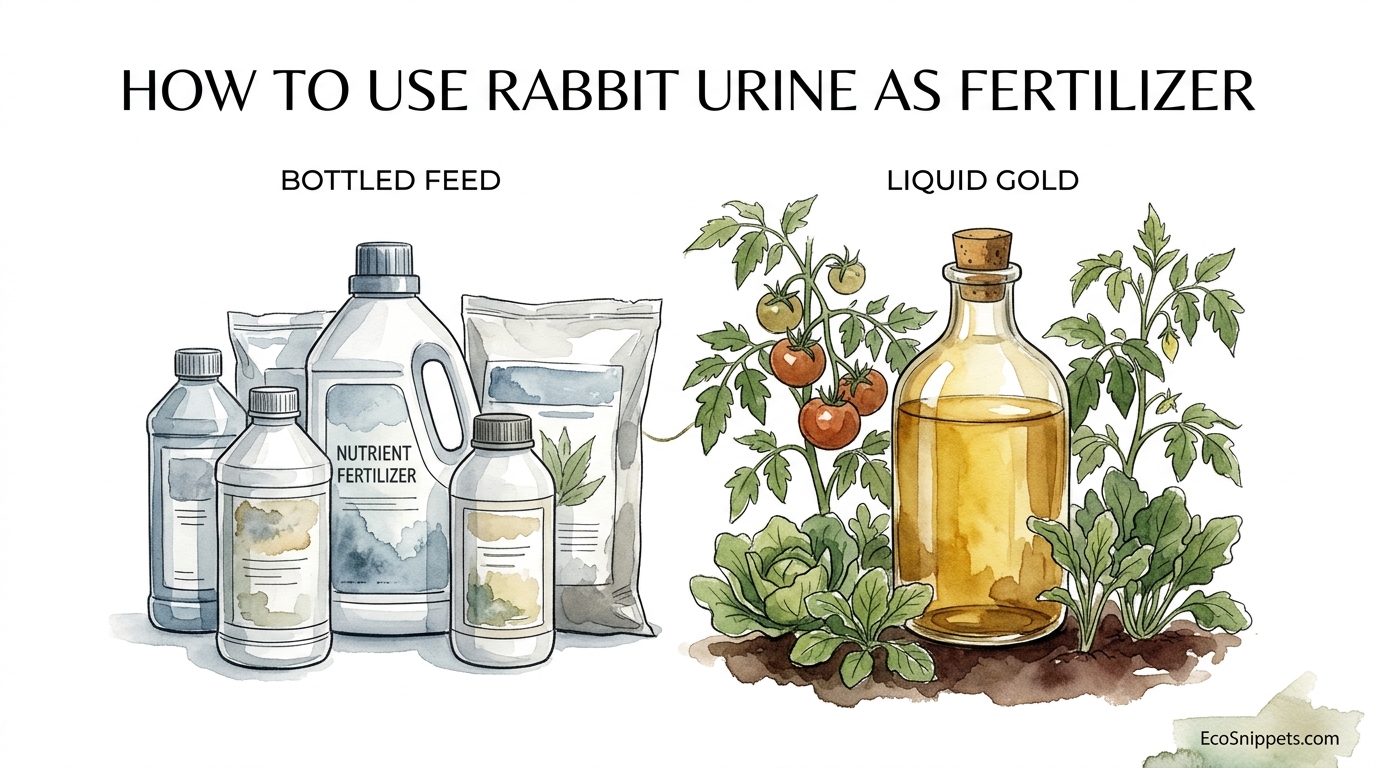
Bottled Feed vs. Liquid Gold
Comparing commercial liquid fertilizers to rabbit urine reveals a trade-off between convenience and biological complexity.
| Factor | Synthetic Bottled Feed | Rabbit Urine (Liquid Gold) |
|---|---|---|
| Cost | High (Recurring) | Zero (Byproduct) |
| Availability | Instant (Store-bought) | Daily (Livestock output) |
| Nutrient Profile | Precise NPK, lacks trace minerals | High NPK plus Micronutrients |
| Soil Health | Can degrade soil microbes over time | Stimulates beneficial soil biology |
| Pest Control | None | Natural repellent properties |
Practical Tips and Best Practices
Always test a new batch of diluted urine on a single plant before treating your entire garden. Every rabbit’s diet is different, and the concentration of their waste can vary based on whether they are eating fresh greens or dry pellets. A quick test on one leaf or one plant will tell you if your dilution ratio is correct.
Apply the foliar spray when the stomata of the plants are open. These are the tiny pores on the leaves through which the plant “breathes.” They are generally open widest in the early morning (before 9:00 AM) and in the late evening. Spraying at these times ensures the maximum amount of nitrogen is absorbed directly into the plant’s vascular system.
Incorporate the urine into your composting routine if you have an excess. If your compost pile has stalled and isn’t heating up, the high nitrogen in rabbit urine acts as a potent activator. Pouring a gallon of diluted urine into the center of a brown-heavy (carbon-rich) pile will often kickstart the microbial decomposition within 24 hours.
Advanced Considerations
For those looking to optimize their system, consider the fermentation process. Some practitioners mix rabbit urine with a small amount of molasses and starch, then let it sit for two to three weeks. This encourages the growth of beneficial bacteria and allows the nitrogen to stabilize into forms that are less likely to evaporate.
You should also tailor your application to the specific needs of the plant family. Brassicaceae (broccoli, kale, cabbage) and Gramineae (corn) are nitrogen-hungry and can handle slightly stronger dilutions. Conversely, Solanaceae (tomatoes, peppers) need nitrogen for growth, but too much during the fruiting stage can lead to “all leaves and no fruit.” Switch to a more diluted form once your tomatoes start to set fruit.
If you are running an aquaponics system, rabbit urine can be used as a supplement, but proceed with extreme caution. The ammonia can be toxic to fish if it isn’t immediately processed by the biofilter. It is generally safer to use the urine on soil-based crops or in a separate wicking bed system.
Practical Example: The Mid-Season Boost
Imagine a row of sweet corn that has reached about knee-height (approx. 45 cm). At this stage, corn is entering its most aggressive growth phase and is desperate for nitrogen. A standard soil drench with a 1:10 dilution of rabbit urine can provide the necessary fuel.
For a ten-foot (3-meter) row, you might use two gallons (7.5 liters) of the diluted mixture. Pour it gently along the base of the stalks, avoiding direct contact with the stem if possible. Within a week, the leaves will often turn a deeper, darker green, and the growth rate will visibly accelerate.
In a separate scenario, a gardener facing an aphid breakout on their kale can mix a 1:15 foliar spray. By thoroughly coating both the tops and bottoms of the leaves in the early morning, they provide a nutrient boost while creating a salty, smelly barrier that discourages the aphids from feeding.
Final Thoughts
The transition from viewing rabbit urine as a waste product to a vital agricultural asset is a hallmark of an efficient, self-reliant system. By capturing the water-soluble nitrogen that is usually lost, you close a significant loop in your homestead’s nutrient cycle. This isn’t just about saving money; it is about using the natural chemistry of the earth to grow food that is more resilient and robust.
Success with this method comes down to observation and respect for the potency of the material. Start with weak dilutions, watch how your plants respond, and adjust based on the seasons and the specific needs of your crops. The “pioneer-grit” approach to gardening doesn’t rely on complex machinery, but on the careful management of the biological wealth right in front of us.
As you become more comfortable with the rhythms of your rabbitry and your garden, you will likely find that the need for outside inputs diminishes. The hutch provides the fertilizer, the garden provides the forage, and the rabbits provide the meat and the manure. It is a timeless system that worked for our ancestors and remains just as powerful today.
