How To Become More Self-Sufficient Without Starting a Full-Blown Farm…
Want to start preserving your harvest, making your own soap, or building a backyard root cellar — but not sure where to begin? “Homesteading Advice” gives you instant lifetime access to 35+ practical homesteading books on food preservation, veggie gardening, DIY natural cleaning products (save over $250 per year with this skill alone), brewing, off-grid energy, and a whole lot more…
Click Here To Check It Out Now!
How did the Mayans create crystal-clear drinking water in a jungle full of bacteria 2,000 years ago? Archaeologists recently discovered that the Mayans used volcanic zeolite and quartz to create massive biological filters for their city reservoirs. While we rely on ‘dead’ systems full of sterile chemicals, they leveraged the ‘living’ energy of minerals to neutralize toxins naturally. This is the ultimate blueprint for a self-cleaning, off-grid pond or cistern.
For centuries, the survival of the Maya at Tikal was a mystery to those accustomed to modern plumbing. They thrived in a tropical environment where half the year brought torrential downpours and the other half brought brutal, unforgiving drought. Without permanent rivers or lakes, their lives depended entirely on how they captured and cleaned the rain. Recent excavations at the Corriental reservoir have finally peeled back the layers of soil to reveal a technology we are only just beginning to rediscover.
The secret lies in a specific combination of volcanic minerals and crystalline sand that acted as a molecular sieve. This wasn’t just a pile of rocks; it was a high-performance purification plant that operated without electricity, pumps, or chlorine for over a millennium. By understanding their methods, you can stop fighting against nature in your own water systems and start working with the same principles that sustained a civilization of 60,000 people in the middle of a rainforest.
Ancient Mayan Water Filtration Systems
The Mayan water filtration system was a sophisticated engineering feat centered around the use of imported minerals to maintain potable water in massive urban reservoirs. At the heart of this discovery is the Corriental reservoir in Tikal, Guatemala, where researchers found layers of zeolite and coarse quartz sand that do not occur naturally in the local limestone bedrock. These materials were hauled from volcanic sources nearly 18 miles (30 kilometers) away because the Maya recognized their unique ability to “sweeten” and purify the water.
Unlike modern systems that often prioritize high-pressure mechanical filtration, the Mayan approach was passive and persistent. They designed their cities so that rainwater would wash off paved plazas and temples, flowing through a series of settling tanks and mineral filters before entering the main storage basins. This ensured that by the time the water reached the reservoir, it was already stripped of heavy metals, harmful microbes, and the nitrogen-rich runoff common in tropical settlements.
This system exists because the Maya lived in a “karst” landscape. In these regions, the limestone is so porous that rainwater quickly sinks into the earth, leaving the surface dry. To survive the six-month dry season, they had to build “chultuns” (underground cisterns) and massive reservoirs. But stagnant water in a hot, humid jungle quickly becomes a breeding ground for bacteria and blue-green algae. The mineral filters were their primary defense, turning a potential health hazard into a reliable, life-sustaining resource.
How the Mayan Molecular Sieve Works
The effectiveness of the Mayan system comes down to the chemistry of two primary components: zeolite and quartz. When these two are layered correctly, they provide a multi-stage cleaning process that addresses both physical debris and invisible chemical toxins. Understanding these principles allows you to replicate the process in a modern off-grid cistern or a self-cleaning pond.
The Power of Zeolite (Clinoptilolite)
Zeolite is a volcanic mineral with a unique “cage-like” molecular structure. It is essentially a natural magnet for toxins. Because it is highly porous and possesses a high cation exchange capacity (CEC), it can pull heavy metals like lead and mercury out of the water and trap them within its lattice. In the context of Tikal, this was critical for removing mercury that naturally leached from the cinnabar paint used on Mayan buildings.
Beyond heavy metals, zeolite is exceptionally good at absorbing ammonia and nitrogenous compounds. In a living system, these are the primary drivers of algae blooms and stagnant odors. By capturing these nutrients, the zeolite starves the “bad” bacteria and algae, keeping the water clear and oxygenated without the need for chemical algaecides.
Crystalline Quartz and Physical Sieving
The quartz sand used by the Maya acted as the physical filter. While the zeolite handled the molecular cleaning, the coarse quartz sand trapped sediment, pollen, and larger organic matter. Because quartz is a hard, inert mineral, it doesn’t break down or alter the pH of the water over time. This makes it a superior choice to standard local sand, which might contain carbonates that could make the water too alkaline for long-term storage.
The Multi-Stage Flow Design
The Maya didn’t just dump these minerals into the water. They used a “settling tank” approach. Water would first enter a shallow basin where heavy silt and debris would sink to the bottom. It then passed through a “filter box” packed with the zeolite-quartz mixture before finally spilling into the main reservoir. This ensured the filter didn’t clog prematurely and allowed for easier maintenance of the mineral layers.
The Living Buffer: Aquatic Plants and Shade
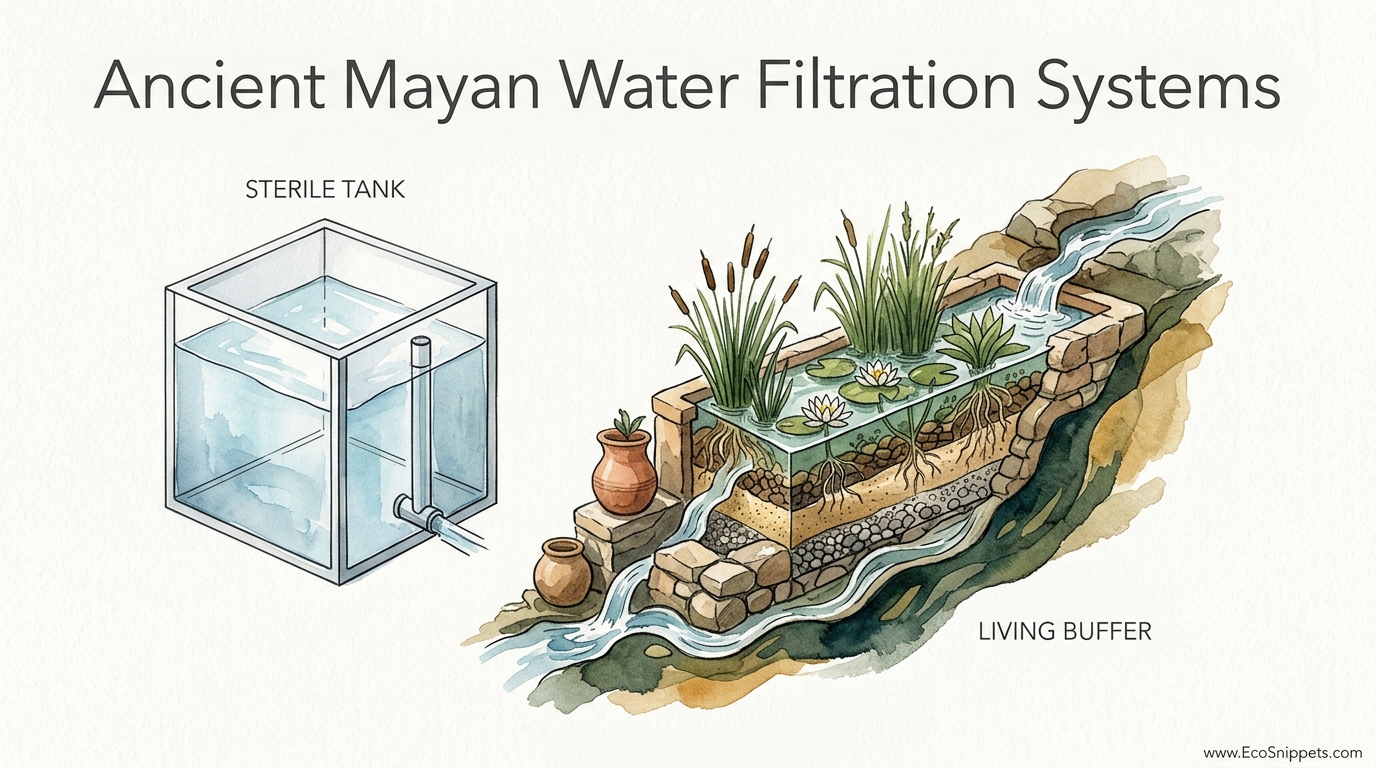
A “sterile” tank is an uphill battle against biology; a “living” buffer is an ecosystem that maintains its own balance. The Maya integrated their mineral filters with biological controls, specifically the use of water lilies (Nymphaea ampla). Pollen from these plants has been found deep in the sediment of Tikal’s cleanest reservoirs, indicating they were a deliberate part of the water management strategy.
Water lilies are incredibly sensitive to water quality. They cannot thrive in water that is too acidic or contaminated with heavy metals. By keeping water lilies alive, the Maya had a visual “canary in the coal mine” for their water health. Additionally, the broad leaves of the lilies provided shade, which cooled the water and further inhibited the growth of sunlight-dependent algae.
These reservoirs functioned like modern “constructed wetlands.” The roots of the plants, along with the beneficial bacteria living on the surface of the zeolite, worked together to cycle nutrients. This meant the water wasn’t just “filtered”—it was actively being processed and purified by a living community of organisms. This “living buffer” approach is what separates a Mayan-style system from a stagnant modern cistern.
Benefits of a Mineral-Based Living System
Choosing to build a system based on Mayan principles offers several practical advantages for the modern self-reliant practitioner. These benefits go beyond simple water clarity; they touch on the long-term resilience and health of your entire water supply.
- Chemical-Free Purity: You can avoid the use of chlorine, bromine, or copper sulfate. This is healthier for consumption, irrigation, and the local environment.
- Extreme Longevity: Archaeological evidence shows the Corriental filters functioned for over 1,000 years. With proper maintenance, a mineral-based filter can last decades before the media needs refreshing.
- Low Energy Requirements: These systems are gravity-fed. They don’t require the high-pressure pumps needed for reverse osmosis or the electricity required for UV sterilization.
- Nutrient Management: Unlike mechanical filters that just trap dirt, the zeolite actually removes the nitrogen and ammonia that cause water to “go bad” and smell.
- Secondary Value: Spent zeolite is a world-class soil amendment. Once it has finished its life as a water filter, it is loaded with captured nutrients and can be tilled into your garden to improve soil structure and fertility.
Common Challenges and Pitfalls
While the Mayan system is brilliant, it is not a “set it and forget it” solution. Modern users often fail because they underestimate the amount of organic matter a jungle (or a backyard) can produce. If you don’t account for maintenance, your ancient-tech filter will quickly become a swampy mess.
The most frequent mistake is clogging the mineral bed. If raw, muddy runoff hits your zeolite-quartz filter directly, the fine silt will fill the pores of the zeolite, rendering its ion-exchange capabilities useless. You must have a pre-filtration stage or a settling tank to remove the “heavy” dirt before the water touches your expensive minerals.
Another pitfall is neglecting the “Living” part of the buffer. If you use zeolite to clean a pond but don’t add the necessary plants (like lilies or rushes), you are missing half the system. The plants help pull the captured nutrients out of the cycle. Without them, the minerals can eventually become saturated, and the water quality will begin to decline.
Finally, there is the issue of mineral sourcing. Not all “zeolite” is the same. For water filtration, you need clinoptilolite, which is the most stable and effective form for cation exchange. Buying cheap, industrial-grade zeolite meant for “spill cleanup” may introduce unwanted dust or chemicals into your water supply. Always ensure you are using food-grade or high-purity water treatment minerals.
Limitations and Constraints
No system is universal. There are specific environmental and chemical constraints where a Mayan-inspired filter might not be the best choice. It is important to understand these boundaries to ensure your water remains safe.
Firstly, acidic water can be a problem. Zeolites are generally stable, but extremely acidic conditions (pH below 4.0) can cause the mineral structure to break down. If your local rainwater is highly acidic due to industrial pollution, you may need to add a limestone buffer to the settling tank to raise the pH before the water enters the zeolite bed.
Secondly, while zeolite is excellent at removing heavy metals and many bacteria, it is not a 100% guarantee against all viruses or parasites in every situation. In the ancient world, the Maya likely relied on the massive scale of their reservoirs and long “dwell times” (the time water spends in the tank) for natural die-off of pathogens. For modern drinking water, especially in a survival scenario, you should still consider a final “kill step” such as boiling or high-quality ceramic filtration for the water you actually consume.
Lastly, high calcium levels (very hard water) can compete with toxins for the “slots” in the zeolite’s molecular cage. If your water is extremely hard, the zeolite will “fill up” with calcium and magnesium faster, meaning you will need to regenerate or replace the mineral media more frequently than if you were filtering soft rainwater.
Sterile Tank vs. Living Buffer
To understand why the Mayan system is so revolutionary, it helps to compare it to the standard modern approach to off-grid water storage. Most people build “sterile tanks,” but the Maya built “living buffers.”
| Feature | Sterile Tank (Modern) | Living Buffer (Mayan) |
|---|---|---|
| Primary Agent | Chemicals (Chlorine, Silver) | Minerals & Plants |
| Maintenance | Frequent dosing and testing | Seasonal dredging/pruning |
| Cost | High recurring chemical cost | Low (One-time mineral buy) |
| Resilience | Fails if supply chain breaks | Self-sustaining for decades |
| Environmental Impact | Potentially toxic byproduct | Creates habitat/Fertilizer |
The “Sterile Tank” approach tries to kill everything in the water. This creates a vacuum where, if the chemicals run out, “bad” bacteria can explode in population because there is no “good” biology to keep them in check. The “Living Buffer” creates a stable, diverse ecosystem where the minerals remove the toxins and the plants/beneficial bacteria compete with pathogens, creating a naturally stable environment.
Practical Tips for Building Your System
If you want to apply this ancestral wisdom today, you don’t need to haul rocks from a Guatemalan volcano. You can source modern equivalents and use a “bucket-in-tank” or “up-flow” design to replicate the Mayan reservoir logic.
- Use a 3-Stage Design: Stage 1 is a mechanical screen or settling basin for large debris. Stage 2 is your mineral bed (60% quartz sand, 40% zeolite). Stage 3 is the storage reservoir with aquatic plants.
- The Up-Flow Method: Instead of pouring water on top of the sand, feed it into the bottom of the filter container and let it rise up through the minerals. This prevents “channeling” (where water finds a single path and bypasses the filter) and makes cleaning easier by allowing you to “backwash” the silt out.
- Incorporate Water Lilies: In a pond or large open-topped cistern, water lilies are essential for temperature control and nutrient uptake. If using a closed tank, consider a small “bio-box” with floating plants through which the water circulates.
- Dwell Time Matters: The slower the water moves through the zeolite, the more ions it can exchange. Don’t rush the process. A slow, steady drip is always better than a high-pressure blast.
- Regenerate Your Zeolite: Did you know you can “recharge” zeolite? By soaking it in a concentrated salt-water (brine) solution, you can force the trapped heavy metals and ammonia out of the mineral cage, allowing you to use the media again. (Note: Only do this if you are using the water for non-potable purposes or have a way to thoroughly rinse the salt out).
Advanced Considerations for Serious Practitioners
For those looking to scale this up to a whole-property water system, you must consider the flow rate and surface area. The Maya had massive filter beds at the entrance of their reservoirs to handle the volume of tropical storms. If your roof catchment is large, a small 5-gallon (19-liter) bucket of zeolite will be overwhelmed in minutes. You need to calculate your peak flow and ensure your filter bed is wide enough to let the water pass through at a manageable speed.
Consider the “Dredge Cycle.” Every few years, the Maya would dredge the sediment from the bottom of their reservoirs. This sediment, rich in the nitrogen and phosphorus captured by the plants and minerals, was a primary source of fertilizer for their “forest gardens.” When designing your system, make sure the bottom of your settling tanks and reservoirs are accessible so you can harvest this “black gold” for your garden.
Furthermore, if you are in a region with high mercury or lead in the soil, you can increase the ratio of zeolite to quartz. Zeolite’s ability to selectively target heavy metal cations makes it one of the few natural materials capable of dealing with industrial-age pollutants without expensive modern membranes.
Example Scenario: The Self-Cleaning Livestock Pond
Imagine a 1,000-gallon (3,785-liter) stock tank that always stays clear, despite horses or cattle drinking from it. Using the Mayan blueprint, you would set up a secondary 50-gallon (189-liter) drum slightly higher than the main tank. This drum is filled with a bottom layer of large river rocks, a middle layer of zeolite, and a top layer of coarse quartz sand.
A small solar-powered pump moves water from the main tank into the bottom of the drum. The water rises through the minerals, where ammonia (from animal saliva and waste) is captured. The water then overflows from the top of the drum back into the main tank through a “bog” area filled with water lilies and rushes. The result? The ammonia is stripped by the zeolite, the plants thrive on the overflow, and the livestock have access to “sweet,” clear water that never develops a thick layer of green scum, even in the height of summer.
Final Thoughts
The Mayan water filtration system is a humbling reminder that “modern” does not always mean “better.” By using the living energy of volcanic minerals and the biological power of aquatic plants, the Maya solved one of the most difficult engineering problems on Earth: providing clean water for a massive population in a landscape that tried to drain or contaminate every drop.
As we look toward a future where self-reliance and sustainable resource management are becoming essential skills, these ancestral blueprints offer a way forward. We don’t have to choose between dirty water or a chemical-dependent life. We can look to the ruins of Tikal and see that the earth itself provides the tools we need to thrive. Whether you are building a simple backyard pond or a sophisticated off-grid cistern, remember that the minerals and the plants are your greatest allies.
Take the first step by sourcing some high-quality clinoptilolite zeolite and experimenting with a small-scale filter. Observe how it changes the clarity and scent of your water. Much like the ancient Maya, you will likely find that with a little empirical observation and a respect for natural processes, you can create a system that remains crystal-clear for years to come.
