How To Become More Self-Sufficient Without Starting a Full-Blown Farm…
Want to start preserving your harvest, making your own soap, or building a backyard root cellar — but not sure where to begin? “Homesteading Advice” gives you instant lifetime access to 35+ practical homesteading books on food preservation, veggie gardening, DIY natural cleaning products (save over $250 per year with this skill alone), brewing, off-grid energy, and a whole lot more…
Click Here To Check It Out Now!
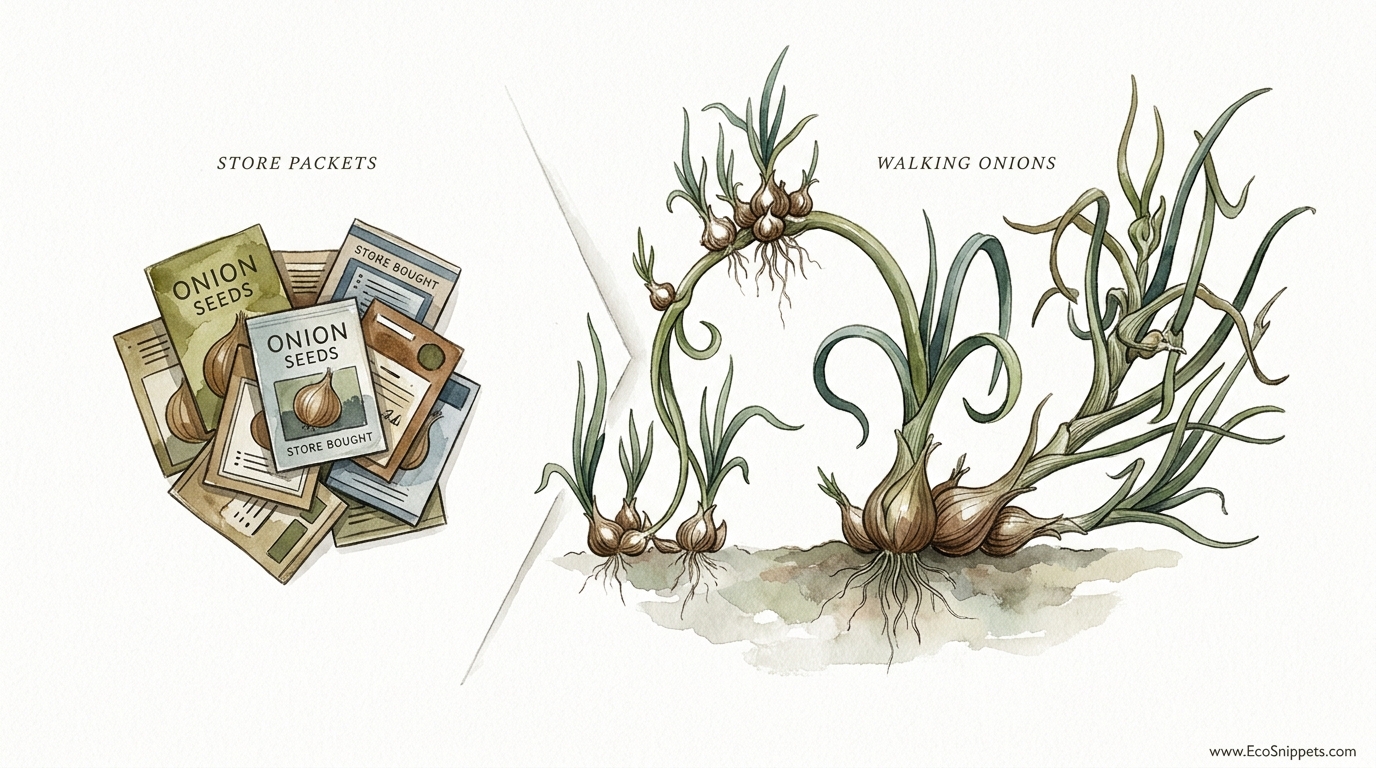
Imagine a vegetable that plants itself and provides a harvest for the next 20 years. Why are you still buying onion sets every spring? Egyptian Walking Onions are the ultimate producer’s crop. They are perennial, cold-hardy, and they literally ‘walk’ across your garden, planting their own next generation. Plant them once and you’ve secured a lifetime supply of savory greens.
Growing Egyptian Walking Onions
Egyptian Walking Onions, scientifically known as Allium × proliferum, are a fascinating hybrid between the common onion (Allium cepa) and the Welsh onion (Allium fistulosum). They are often referred to as tree onions, topset onions, or winter onions. Unlike the standard onions you find at the grocery store, which are typically grown as annuals and harvested once, these plants are rugged perennials that can stay in your garden for decades.
The name “Egyptian” is likely a historical misnomer, as researchers believe the plant originated in India or Pakistan and was later carried across Europe by Romani travelers. The “walking” part of the name, however, is a literal description of how the plant behaves in the soil. Instead of producing flowers and seeds at the top of a stalk like most alliums, these onions produce clusters of small, reddish-purple bulbs called bulbils.
As these bulbils mature and gain weight, the hollow stalks begin to arch toward the ground. Eventually, the weight becomes too much to bear, and the stalk topples over. Where the bulbils touch the earth, they strike roots and begin to grow into a new plant. This process allows a single original plant to travel across a garden bed at a rate of 2 to 3 feet (60 to 90 cm) per year.
In a real-world homestead setting, these onions serve as a reliable “emergency” crop. They are often the very first greens to emerge through the melting snow in late winter or early spring, providing fresh vitamins when the rest of the garden is still dormant. Because they are perennials, they don’t require the annual ritual of tilling, seed starting, or buying new sets, making them a cornerstone of a self-reliant kitchen garden.
How It Works: The Lifecycle of a Walking Onion
Understanding how these plants grow is the first step toward managing a productive patch. The lifecycle follows a predictable, seasonal rhythm that provides different harvests at different times of the year.
The Spring Surge
As soon as the ground thaws—often when temperatures are still hovering near freezing (0°C)—the established bulbs in the ground send up thick, hollow green shoots. At this stage, they look exactly like oversized scallions. You can harvest these greens by the handful, and they will continue to grow back as long as you don’t pull the entire plant.
The Summer “Tree” Phase
By late spring or early summer, a central stalk begins to grow taller than the rest of the leaves, often reaching heights of 2 to 3 feet (60 to 90 cm). Instead of a flower head, a protective papery sheath develops at the tip. When this sheath bursts open, it reveals a cluster of tiny onions. This is why they are called “tree onions.” Sometimes, a second or even third tier of bulbils will grow out of the first cluster, creating a multi-story tower of miniature onions.
The Fall Walk
By late summer, the stalks begin to dry and turn brown. The bulbils are now fully formed, usually about the size of a marble or a large pearl onion. The stalk weakens at the base and leans over until the bulbils touch the soil. If you leave them alone, they will root within days. If you want to expand your patch elsewhere, this is the time to snap off those bulbils and plant them where you choose.
Winter Dormancy
While the green tops will eventually die back after a series of hard freezes, the underground bulbs are incredibly cold-hardy. They can survive in USDA Zone 3, where temperatures can drop to -40°F (-40°C). They remain dormant under the snow, waiting for the first hint of warmth to begin the cycle again.
Benefits of the Perennial Path
Choosing to grow Egyptian Walking Onions over standard store-bought sets offers several measurable advantages for the serious gardener.
1. Lifetime ROI: When you buy a bag of onion sets at the store, you get one harvest. When you buy a handful of walking onion bulbils, you are purchasing an infinite supply. The initial cost is paid once, and the “dividends” in the form of food and new plants grow exponentially every year.
2. Three Harvests in One: Most onions offer one main product. Walking onions provide three:
- Spring Greens: Used like scallions or chives.
- Summer Bulbils: Used as pearl onions for pickling or cooking.
- Fall Underground Bulbs: Used like shallots or small storage onions.
3. Unmatched Resilience: These plants are notoriously difficult to kill. They are not bothered by most common garden pests and are highly resistant to juglone, the toxin produced by Black Walnut trees that kills most other vegetables. They can thrive in a variety of soil types, from sandy loam to slightly heavier soils, as long as there is decent drainage.
4. Early Production: Because the root system is already established in the ground, walking onions don’t have to wait for you to “get around” to planting. They start growing the moment the soil permits, often beating “early” crops like peas and radishes by several weeks.
Challenges and Common Mistakes
While these onions are low-maintenance, they are not “no-maintenance.” There are several pitfalls that can lead to a messy or unproductive garden.
The “Messy Garden” Syndrome
If you do not manage the walking process, these onions will literally take over a garden bed. Within three or four years, what started as a neat row can become a chaotic thicket of stalks and bulbils. This crowding leads to smaller plants and makes weeding nearly impossible. To avoid this, you must be disciplined about harvesting or removing the top bulbils before they fall.
Peeling the Tiny Bulbils
One of the most common complaints among cooks is the difficulty of peeling the aerial bulbils. Because they are small, removing the papery skins can be tedious. Many gardeners solve this by using the bulbils primarily for pickling, where the skins can sometimes be softened, or by focusing on the large underground bulbs and spring greens instead.
Soil Compaction and Wet Feet
Like all members of the Allium family, walking onions hate sitting in water. If your soil is heavy clay and remains soggy during the spring thaw, the bulbs may rot. White Rot is a fungal disease that can persist in the soil for years; if you see your plants wilting and find a white, fluffy growth at the base, you must remove the affected plants and avoid planting any onions in that spot for a long time.
Limitations of the Walking Onion
It is important to have realistic expectations. This onion is not a direct replacement for the large, sweet Vidalia or Spanish onions you might use for onion rings.
The underground bulbs of a walking onion are generally the size of a large shallot—about 1 to 2 inches (2.5 to 5 cm) in diameter. If you are looking for massive “slicing” onions, you will still need to grow annual varieties. Additionally, the flavor of walking onions is often more intense and “hot” than standard varieties. While they mellow out beautifully when cooked, they can be quite pungent when eaten raw.
Another limitation is space. Because they “walk,” they are not ideal for small, intensive raised beds unless you are diligent about harvesting the topsets. They are much better suited for the edges of a garden, a dedicated perennial bed, or a permaculture “food forest” setting where they can be allowed to roam a bit more freely.
Comparison: Store-Bought Sets vs. Walking Onions
| Feature | Store-Bought Onion Sets | Egyptian Walking Onions |
|---|---|---|
| Longevity | Annual (Harvested once) | Perennial (20+ years) |
| Maintenance | High (Tilling, planting, weeding) | Low (Occasional thinning) |
| Bulb Size | Large (3-5 inches / 7-12 cm) | Small/Medium (1-2 inches / 2-5 cm) |
| Propagation | Must buy new seeds/sets annually | Self-propagating via bulbils |
| Cold Hardiness | Varied; usually sensitive to deep freezes | Extremely hardy (Down to Zone 3) |
Practical Tips for a Productive Patch
To get the most out of your walking onions, follow these best practices derived from years of ancestral gardening wisdom.
- Plant in the Fall: While you can plant them in the spring, fall planting (September to October in the Northern Hemisphere) allows the roots to establish before the ground freezes. This results in much larger greens the following spring.
- Depth Matters: Plant the bulbils or underground sets about 1 to 2 inches (2.5 to 5 cm) deep. If you plant them too deep, they may struggle to push through the soil; too shallow, and they might heave out of the ground during winter freeze-thaw cycles.
- Mulch Heavily: A thick layer of straw or shredded leaves helps regulate soil temperature and keeps moisture in the ground. It also prevents the “walking” bulbils from rooting in places you don’t want them to.
- Thin Every Three Years: The underground bulbs will eventually divide and become crowded, much like garlic or shallots. Every three years, dig up the entire clump in the fall, separate the largest bulbs for eating, and replant a few to keep the patch going.
- Control the Walk: If you want your onions to stay in a neat row, simply snap off the top stalks as they begin to lean. You can drop the bulbils into a basket for the kitchen or give them away to neighbors.
Advanced Considerations: Selective Breeding
For the serious practitioner, Egyptian Walking Onions offer a unique opportunity for “garden-level” selective breeding. Although they rarely produce true seeds, you can still select for traits by choosing which bulbils to replant.
Over time, you may notice that some plants produce larger bulbils than others, or that some are more resistant to the mid-summer heat. By consistently replanting only the largest, healthiest bulbils from your best plants, you effectively “train” your local strain to thrive in your specific microclimate. This is how heirloom varieties were developed over centuries of human-plant partnership.
If you are interested in permaculture design, consider planting your walking onions in “guilds” near fruit trees. Their strong scent helps deter pests like aphids and borers, while their deep roots help break up the soil without competing for the same nutrients as the trees.
Scenario: The Five-Year Onion Plan
Imagine you start today with just 10 small bulbils. Here is how your harvest grows:
Year 1: You plant the 10 bulbils in a 2-foot (60 cm) row. You harvest a few green shoots in the spring but mostly leave the plants alone to establish their roots. By the end of summer, you have 10 parent plants, each producing about 5-10 bulbils.
Year 2: You now have about 75 bulbils. You plant half of them to expand your row and eat the other half. Your original 10 plants have also divided underground, so you now have 20-30 large bulbs below the surface.
Year 3: Your patch has expanded to a 10-foot (3 meter) bed. You are now harvesting enough green onions every week to never buy them at the store again. You begin pickling the top bulbils for winter use.
Year 5: Your garden “walking onion” population is in the hundreds. You are giving away bags of bulbils to friends and family. You have a permanent, self-sustaining food source that requires nothing from you but a little bit of weeding and the occasional harvest.
Final Thoughts
Egyptian Walking Onions represent a return to a more resilient, common-sense way of gardening. They bridge the gap between the wild foraging of our ancestors and the organized vegetable beds of today. By dedicating even a small corner of your yard to these “walking” wonders, you are opting out of the cycle of annual seed purchases and opting into a relationship with a plant that genuinely wants to grow.
Whether you use them as a decorative curiosity in a flower bed or as a staple in a high-production kitchen garden, the value of a perennial onion cannot be overstated. They offer a sense of security that few other crops can provide—the knowledge that no matter what happens, the onions will be back next spring, ready to harvest.
Start your patch this season. Find a few bulbils from a fellow gardener or a reputable heirloom supplier, tuck them into the earth, and watch as they begin their slow, steady walk through your garden and your culinary life. Experiment with them in soups, ferments, and sautés, and you will soon wonder why you ever settled for onions that didn’t know how to plant themselves.
