How To Become More Self-Sufficient Without Starting a Full-Blown Farm…
Want to start preserving your harvest, making your own soap, or building a backyard root cellar — but not sure where to begin? “Homesteading Advice” gives you instant lifetime access to 35+ practical homesteading books on food preservation, veggie gardening, DIY natural cleaning products (save over $250 per year with this skill alone), brewing, off-grid energy, and a whole lot more…
Click Here To Check It Out Now!
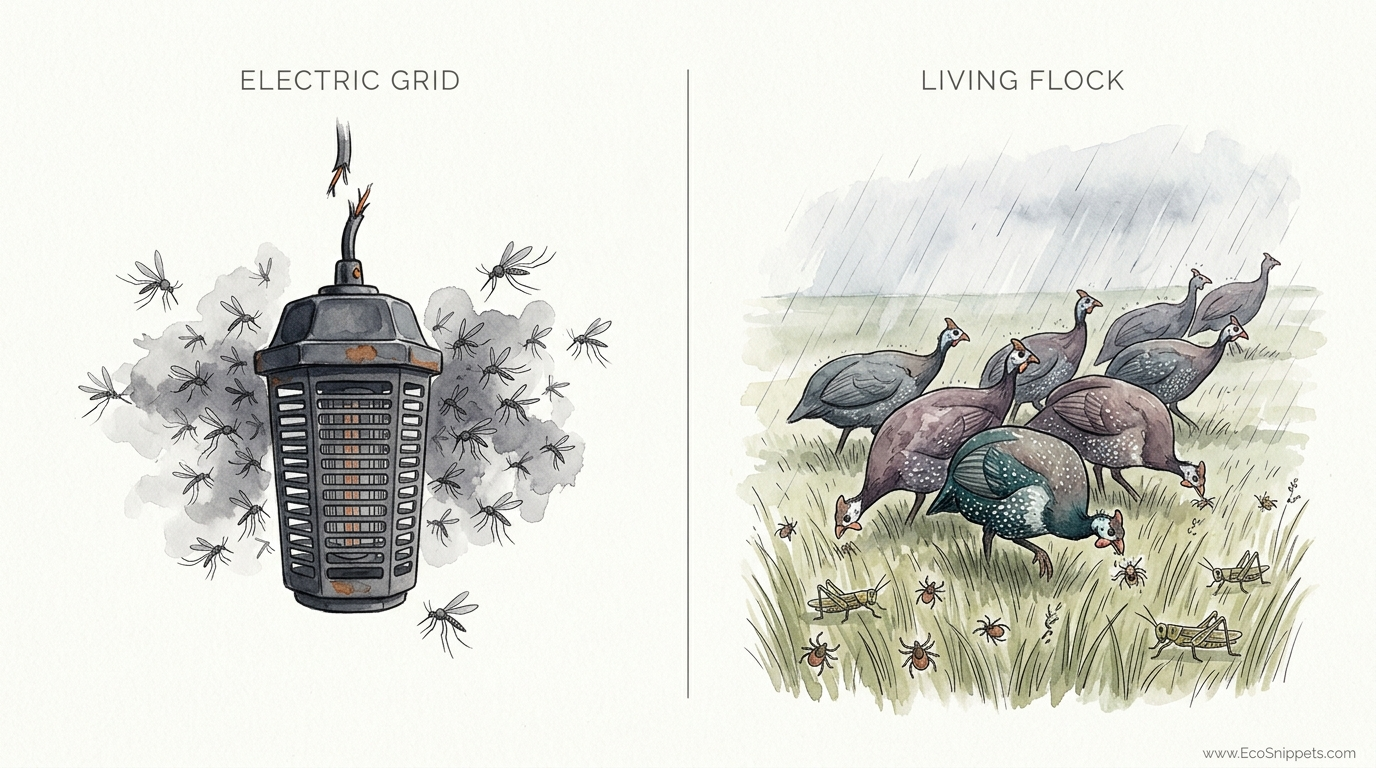
One relies on a fragile wire and a power plant; the other reproduces itself, feeds your family, and hunts in the dark. High-tech pest gadgets fail the moment the grid takes a nap. Resilient homesteading uses biological systems like Guinea Fowl. These birds don’t just ‘zap’ bugs; they seek them out, convert them into high-quality fertilizer, and sound the alarm when predators approach.
Speaking directly to the needs of the modern self-reliant home, it is time to move past temporary fixes. When you invest in a living flock, you are installing a decentralized, self-repairing security and sanitation department on your land. Guinea fowl are the frontline soldiers in the war against the pests that threaten our health and our harvests.
Natural Tick And Pest Management With Guinea Fowl
Natural pest management is the practice of using biological agents to control unwanted insect populations without the use of synthetic chemicals. Guinea fowl (Numida meleagris), originally native to the savannas of sub-Saharan Africa, are perhaps the most efficient biological controls available to the small-scale farmer or homesteader. Unlike domestic chickens, which were bred for high egg production or heavy meat, guineas have retained their wild instincts and voracious appetite for movement-based prey.
These birds are “gleaners.” They move across a landscape in a coordinated line, often called a “skirmish line,” and systematically inspect every blade of grass and leaf for movement. In real-world situations, they are used to protect orchards from Japanese beetles, keep vegetable gardens free of grasshoppers, and, most importantly, purge properties of disease-carrying ticks. While a chemical spray might kill a generation of bugs, it also kills the beneficial insects that keep the ecosystem balanced. Guinea fowl, however, selectively target the pests while leaving the soil and plants largely undisturbed.
How It Works: The Biological Search-and-Destroy System
Understanding how guinea fowl manage pests requires looking at their unique hunting geometry. Unlike chickens, which use a “scratch and peck” method that can destroy garden mulch and uproot delicate seedlings, guineas use a “glide and grab” technique. They rarely dig deep into the earth, preferring to snatch insects directly from the foliage or the surface of the soil.
The Skirmish Line
When a flock of guineas enters a field, they naturally space themselves about 1 to 1.5 meters (3 to 5 feet) apart. They then walk forward in unison. This creates a wide sweep that flushes out insects like grasshoppers and locusts. As an insect jumps to escape one bird, it often lands directly in the path of another. This cooperative hunting style allows a small flock of 10 to 15 birds to effectively patrol several acres of land daily.
Tick Consumption and Lifecycle Interruption
Ticks are the primary target for many homesteaders. Guineas are particularly effective against the Blacklegged (Deer) tick and the Lone Star tick. These pests often congregate in tall grass and the “edge” zones where forest meets field. Because guineas are naturally drawn to these transition zones, they intercept ticks before they can reach your home or your larger livestock. While some internet myths suggest a single bird eats 4,000 ticks a day, scientific observations are more grounded but still impressive; a well-managed flock can reduce tick populations by up to 90% in a single season by breaking the tick’s reproductive cycle.
Nutritional Fueling
To keep this biological engine running, you must understand their nutritional requirements. Adult guinea fowl require a diet with roughly 16% to 18% protein, but they will source a significant portion of this themselves through foraging. During the “keet” stage (babies from 0 to 8 weeks), they need a much higher protein intake—typically 24% to 26%—to support their rapid feather development and high metabolism.
Benefits of the Living Flock
Choosing a biological system over a mechanical or chemical one offers several measurable advantages that go beyond simple bug control.
* Multi-Purpose Utility: Guineas provide high-protein meat and rich, flavorful eggs. While their eggs are smaller than chicken eggs—about two guinea eggs equal one large chicken egg—the yolk-to-white ratio is higher, making them prized for baking.
* The “Watchdog” Effect: Guineas are famously loud and territorial. They possess a “stranger danger” instinct that triggers a metallic, repetitive alarm call when anything unusual enters their territory. This includes hawks, snakes, foxes, and even human intruders.
* Fertilizer Production: As they patrol, they distribute high-nitrogen manure across your pastures and orchards. This “on-the-go” fertilization saves you the labor of hauling compost and ensures your soil remains productive.
* Snake Deterrence: While they may not eat large snakes, a flock will surround and harass a snake until it leaves the area. Smaller snakes are often killed and consumed as part of their varied diet.
Challenges and Common Mistakes
The very traits that make guinea fowl excellent for pest management can also make them a headache for the unprepared. The most common mistake is treating them like chickens.
The Noise Factor
Guineas do not have a “quiet” mode. Their alarm calls can reach over 100 decibels, which is equivalent to a handheld drill or a lawnmower. If you have neighbors within 50 meters (165 feet), you must discuss the noise with them first. Many homesteaders lose their flocks because neighbors complain about the incessant chatter during the early morning hours.
Wandering and Property Lines
Guineas have no concept of fences. A standard 1.2-meter (4-foot) fence is a mere suggestion to a bird that can fly 150 meters (500 feet) in a single burst. Without proper training, your “tick mercenaries” will quickly become your neighbor’s “annoying intruders.” They are also prone to roosting in trees at night, which makes them easy pickings for owls and raccoons.
Communal Nesting Errors
Guinea hens are notoriously bad at traditional nesting. They prefer to hide “communal nests” in tall grass or thick brush. Several hens will lay in the same spot, resulting in a pile of 30 or 40 eggs. If you don’t find these nests early, the eggs will either spoil or be eaten by predators. Furthermore, guinea hens are “distracted” mothers; they will often lead their keets through wet grass, which can lead to the babies dying of hypothermia within hours.
Limitations: When Biological Control May Not Be Ideal
Despite their prowess, guinea fowl are not a universal solution. There are specific environmental and practical boundaries to consider.
* Small Urban Lots: In a high-density suburban environment, the noise and wandering habits of guineas are usually a deal-breaker. They require space—ideally at least 0.4 to 1 hectare (1 to 2 acres)—to truly shine.
* High Predator Loads: If your property is heavily infested with coyotes or bobcats and you cannot provide a secure, enclosed coop for nighttime, your flock will dwindle quickly. They are “sitting ducks” when roosting in trees.
* Extreme Cold and Wet: While they are hardy, they are still African birds. In regions with long, wet winters or temperatures consistently below -15°C (5°F), they require a draft-free, dry shelter with supplemental heat to prevent frostbite on their feet and wattles.
Comparison: Living Flock vs. High-Tech Pest Control
To understand the value of guinea fowl, we can compare them to common technological alternatives like electric bug zappers or chemical perimeter sprays.
| Factor | Living Flock (Guinea Fowl) | Technological Solutions |
|---|---|---|
| Energy Source | Solar (Grass/Insects) | Grid Electricity / Petroleum |
| Maintenance | Self-reproducing & Self-healing | Requires parts & replacement |
| By-products | Meat, Eggs, Fertilizer | Toxic waste / Ozone depletion |
| Reliability | Works during power outages | Zero utility without power |
Practical Tips and Best Practices
If you decide to deploy this biological system, follow these best practices to ensure your success.
* Coop Training (The Lockdown): When you first get adult guineas, keep them in a completely enclosed coop for 4 to 6 weeks. This “resets” their internal GPS, teaching them that this specific building is “home.” If you let them out too early, they will fly back toward their place of birth.
* Start with Keets: The easiest way to keep guineas on your property is to raise them from babies. They will bond with your land and your other livestock. Raising them alongside a few chicken chicks can also “tame” them slightly, making them more likely to return to the coop at night.
* The White Millet Trick: Guineas love French white millet. Use this as a high-value treat to lure them back into the coop every evening. Rattle a tin can full of millet and they will quickly learn to associate that sound with a reward.
* High Roosts: Inside your coop, install roosting bars at least 1.2 to 1.8 meters (4 to 6 feet) off the ground. Guineas feel safest when they are high up, and providing these rungs will encourage them to sleep indoors rather than in the trees.
Advanced Considerations for Serious Practitioners
For those looking to scale their tick management, consider Mobile Coop Systems. Similar to the “Chicken Tractor” but larger, a mobile guinea house can be moved across different sections of an orchard or pasture. This prevents overgrazing of a single area and ensures that the “skirmish line” covers every square meter of your property systematically.
Another advanced technique is Controlled Incubation. Because guinea hens are poor mothers, serious practitioners often collect the eggs and use an artificial incubator. Set the temperature at 37.5°C (99.5°F) with a humidity of 45-50% for the first 25 days, increasing to 65% for the final 3 days of the 28-day incubation period. This ensures a high survival rate and allows you to grow your flock faster than relying on natural brooding.
Example: The Tick-Free Orchard Scenario
Imagine a 2-hectare (5-acre) apple orchard plagued by Japanese beetles and ticks. A traditional approach might involve three chemical applications per season, costing hundreds of dollars and killing the bees needed for pollination.
By introducing a flock of 20 guinea fowl, the homesteader sees a different result. The birds spend their mornings in the orchard, clearing the beetles from the low-hanging fruit. By midday, they move to the perimeter tall grass, intercepting ticks. By evening, they are lured back to a secure coop with millet. The result is a harvest free of chemical residue, a family safe from Lyme disease, and a soil profile enriched by the birds’ constant fertilization. The only “cost” is a bag of supplemental grain and the occasional loud squawk.
Final Thoughts
Embracing guinea fowl as a biological pest management system is a step toward true self-reliance. It moves the homesteader away from the fragile, linear systems of the modern world and into a circular, resilient way of living. These birds are a testament to the idea that nature often has the best solution for the problems we face, provided we are willing to listen to the noise and manage the wildness.
While the learning curve can be steep, the rewards—a tick-free yard, a built-in alarm system, and fresh eggs—are well worth the effort. Start small, train them well, and watch as your land transforms into a balanced ecosystem where the “grid” is no longer the only thing keeping your family safe.
