How To Become More Self-Sufficient Without Starting a Full-Blown Farm…
Want to start preserving your harvest, making your own soap, or building a backyard root cellar — but not sure where to begin? “Homesteading Advice” gives you instant lifetime access to 35+ practical homesteading books on food preservation, veggie gardening, DIY natural cleaning products (save over $250 per year with this skill alone), brewing, off-grid energy, and a whole lot more…
Click Here To Check It Out Now!
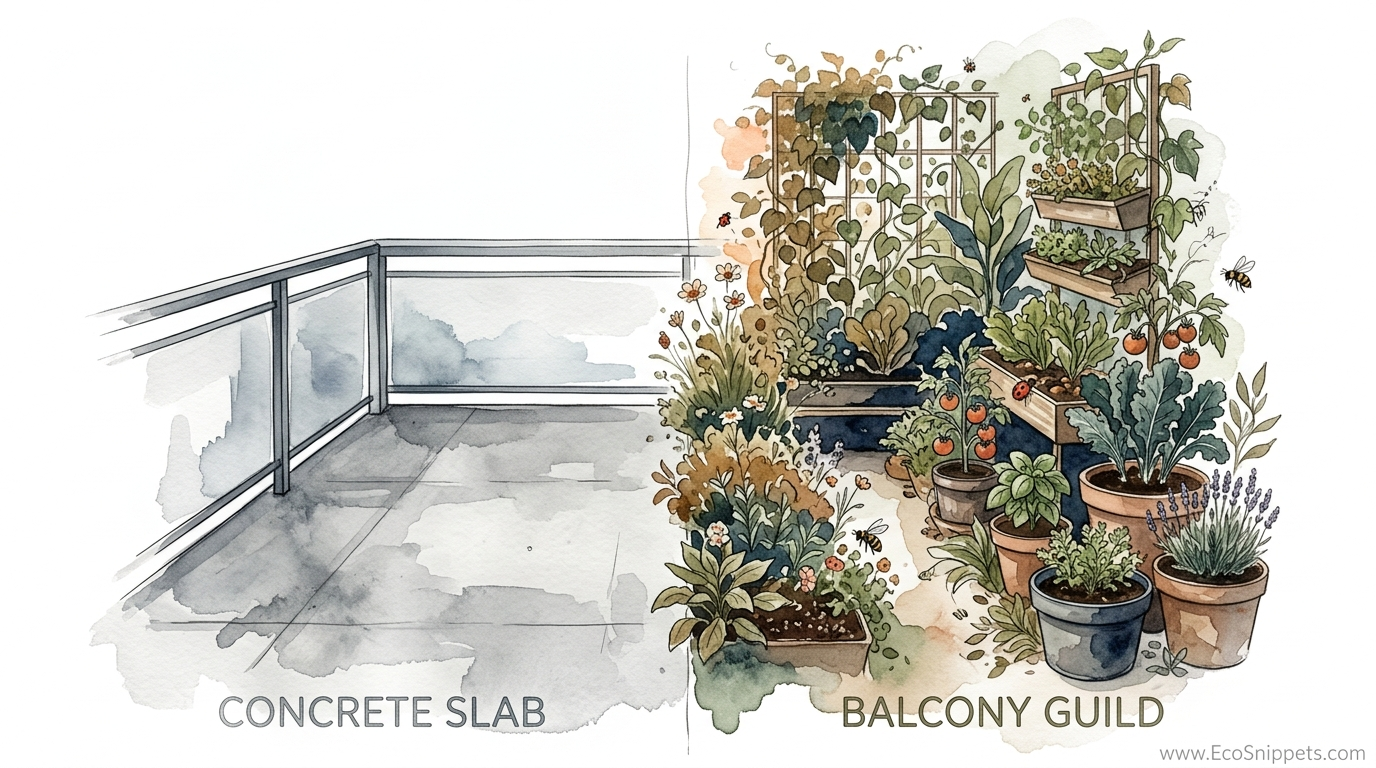
Your landlord calls it a balcony, but to a permaculturist, it is a high-functioning ecosystem cell waiting to be activated. Some people think permaculture is only for those with acres of land, but even a concrete balcony can be a microclimate waiting for a guild. By stacking functions in just 40 square feet, it’s possible to create a small sanctuary that provides salad greens, herbs, and shade while helping to cool the surrounding apartment. You don’t need a farm to grow an ecosystem.
Establishing a garden in the sky requires more than just buying a few plastic pots and some overpriced seedlings. It demands a shift in perspective where you stop seeing a concrete slab and start seeing a resource-rich environment. This approach focuses on ancestral wisdom and self-reliance, treating your limited outdoor space as a productive unit of a larger landscape.
Every design choice should serve multiple purposes. A trellis shouldn’t just support a vine; it should act as a windbreak and a privacy screen while providing vertical habitat for beneficial insects. This is how we transform a sterile urban ledge into a thriving balcony guild.
Permaculture Balcony Garden Design
Permaculture balcony garden design is the intentional arrangement of plants, containers, and water systems to mimic the efficiency of natural ecosystems within an urban footprint. Unlike traditional container gardening, which often treats each pot as an isolated unit, permaculture seeks to connect these elements. Every input should ideally come from within the system, and every output should be a resource for another part of the garden.
In the real world, this means your balcony is no longer a dead zone for storage or laundry. It becomes a climate-regulating lung for your home. Designers look at the balcony as a micro-niche where thermal mass from concrete walls is harvested to keep plants warm at night. Sunlight is captured not just for growth, but to provide shade that lowers your cooling bills.
Think of your balcony as a forest floor that has been lifted into the air. In a natural forest, you have layers: the canopy, the shrub layer, the herbaceous layer, and the root zone. On a balcony, we replicate these layers using different sizes of containers and vertical structures. A dwarf lemon tree might serve as your canopy, while pots of basil and parsley sit at its feet, and radishes grow in the soil below.
How the Balcony Ecosystem Works
Creating a functioning ecosystem on a concrete slab requires a disciplined approach to the 12 permaculture principles. Observation is your first and most vital tool. Spend several weeks tracking how the sun moves across your space and where the wind hits hardest.
Mapping Your Microclimates
The environment on a fifth-floor balcony is vastly different from a ground-floor garden. Wind speeds can be two to three times higher, which increases evaporation rates significantly. You must map out “sun traps” where heat reflects off glass or brick, and “shade pockets” created by railings or overhanging roofs.
South-facing balconies in the northern hemisphere receive the most intense light, often requiring heat-tolerant species and heavy mulching. Conversely, north-facing balconies may only receive 4 hours of indirect light, making them ideal for leafy greens and forest-edge herbs like mint or chives. Understanding these patterns prevents you from fighting nature and allows you to plant what will naturally thrive.
Stacking Functions in Small Spaces
Stacking functions is the art of making one element do the work of three. A wooden privacy screen is a classic example. When designed correctly, it provides a sense of seclusion, acts as a structural support for climbing beans, and serves as a windbreak for more delicate plants behind it.
Another example is the use of “Living Mulch.” Instead of using wood chips, you can plant low-growing herbs like thyme or oregano around the base of a larger plant. These herbs protect the soil from the sun, reducing water needs, while providing a culinary harvest and attracting pollinators. Every square inch must earn its keep.
Water Management Systems
Water is the lifeblood of the system, but in an apartment, it is also a liability. Permaculture design prioritizes “slowing, spreading, and sinking” water. On a balcony, this translates to self-watering containers (sub-irrigation planters) or ollas—unglazed clay pots buried in the soil that seep moisture slowly to the roots.
Rainwater harvesting is possible even on a small scale. Small-diameter diverters can be attached to downspouts if available, or simple collection basins can be placed in “wet zones” where rain naturally blows onto the deck. The goal is to reduce your reliance on the municipal tap while ensuring your plants never hit the “wilt point” during a summer heatwave.
The Benefits of the Urban Guild
Transitioning from a concrete slab to a balcony guild offers measurable improvements to your quality of life. The most immediate benefit is thermal regulation. A lushly planted balcony acts as a biological buffer, absorbing solar radiation that would otherwise heat up the concrete and radiate into your living room.
Fresh Food and Medicinal Security
There is a profound sense of self-reliance in stepping outside to harvest herbs for a meal or leaves for a medicinal tea. While you may not grow enough calories to sustain a family, you can certainly grow enough high-value nutrition to supplement your diet. Freshly picked greens have a vitamin density far superior to store-bought produce that has traveled hundreds of miles.
Waste Loop Closure
Permaculture encourages us to “produce no waste.” A balcony garden allows you to close the loop on your kitchen scraps through vermicomposting. A small worm bin tucked under a bench can turn vegetable peelings into high-grade “black gold” fertilizer. This eliminates the need for synthetic chemicals and keeps organic matter out of the landfill.
Challenges of High-Rise Gardening
The primary challenge of a balcony garden is the lack of a natural “buffer.” In the ground, soil acts as a massive thermal and moisture sponge. In a pot, your plants are exposed. A single day of forgotten watering or an unexpected frost can be catastrophic.
Wind and Evaporation
Airflow is constant at higher elevations. This dries out potting media rapidly, often requiring you to water twice a day in peak summer if you aren’t using self-watering systems. Strong gusts can also physically damage tall plants or topple top-heavy containers.
Weight and Structural Integrity
Weight is a silent danger. Most residential balconies are engineered to hold between 40 and 60 pounds per square foot (195 to 290 kg per square meter). A large ceramic pot filled with wet soil can easily exceed this limit. You must be strategic about container placement, keeping heavier items near the load-bearing walls of the building rather than the outer edge.
Limitations of the Method
No matter how well you design it, a balcony will never be a 10-acre homestead. Space is the ultimate constraint. You cannot grow large fruit trees or maintain a flock of chickens. You are limited to “dwarf” varieties and small-scale livestock like worms or perhaps a very small bee hotel.
Legal and Social Constraints
Renters and condo owners often face strict rules. Some buildings prohibit hanging pots over the railing or using certain types of trellises. You must also consider your neighbors. Runoff from watering your plants can drip onto the balcony below, leading to social friction. A good permaculture design includes saucers or closed-loop drainage to prevent this.
Comparison: Traditional vs. Permaculture Balcony
| Feature | Traditional Container Garden | Permaculture Balcony Guild |
|---|---|---|
| Fertilizer | Store-bought synthetic or organic liquids. | On-site vermicompost and “compost tea” from scraps. |
| Water Use | High. Daily hand-watering with tap water. | Low. Self-watering pots, mulching, and rain capture. |
| Biodiversity | Low. Often monoculture pots (one plant per pot). | High. Companion planting and insect-attracting flowers. |
| Maintenance | Frequent tasks: weeding, feeding, watering. | Initially high setup; low ongoing tasks once balanced. |
Practical Tips for the Urban Pioneer
If you are ready to activate your space, start small and prioritize soil health. Never use “garden soil” from the ground in a container; it is too heavy and will compact, suffocating your roots. Instead, build a “living” potting mix using high-quality compost, coconut coir or peat moss, and perlite for aeration.
- Use Lightweight Containers: Opt for fabric “grow bags” or recycled food-grade plastic. These are lighter than terra cotta and allow for better air pruning of roots.
- Group Plants by Thirst: Place thirsty plants like cucumbers and tomatoes together, and keep drought-tolerant herbs like rosemary and lavender in a separate “dry zone.”
- Mulch Everything: A layer of straw, shredded leaves, or even pebbles reduces evaporation by up to 50%. This is critical for keeping soil microbes alive in the heat.
- Install a Worm Tower: You can create a vertical composting tube directly inside a large planter. As the worms eat your scraps, they deposit nutrients directly into the root zone of your plants.
Advanced Considerations: Going Beyond the Basics
For those who have mastered the basics, the next step is “biological cycling.” This involves growing plants specifically to be used as fertilizer for other plants. Comfrey, for instance, is a dynamic accumulator with deep roots that pull minerals from the soil. On a balcony, you can grow a dwarf variety, chop the leaves, and use them as a nutrient-rich mulch for your heavy feeders like peppers.
Scaling an urban permaculture system might also involve integrating solar-powered automation. A small solar panel can run a tiny pump for a drip irrigation system, ensuring your garden thrives even when you are away for a week. This level of design moves the garden from a hobby to a resilient, self-operating life-support system.
The “Salad Bar” Scenario
Imagine a typical 5×8 foot (1.5×2.4 meter) balcony. In the corners, where the structure is strongest, place two 15-gallon (57-liter) grow bags. In one, plant a “Three Sisters” mini-guild: a central corn stalk (for structure), a climbing bean (to fix nitrogen), and a squash (to cover the soil).
Along the railing, hang “gutter gardens” filled with cut-and-come-again lettuces and spinach. Because these are shallow-rooted, they don’t require heavy pots. Against the wall, a vertical pallet planter holds medicinal herbs like calendula and chamomile. This simple setup can produce several salads a week for six months of the year while providing enough biomass to feed a small worm bin.
Final Thoughts
Transforming a balcony into a permaculture guild is an act of quiet rebellion against a disconnected food system. It proves that productivity is not a matter of acreage, but of thoughtful design and observation. By working with the natural patterns of sun, wind, and water, you turn a forgotten concrete slab into a sanctuary for both yourself and the local ecology.
The wisdom of our ancestors taught us that we must take care of the land so it can take care of us. In the modern world, that “land” might just be forty square feet of concrete outside your sliding glass door. Start today by observing the light and saving your first container of rainwater.
Every seed planted is a step toward self-reliance. As your balcony ecosystem matures, you will find that the benefits extend far beyond the harvest. You are creating a cooler home, a smaller carbon footprint, and a more resilient way of life, one pot at a time.
