How To Become More Self-Sufficient Without Starting a Full-Blown Farm…
Want to start preserving your harvest, making your own soap, or building a backyard root cellar — but not sure where to begin? “Homesteading Advice” gives you instant lifetime access to 35+ practical homesteading books on food preservation, veggie gardening, DIY natural cleaning products (save over $250 per year with this skill alone), brewing, off-grid energy, and a whole lot more…
Click Here To Check It Out Now!
Your ducks aren’t a chore to be managed – they are the missing engine of your garden’s fertility. Most people see duck water as a mess; smart homesteaders see it as liquid gold. See how integrating your ducks into a gravity-fed garden loop turns a daily chore into an automatic growth engine.
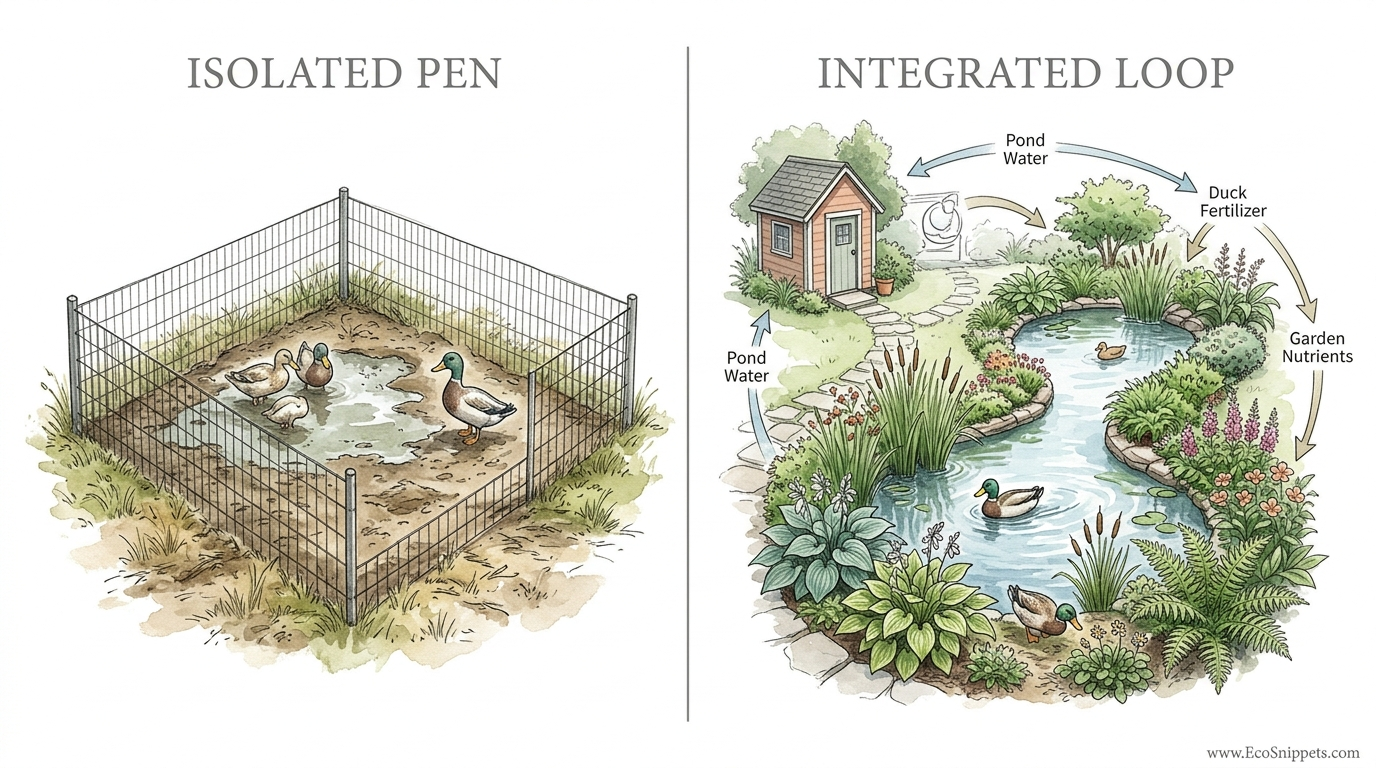
For generations, the traditional approach to poultry was isolation. We kept the birds in a pen, the garden in a plot, and the water in a stagnant pool that required back-breaking labor to dump and refill. This “isolated pen” mentality creates a series of problems: wasted nutrients, muddy messes, and an endless cycle of cleaning. When we shift our perspective toward an integrated loop, we stop fighting nature and start harvesting the energy already present on the land.
The integrated duck pond garden design is more than just a plumbing trick. It is an act of ancestral wisdom updated for the modern self-reliant homestead. By positioning your pond at a higher elevation than your crops, you harness the simple power of gravity to deliver nitrogen-rich “compost tea” exactly where it is needed most. This system mimics natural wetlands where water moves, filters through soil, and feeds the surrounding flora in a perpetual cycle of renewal.
Integrated Duck Pond Garden Design
An integrated duck pond garden design is a permaculture-based system that connects the ducks’ aquatic habitat directly to the garden’s irrigation needs [1.1.5]. In a standard setup, duck waste—rich in nitrogen, phosphorus, and potassium—is treated as a pollutant to be scrubbed away. In an integrated design, this waste becomes the primary fuel for plant growth. The system typically consists of a raised pond or stock tank, a filtration or silt trap mechanism, and a network of gravity-fed pipes or swales that lead to the orchard or vegetable beds [1.2.1, 1.2.5].
This design exists because ducks are uniquely suited to “wet” fertility. Unlike chicken manure, which often requires months of hot composting to avoid burning plants, duck manure is naturally diluted in their swimming water. When ducks poop in water, the nitrogen is preserved and prevented from volatilizing into the air [1.3.2]. As much as 70% of the nitrogen can be retained in the water even after several days, compared to dry manure which loses half its nitrogen to evaporation in the first 24 hours [1.3.2].
Visualize the system as a heart and veins. The pond is the heart, pumping out life-giving nutrients. The gravity-fed pipes are the veins, carrying that “blood” to the limbs of the garden. Whether you are managing a small suburban backyard with a 300-liter (80-gallon) bathtub or a large farm with a 49,000-liter (13,000-gallon) clay pond, the principle remains the same: move the water, feed the soil, and let the ducks do the heavy lifting [1.3.7].
How the Gravity-Fed Loop Works
Building a successful gravity-fed loop requires careful planning of elevation and flow. The system relies on the fact that water always seeks the lowest point. By placing the pond just 1 to 2 meters (3 to 6 feet) higher than the garden beds, you create enough head pressure to move “mucky” water through pipes without the need for expensive electric pumps [1.2.5, 1.2.8].
The first stage is the intake. A 50mm to 100mm (2-inch to 4-inch) PVC pipe is typically installed at the lowest point of the pond bank or bottom [1.2.6]. Using a large-diameter pipe is critical; small irrigation lines used for clean tap water will clog instantly with duck feathers, mud, and organic solids [1.2.8]. A silt trap or a coarse mechanical filter—such as a mesh-covered bucket—at the intake helps prevent large debris from entering the main line [1.1.4, 1.4.6].
Once the water enters the main line, it travels to a manifold. This is a junction of valves that allows you to direct the nutrient-dense water to different zones of the garden [1.2.5]. In the spring, you might direct the flow to your heavy-feeding fruit trees. In the heat of summer, the loop might feed your corn or squash. Using ball valves at this junction gives you total control over the “fertility faucet” of your homestead.
The final stage is the discharge. Because duck water contains solids, it is best delivered through open swales, “leaky” pipes with large drilled holes, or directly into the mulch basins of trees [1.1.4, 1.2.8]. Traditional drip emitters are generally avoided as they are not designed for the thick, “tea-like” consistency of duck pond effluent. Instead, many practitioners use the water to flood-irrigate “permaculture slices”—sections of the garden that can handle a large volume of water and nutrients at once.
The Practical Benefits of the Integrated Loop
The most immediate benefit is the massive reduction in manual labor. In an isolated system, cleaning a 150-gallon (570-liter) stock tank involves scrubbing, siphoning, and hauling heavy buckets of sludge to the compost pile. In a gravity loop, you simply turn a valve. The pond drains into the garden, and you refill it with fresh rainwater or well water, completing the chore in minutes rather than hours [1.2.4].
From a fertility standpoint, the water is a powerhouse. Duck manure in liquid form acts as a balanced organic fertilizer, often compared to a 4-4-4 NPK tea [1.3.2]. It provides immediate-release nitrogen for leafy growth, while the phosphorus and potassium support root development and fruiting. Because the ducks “backwash” mud and minerals into the water, it also contains trace minerals that are often missing from synthetic fertilizers [1.3.2].
Beyond the plants, the ducks themselves benefit from the constant water turnover. Frequent draining of the pond prevents the buildup of anaerobic bacteria and “stagnant” smells that plague traditional duck pens [1.1.6]. Fresh water access is a core requirement for duck health; it allows them to clean their eyes, nostrils, and feathers effectively, significantly reducing the risk of eye infections and parasites [1.6.6].
Finally, the system serves as a decentralized water storage strategy. By capturing rainwater to fill the pond and then using that water twice—once for the ducks and once for the garden—you maximize every drop. This is particularly vital in regions with seasonal droughts, where the “duck loop” can keep an orchard thriving when traditional water sources are restricted [1.2.2, 1.3.7].
Challenges and Common Mistakes
The most frequent pitfall is the “clog of despair.” Beginners often try to hook a standard garden hose or a 1/2-inch irrigation line to their duck pond. Duck water is thick with “fines”—tiny particles of poop and feathers—that will bridge and block any small opening [1.2.8]. Always use at least a 2-inch (50mm) pipe for the main gravity line and avoid any 90-degree elbows that could trap sediment. Use 45-degree bends instead to maintain a smooth flow.
Pathogen management is another critical concern. Duck water can harbor Salmonella and E. coli [1.5.1, 1.5.6]. A common mistake is splashing this water directly onto the leaves of crops that will be eaten raw, such as lettuce or kale [1.3.1]. To stay safe, apply the water only to the soil at the base of the plant. The USDA organic standard generally recommends a 120-day “buffer” between the application of raw manure and the harvest of crops that touch the soil [1.3.5]. For fruit trees and berries, where the edible part is high off the ground, the risk is significantly lower.
Improper pond placement can also lead to “bogging.” If the drainage area does not have high-quality, well-draining soil, the constant influx of nutrient-rich water can turn your garden into a smelly swamp. It is essential to match the volume of your pond to the absorption capacity of your land. For heavy clay soils, you may need to incorporate “biofilter” beds—intermediate areas filled with gravel and water-hungry plants like rushes or irises—to process the water before it reaches your delicate crops [1.1.3, 1.1.6].
Realistic Limitations and Constraints
The primary limitation is topography. If your garden is uphill from your pond, gravity will not help you. While you can use a sump pump to move the water uphill, this introduces electricity costs and mechanical points of failure [1.3.5]. A true gravity loop is most efficient on sloped land or for homesteaders who can build raised “above-ground” ponds on platforms [1.2.8].
Climate also plays a role in the system’s timing. In freezing climates, the gravity lines must be buried below the frost line or fully drained before winter to prevent the PVC from cracking. Furthermore, the 120-day safety rule means you cannot use the “duck tea” on your autumn salad greens right before harvest. You must time your applications to the early growing season or use the loop primarily for perennials, orchards, and “hungry” summer crops like pumpkins and corn [1.3.5, 1.3.8].
Small-scale limitations are also worth noting. A single kiddy pool (approximately 100 liters or 25 gallons) might not provide enough pressure to push water through a long run of pipe. For the gravity loop to work effectively without a pump, a larger “head” of water (at least 300 to 600 liters / 80 to 150 gallons) is usually required to create the weight necessary for consistent flow [1.2.3, 1.3.7].
Comparison: Isolated Pen vs. Integrated Loop
| Factor | Isolated Pen (Traditional) | Integrated Loop (Permaculture) |
|---|---|---|
| Maintenance Labor | High (manual dumping/hauling) | Low (valve-based drainage) |
| Nutrient Efficiency | Low (nitrogen evaporates/lost) | High (70% nitrogen retention) |
| Water Quality | Often stagnant/anaerobic | Fresh due to frequent turnover |
| Initial Complexity | Low (simple tub) | Moderate (plumbing/earthworks) |
| Safety Risks | Localized to pen | Requires careful crop targeting |
Practical Tips and Best Practices
When selecting pipes, choose Schedule 40 PVC for durability. Use “True Union” ball valves for your manifold; these allow you to disconnect and clean the valve if a particularly stubborn feather gets stuck inside [1.2.6]. Always include a “clean-out” T-junction at the highest point of the line so you can flush it with a high-pressure hose if a clog occurs.
Integrate “nutrient-hungry” plants directly into the loop. Species like Yellow Flag Iris, Canna Lilies, and Papyrus thrive in the mucky water and act as a living biofilter, stripping excess nutrients before the water moves further down the line [1.1.3, 1.4.6]. These plants don’t just filter; they provide a secondary harvest of mulch or ornamental beauty.
Consider the “Silt Trap.” A small 20-liter (5-gallon) bucket placed inline between the pond and the garden can act as a settling chamber. The heavy sludge sinks to the bottom of the bucket, while the cleaner, more fluid “tea” flows out the top toward the garden. Once a week, you can open a bottom drain on the bucket to collect the concentrated “black gold” for your compost pile [1.1.4].
Advanced Considerations: The Biofilter Edge
For serious practitioners, a simple pipe is only the beginning. The addition of a multi-stage biofilter can turn even the messiest pond into a clear, recirculating ecosystem. By pumping or gravity-feeding water through a series of gravel beds planted with specific aquatic species, you create a “Quaquaponics” system [1.2.8]. The bacteria living on the gravel convert toxic ammonia from the duck waste into nitrites and then into nitrates—the form of nitrogen most easily used by plants [1.1.6, 1.4.1].
Scaling this system requires understanding the relationship between “bioload” and “surface area.” A rule of thumb is to have at least 1 square meter of biofilter for every 5 ducks in a 1,000-liter pond. Adding solar-powered aeration to the pond or the biofilter beds can double their efficiency, as the “good” bacteria require oxygen to process the waste [1.2.2, 1.5.4].
In larger homesteads, the loop can terminate in a “recharge basin” or a wetland swale. Instead of just watering a single garden bed, the water is used to replenish the local groundwater table. This creates a lush microclimate that can lower ambient temperatures during the summer and provide habitat for beneficial predators like frogs and dragonflies, who will help the ducks with pest control [1.1.5, 1.4.4].
A Realistic Scenario: The 10-Duck Orchard Loop
Imagine a homestead with 10 Pekin ducks and a 20-tree fruit orchard. The ducks live in a 2.5m x 2.5m (8ft x 8ft) pen with a 600-liter (150-gallon) stock tank. The pen is located on a slight rise, about 1.5 meters (5 feet) above the orchard floor [1.2.3, 1.3.7].
Every three days, the homesteader opens a 2-inch ball valve. In less than 10 minutes, 600 liters of nutrient-dense water flows through a main PVC line and into a series of mulch basins surrounding the apple and peach trees. Each tree receives roughly 30 liters of liquid fertilizer—enough to keep the soil moist and the nitrogen levels high during the peak growing season [1.2.5].
The “muck” that remains at the bottom of the tank is flushed out with a quick spray from the hose. The valve is closed, and the tank is refilled with fresh rainwater from a nearby shed roof. The ducks are happy with their clean bath, and the orchard receives a “shot” of fertility that would cost fifty dollars at a garden center. Over a single season, this system moves over 60,000 liters (15,000 gallons) of water and hundreds of pounds of organic manure with almost zero physical lifting [1.2.2].
Final Thoughts
The integrated duck pond garden loop is the ultimate expression of homestead efficiency. It takes the messiest part of raising waterfowl and turns it into the most productive part of the garden. By understanding the principles of gravity, nutrient preservation, and pathogen safety, any homesteader can build a system that saves time and grows better food.
True self-reliance is not about working harder; it is about working smarter by mimicking the elegant systems of the natural world. Your ducks are ready to be the engine of your garden’s fertility. All you have to do is build the loop and let the water flow.
As you experiment with different pipe sizes, biofilter plants, and discharge methods, you will find a balance that fits your unique land. Start small, focus on your perennials first, and watch as your “liquid gold” transforms your homestead from a series of chores into a thriving, integrated ecosystem.
