How To Become More Self-Sufficient Without Starting a Full-Blown Farm…
Want to start preserving your harvest, making your own soap, or building a backyard root cellar — but not sure where to begin? “Homesteading Advice” gives you instant lifetime access to 35+ practical homesteading books on food preservation, veggie gardening, DIY natural cleaning products (save over $250 per year with this skill alone), brewing, off-grid energy, and a whole lot more…
Click Here To Check It Out Now!
Most commercial flavorings are just chemical masks; real homestead bitters are a strategic health tool you can make for pennies. True food autonomy means owning your flavors. Stop buying mystery extracts in plastic bottles and start infusing the medicinal roots and barks found at the edge of your own property.
Bitters are more than just a cocktail ingredient; they are a concentrated extract of the earth’s most potent botanicals. For centuries, every self-reliant household kept a bottle of “digestive tonic” or “stomach bitters” on the shelf. These elixirs were the first line of defense against sluggish digestion, seasonal illness, and the heavy meals common in a labor-heavy lifestyle.
Modern store-bought versions often prioritize shelf stability and sugar over medicinal efficacy. When you make your own, you control the potency, the purity, and the profile. You transition from being a consumer of synthetic “natural flavors” to a master of the apothecary elixir.
How To Make Homemade Bitters
Homemade bitters are concentrated alcoholic infusions of bittering agents—roots, barks, or leaves—balanced with aromatic herbs, fruits, and spices. At their simplest, they are a way to capture the essence of a plant in a shelf-stable liquid form. While we often think of them in the context of a glass of whiskey, their primary historical role was as a digestive aid.
The “bitter reflex” is a physiological response that begins the moment a bitter substance touches your tongue. Your body has 29 different types of T2R bitter taste receptors. These receptors are not just on your tongue; they are found throughout your stomach, gut, liver, and pancreas. When triggered, they signal the brain to release saliva, gastric juices, and bile, preparing the body to break down food efficiently.
In the real world, bitters are used to settle an upset stomach, curb sugar cravings, or provide a complex layer of flavor to beverages and culinary dishes. They act as the “salt and pepper” of the liquid world, tying disparate flavors together and adding a grounded, earthy depth that sweet or sour ingredients cannot achieve on their own.
The Underlying Principles of Extraction
Understanding how to make bitters requires a basic grasp of solvent extraction. Alcohol is the preferred solvent because it is exceptionally efficient at pulling out both water-soluble and fat-soluble compounds from plant material. For a truly effective homestead bitter, you need a high-proof spirit—ideally 100 proof (50% alcohol by volume) or higher.
High-proof spirits like 151-proof (75.5% ABV) neutral grain alcohol or 100-proof (50% ABV) vodka act as a preservative and a powerful extractor. The alcohol breaks down the cellular walls of the dried roots and barks, pulling out the alkaloids and essential oils that contain the medicinal and flavor properties.
You can choose between two primary methods of production. The “Single Jar Method” involves putting all your ingredients into one vessel and letting them steep together. This is the traditional homestead way, resulting in a “synergistic” blend where flavors marry over time. The “Component Method” involves making separate tinctures of each ingredient and blending them at the end. This provides more control but requires more jars and patience.
Botanical Profiles: Selecting Your Bittering Agents
The backbone of any bitter is the bittering agent. Without these, you simply have a flavored tincture. These ingredients are often potent and should be used with respect.
Gentian Root (Gentiana lutea): Often called the “King of Bitters,” gentian is the primary ingredient in most commercial bitters. It provides a clean, intense bitterness without a heavy aroma. It is prized for its ability to stimulate the gallbladder and liver.
Wormwood (Artemisia absinthium): This herb is famous for its role in absinthe. It offers a more herbaceous, menthol-like bitterness. It is a powerful digestive stimulant but should be used sparingly due to the presence of thujone, which can be toxic in very large, concentrated doses over long periods.
Dandelion Root (Taraxacum officinale): A common “weed” that is actually a homestead powerhouse. Dandelion root is a mild bittering agent that supports liver health and acts as a prebiotic. It is an excellent choice for a daily digestive tonic.
Burdock Root (Arctium lappa): Burdock provides an earthy, almost nutty bitterness. It is traditionally used as a “blood purifier” and helps to balance the more intense flavors of barks like cinchona or quassia.
Cinchona Bark (Quinine Bark): This bark is the source of quinine. It provides a deep, woody bitterness that lingers on the palate. However, it requires caution, as excessive amounts can lead to cinchonism, characterized by ringing in the ears or nausea.
Aromatic and Flavoring Components
Once you have selected your bitter base, you must balance it with aromatics. These provide the “nose” of the bitters and make them palatable.
- Citrus Peels: Dried orange, lemon, or grapefruit peels add brightness and essential oils. Always use organic peels to avoid infusing pesticides into your tonic.
- Warming Spices: Cardamom, cloves, cinnamon, and star anise provide a nostalgic, “Old World” flavor profile. These spices are also carminative, meaning they help reduce gas and bloating.
- Herbs and Florals: Lavender, chamomile, and rose petals can soften a harsh bitter profile. Rosemary or sage can add a savory, rustic edge.
- Fixatives: Ingredients like wild cherry bark or black walnut hulls help to “fix” the flavors and add a rounded, tannic finish to the liquid.
Step-by-Step Production Process
To begin, you will need clean glass jars (4 oz or 120 ml Mason jars work best for small batches), high-proof alcohol, and your botanicals.
1. Prepare the Botanicals: Roughly chop or crush your dried roots and spices. Increasing the surface area allows the alcohol to penetrate the material more effectively. If using fresh citrus, remove as much of the white pith as possible, as the pith adds a one-dimensional, acrid bitterness that lacks complexity.
2. Measure Your Ratios: A standard homestead ratio is 1 part dried botanicals to 5 parts alcohol by weight. For example, if you have 1 oz (28 g) of dried herbs, you would use 5 oz (140 ml) of alcohol. If using fresh herbs, use a 1:2 ratio, as the water content in the plant will dilute the spirit.
3. The Maceration Period: Place your ingredients in the jar and cover them with the alcohol. Seal the lid tightly and store the jar in a cool, dark place. Shake the jar daily. This agitation ensures the solvent is constantly in contact with new surfaces of the plant material.
4. Monitoring the Infusion: Most bitters take between 2 to 4 weeks to reach full potency. Taste your infusion every few days. The flavor will transition from a sharp alcohol burn to a complex, layered botanical profile.
5. Straining and Clarifying: Once the desired strength is reached, strain the liquid through a fine-mesh sieve. For a clearer product, follow this with a second strain through a coffee filter or several layers of cheesecloth. Some homesteaders prefer to leave the “lees” (sediment) at the bottom for a more rustic, full-bodied extract.
Benefits of Making Your Own Bitters
Crafting bitters at home offers measurable advantages over purchasing mass-produced extracts. The most immediate benefit is cost efficiency. A small bottle of premium bitters can cost upwards of $20.00 USD, while a gallon of homemade extract can be produced for the price of a bottle of vodka and a few foraged or bulk-bought roots.
Potency Control is another major factor. You can adjust the “bitter-to-aromatic” ratio to suit your specific health needs. If you struggle with heavy meals, you can increase the gentian or burdock content. If you want a sleep aid, you can infuse chamomile and hops into a bitter base.
Furthermore, you eliminate synthetic additives. Many commercial flavorings use propylene glycol, caramel color, and artificial sweeteners. Your homestead bitters contain only three things: alcohol, water, and plants. This purity ensures that the medicinal benefits of the botanicals remain uncompromised.
Challenges and Common Mistakes
The most frequent error in bitters making is over-extraction. Some botanicals, particularly wormwood and cinchona bark, can become overwhelmingly acrid if left to steep for too long. If your bitters taste like burnt rubber or copper, you have likely over-extracted your bittering agents. To avoid this, taste your brew daily after the first week.
Another mistake is using low-proof alcohol. If you use a standard 80-proof (40% ABV) vodka, the water content is high enough that it may not extract the resins and heavy oils from certain barks and seeds. This results in a “thin” tasting bitter that lacks the shelf stability required for long-term storage.
Cloudiness is a cosmetic challenge that frustrates many beginners. This often happens when you add water or syrup to a high-proof infusion (a process called “louching”). The oils that were dissolved in the high-proof alcohol become insoluble at lower proofs. While cloudiness does not affect the flavor or safety, you can minimize it by chilling the bitters and then filtering them through a very fine paper filter.
Limitations and Realistic Constraints
While bitters are a powerful tool, they are not a universal cure. It is important to recognize that alcohol-based extractions are not suitable for everyone. Individuals with a history of alcohol dependency or certain liver conditions should opt for glycerin-based extractions, although these are less efficient at pulling out certain medicinal compounds.
Environmental factors also play a role. The quality of your bitters depends entirely on the quality of your botanicals. If you forage roots from soil contaminated by heavy metals or pesticides, those toxins will be concentrated in your final extract. Always know the history of the land where you harvest.
Finally, bitters are strong medicine. They are intended to be used in drops or “dashes,” not ounces. Consuming large quantities of concentrated bittering agents can irritate the stomach lining or cause nausea, particularly in individuals with pre-existing stomach ulcers or gallbladder stones.
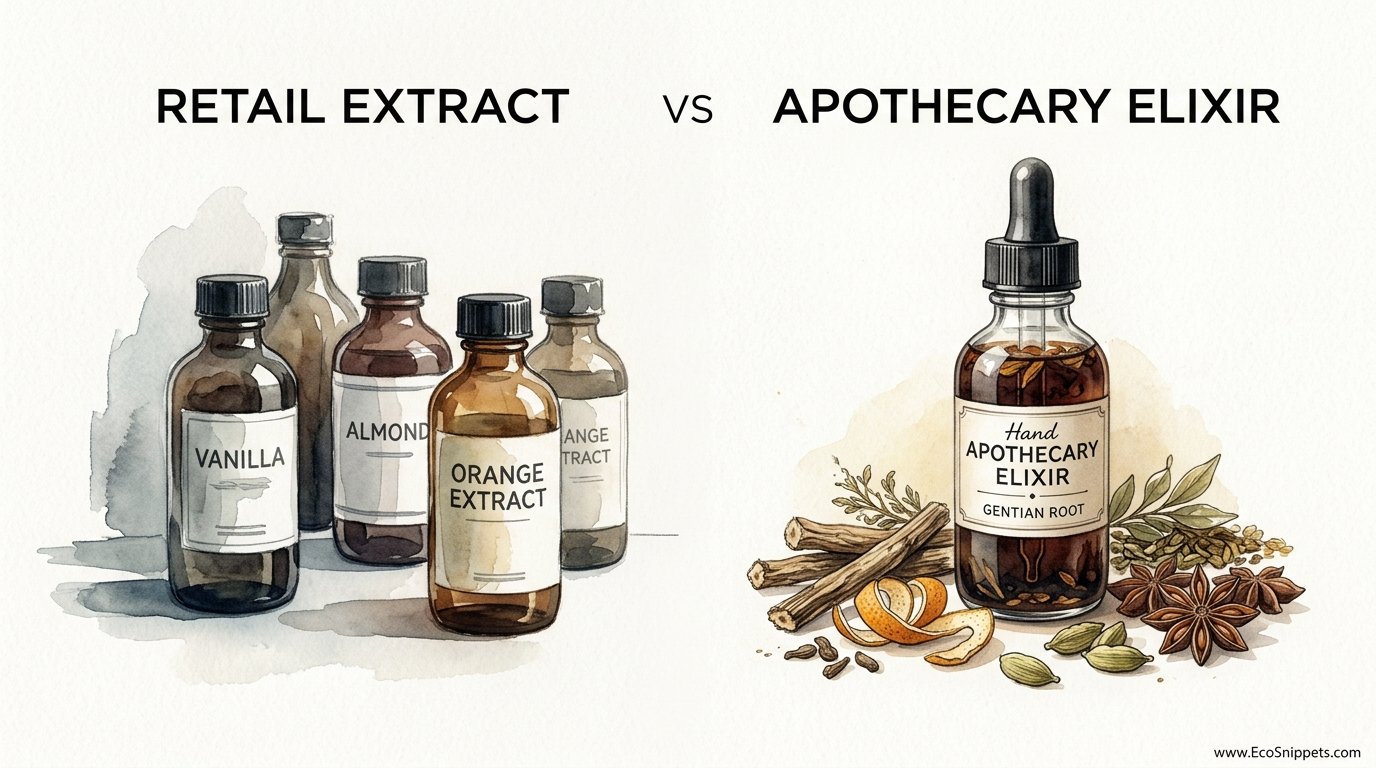
Retail Extract vs. Apothecary Elixir
| Feature | Retail Extract | Apothecary Elixir (Homemade) |
|---|---|---|
| Ingredients | Glycerin, Water, “Natural Flavors,” Caramel Color. | High-proof spirit, whole roots, barks, foraged herbs. |
| Medicinal Potency | Low; designed for flavor and aroma over function. | High; retains full alkaloid and essential oil profile. |
| Cost per Ounce | $4.00 – $8.00 USD | $0.15 – $0.50 USD |
| Customization | None; fixed flavor profile. | Infinite; can be tailored to specific health needs. |
| Sustainability | Plastic bottles, global shipping, industrial processing. | Reusable glass jars, foraged materials, zero waste. |
Practical Tips and Best Practices
If you want to produce professional-grade bitters on your homestead, follow these veteran tips. Always label your jars with the date, the alcohol proof used, and the exact weight of each ingredient. Memories fade over a three-week infusion period, and you will want to be able to replicate a successful batch or troubleshoot a failed one.
Use amber glass bottles for your finished product. Ultraviolet light is the enemy of botanical extracts; it breaks down the complex molecules you worked hard to extract. Storing your bitters in dark glass in a cool cupboard will keep them potent for years.
When blending, use the “Dropper Test.” Add one drop of your finished bitter to a tablespoon (15 ml) of water and taste it. This is how the bitters will actually be experienced by your palate and your gut. Tasting them straight from the jar is often too overwhelming to provide an accurate sense of the balance between bitter, sweet, and aromatic.
Advanced Considerations: The Secondary Extraction
Serious practitioners often use a two-stage extraction to get the most out of their botanicals. After you strain the alcohol from your herbs, do not throw the herbs away. They still contain water-soluble compounds that the alcohol couldn’t fully pull out.
Place the alcohol-soaked botanicals in a pot with a small amount of distilled water and simmer them for 10–15 minutes (this is called a decoction). Let the water cool, strain it, and then combine this “tea” with your alcohol infusion. This reduces the overall alcohol proof to a more drinkable level (typically 40–45% ABV) and results in a much more complex, full-bodied elixir.
If you find your bitters too harsh, consider adding a small amount of sweetener. A teaspoon of raw honey, maple syrup, or molasses per 8 oz (240 ml) can round out the edges of a sharp bitter without making it “sweet.” This is particularly helpful for “Old World” style aromatic bitters meant for cocktails.
Example Scenarios and Recipes
Scenario A: The Digestive Heavy-Hitter
You have just finished a large homestead meal of roasted meats and root vegetables. You feel sluggish and bloated.
Recipe: 1 oz (28 g) dried Dandelion Root, 0.5 oz (14 g) Burdock Root, 0.25 oz (7 g) Ginger Root, and 0.25 oz (7 g) Fennel Seeds. Infuse in 10 oz (300 ml) of 100-proof vodka for 3 weeks. Take 5–10 drops in a splash of water after the meal.
Scenario B: The Wild Orchard Bitter
You want a bitter that captures the essence of your fruit trees to use in evening beverages.
Recipe: 2 oz (56 g) dried Orange Peel, 1 stick of Cinnamon, 3 Cloves, and 0.5 oz (14 g) Gentian Root. Infuse in 12 oz (350 ml) of high-proof Bourbon for 2 weeks. The bourbon adds a natural vanilla and oak sweetness that complements the citrus perfectly.
Final Thoughts
Owning the process of making bitters is a fundamental step toward reclaiming your health and your pantry. By moving away from store-bought masks and toward the medicinal barks and roots of the earth, you are participating in a tradition that spans millennia. These elixirs are a testament to the fact that the most powerful tools for our well-being are often the ones we can grow or forage ourselves.
As you experiment with different ratios and botanicals, you will develop a “palate for the bitter”—a sense that modern diets have largely lost. This return to ancestral flavors not only improves your digestion but also deepens your connection to the landscape around you. Every bottle you produce is a shelf-stable piece of the season, ready to serve as a strategic health tool whenever it is needed.
Start small, keep meticulous notes, and do not be afraid of the intense flavors you encounter. The goal is not a “pleasant” sugar-water, but a potent, functional elixir that honors the complexity of the natural world. Once you have tasted the depth of a true homestead bitter, the clear-plastic-bottled extracts of the retail world will never suffice again.
