How To Become More Self-Sufficient Without Starting a Full-Blown Farm…
Want to start preserving your harvest, making your own soap, or building a backyard root cellar — but not sure where to begin? “Homesteading Advice” gives you instant lifetime access to 35+ practical homesteading books on food preservation, veggie gardening, DIY natural cleaning products (save over $250 per year with this skill alone), brewing, off-grid energy, and a whole lot more…
Click Here To Check It Out Now!
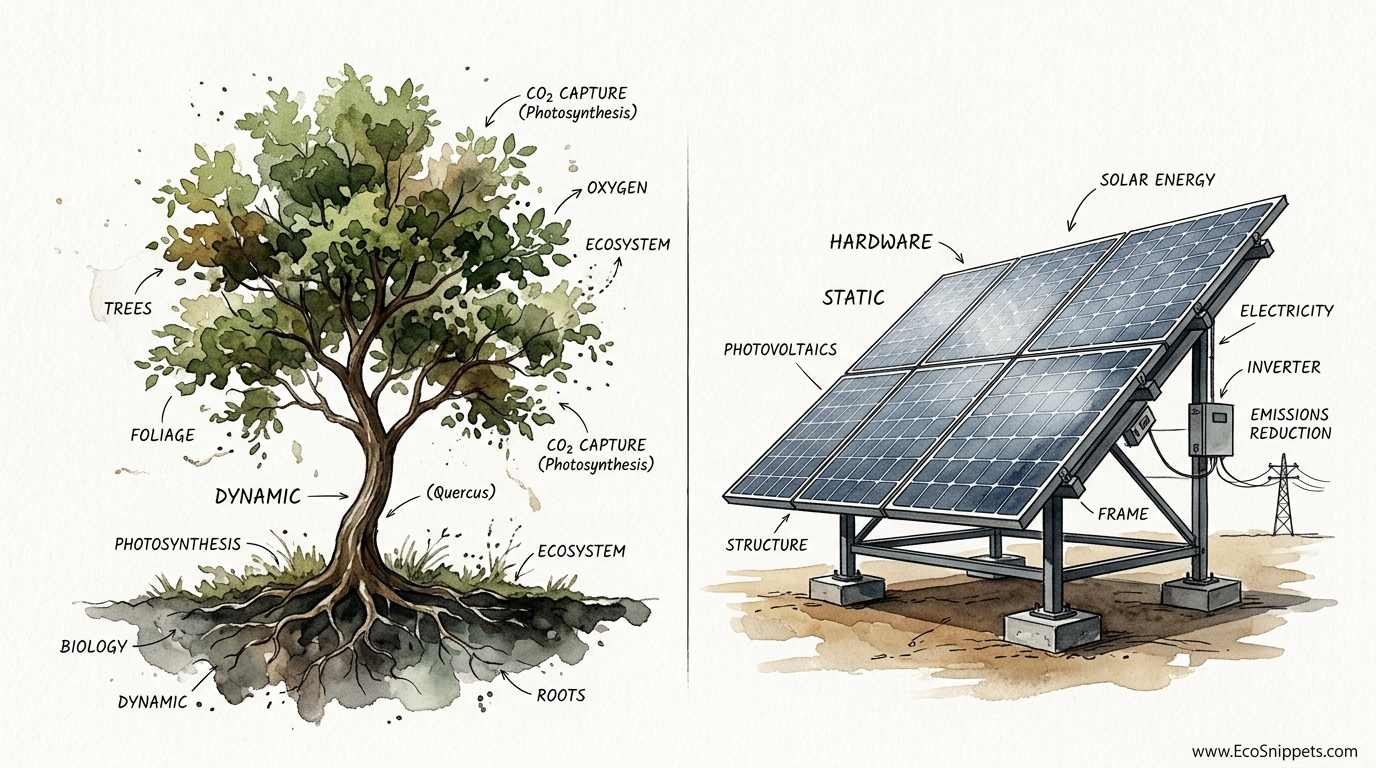
Would you rather plant 100 trees or install one solar panel? This question is the gateway to understanding real-world environmental impact. Environmental impact isn’t just one number; it is a complex calculation of carbon reduction, energy displacement, and biodiversity support.
Trees are biological masters of carbon sequestration, actively pulling CO2 from the air while rebuilding soil and creating habitats. Solar panels, however, provide immediate grid-wide relief by displacing the burning of fossil fuels, though they carry a higher upfront manufacturing footprint. While solar offers a faster carbon ‘payback’ in terms of energy, trees offer a multi-generational legacy of ecosystem services. The most effective approach isn’t choosing one—it’s integrating them. Use solar where the grid is dirty and use trees where the land is thirsty. Combined, they create a resilient, low-carbon future.
Deciding between biological stewardship and technological intervention is a choice many modern land-owners face. It is a question of how we spend our sweat and our silver to leave the world better than we found it. For some, the rustle of leaves in the wind provides a sense of ancestral connection that no piece of silicon ever could. For others, the steady hum of an inverter signifies a practical break from the reliance on centralized power grids. Both paths require a dedicated heart and a willing hand.
Understanding the balance between these two forces requires looking past the glossy brochures of energy companies and the simplified slogans of environmental groups. Real impact comes from understanding the physics of energy and the slow, steady rhythm of the natural world. This guide explores the depths of carbon math, soil health, and energy independence to help you decide which path fits your land and your legacy.
Planting Trees Or Solar Panels For Reducing C02 Emissions?
Reducing carbon dioxide emissions is the primary goal of both reforestation and renewable energy. When we plant a tree, we are engaging in a process of dynamic biology. The tree uses the power of the sun to pull carbon from the atmosphere, turning it into wood, roots, and leaves. Over a single year, a mature tree can absorb approximately 48.5 pounds (22 kilograms) of CO2 from the air. This carbon is held in the physical structure of the tree for its entire life, which can span centuries if the tree is well-tended.
A solar panel takes a different approach. It acts as a piece of static hardware that prevents carbon from being emitted in the first place. Every kilowatt-hour of electricity generated by a solar panel is one less kilowatt-hour that needs to be generated by burning coal or natural gas. In a region where the electrical grid relies heavily on fossil fuels, a single 400-watt solar panel can offset about 510 pounds (231 kilograms) of CO2 per year. This immediate displacement of dirty energy is often much faster than the slow growth of a sapling.
The comparison between these two is often startling. Research indicates that a typical residential solar system can offset as much carbon as planting over 100 trees every single year. If the goal is purely the reduction of atmospheric carbon on a rapid timeline, the hardware of solar technology often wins the race. However, trees provide services that no panel can replicate, such as cooling the air through evapotranspiration and providing a home for the creatures that maintain the balance of our local ecosystems.
One must consider the land use as well. In densely populated areas or regions with limited space, solar panels can be installed on rooftops, leaving the ground free for gardening or walking. Trees require deep soil and space for their canopies to spread. On a per-acre basis, solar arrays have been shown to reduce CO2 emissions by up to 200 times more effectively than a forest of the same size. This efficiency makes solar a powerful tool for those with limited acreage who want to maximize their environmental contribution.
How Carbon Sequestration and Displacement Work
Biological sequestration is a slow, methodical process that relies on the magic of photosynthesis. When a seed takes root, it begins to build its body out of the very air that surrounds it. This is not just a surface-level change. Deep in the earth, tree roots interact with fungal networks to pump carbon into the soil, creating a subterranean reservoir of energy. This process improves soil structure, allows the earth to hold more water, and supports the microscopic life that keeps the land fertile for generations.
Technological displacement operates on the principle of substitution. Our modern world demands a constant flow of electrons to keep the lights on and the food cold. Most of those electrons are currently born from the fire of fossil fuels. By placing a solar array in the path of the sun, you are creating a local source of power that requires no fire and produces no smoke. This displacement happens at the speed of light, providing an immediate reduction in the demand for centralized, high-emission power plants.
Establishing a forest requires a deep knowledge of the local climate and soil. You cannot simply throw seeds on the ground and hope for the best. You must choose species that are hardy for your region, ensuring they have the resilience to survive droughts and frost. Planting in the late autumn or early spring, when the earth is damp and the sun is mild, gives the roots time to settle before the harshness of summer arrives. A well-placed grove can become a self-sustaining system that requires less human intervention as the years go by.
Maintaining a solar array is a matter of vigilance and mechanical understanding. Unlike a tree, a solar panel does not grow; it slowly degrades over time. It requires a clean surface to capture the maximum amount of light. Dust, pollen, and bird droppings can all reduce the efficiency of the system. Ensuring the wiring remains tight and the inverter is functioning correctly is the responsibility of the modern steward. While the panel does the work of capturing energy, the human element ensures that energy is used wisely and efficiently.
The Benefits of Trees and Solar Panels
The advantages of planting trees extend far beyond the simple measurement of carbon. Trees are the lungs of the land, filtering particulate matter from the air and releasing oxygen. Their root systems are natural anchors, preventing the topsoil from washing away during heavy rains. In urban environments, the shade of a mature tree can lower local temperatures by as much as 10 degrees Fahrenheit (5.5 degrees Celsius), reducing the need for mechanical cooling and saving energy in the process.
Solar panels offer a path to true self-reliance. By generating your own power, you are no longer entirely dependent on the whims of utility companies or the stability of a distant grid. This independence provides a sense of security during storms or economic shifts. Furthermore, the financial savings from a solar installation can be substantial over its 25 to 30-year lifespan. The money saved on electricity bills can be reinvested into the land, perhaps by purchasing more seeds or better tools for further stewardship.
- Trees: Enhance local biodiversity by providing food and shelter for birds, insects, and mammals.
- Solar: Require zero water for operation, making them ideal for arid regions where water is a precious resource.
- Trees: Naturally improve water quality by filtering runoff before it reaches streams and groundwater.
- Solar: Can be installed on non-productive land, such as rooftops or rocky outcroppings, preserving fertile soil for agriculture.
- Trees: Provide a source of food, medicine, and timber that can be harvested sustainably over many generations.
Choosing the right tool depends on the needs of the land. A wind-swept plain might benefit more from a shelterbelt of trees to protect the soil, while a sunny rooftop in a coal-burning state is the perfect place for a solar array. When these two systems are used together, they create a synergy. Shading a house with trees reduces the cooling load, allowing a smaller solar system to meet the remaining energy needs. This integrated approach is the hallmark of a wise land manager.
Challenges and Common Pitfalls
One frequent mistake in reforestation is the pursuit of monoculture. Planting hundreds of the same tree species creates a fragile system. If a specific pest or disease arrives, the entire grove can be wiped out in a single season. Ancestral wisdom teaches us that a diverse forest is a strong forest. Mixing hardwoods with softwoods and including understory shrubs creates a resilient ecosystem that can withstand the tests of time and nature.
Solar installations face challenges related to their “energy debt.” The manufacturing of silicon panels requires high-heat processes and the mining of rare materials. This creates an upfront environmental cost that must be paid back through clean energy generation. Most panels reach their break-even point within one to three years of operation. If a system is poorly installed or shaded by buildings, it may take much longer to become a net positive for the planet. Precision in placement is not just an aesthetic choice; it is a moral requirement for efficiency.
Improper maintenance of trees often leads to their early demise. Saplings are vulnerable to deer, drought, and competition from aggressive weeds. Many well-meaning people plant trees only to forget them. A tree needs protection in its early years, including sturdy fencing and consistent watering during dry spells. Without this initial investment of labor, the carbon sequestered by the young tree is lost when it dies and decays, releasing its stored energy back into the atmosphere.
Neglecting the electrical components of a solar system is a common error among homeowners. Inverters are the most common point of failure, often requiring replacement after 10 to 15 years. Ignoring the monitoring systems can result in a system that is underperforming for months before the problem is noticed. A diligent steward checks their production levels regularly, ensuring that the harvest of sunlight is as bountiful as possible.
Limitations and Realistic Constraints
Trees are not infinite carbon sinks. A mature forest eventually reaches an equilibrium where the amount of carbon absorbed by new growth is balanced by the carbon released from dying and decaying wood. While old-growth forests store massive amounts of carbon in their biomass and soil, they do not continue to sequester at the same high rates as a young, growing forest. This means that simply protecting existing trees is not enough; we must also ensure that new life is constantly taking root.
Environmental limitations play a major role in the effectiveness of solar technology. In high-latitude regions during the winter, the sun remains low in the sky, providing very little energy. Areas with constant cloud cover or heavy fog will see significantly reduced production. Solar panels are also static; they cannot adapt to changing conditions without human intervention. If the local grid is already powered by clean sources like hydro or wind, the marginal benefit of adding more solar is much smaller than in a coal-heavy region.
The availability of land is perhaps the most significant constraint for both methods. Reforesting enough land to offset total human emissions would require a forest the size of the United States and Canada combined. Most of that land is currently used for food production, housing, or industry. Similarly, large-scale solar farms can sometimes displace wildlife habitats if they are built on wild lands. The focus must remain on using “disturbed” lands—rooftops, parking lots, and old industrial sites—to minimize the impact on the natural world.
Comparing Hardware vs. Biology
When comparing static hardware to dynamic biology, we are looking at two different time scales and two different ways of interacting with the earth. The following table provides a breakdown of how these two approaches differ in practical application.
| Factor | Tree Planting (Biology) | Solar Panels (Hardware) |
|---|---|---|
| Immediate Impact | Low (Years to mature) | High (Instant displacement) |
| Maintenance Style | Physical labor, pruning, watering | Cleaning, monitoring electronics |
| Ecosystem Service | High (Biodiversity, soil health) | None (Purely energy production) |
| Carbon Capacity | Limited by biomass and lifespan | Limited by grid intensity |
| Cost per Unit | Low (Cost of seeds/saplings) | High (Upfront capital investment) |
A serious practitioner understands that cost is not just measured in dollars. The “cost” of a tree is the time it takes to grow and the space it occupies. The “cost” of a panel is the energy and materials used to build it. For a homeowner looking for the biggest “bang for their buck” in terms of carbon, solar is often the clear winner. For someone looking to heal a piece of degraded land, the tree is the indispensable tool.
Practical Tips for Maximum Impact
If you choose the path of the tree, focus on native species that have a long history in your region. These trees are more likely to have established relationships with local insects and fungi, increasing their chances of survival. Consider planting a “succession” of trees, starting with fast-growing pioneer species that can provide shade for slower-growing hardwoods. Using mulch and compost around the base of young trees helps retain moisture and mimics the natural forest floor.
For those installing solar, the orientation and tilt of the panels are crucial. In the northern hemisphere, panels should ideally face true south. The angle of the tilt should be adjusted based on your latitude to capture the most direct sunlight throughout the year. If you have the space, ground-mounted systems allow for easier cleaning and better airflow, which keeps the panels cool and efficient. Heat is actually an enemy of solar production, as high temperatures increase the resistance in the silicon cells.
- Trees: Group trees together to create a microclimate that protects them from high winds and extreme heat.
- Solar: Integrate battery storage to ensure that the clean energy you produce during the day can be used when the sun goes down.
- Trees: Use “tree tubes” or guards to protect young saplings from being gnawed by rabbits or rubbed by deer.
- Solar: Check for “micro-shading” from chimneys, vents, or distant branches, as even a small shadow can significantly drop the output of an entire string of panels.
- Integrated: Plant low-growing “pollinator gardens” under solar arrays to combine energy production with habitat creation.
Hiring a professional for the initial setup can save a world of trouble later. A skilled arborist can tell you which trees are likely to thrive in your specific soil type, while a certified electrician ensures your solar system is safe and compliant with local codes. Self-reliance does not mean doing everything alone; it means having the wisdom to seek expert guidance when necessary.
Advanced Considerations for Serious Practitioners
For those looking to go beyond the basics, the concept of “agrivoltaics” offers an intriguing middle ground. This involves mounting solar panels higher off the ground to allow for agriculture or grazing underneath. The panels provide shade for crops, reducing their water needs, while the transpiration from the plants helps cool the panels and increase their efficiency. This is the ultimate expression of integrating hardware and biology on a single piece of land.
Understanding the “albedo effect” is another advanced consideration. Forests have a low albedo, meaning they are dark and absorb a lot of solar heat. Solar panels also have a low albedo. In some environments, such as snowy regions or deserts, adding dark surfaces can actually contribute to local warming, even if they are sequestering or displacing carbon. The net benefit of a project must account for these changes in surface reflectance to be truly accurate.
Lifecycle analysis of your tools is essential for true stewardship. Where were your panels made? What is the plan for recycling them at the end of their life? Similarly, if you are planting trees for timber, what is the plan for the wood? If it is burned, the carbon goes back into the air. If it is used for building a permanent structure, the carbon remains locked away for decades. Every choice has a ripple effect that extends far beyond the current moment.
Real-World Example: The 10-Acre Homestead
Imagine a person with 10 acres (4 hectares) of land in a temperate region. The soil is somewhat degraded from years of over-grazing. The grid in this area is powered 50% by coal. The owner has a limited budget and wants to make the most impact. They decide to split their efforts. They devote 2 acres to a diverse woodlot, planting 500 saplings of various species. Over the next 20 years, these trees will sequester roughly 24,000 pounds (10,886 kilograms) of CO2 per year once they mature.
On the remaining land, they install a 10-kilowatt solar array on the roof of their barn. This system generates approximately 14,000 kilowatt-hours of electricity annually. In their region, this displaces about 12,000 pounds (5,443 kilograms) of CO2 every year from the very first day. Over 25 years, the solar array will have prevented 300,000 pounds of emissions. Meanwhile, the trees have built soil, created a windbreak for the home, and provided a habitat for owls that now keep the rodent population in check.
In this scenario, the solar panel provided the fastest and largest carbon reduction, but the trees provided the resiliency and biological health that allowed the homestead to flourish. If they had only planted trees, the owner would still be reliant on coal power. If they had only installed solar, their land would remain barren and prone to erosion. The combination of the two created a balanced system that served both the atmosphere and the local earth.
Final Thoughts
The choice between planting 100 trees or installing a solar panel is not a competition; it is a question of matching the right tool to the right task. Solar technology is an unparalleled weapon for the immediate reduction of carbon emissions and the pursuit of energy independence. It is a clean, efficient way to break our ties with the destructive practices of the fossil fuel industry. For those with a sunny roof and a desire for rapid change, it is the logical first step.
Trees, however, are the foundation of a living world. They represent a long-term commitment to the health of the planet that transcends simple carbon math. A tree planted today is a gift to the children of the next century, providing them with clean air, fertile soil, and a connection to the natural world. Stewardship is about more than just numbers on a spreadsheet; it is about the careful tending of life in all its forms.
Ideally, we should strive to do both. Plant the trees where the earth needs healing and install the panels where the grid needs cleaning. By combining the precision of modern hardware with the wisdom of ancient biology, we can build a future that is both technologically advanced and ecologically sound. Take the first step today, whether it is with a shovel or a solar quote, and begin the work of leaving a lasting legacy.
