How To Become More Self-Sufficient Without Starting a Full-Blown Farm…
Want to start preserving your harvest, making your own soap, or building a backyard root cellar — but not sure where to begin? “Homesteading Advice” gives you instant lifetime access to 35+ practical homesteading books on food preservation, veggie gardening, DIY natural cleaning products (save over $250 per year with this skill alone), brewing, off-grid energy, and a whole lot more…
Click Here To Check It Out Now!
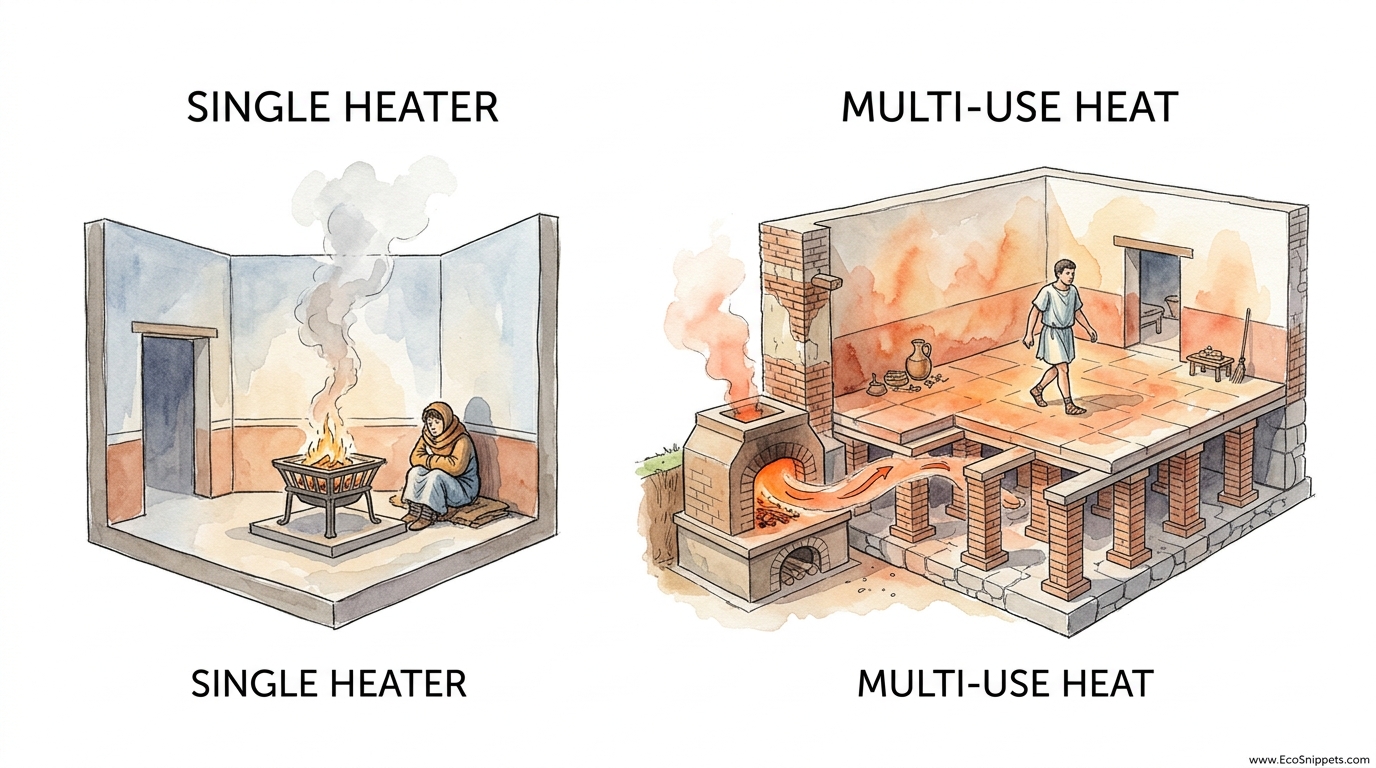
What if one fire could heat your floor, your walls, and your shower all at the same time? The Romans looked at a fire and didn’t just see light; they saw a resource. Their ‘Hypocaust’ system used hollow bricks to pipe hot air under the entire house, turning the structure itself into a giant battery. Most modern homes use ‘single-use’ heat that escapes through the ceiling. It is time we start building for multi-use thermal mastery again.
The concept of radiant warmth is as old as civilization itself, yet it feels like a revelation in an age of rattling air ducts and cold tile. When you step onto a floor that has been kissed by the sun—or in this case, by the exhaust of a carefully managed fire—you aren’t just warm; you are comfortable in a way that air-based heating can never replicate. This is the difference between being “heated” and being “held” by your environment.
To understand the Roman approach is to understand that the house is not just a container for people, but a tool for living. By capturing the thermal energy that most of us vent out of a chimney, we can create spaces that stay warm for hours, or even days, after the last log has turned to ash. This guide will walk you through the mechanics of the ancient hypocaust, its medieval successors, and how the same principles can be applied to modern homesteads and off-grid builds.
Whether you are a serious practitioner looking to install a rocket mass heater or a curious beginner fascinated by ancestral wisdom, the logic of the hypocaust offers a path toward true self-reliance. We aren’t just looking at history; we are looking at a blueprint for a more resilient future.
Roman Hypocaust Underfloor Heating Explained
The Roman hypocaust was the first true central heating system in the Western world. The name itself comes from the Greek words hypo (under) and caust (burnt), literally meaning “heat from below.” This system was a marvel of civil engineering that allowed the Roman Empire to expand into the shivering climates of Northern Gaul and Britain without sacrificing the comforts of the Mediterranean.
At its core, a hypocaust is a raised floor system supported by hundreds of small pillars, or pilae. These pillars were typically made of square or circular bricks, stacked about two feet (60 cm) high. Above these pillars sat the suspensura, or the living floor, which was a thick sandwich of tile, concrete, and often decorative marble or mosaic.
The heat originated in a furnace called a praefurnium, located outside the main living area. This was not a small fireplace; it was a roaring combustion chamber designed to move massive volumes of hot air and smoke. Because the floor was suspended on the pilae stacks, the heat from the furnace was drawn into the void beneath the rooms.
The brilliance of the system didn’t stop at the floor. In more advanced structures, Roman engineers embedded hollow clay tiles called tubuli into the walls. These functioned as vertical flues, pulling the hot air up from the floor void and through the walls before venting it at the roofline. This created a 360-degree cocoon of radiant heat, warming the very fabric of the building.
The hypocaust was primarily a feature of public bathhouses (thermae) and the villas of the elite. In the baths, the system was so powerful that the floor in the caldarium (the hot room) was often too hot to touch with bare feet, requiring bathers to wear wooden-soled sandals. This wasn’t just a luxury; it was a way to maintain consistent temperatures in massive stone buildings that would otherwise be damp and cold.
How the Hypocaust Works: The Physics of Thermal Mastery
To build or understand a hypocaust system, you must first grasp the three modes of heat transfer: conduction, convection, and radiation. The Roman system masterfully manipulated all three to turn a single fire into a whole-home climate control solution.
Convection: The Engine of Movement
The system relies on the basic principle that hot air is less dense than cold air and will always seek to rise. As the fire in the praefurnium burns, it creates a powerful draft. This draft pulls the hot combustion gases through the sub-floor void. By placing the chimney or wall flues on the opposite side of the building from the furnace, the Romans ensured that the heat had to travel across the entire surface area of the floor before escaping.
Conduction: Storing the Energy
As the hot air moves beneath the floor, it transfers its energy to the pilae stacks and the thick suspensura above. This is where material choice becomes critical. Materials like brick, stone, and lime concrete are excellent conductors of heat but have high thermal mass. They soak up the heat slowly and hold onto it with incredible tenacity.
Radiation: The Comfort Factor
Once the floor and walls are saturated with heat, they begin to emit infrared radiation. Unlike forced-air systems that merely warm the air around you (which then quickly rises to the ceiling where it is useless), radiant heat warms the objects and people in the room directly. This creates a deep, “bone-warming” sensation that allows you to feel comfortable at lower air temperatures.
The Structural Components
For a practitioner looking to replicate these principles, understanding the specific dimensions and materials is vital.
- The Furnace (Praefurnium): Usually a stone or brick arched opening. It needs to be large enough to handle significant fuel but designed to create a strong horizontal draft.
- The Pillars (Pilae): Typically 8-inch (20 cm) square bricks stacked roughly 2 feet (60 cm) high. They are spaced to provide support for the floor above without obstructing the airflow.
- The Floor (Suspensura): A multilayered slab. The bottom layer is often a large tile (bipedalis), followed by a layer of mortar or concrete, and finally the decorative finish. Total thickness was often 6 to 10 inches (15–25 cm).
- The Flues (Tubuli): Box-shaped tiles integrated into the masonry walls. These ensure the smoke and heat don’t just sit under the floor but are actively “pulled” through the structure.
The Successors: Gloria and Ondol
While the Roman Empire eventually collapsed, the wisdom of heating from below did not vanish. It evolved into two distinct regional systems that offer incredible insights for modern self-reliant builders: the Spanish Gloria and the Korean Ondol.
The Spanish Gloria
In the high, cold plateaus of Castile, the Gloria system emerged as a medieval evolution of the hypocaust. Unlike the Roman system, which required vast amounts of wood, the Gloria was designed for efficiency. It used an external firebox where the fire was covered with metal plates to slow the combustion rate. This allowed the system to burn low-quality fuels like vine cuttings, straw, or twigs while still keeping the floor warm for 24 hours with a single firing.
The Korean Ondol (Gudeul)
Perhaps the most sophisticated version of ancient underfloor heating is the Korean Ondol. In a traditional Korean house (Hanok), the fire used for cooking in the kitchen was also the furnace for the home’s heating. The smoke and heat were channeled through horizontal stone flues beneath the floor. A unique feature of the Ondol is the gaejari—a deep pit at the end of the flue that traps ash and helps regulate the draft.
A Comparison of Systems
| System | Primary Fuel | Main Advantage | Key Challenge |
|---|---|---|---|
| Roman Hypocaust | Hardwood / Charcoal | 360-degree radiant heat (walls + floors) | High labor and fuel consumption |
| Spanish Gloria | Twigs, Straw, Waste | Extreme fuel efficiency / slow burn | Slow response time (high lag) |
| Korean Ondol | Cooking fires (Biomass) | Multi-use (Cook + Heat simultaneously) | Requires precise masonry for smoke seal |
| Modern Hydronic | Electricity / Gas / Solar | Precise temperature control | Highly dependent on external infrastructure |
Benefits of Radiant Thermal Mastery
Why would a modern builder look backward to a 2,000-year-old Roman design? The benefits are measurable and, in many ways, superior to modern HVAC systems.
1. Unmatched Comfort
Radiant heat provides a vertical temperature profile that is ideal for human biology. In a forced-air home, your head is often warm while your feet are cold. In a hypocaust-style system, the floor is the warmest part of the room. This “warm feet, cool head” environment is widely considered the pinnacle of indoor comfort.
2. High Thermal Inertia
Because the system heats a massive slab of stone or concrete, it acts as a thermal battery. If your fire goes out in the middle of the night, the floor will continue to radiate heat for many hours. This provides a safety margin that is essential for off-grid living in harsh climates.
3. Improved Air Quality
Forced air systems circulate dust, allergens, and pathogens. They also tend to dry out the air, leading to respiratory discomfort. A hypocaust system has no moving air in the living space. The air stays still, clean, and at a more natural humidity level.
4. Fuel Versatility
Modern furnaces require specific, refined fuels (natural gas, propane, or highly seasoned pellets). A masonry-based system like the Gloria or a Rocket Mass Heater can effectively use “marginal” fuels—branches, small-diameter “trash wood,” and agricultural waste—that would be useless in a standard wood stove.
Common Challenges and Mistakes
Building a system that involves piping fire and smoke beneath your feet is not without risk. Historical records and modern reconstructions highlight several critical areas where things can go wrong.
The Silent Killer: Carbon Monoxide
The most significant risk in any hypocaust-style system is a breach in the floor or wall flues. If smoke and gases leak into the living area, it can lead to carbon monoxide poisoning. The Romans mitigated this by using high-quality lime mortars and ceramic tiles that expanded and contracted at similar rates. Modern builders must ensure an airtight seal using appropriate refractory cements and thorough testing.
Condensation and Creosote
If the exhaust gases cool down too much before they exit the chimney, they can deposit creosote (in wood-burning systems) or moisture (in gas systems). This is especially dangerous in horizontal flues. Maintaining a strong draft and ensuring the flue stays above the “dew point” of the exhaust gas is essential for safety and longevity.
The Weight Factor
A true hypocaust system involves hundreds of pounds—sometimes tons—of masonry. This cannot be built on a standard 2×10 wooden floor joist system. It requires a dedicated concrete slab or a reinforced foundation that can handle the massive dead load.
Limitations: When This May Not Be Ideal
Despite its majesty, the hypocaust is not a “plug-and-play” solution for every home.
Thermal Lag (Response Time)
A masonry floor can take 4 to 12 hours to reach its operating temperature. If you are someone who likes to turn the heat up and feel it instantly, you will be frustrated. This system is designed for constant-state heating, not intermittent use. It is perfect for a primary residence but poorly suited for a weekend cabin that you only visit for 48 hours.
Zoning Complexity
In a modern home, you can easily turn off the heat in an guest bedroom. In a hypocaust, the heat is part of the structure. While you can design “shut-off” dampers for specific flues, the thermal mass of the building tends to normalize the temperature across all connected rooms.
Retrofitting Difficulty
Installing a Roman-style hypocaust into an existing modern home is almost impossible without a total gut renovation. It is fundamentally a new construction or “major addition” technology.
Advanced Considerations for Practitioners
For those looking to actually build a system inspired by these principles, here are the technical nuances that separate a successful build from a smoky failure.
Calculating Thermal Mass and Lag
Thermal lag is the time it takes for heat to travel from the furnace through the floor thickness to the surface.
- Concrete: Roughly 1 inch per hour. A 4-inch slab has a 4-hour lag.
- Adobe/Cob: Slower than concrete; roughly 0.75 inches per hour.
- Brick: Faster than adobe; similar to concrete.
A “pioneer” builder in a climate with 40-degree (F) / 22-degree (C) diurnal temperature swings would aim for an 8-to-10 hour lag. This ensures the heat from an evening fire reaches the floor surface during the coldest pre-dawn hours.
Draft and The “Stack Effect”
To move air horizontally through a subfloor, you need a powerful vertical pull at the end. This is the stack effect. Your chimney must be tall enough and stay warm enough to create the pressure differential required to “suck” the heat through the floor. In Rocket Mass Heaters, this is achieved through a heat riser—an insulated vertical combustion chamber that creates a localized, high-velocity draft before the air is pushed into the horizontal mass.
Access and Maintenance
Soot happens. Even the cleanest-burning fire will eventually deposit ash in the subfloor void. The Romans built their pilae stacks with enough space for a small person (usually a slave) to crawl in and clean the soot. In a modern DIY version, you must include clean-out ports—removable plugs or doors—at every 90-degree turn and every 10 feet of horizontal run.
Practical Example: The Modern Homestead “Gloria”
Imagine a small, 600-square-foot (55 sq m) off-grid cabin. Instead of a standard wood stove that creates a “hot zone” near the fire and a “cold zone” by the door, the builder installs a modern Gloria-inspired system.
The furnace is a Rocket Batch Box located in a small utility “lean-to” on the side of the cabin. The exhaust from this high-temperature burn is routed into 8-inch (20 cm) heavy-duty steel pipes. These pipes are laid in a serpentine pattern across the floor area, which has been prepped with a 4-inch (10 cm) layer of gravel for insulation.
The pipes are then buried in 8 inches (20 cm) of compacted cob (a mix of clay, sand, and straw) and topped with a 2-inch (5 cm) flagstone floor.
- Fueling: The builder burns one large armload of wood at 6:00 PM.
- Heat Transfer: The 1,000-degree (537 C) exhaust gases pass through the pipes, dumping their energy into the cob and stone.
- Surface Temp: At 6:00 PM, the floor is cool. By 10:00 PM, it is pleasantly warm. By 4:00 AM, the floor is at its peak temperature (roughly 80°F / 27°C), keeping the cabin toasty even as the outside temperature drops to 10°F (-12°C).
- The Result: One fire, 24 hours of comfort.
Final Thoughts on Thermal Mastery
Building for multi-use thermal mastery is an act of defiance against a disposable culture. The Romans understood that energy is precious and that the structures we inhabit should work for us, not just house us. By utilizing the principles of the hypocaust, we move away from “single-use” heat and toward a system that integrates comfort, cooking, and structural longevity.
True self-reliance isn’t just about having a pile of wood; it’s about having the wisdom to make that wood go four times further. Whether you choose to build a traditional masonry heater, a modern rocket mass bench, or a full underfloor air-transfer system, you are engaging in a tradition of engineering that has kept humanity warm for millennia.
Start small. Experiment with thermal mass in a greenhouse or a workshop. Once you feel the steady, silent, and enveloping warmth of a stone floor, you will never want to go back to the rattling of a furnace again. The Romans may be gone, but their fire is still waiting to be lit.
