How To Become More Self-Sufficient Without Starting a Full-Blown Farm…
Want to start preserving your harvest, making your own soap, or building a backyard root cellar — but not sure where to begin? “Homesteading Advice” gives you instant lifetime access to 35+ practical homesteading books on food preservation, veggie gardening, DIY natural cleaning products (save over $250 per year with this skill alone), brewing, off-grid energy, and a whole lot more…
Click Here To Check It Out Now!
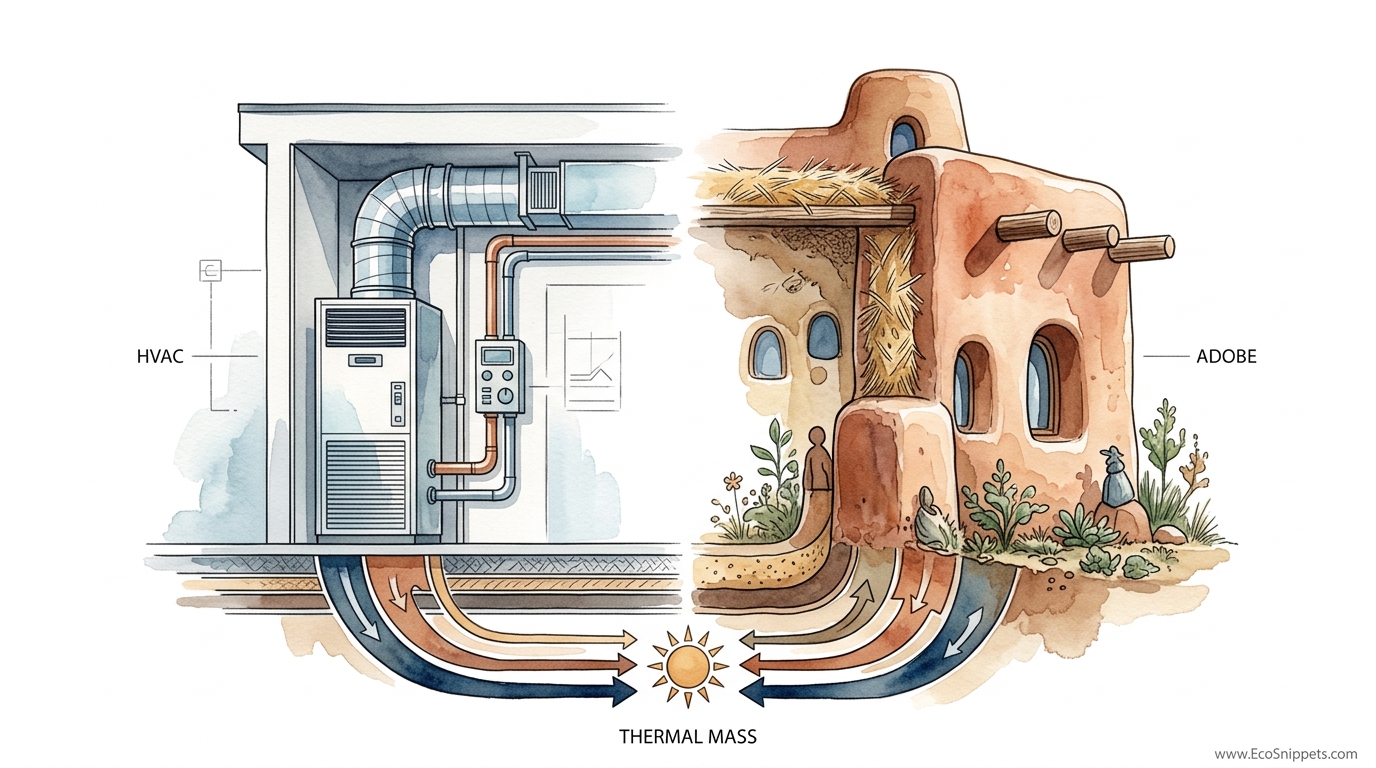
Is your comfort dependent on a circuit breaker, or can your walls do the cooling for you? We traded 2-foot-thick earthen walls for 4 inches of drywall and a monthly utility bill. While the grid struggles to keep up with the heat, ancient building techniques are keeping homesteaders cool for zero dollars. Learn why thermal mass is the ultimate resilient alternative to modern HVAC dependency.
The modern world has largely forgotten how to build for the long haul. We rely on thin membranes of wood and fiberglass to separate us from the elements, using massive amounts of electricity to force our indoor air into submission. This approach is fragile, expensive, and entirely dependent on a functional energy grid. If the power fails during a heatwave or a cold snap, a modern “stick-frame” house becomes an oven or an icebox within hours.
Ancestral builders knew better. From the adobe pueblos of the American Southwest to the stone farmhouses of Europe, our ancestors used the weight of the earth to regulate their lives. This concept is known as thermal mass, and it is the cornerstone of passive solar design and permaculture architecture. It is not a new technology; it is the rediscovery of physics that has governed human comfort for millennia.
Choosing to incorporate thermal mass into your homestead is a declaration of independence. It means your home is no longer a passive consumer of energy, but an active participant in the local climate. Understanding how to harness this “heat battery” allows you to store the sun’s energy during the day and release it when you need it most, creating a living space that breathes with the rhythms of the earth rather than the hum of a compressor.
The Science Of Thermal Mass In Permaculture Design
Thermal mass refers to the ability of a material to absorb, store, and eventually release heat energy. In the context of permaculture and building design, we think of it as a thermal battery. Just as an electrical battery stores electrons for later use, a thermally massive material stores calories of heat. The denser and heavier a material is, the more potential it has to function as thermal mass. Common materials include stone, brick, concrete, adobe, cob, and even water.
To understand the science, we must look at a material’s specific heat capacity. This is the amount of heat energy required to change the temperature of a specific amount of mass by one degree. Water has an incredibly high specific heat capacity, meaning it can hold a vast amount of energy before it actually gets “hot.” Dense earth and stone have lower specific heat capacities than water, but because they are so heavy, their volumetric heat capacity is significant. They can soak up the sun’s radiation all day without the room’s air temperature spiking.
Another critical concept is thermal lag, also known as phase shift. This is the time it takes for heat to travel from the outside of a wall to the inside. A well-designed 12-inch (30 cm) adobe wall might have a thermal lag of 8 to 12 hours. This means the peak heat of the midday sun doesn’t reach the interior of the home until the middle of the night, when the outside air has cooled down and the warmth is actually welcomed. Conversely, the “coolth” of the night is stored in the walls and radiates inward during the following day.
In permaculture, we also discuss thermal damping. This is the reduction in the amplitude of temperature fluctuations. If the outside temperature swings between 40°F (4°C) at night and 90°F (32°C) during the day, a high-mass home might only fluctuate between 68°F (20°C) and 74°F (23°C). The mass “dampens” the extremes, creating a stable, predictable environment that is far more comfortable for humans, plants, and animals alike.
How to Design with Thermal Mass
Designing with thermal mass requires a shift in perspective. You are not just building a box; you are orienting a collector and a battery. The first step is always site analysis. You must understand the sun’s path across your property throughout the seasons. In the Northern Hemisphere, your primary thermal mass elements should be placed where they can “see” the low winter sun from the south. In the Southern Hemisphere, they should face north.
Direct gain is the most common technique. This involves placing high-mass materials, such as a slate floor or a brick interior wall, directly in the path of sunlight coming through windows. The sun’s rays strike the dark, heavy surface, and the energy is absorbed through conduction. To optimize this, use dark colors for your mass elements, as they have higher solar absorptance. A light-colored concrete floor will reflect heat away, whereas a dark-stained one will drink it in.
Indirect gain utilizes a buffer between the sun and the living space. A classic example is the Trombe wall. This is a thick masonry wall painted black and covered with a layer of glass on the exterior. There is a small air gap between the glass and the wall. The sun heats the wall and the air in the gap. The heat then slowly migrates through the masonry into the home. Vents at the top and bottom of the wall can allow for convective loops, pulling cool air from the floor and venting warm air into the room during the day.
Isolated gain involves a separate space, like a sunroom or greenhouse, attached to the home. The thermal mass is located within this “sun-catcher” room. During the day, the sunroom heats up, and at night, the heat is allowed to enter the main house through doors, windows, or vents. This is particularly useful for homesteaders who want to grow food year-round, as the mass in the greenhouse protects the plants from frost while also contributing to the home’s heating needs.
The “Golden Rule” for mass-to-glass ratios is a helpful starting point. Generally, for every square foot of south-facing glass (Northern Hemisphere), you need between 3 and 6 cubic feet of thermal mass inside the insulated envelope. If you have too much glass and not enough mass, the house will overheat in the afternoon and cool down too quickly at night. If you have too much mass and not enough glass, the house may stay perpetually chilly because the sun can never “charge” the battery.
The Benefits of Living in a High-Mass Home
The most immediate benefit is the reduction—or total elimination—of utility bills. By letting the sun do the work of heating and the earth do the work of cooling, you bypass the need for expensive mechanical systems. This leads to a level of resilience that modern homes simply cannot match. If the power grid fails, your home remains habitable. This is “passive” technology in the truest sense; it works because of what it is, not because of what it consumes.
The quality of heat provided by thermal mass is also vastly superior to forced-air systems. High-mass materials provide radiant heat. Radiant heat warms objects (including people) directly, rather than just heating the air. It feels like the warmth of the sun on your skin even on a cold day. Because the air itself isn’t being blown around by fans, there are fewer drafts, less dust, and a more stable humidity level, which is much better for respiratory health.
Acoustic comfort is an often-overlooked advantage. Heavy materials like stone, earth, and thick concrete are incredible sound insulators. A high-mass home is remarkably quiet. The thick walls dampen the sound of wind, rain, and passing traffic, creating a sanctuary-like environment. This silence contributes to the overall sense of well-being and groundedness that many people report when living in natural, heavy-walled structures.
Finally, there is the benefit of longevity. Modern stick-frame homes have a functional lifespan that is often measured in decades. Earthen and masonry buildings, when properly maintained, can last for centuries. By building with thermal mass, you are creating a legacy. You are constructing a shelter that will likely outlive you, providing comfort for future generations with the same efficiency it provides today.
Challenges and Common Pitfalls
One of the most frequent mistakes is confusing thermal mass with insulation. They are not the same thing. Insulation (like straw bale, wool, or foam) resists the flow of heat; it is like a blanket. Thermal mass (like concrete or stone) stores heat; it is like a hot water bottle. If you build a home with massive stone walls but no insulation, the heat you store will eventually leak out to the cold exterior. In cold climates, the “mass” should be on the inside of the “insulative” layer.
Another pitfall is the “Overheating Trap.” Designers sometimes get excited about solar gain and install massive windows without calculating the necessary mass to soak up that energy. Without enough mass, the indoor temperature can easily climb to 85°F or 90°F (30°C+) on a sunny winter day, forcing you to open windows and waste the very energy you were trying to capture. Proper shading, such as roof eaves or deciduous trees, is essential to block the high summer sun while letting in the low winter sun.
Moisture management is also a critical challenge, especially with earthen materials like cob or adobe. While these materials have excellent thermal properties, they can be vulnerable to “rising damp” or driving rain. You must provide a “good hat and good boots”—a wide roof overhang and a solid, waterproof foundation—to protect the mass from liquid water. If the mass becomes saturated, its thermal performance drops significantly, and structural integrity can be compromised.
Limitations: When High Mass is Not Ideal
Thermal mass is not a universal solution for every climate. Its effectiveness relies heavily on the diurnal temperature swing—the difference between daytime highs and nighttime lows. In regions where the temperature stays relatively constant (such as the humid tropics where it is 80°F/27°C day and night), thermal mass can actually be a disadvantage. It can soak up the daytime heat and then keep the house uncomfortably warm all night because there is no cool night air to “flush” the mass.
In extremely cold, cloudy climates with very little winter sun, thermal mass can also be a liability. Without the sun to charge it, the mass becomes a “cold sink.” It will take a massive amount of internal energy (from a wood stove or heater) to warm up those heavy walls before the occupants feel comfortable. In these environments, focusing on a highly insulated “lightweight” envelope (like straw bale or double-stud framing) is often more efficient than relying on solar mass.
Practical constraints like cost and labor also play a role. Building with heavy materials is physically demanding and often more expensive upfront than standard timber framing. Moving tons of stone, earth, or concrete requires specialized equipment or a lot of community labor. If you are on a tight budget or have limited physical ability, you must weigh the long-term energy savings against the immediate investment of sweat equity and capital.
Comparing Building Approaches
To better understand how thermal mass fits into the broader world of construction, it is helpful to compare it to modern standards. While both aim for comfort, they use fundamentally different mechanisms.
| Feature | Modern HVAC/Stick-Frame | Ancestral Adobe/Thermal Mass |
|---|---|---|
| Mechanism | Active (mechanical air movement) | Passive (heat storage/radiation) |
| Energy Source | Electricity/Gas (Continuous) | Solar Radiation (Periodic) |
| Maintenance | High (Filters, motors, tech) | Low (Structural integrity) |
| Longevity | 30–60 Years | 100–500+ Years |
| Resilience | Low (Fails without power) | High (Grid-independent) |
| Typical R-Value | High (with insulation) | Variable (often low, requires thickness) |
The choice between MODERN HVAC and ANCESTRAL ADOBE isn’t always an either-or scenario. Many modern high-performance homes use a hybrid approach: they use high-tech insulation for the envelope and then strategically place thermal mass inside to stabilize the interior temperature. This combines the best of both worlds—resistance to heat flow and the ability to store free energy.
Practical Tips for the Modern Homesteader
You don’t need to build a new house to benefit from thermal mass. Small, intentional additions can make a noticeable difference in your current home’s comfort. If you have a sunny room, consider replacing the carpet with ceramic or stone tile. The weight of the tile will act as a mini-battery, smoothing out the afternoon heat spikes. Even a large collection of heavy potted plants or a decorative stone feature wall can provide some thermal damping.
Water is the most efficient thermal mass material available to the DIYer. It has about four times the heat capacity of concrete by weight. You can create “water walls” using recycled 55-gallon (200-liter) drums painted black and filled with water. Placed in a south-facing window (or north-facing in the Southern Hemisphere), these barrels will soak up an enormous amount of solar energy. At night, they radiate that heat back into the room. This is a common and highly effective strategy in off-grid greenhouses.
Internal masonry is another powerful tool. If you are remodeling, consider adding a heavy brick or stone chimney or a “mass wall” in the center of the house. By keeping the mass away from the exterior walls, you ensure that the heat it stores stays inside the living space. This internal mass acts as a stabilizer for the entire home, absorbing excess heat from the kitchen or the sun and releasing it during the early morning hours.
Advanced Considerations: The Rocket Mass Heater
For those serious about self-reliance, the Rocket Mass Heater (RMH) is the pinnacle of thermal mass engineering. A standard wood stove is “mass-less”; it gets very hot and sends most of its energy up the chimney, cooling down the moment the fire goes out. An RMH uses a specialized combustion chamber to burn wood at extremely high temperatures, and then it snakes the exhaust through a long, heavy masonry bench (usually made of cob or brick) before exiting the building.
The thermal mass of the bench absorbs nearly all the heat from the exhaust gases. By the time the air leaves the house, it is often barely warm to the touch. The hundreds of pounds of earth in the bench then slowly radiate that heat for 12 to 24 hours after the fire has been extinguished. You can burn a small bundle of sticks for two hours in the evening and wake up to a warm house and a warm bed the next morning. It is a masterful application of physics that reduces wood consumption by up to 80%.
Scaling these systems requires careful calculation. If the mass is too large for the heater’s output, it will never reach a comfortable temperature. If it is too small, you won’t maximize the storage potential. Advanced practitioners also consider the “decrement factor,” which is the ratio between the outside temperature swing and the inside temperature swing. Tuning these factors allows for a home that feels almost “automated” in its climate control, without a single sensor or wire.
Example Scenario: The High-Desert Homestead
Consider a homestead in a high-desert environment, such as Northern Arizona or the Spanish Interior. In these regions, the summer sun is brutal, with daytime highs reaching 100°F (38°C), but the clear skies allow the heat to radiate away at night, dropping temperatures to 60°F (15°C). This 40-degree diurnal swing is the perfect playground for thermal mass.
A designer might build a home with 18-inch (45 cm) thick rammed earth walls. During the day, the exterior of the wall is hammered by the sun, but because of the thermal lag, that heat takes 10 hours to move through the wall. Inside, the air remains a cool 72°F (22°C) because the massive walls were “pre-cooled” by the 60°F night air. The windows are shaded by deep overhangs so no direct sun enters the house during the day.
By 8:00 PM, the outside air has dropped to 70°F and is falling fast. This is when the heat from the midday sun finally reaches the interior surface of the rammed earth. As the family gets ready for bed, the walls begin to glow with a gentle, radiant warmth. By 3:00 AM, when it is 55°F (13°C) outside, the house is still a comfortable 68°F (20°C). The cycle repeats the next day, using nothing but the weight of the earth and the timing of the sun.
Final Thoughts
Thermal mass is more than just a building technique; it is a philosophy of resilience. It asks us to stop fighting the climate and start working with it. By choosing materials that have “grit”—materials that are heavy, dense, and enduring—we create structures that provide for us rather than demanding constant maintenance and external inputs. It is a return to a more stable, grounded way of living that values physics over gadgets.
Whether you are building a new cob cottage, installing a rocket mass heater, or simply placing a few water barrels in your greenhouse, you are participating in a tradition of ancestral wisdom. This approach to design rewards observation and patience. It requires you to know your site, to watch the shadows, and to understand the weight of the world around you. The result is a home that is not just a shelter, but a partner in your survival.
As we move into an era of increasing energy uncertainty and climatic extremes, the lessons of thermal mass become more vital than ever. We cannot always rely on the grid, but we can always rely on the sun to rise and the earth to hold its heat. Start small, experiment with the materials at your feet, and discover the quiet power of the thermal battery. Your comfort, and your independence, may just depend on it.
