How To Become More Self-Sufficient Without Starting a Full-Blown Farm…
Want to start preserving your harvest, making your own soap, or building a backyard root cellar — but not sure where to begin? “Homesteading Advice” gives you instant lifetime access to 35+ practical homesteading books on food preservation, veggie gardening, DIY natural cleaning products (save over $250 per year with this skill alone), brewing, off-grid energy, and a whole lot more…
Click Here To Check It Out Now!
You don’t need a bigger battery bank; you just need to stop using energy when the sun isn’t looking. The most expensive part of any solar system isn’t the panels – it’s the batteries. Most people build a ‘Static’ system that stores power to use whenever they want. But by ‘Dynamically’ shifting your heaviest tasks – like pumping water or milling grain – to peak sunlight hours, you can cut your battery needs in half and save thousands of dollars instantly.
Building a solar setup often feels like an arms race against your own consumption. You add more panels, then you realize your battery bank is too small to last through a rainy Tuesday, so you buy more lithium. This cycle of buying your way out of energy scarcity is a modern trap. Our ancestors understood that work happens when the conditions are right, and we can apply that same wisdom to our electrical systems today.
Solar load shifting is the art of matching your appetite for power with the sun’s peak output. It is a fundamental shift in how we relate to our environment. Instead of forcing the sun’s energy into a chemical box to be used later at a loss, we use it directly as it falls. This approach treats your appliances as the primary consumers and your batteries as a small, emergency reserve rather than a massive warehouse.
Solar Load Shifting For Beginners
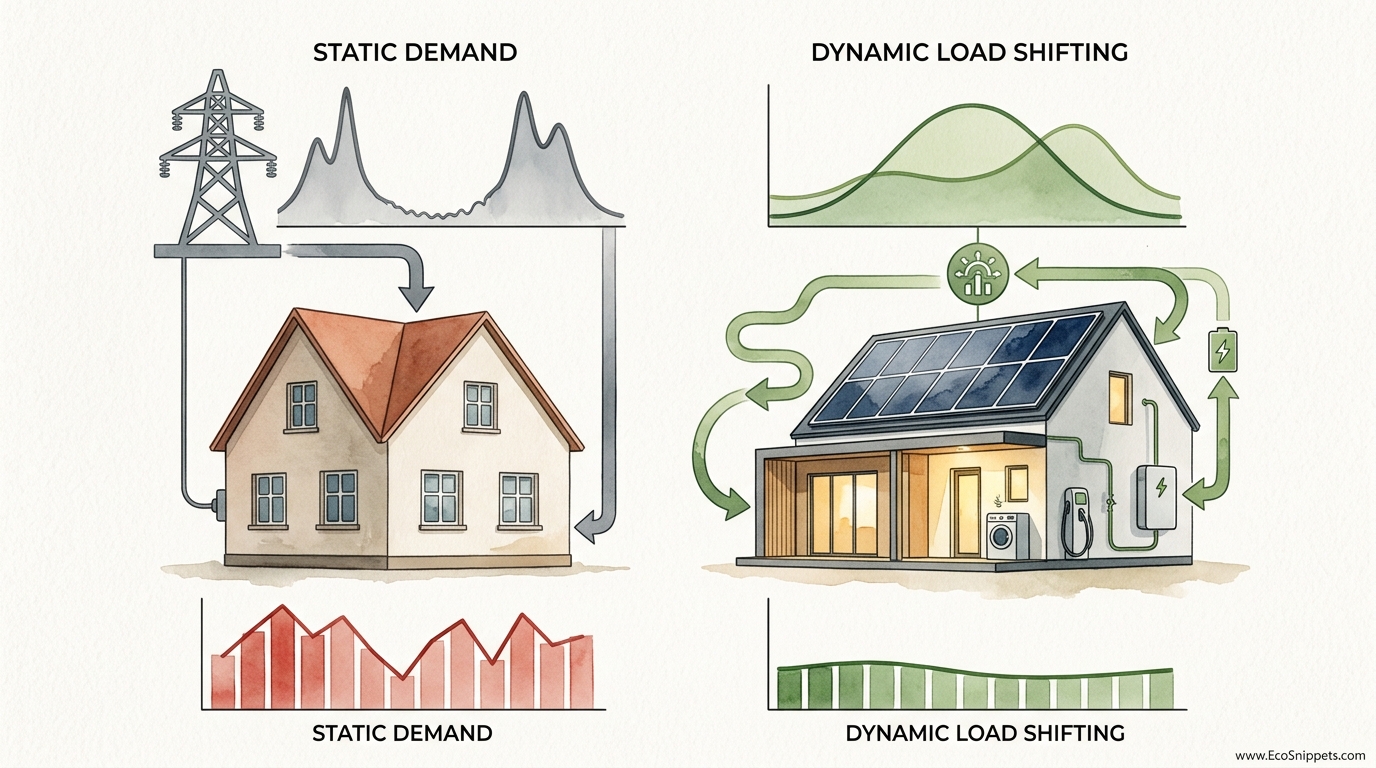
At its simplest, solar load shifting is the practice of moving your most energy-intensive activities to the middle of the day. Most households follow a “Static Demand” pattern where energy is used whenever it is convenient. This usually results in a massive spike in the morning and an even larger one in the evening when everyone returns home and the sun has already set.
In a traditional grid-tied home, this doesn’t feel like a problem because the utility company acts as an infinite battery. However, in an off-grid or solar-heavy system, this pattern is incredibly inefficient. Shifting those loads means you are essentially “using it while you have it.” It is the difference between eating a fresh meal directly from the garden versus canning it, storing it, and reheating it months later.
Real-world examples are everywhere once you start looking for them. A farmer might wait until 11:00 AM to start the deep-well pump, filling a 5,000-liter (1,320-gallon) tank while the panels are at 90% capacity. A homesteader might choose to mill 20 kilograms (44 pounds) of grain for flour during the brightest window of the afternoon. These tasks require massive amounts of “surge” and “bulk” energy that would otherwise punish a battery bank.
Load shifting exists because the “round-trip efficiency” of a battery is never 100 percent. You lose energy when you push it into the battery (charging) and you lose more when you pull it back out (discharging). Shifting your load to the daytime bypasses the battery entirely. This ensures that every photon captured by your panels goes directly into productive work without the 10-20% loss common in chemical storage.
How Solar Load Shifting Works in Practice
The core principle involves understanding the “Solar Noon” curve. Your solar panels do not produce a flat line of energy from dawn to dusk; they produce a bell curve that peaks when the sun is highest in the sky. Shifting your load is about moving the “blobs” of energy consumption from the dark edges of the day into the high center of that curve.
To do this effectively, you must first categorize your loads into “Static” and “Dynamic.” Static loads are things that must run regardless of the sun, such as a refrigerator, a Wi-Fi router, or medical equipment. Dynamic loads are flexible tasks that can wait. Identifying these allows you to create a schedule that respects the limits of your system.
Manual shifting is the most reliable and low-cost method. It requires nothing more than a change in habits and perhaps a few simple mechanical timers. You might set your dishwasher to run at 1:00 PM instead of after dinner. You could plug in your electric vehicle or power tool batteries only when you see the “Charge” light on your controller glowing green.
Technological solutions can take the guesswork out of the process. Modern “Smart Loads” or Energy Management Systems (EMS) can be programmed to trigger specific circuits only when the battery is above a certain voltage. For instance, a water heater could be set to divert “excess” power once the primary house batteries are full. This is often called “diversion loading” or “dump loading,” and it is the pinnacle of solar efficiency.
Benefits of Shifting Your Energy Usage
The most immediate benefit is the massive reduction in capital expenditure. A typical 10kWh lithium battery bank can cost between $4,000 and $7,000 depending on the brand and installation complexity. If you can shift half of your daily needs to sunlight hours, you might only need a 5kWh battery. This puts thousands of dollars back in your pocket from day one.
Battery longevity is another hidden advantage. Every time you drain a battery to run a heavy appliance at night, you are using up one of its limited “cycles.” Most high-quality Lithium Iron Phosphate (LiFePO4) batteries are rated for 3,000 to 6,000 cycles. Using the sun directly during the day means your batteries stay at a high state of charge, which significantly extends their functional lifespan.
Self-reliance grows when you are no longer dependent on a massive, fragile storage system. When you learn to work with the sun, you become more resilient to equipment failures. If one of your batteries dies in a “Static” system, you are in the dark. In a “Dynamic” system, you simply adjust your heavy work to the daylight hours and continue your life with minimal disruption.
There is also a profound psychological satisfaction in aligning your life with natural rhythms. There is a “pioneer-grit” mentality that comes from knowing you are harvesting energy at its source. You stop viewing the sun as an abstract source of “juice” and start seeing it as a partner in your daily labor. This connection to the environment fosters a deeper understanding of conservation and efficiency.
Common Challenges and Mistakes to Avoid
One of the most frequent errors is forgetting that weather is unpredictable. A user might schedule a massive laundry day for noon, only for a heavy cloud bank to roll in at 11:30 AM. If the system isn’t monitored, the washing machine will start pulling that heavy load from the batteries instead of the sun. This “hidden drain” can leave you with empty batteries by nightfall.
Complexity can also be a pitfall for beginners. It is tempting to buy expensive automated controllers and smart plugs for every device in the house. However, every “smart” device has its own parasitic power draw. If you have twenty smart plugs each drawing 1 or 2 watts, you are wasting nearly 1kWh of energy every single day just to “save” energy.
The “Convenience Tax” is the biggest hurdle for most families. Shifting loads requires a change in lifestyle that not everyone is willing to embrace. Waiting to take a hot shower until the solar water heater has had four hours of sun, or doing the vacuuming on a Saturday afternoon instead of Friday night, can feel like a burden. Without buy-in from everyone in the household, a load-shifting strategy will eventually fail.
Overloading the inverter is another technical risk. When you move all your heavy tasks to the same two-hour window, you might accidentally start the well pump, the toaster, and the wood splitter at the same time. This can exceed the “surge” capacity of your inverter and cause a system shutdown. Proper load shifting involves staggering the tasks throughout the daylight window, not dumping them all at once.
Limitations and Realistic Constraints
Solar load shifting is not a magic wand that eliminates the need for batteries entirely. You will always need a “Static” reservoir for lighting, refrigeration, and communications. Trying to shift 100% of your load is practically impossible and would lead to a very uncomfortable lifestyle. There is a point of diminishing returns where the effort of shifting a tiny load is greater than the cost of the battery capacity needed to run it.
Environmental factors such as latitude and season play a massive role. In northern regions during the winter, the “Solar Window” might only be four hours long. In these conditions, there simply isn’t enough time to shift every heavy task. You must recognize that your “Dynamic” capacity shrinks in the winter and grows in the summer, requiring a seasonal adjustment to your habits.
Critical loads should never be shifted to the point of risk. If you rely on a CPAP machine for sleep or an oxygen concentrator, these must be treated as “Static” loads with dedicated battery backup. Never gamble with essential health or safety equipment for the sake of saving a few cycles on a battery bank. Similarly, refrigeration for temperature-sensitive medicine must always be prioritized.
Geography and terrain can also create “shading” issues that shorten your productive window. If your panels are shaded by a mountain or a neighbor’s trees until 10:00 AM, your shifting window is naturally compressed. You must calculate your specific “Sun Hours” based on your local horizon, not just what a general solar map tells you.
Comparing the Two Approaches
To truly understand why shifting matters, we have to look at the numbers. The following table compares a standard “Static” setup where energy is used at will versus a “Dynamic” setup where loads are shifted to the sun.
| Feature | Static Demand (Standard) | Dynamic Load Shifting |
|---|---|---|
| Battery Size Required | Large (must cover all 24-hour needs) | Small to Medium (covers nighttime only) |
| System Efficiency | Lower (15-20% losses in batteries) | Higher (direct usage of PV energy) |
| Initial Setup Cost | Expensive (High battery investment) | Lower (More panels, fewer batteries) |
| Lifestyle Impact | None (Use power whenever) | Moderate (Tasks follow the sun) |
| Hardware Lifespan | Shorter (Batteries cycled heavily) | Longer (Batteries kept “topped off”) |
| Reliability | Depends on battery health | Depends on weather and habits |
As the table demonstrates, the primary trade-off is between convenience and cost. The Static system is “set and forget,” but you pay a massive premium for that luxury. The Dynamic system requires more active participation but rewards you with a more robust and affordable energy profile.
Practical Tips for Immediate Optimization
Start by auditing your heavy hitters. Appliances that generate heat (stoves, dryers, space heaters) or move large amounts of fluid (pumps, compressors) are your primary targets. A standard electric dryer can pull 5,000 watts, which is enough to cripple a small battery bank in minutes. Switching to a clothesline or only drying clothes during a sunny afternoon is the single most effective change you can make.
Use mechanical timers on your “dumb” appliances. You don’t need a Wi-Fi-connected dishwasher to load shift. A simple $10 plug-in timer can be set to turn the appliance on at noon. This removes the “human error” element of forgetting to press the start button during the solar peak. This is particularly useful for pool pumps or stock tank heaters on a farm.
Pre-cool or pre-heat your home during the day. This is a form of “Thermal Storage.” If you run your air conditioner at 20°C (68°F) during the peak sun hours, your home’s walls and furniture will act as a “coolth” battery. When the sun goes down, you can turn the AC off or set it to 24°C (75°F). The house will stay comfortable for hours using the thermal mass you “charged” during the day.
Manage your water storage like a battery. If you are off-grid, pumping water is one of your biggest energy expenses. Instead of a pressure tank that triggers the pump every time you flush a toilet, install a large gravity-fed reservoir at a high point on your property. Run your pump only when the sun is shining to fill the tank, and let gravity provide the pressure at night.
Advanced Considerations for Serious Practitioners
For those who want to take load shifting to the next level, Variable Frequency Drives (VFDs) are a game changer. A standard pump motor has a massive “inrush” current that can be 5 to 7 times its running wattage. A VFD allows the motor to “soft start,” slowly ramping up the speed. This prevents the massive voltage sag that often triggers inverter alarms during high-noon pumping.
Diversion controllers (also known as PWM dump loads) allow you to use “wasted” energy. Once your batteries reach their “float” stage, your charge controller begins to throttle the panels to prevent overcharging. That “lost” energy can be diverted to a DC heating element in your hot water tank. You are essentially turning excess electricity into hot water, which is a far cheaper way to store energy than buying more lead or lithium.
Inverters with “Load Assist” or “Peak Shaving” capabilities can help bridge the gap. These high-end units can be programmed to pull a specific amount of power from the batteries while taking the rest from the sun or a generator. This is useful for running tools that exceed your solar output. It allows you to “shave” the top off the energy spike, preventing an over-current trip while still utilizing every bit of available sunlight.
Ice-based thermal storage is another advanced technique often used in agricultural refrigeration. By using excess daytime power to freeze large blocks of ice or “eutectic plates,” you can keep a cold room at the proper temperature all night without the compressor ever turning on. This is particularly effective for storing produce or dairy products in remote areas where battery maintenance is difficult.
Real-World Scenarios and Success Stories
Consider the case of a small homestead in a mountainous region. The owner originally calculated they needed 20kWh of storage to run their electric wood-splitter and well pump. After seeing the $12,000 price tag for the batteries, they decided to pivot. They bought only 5kWh of batteries but doubled their solar panel array for a fraction of the cost.
They now split wood only on clear afternoons and pump their water into a 10,000-liter (2,640-gallon) hilltop tank twice a week. Their batteries are rarely discharged below 80%, and their system has run flawlessly for five years. By choosing a “Dynamic” lifestyle, they saved over $8,000 on their initial build and have never experienced a “low battery” shutdown.
In a suburban setting, a family used load shifting to tackle their high “Time-of-Use” (TOU) rates. They programmed their electric vehicle to charge between 10:00 AM and 2:00 PM while they were at work, utilizing their rooftop solar. They also moved their meal prep to the afternoon, using a slow cooker that starts at noon. Their monthly utility bill dropped from $250 to $15, despite not having a single home battery installed.
These stories illustrate that load shifting isn’t about “doing without.” It is about doing things at the right time. It is a strategy that rewards intelligence and observation over raw spending. Whether you are deep in the woods or in the heart of a city, the principles of working with the solar cycle remain the same.
Final Thoughts on Solar Load Shifting
Mastering the flow of energy is the ultimate skill for any modern pioneer. By moving your heavy tasks to the peak of the day, you break the cycle of expensive battery upgrades and fragile systems. You begin to treat energy as a living resource that waxes and wanes with the sky, rather than a commodity to be hoarded in a box.
This shift in perspective is the first step toward true energy independence. It requires a bit of grit to change old habits, but the financial and practical rewards are undeniable. You will find that your system runs cooler, your batteries last longer, and your connection to the natural world becomes a source of daily pride.
Start small by moving one or two tasks to high noon tomorrow. Watch your battery monitor and see the difference for yourself. As you get comfortable, you can add timers, diversion loads, and more complex strategies. The sun is providing the power for free; it is up to you to be there when it arrives.
