How To Become More Self-Sufficient Without Starting a Full-Blown Farm…
Want to start preserving your harvest, making your own soap, or building a backyard root cellar — but not sure where to begin? “Homesteading Advice” gives you instant lifetime access to 35+ practical homesteading books on food preservation, veggie gardening, DIY natural cleaning products (save over $250 per year with this skill alone), brewing, off-grid energy, and a whole lot more…
Click Here To Check It Out Now!
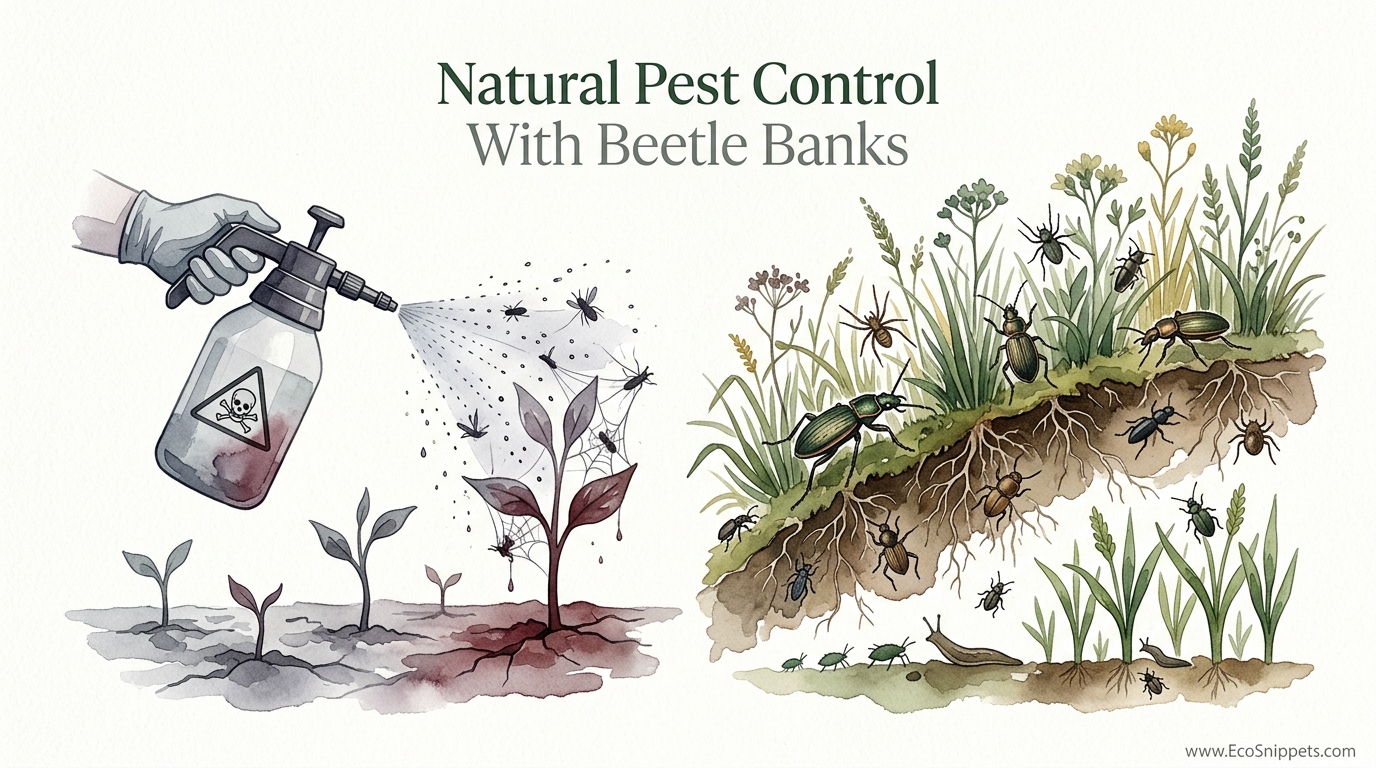
You can spend $200 on poison, or $0 on a permanent army of beneficial hunters. Why pay for chemicals that kill your soil when nature provides a security team for free? A Beetle Bank is a simple strip of bunchgrass that provides a winter home for the predators your garden needs. Once established, they do the hunting for you, 24/7, for zero dollars an hour.
The concept is rooted in the hard-earned wisdom of land management that predates the chemical era. For generations, farmers and gardeners understood that every pest has a shadow—a predator designed to keep its numbers in check. Modern practices often wipe out the shadow, leaving the land defenseless. Reclaiming this balance starts with a single, purposeful mound of earth and the right kind of grass.
Establishing a beetle bank is a commitment to self-reliance. It is an acknowledgment that the most effective tools in the garden are often the ones that have been there all along, waiting for a place to stay. This guide will walk you through the mechanics of building these “predator hotels” and how to manage them for lifelong pest control.
Natural Pest Control With Beetle Banks
A beetle bank is a raised earthen berm, typically between 0.4 meters (1.3 feet) and 0.5 meters (1.6 feet) high, specifically planted with perennial bunchgrasses. It serves as a permanent refuge for predatory insects, most notably ground beetles (Carabidae), rove beetles (Staphylinidae), and various species of spiders. These insects are the unsung heroes of the agricultural world, capable of consuming vast quantities of crop-destroying pests.
The strategy originated in Great Britain during the late 20th century as a response to the loss of traditional hedgerows. Hedgerows provided the dense, undisturbed grass bases that predators need to survive the winter. As fields grew larger and hedges were removed, these beneficial hunters lost their homes, and pest populations like aphids and slugs exploded. A beetle bank effectively recreates the most important part of a hedgerow—the grassy base—without the need for woody shrubs.
In a real-world agricultural setting, these banks are often placed in the middle of large fields. Research shows that most ground-dwelling predators will only forage about 250 meters (820 feet) away from their home base. If a field is 500 meters (1,640 feet) wide, the center of that field becomes a “predator desert” where pests can multiply without interference. By installing a beetle bank in the center, you bring the security team directly to the front lines.
For the home gardener or small-scale homesteader, the beetle bank functions as a localized biological control center. It creates a stable microclimate that is warmer and drier than the surrounding soil, allowing insects to survive harsh winters and emerge early in the spring. This early emergence is critical; if the predators are already active when the first aphids hatch, they can suppress the population before it reaches outbreak levels.
The Biology of the Hunt: How Beetle Banks Work
Understanding how a beetle bank works requires looking at the life cycles of the residents. Ground beetles are largely nocturnal, fierce hunters that spend their days under the cover of dense vegetation. Many species are polyphagous, meaning they eat a wide variety of prey, including slugs, snails, caterpillars, and the larvae of harmful beetles like the Colorado potato beetle.
Rove beetles are equally important. These slender, fast-moving insects often have shortened wing covers and a habit of curling their tails upward. They are particularly effective at controlling soil-dwelling pests and the eggs of root maggots. Some species are so prolific that a single pair can destroy over 1,200 pest eggs in their lifetime.
Bunchgrasses are the essential building blocks of the bank. Unlike sod-forming grasses (like typical lawn grass), bunchgrasses grow in dense, elevated clumps. These clumps create a “tussock” structure. The center of a tussock remains dry and insulated even when the surrounding ground is frozen or waterlogged. This architectural feature is what allows the beneficial army to survive the winter.
The berm itself serves a dual purpose. First, the elevated soil drains faster and warms up earlier in the spring sun than flat ground. Second, it creates a physical barrier that can help reduce soil erosion and manage water runoff on sloped land. The height and structure of the bank make it an ideal “high ground” for insects that would otherwise drown or freeze in compacted, flat soil.
How to Construct Your Beetle Bank
Building a beetle bank is a straightforward process, but it requires attention to timing and material choice. The goal is to create a permanent, undisturbed feature that will remain in place for decades.
1. Site Selection and Layout
Location is the most critical factor. For a large field, place the bank across the center, parallel to your planting rows, but perpendicular to the slope if erosion control is a secondary goal. For a garden, the bank can be a border element or a central “island” between vegetable beds. Ensure the site is well-drained; avoid low spots where water pools, as this will drown the overwintering insects.
2. Preparing the Berm
To create the berm, you must move soil toward a central line. On a farm scale, this is done by plowing two reverse furrows toward each other. In a garden, you can use a shovel to pile soil into a ridge approximately 2 meters (6.5 feet) wide at the base and 0.4 meters (1.3 feet) high. The resulting mound should be slightly rounded or flat-topped to provide a stable planting surface.
3. Choosing the Right Grass Species
You must avoid sod-forming grasses like Kentucky Bluegrass or Bermuda grass. These will mat down and fail to provide the necessary air pockets for insulation. Instead, look for native bunchgrasses. In the United Kingdom and Europe, the gold standard is Cocksfoot (Dactylis glomerata), often mixed with Timothy (Phleum pratense) or Red Fescue (Festuca rubra).
In North America, particularly the Upper Midwest and Pacific Northwest, native species like Prairie Dropseed (Sporobolus heterolepis) and Little Bluestem (Schizachyrium scoparium) are highly recommended. These grasses provide the dense, vertical structure required for beetle shelter. Aim for a mix that includes at least 30% to 50% of these tussock-forming species.
4. Sowing and Initial Care
Sow your seed in late summer or early autumn (August or September in the Northern Hemisphere). This allows the grass to establish a root system before winter. Broadcast the seed at a rate of approximately 35kg to 40kg per hectare (about 3.5 to 4 grams per square meter). Lightly rake the seed into the surface to ensure good soil contact.
During the first year, the bank will need some maintenance. Cut the grass two or three times to a height of about 10 centimeters (4 inches) to encourage the plants to “tiller”—that is, to spread out from the base and form those thick, protective clumps. This also helps suppress annual weeds that might try to outcompete your slow-growing perennial grasses.
The Practical Benefits of the Beetle Bank
The primary advantage of a beetle bank is the significant reduction in pest pressure without the use of synthetic chemicals. Research in the UK has shown that beetle banks can reduce cereal aphid populations by 45% to 80%. This level of control is often enough to keep pests below the “economic threshold,” meaning the damage they do is less than the cost of a pesticide application.
Beyond pest control, beetle banks provide a massive boost to biodiversity. They are not just for beetles; they support spiders, solitary bees, and hoverflies. The dense grass is also a favored nesting site for ground-nesting birds like skylarks and small mammals like harvest mice. This creates a more resilient ecosystem where no single species—pest or otherwise—can dominate.
Economic savings are another measurable benefit. In the United States, beneficial insects are estimated to provide over $4.5 billion in free pest management services annually. By investing the time to build a beetle bank, you are essentially “hiring” this workforce for the price of a few pounds of grass seed. The long-term savings on insecticides, labor, and equipment wear-and-tear are substantial.
Soil health and erosion control are the final pieces of the puzzle. On sloped terrain, a well-placed beetle bank acts as a “buffer strip,” slowing down surface water and allowing it to infiltrate the soil. This prevents precious topsoil from washing away during heavy rains. Over time, the deep roots of the perennial grasses also improve soil structure and increase organic matter.
Challenges and Common Mistakes
The most frequent error is planting the wrong type of vegetation. If you use invasive or sod-forming grasses, the bank will become a dense mat that offers no protection for insects and may even become a haven for pests like voles or slugs without the corresponding predators. The “tussock” or “clump” structure is non-negotiable.
Another common pitfall is the use of fertilizers or herbicides near the bank. High nitrogen fertilizers can cause the grass to grow too quickly and “lodge”—fall over—which destroys the airy structure beetles need. Pesticide drift is even more dangerous; ground beetles reproduce slowly, often only once a year. A single poorly timed spray can wipe out an entire year’s generation of hunters, leaving your bank empty just when you need it most.
Patience is a challenge for many. A beetle bank does not reach its full potential until the second or third year when the tussocks are large enough to provide deep insulation. Many people give up or mow the bank down before it has a chance to work. You must view the bank as a long-term infrastructure project, not a quick fix.
Finally, weed management in the early stages can be tricky. If invasive woody shrubs like brambles or thistles take hold, they can shade out the grasses. You should manually remove woody growth or spot-treat perennial weeds early on. Once the grasses are established, their dense root systems will naturally exclude most weeds.
Limitations and Realistic Constraints
A beetle bank is not a silver bullet. It is one part of an Integrated Pest Management (IPM) strategy. While it is excellent for controlling aphids, slugs, and many larvae, it may be less effective against highly mobile flying pests that don’t spend much time on or near the ground.
Space is a practical constraint. A beetle bank takes land out of production. In a small garden, a 2-meter wide strip might seem like a lot of lost space. However, the trade-off is often worth it if it means you no longer have to spend hours hand-picking slugs or spraying neem oil. You must weigh the “land cost” against the “protection value.”
Environmental factors also play a role. In very arid regions, the grasses may struggle to establish without initial irrigation. In extremely wet areas, even a berm might not be enough to prevent anaerobic conditions in the soil if the surrounding drainage is poor. You must adapt the concept to your local geography.
Plastic Poisons vs. Beetle Bank
The comparison between chemical control and biological control is stark. It is the difference between a temporary, toxic patch and a permanent, living solution.
| Factor | Chemical Pesticides (Plastic Poisons) | Beetle Bank (Biological Security) |
|---|---|---|
| Initial Cost | $50–$200 per application | $20–$50 for seed and labor (one-time) |
| Ongoing Cost | Recurring every season | $0 (self-sustaining) |
| Pest Resistance | Pests quickly build immunity | Pests cannot “evolve” out of being eaten |
| Soil Health | Kills beneficial microbes and worms | Improves structure and organic matter |
| Maintenance | High (mixing, spraying, PPE) | Very low (minimal cutting) |
Relying on chemicals puts you on a “pesticide treadmill.” Because the poisons kill the predators along with the pests, you have no natural defense when the next wave of pests arrives, forcing you to spray again. The beetle bank breaks this cycle by keeping the “police force” on-site at all times.
Practical Tips and Best Practices
The most successful beetle banks are those that are integrated into the wider landscape. If you have existing hedgerows or woods, try to connect your beetle bank to them. This creates a “wildlife corridor” that allows beneficial insects to migrate safely across your property.
Mix in Wildflowers
Adding a small percentage (10% to 20%) of native wildflowers to your grass mix can attract even more beneficials. Hoverflies and parasitic wasps need nectar and pollen as adults, but their larvae are voracious aphid hunters. Tall, hardy flowers like Yarrow, Goldenrod, or Knapweed work well in a beetle bank because they can handle the competition from the grasses.
The “Don’t Touch” Rule
Once established, the best thing you can do for a beetle bank is to leave it alone. Do not mow it in the fall. The dead grass stems and seed heads are essential overwintering habitat. If you must manage the growth, mow only one-third of the bank every year on a three-year rotation. This ensures there is always undisturbed habitat available.
Manage Your Edges
Keep a 1-meter (3-foot) “sterile strip” or a very low-mown path between your beetle bank and your crops. This prevents the bunchgrasses from seeding into your garden beds and makes it easier for the beetles to move from the bank into the field to start their nightly patrols.
Advanced Considerations for Large-Scale Success
For those managing larger acreages (over 20 hectares or 50 acres), the density of beetle banks becomes important. Research suggests one bank for every 20 hectares is a good starting point, but placing them at 200-meter (650-foot) intervals is even better for uniform pest control coverage.
Consider the soil moisture levels. Ground beetles like Pterostichus melanarius are highly effective hunters but require relatively moist soil for their larvae to thrive. If you are in a dry climate, choosing grasses that provide heavy shade at the base can help retain that necessary moisture within the bank’s microclimate.
Integrating beetle banks with other systems like no-till farming or cover cropping can create a “fortress” of biological control. No-till farming preserves the soil structure that beetles use for pupation, while cover crops provide additional foraging ground when the main crop is not in the field. When these methods are used together, the need for external inputs drops dramatically.
Scenario: The Potato Patch Defense
Imagine a homestead in the American Midwest struggling with the Colorado Potato Beetle. In previous years, the owner spent hundreds of dollars on organic-approved sprays and hours hand-squishing larvae.
Last autumn, they built a 10-meter (33-foot) beetle bank along the uphill side of the garden using a mix of Little Bluestem and Prairie Dropseed. By the time the first potato sprouts appeared in the spring, the bank was humming with life. Ground beetles, having overwintered in the dry tussocks, emerged as soon as the soil reached 10°C (50°F).
When the adult potato beetles began laying eggs on the leaves, the ground beetles were already there, patrolling the soil at night. They consumed the larvae as they dropped to the ground to pupate. By mid-summer, the pest population was so low that the homesteader didn’t need to spray a single time. The $30 they spent on grass seed and two hours of shoveling soil had saved them an entire season of labor and cost.
Final Thoughts
A beetle bank is more than just a strip of grass. It is a fundamental shift in how we view the land. Instead of seeing the garden as a place that must be constantly “cleaned” and “protected” from nature, we begin to see it as an ecosystem that can be designed to protect itself.
Building these habitats requires very little in terms of money or complex technology. It requires observation, a bit of physical labor, and the discipline to let nature do its work. By providing a winter home for the hunters, you ensure a safer, more productive summer for your crops.
The transition away from chemical dependency starts with these small, intentional acts of land stewardship. Start with one bank, watch the beetles return, and you will see that the most powerful solutions are often the simplest ones. Experiment with different native grasses, observe which insects take up residence, and join the growing movement of growers who are letting nature handle the security detail.
