How To Become More Self-Sufficient Without Starting a Full-Blown Farm…
Want to start preserving your harvest, making your own soap, or building a backyard root cellar — but not sure where to begin? “Homesteading Advice” gives you instant lifetime access to 35+ practical homesteading books on food preservation, veggie gardening, DIY natural cleaning products (save over $250 per year with this skill alone), brewing, off-grid energy, and a whole lot more…
Click Here To Check It Out Now!
The ‘mess’ on your pond surface contains more protein than the expensive soy you’re currently buying. Most farmers see duckweed as a drainage disaster, but it’s actually 40% protein and grows for free. Here is how to turn pond scum into the world’s most sustainable livestock feed.
The rising costs of commercial feed are driving many small-scale producers to the brink of insolvency. Relying on global supply chains for soybean meal and corn is a gamble that fewer people are willing to take. Transitioning to a self-reliant system requires looking at the resources already at your disposal, and often, the most valuable resources are the ones we’ve been taught to spray with herbicides.
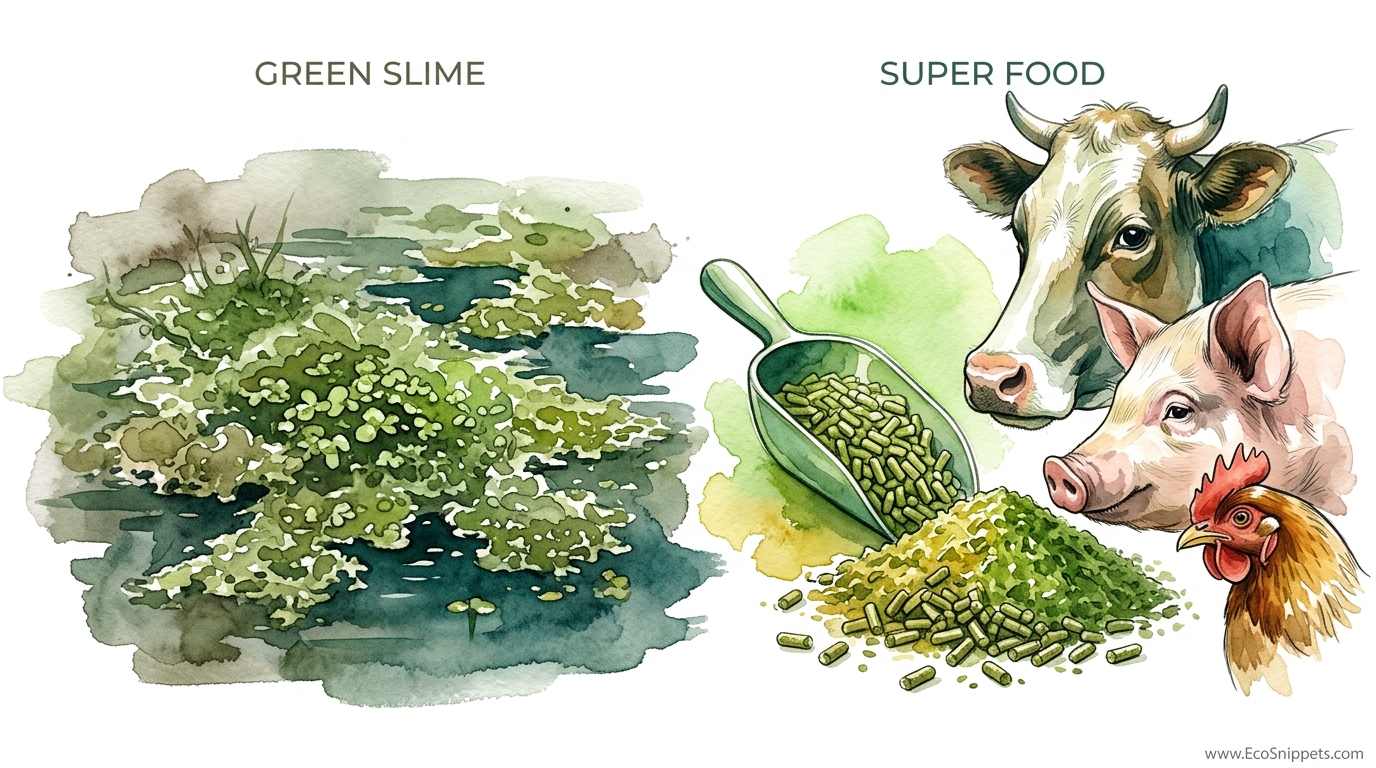
This tiny floating plant, often dismissed as GREEN SLIME, is actually a SUPER FOOD capable of outproducing traditional crops by a staggering margin. While a field of soybeans might yield about 1.5 metric tonnes of protein per hectare (0.6 tons per acre) each year, a well-managed duckweed system can produce up to 10 metric tonnes (11 tons) of protein in the same space. It is a biological engine that converts waste into high-quality muscle and eggs.
Every pond, ditch, and slow-moving stream holds the potential to become a perpetual protein harvest. Understanding how to harness this growth is the first step toward true food security for your homestead or farm.
Duckweed For Livestock Feed
Duckweed is not a single plant but a family of small, floating aquatic plants known as Lemnaceae. These plants are the smallest flowering plants on Earth, yet they possess an evolutionary design that prioritizes rapid reproduction over almost everything else. Unlike land plants that must grow sturdy stalks and deep roots to survive, duckweed is almost entirely composed of metabolically active tissue.
Most of the energy captured by duckweed goes directly into creating new leaves, known as fronds. Under ideal conditions, a colony of duckweed can double its biomass in as little as 16 to 48 hours. This exponential growth makes it look more like a bacterial culture than a traditional crop. Because it floats on the surface, it has direct access to atmospheric carbon dioxide and sunlight, while its tiny roots pull nutrients directly from the water column.
The protein content of duckweed is what truly sets it apart. Depending on the nutrient levels in the water, dry duckweed can contain between 25% and 45% crude protein. This puts it in direct competition with soybean meal, which typically hovers around 44% to 48%. Furthermore, the amino acid profile of duckweed is remarkably balanced, containing higher levels of lysine and methionine than most vegetable proteins.
In real-world situations, duckweed is used as a primary or supplemental feed for a wide range of animals. In Southeast Asia, it has been a staple for carp and tilapia ponds for centuries. Poultry farmers use it to darken egg yolks and boost growth rates, while pig farmers use it to reduce their reliance on expensive grains. Even ruminants like cattle and sheep can benefit from the high mineral and protein content, provided it is introduced correctly into their diet.
How It Works: Cultivation and Setup
Growing duckweed is remarkably simple, but doing it efficiently requires a bit of planning. You don’t need a massive lake to start; in fact, smaller, controlled environments are often better for maintaining the nutrient levels required for high protein production.
To begin, you need a shallow body of water. Duckweed thrives in depths as shallow as 10 to 30 centimeters (4 to 12 inches), though deeper ponds are more stable in terms of temperature. The water must be still or very slow-moving. High winds or strong currents will push the plants to one side, piling them up and causing the bottom layers to die from a lack of light.
Nutrient management is the engine of the system. Duckweed is a “heavy feeder” that excels at removing nitrogen and phosphorus from water. The most economical way to fertilize your duckweed is by using diluted animal manure or “compost tea.” If you have a pond that catches runoff from a barn or a pigpen, you likely already have a duckweed goldmine.
Total Kjeldahl nitrogen should be maintained between 20 and 30 mg/L to ensure the highest growth rates and protein levels. If the nitrogen levels drop too low, the plant will still grow, but its protein content will plummet while its fiber and ash content increase. Many farmers find success by adding a small amount of poultry or ruminant manure to their tanks every few days to keep the “fuel” topped up.
The setup process looks like this:
- Select a Location: Choose a spot with plenty of sunlight but some protection from high winds. If necessary, use floating “baffles” made of PVC pipe to break the surface into smaller sections.
- Prepare the Water: Ensure the pH is between 6.5 and 7.5 for optimal growth. Duckweed can survive in a range from 5.0 to 9.0, but it will grow slowly at the extremes.
- Inoculate: Add a few handfuls of local duckweed (Lemna minor or Spirodela polyrhiza are common choices). Cover about 1/5th of the surface area to start.
- Monitor Temperature: Growth is fastest when water temperatures are between 20°C and 30°C (68°F to 86°F). In temperate regions, the plant will go dormant (forming “turions”) and sink to the bottom when temperatures drop below 7°C (45°F).
Benefits of Duckweed Integration
The primary advantage of duckweed is its incredible efficiency. It produces more protein per unit of area than any other known crop. This allows farmers with limited land to produce a significant portion of their own feed without clearing more forest or buying more acreage.
Because duckweed grows on water, it doesn’t compete for arable land. You can grow it in “marginal” areas, such as drainage ditches, lagoon systems, or even in stacked tanks in a vertical farming setup. This makes it a perfect fit for the “circular economy” of a farm, where waste from one system becomes the input for another.
Water conservation is another major benefit. While it might seem counterintuitive that an aquatic plant saves water, duckweed forms a dense mat on the surface that can reduce evaporation from the pond by up to 20% to 30%. Furthermore, because it treats and cleans the water as it grows, the water can often be reused for irrigation after the duckweed is harvested.
From a nutritional standpoint, duckweed is rich in pigments like beta-carotene and lutein. When fed to laying hens, these pigments result in vibrant, deep-orange yolks that are often associated with high-quality pasture-raised eggs. It also contains significant amounts of trace minerals and vitamins, including Vitamin B12 in some species, which is rare in the plant world.
Challenges and Common Mistakes
The biggest challenge with duckweed is its water content. Freshly harvested duckweed is roughly 92% to 94% water. This means that for every 100 kilograms (220 lbs) of green slime you scoop up, you are only getting about 6 to 8 kilograms (13 to 17 lbs) of actual dry food.
Transporting and feeding wet duckweed is heavy, messy work. If you feed it fresh, you must do so immediately. Harvested duckweed will begin to ferment and spoil within 2 to 3 days if it isn’t refrigerated or dried. This spoilage destroys the protein and can make livestock sick.
A common mistake is over-harvesting or under-harvesting. If you leave the mat too thin, the plants waste energy spreading out rather than growing upward. If you leave it too thick, the plants on top will shade out the ones below, leading to rot and a crash in the population. The “sweet spot” is usually a density where the fronds are just touching, forming a complete but thin carpet.
Another pitfall is ignoring water quality. While duckweed can grow in “dirty” water, it is a bio-accumulator. It will suck up heavy metals, pesticides, and toxins from its environment. If your water is contaminated with lead, arsenic, or industrial chemicals, those toxins will end up in your livestock and eventually in your meat or eggs.
Limitations and Realistic Constraints
Duckweed is not a “magic bullet” that can replace 100% of your feed overnight. For monogastric animals like chickens and pigs, duckweed contains a higher level of fiber and ash than traditional corn-soy diets. If you include too much in the ration—usually over 25% for broilers or 40% for layers—growth rates can slow down due to the bulkiness of the feed.
Environmental constraints are also significant. In very cold climates, duckweed growth stops entirely during the winter. Unless you have a heated greenhouse or a way to store dried duckweed, you will still need to rely on traditional feed for several months of the year.
The presence of calcium oxalate crystals in some species, such as Spirodela polyrhiza, can also be a limitation. High levels of oxalates can interfere with calcium absorption and potentially cause kidney issues in sensitive animals if fed in extreme excess. However, most common species like Lemna minor have lower levels, and processing (such as drying or fermenting) can help mitigate these effects.
Comparing Protein Sources
To understand the value of duckweed, it helps to see how it stacks up against the “big three” of the feed world. The following table compares typical yields and protein percentages based on dry matter.
| Crop | Protein % (Dry) | Yield (Tons Protein/Ha/Year) | Water Usage |
|---|---|---|---|
| Duckweed | 35% – 45% | 8.0 – 10.0 | Very Low (Recycled) |
| Soybeans | 40% – 45% | 0.6 – 1.2 | High |
| Alfalfa | 18% – 22% | 2.0 – 2.5 | Moderate |
| Corn (Maize) | 8% – 10% | 0.4 – 0.8 | High |
The efficiency of duckweed is clear. While soybean meal is slightly higher in terms of raw protein percentage, the sheer volume of biomass duckweed produces in a year far outweighs the single harvest of a soy field.
Practical Tips for the Homestead Farmer
Harvesting duckweed doesn’t require expensive machinery. A simple pool skimmer or a home-made net made of fine mesh and a PVC frame is all you need for a small pond. For larger systems, a floating boom can be used to corral the plants toward a central ramp.
One of the best “hacks” for drying duckweed is the spin cycle method. If you have an old top-loading washing machine, you can put harvested duckweed into a pillowcase and run it through a spin cycle. This centrifugal force removes the “free water” on the outside of the plants, reducing the drying time by half or more.
Once the excess water is spun out, spread the duckweed on a black tarp in the sun or use a solar dehydrator. You want to dry it until it is brittle and smells like fresh hay. Store it in airtight bags in a cool, dark place. This dried “meal” can be easily mixed into your standard grain rations.
When feeding fresh duckweed to chickens, start small. Some birds are wary of the green mat at first. Mixing a bit of grain into the floating duckweed can encourage them to start pecking. Once they realize it’s food, they will often clear a pond surface in minutes.
Advanced Considerations for Scaling
If you are looking to scale your production, consider an Integrated Multi-Trophic Aquaculture (IMTA) system. In this setup, you grow fish (like tilapia) in the main pond and use the duckweed to filter the fish waste. The fish eat the duckweed, and the nutrient-rich water from the fish helps the duckweed grow faster.
For large-scale pig or dairy operations, duckweed can be grown in the final stages of a manure lagoon system. This not only provides a massive amount of free feed but also serves as a biological water treatment plant, reducing the environmental impact of the manure runoff before the water leaves your property.
Automation is the next frontier. Simple timer-based skimmers and screw-press dehydrators can take the labor out of the process. Serious practitioners also experiment with different species of duckweed, such as Wolffia (water meal), which has no roots and an even higher protein density, making it a “caviar” of livestock feed.
Example Scenario: The 50-Chicken Homestead
A typical flock of 50 laying hens requires roughly 6 kilograms (13 lbs) of feed per day. If you want to replace 25% of their diet with duckweed, you need to produce about 1.5 kilograms (3.3 lbs) of dry duckweed daily.
To achieve this, considering a dry matter yield of about 15 grams per square meter per day, you would need a pond surface area of approximately 100 square meters (about 1,076 square feet). This could be achieved with a single 10m x 10m pond or a series of smaller tanks.
By utilizing the waste from the chicken coop to fertilize the pond, the farmer creates a closed loop. The chickens produce manure, the manure feeds the duckweed, the duckweed feeds the chickens, and the chickens produce eggs and meat. This system reduces the monthly feed bill significantly while improving the nutrient density of the eggs.
Final Thoughts
The transition from viewing duckweed as a pest to seeing it as a primary resource is a hallmark of the self-reliant mindset. It requires us to stop fighting nature and start working with the incredible biological efficiency that exists in our own backyards.
While the process of managing water chemistry and drying the harvest has a learning curve, the rewards are measurable in both dollars saved and the health of your animals. Whether you are a backyard hobbyist with a few ducks or a farmer looking to insulate yourself from the volatile soy market, duckweed offers a path toward true agricultural independence.
Experiment with a small tank first. Learn how the plants respond to your local water and sunlight. Once you see the “green gold” doubling before your eyes, you’ll never look at a stagnant pond the same way again.
