How To Become More Self-Sufficient Without Starting a Full-Blown Farm…
Want to start preserving your harvest, making your own soap, or building a backyard root cellar — but not sure where to begin? “Homesteading Advice” gives you instant lifetime access to 35+ practical homesteading books on food preservation, veggie gardening, DIY natural cleaning products (save over $250 per year with this skill alone), brewing, off-grid energy, and a whole lot more…
Click Here To Check It Out Now!
Stop fighting your solar panels’ fixed angles – let gravity do the 9-to-5 tracking for you. Most people think they need expensive sensors and motors to track the sun. We used a bucket of water and a simple leak-valve to create a gravity-clock. It tilts our panels throughout the day using zero electricity, and it works even when the cloud cover is total.
Generating power from the sun is an honest way to provide for a homestead, but the sun is a moving target. While fixed panels sit idle for much of the morning and evening, a panel that follows the sun’s arc captures significantly more energy. This isn’t about high-tech gadgets or complex coding; it’s about returning to the fundamental mechanics that our ancestors used for timekeeping.
Gravity-fed systems offer a reliability that silicon and circuits cannot match. When the grid fails or your electronics fry in a storm, a bucket of water continues to respond to the constant pull of the earth. We are going to explore how to build a system that turns 15 degrees every hour, mirroring the rotation of our planet without a single watt of battery power wasted on the movement itself.
Gravity Powered Solar Tracking Guide
A gravity-powered solar tracker is a mechanical device that uses shifting weights to rotate photovoltaic panels. Instead of using electric actuators or hydraulic pumps, this system relies on the predictable descent of a heavy object—usually a container of water—to provide the torque required for movement. By controlling the rate at which this weight changes, we can synchronize the panel’s rotation with the sun’s movement across the sky.
The core concept is based on the ancient clepsydra, or water clock. For thousands of years, humans tracked time by watching water drip from one vessel into another at a constant rate. In a solar tracking context, we attach this “clock” to a pivoting frame. As water leaks out of a bucket on one side of the frame, the balance of the system shifts, allowing the panel to slowly tilt toward the west.
Real-world applications for these systems are most common in remote off-grid locations where every watt of electricity is precious. In developing regions or deep-woods cabins, the cost of an electronic tracker often outweighs the benefits. A gravity tracker provides a low-cost, repairable alternative that uses locally sourced materials like lumber, salvaged bearings, and standard plumbing valves.
Think of it as a slow-motion seesaw. On one end, you have your solar panels; on the other, a counterweight. By adding a “leaking” weight to the equation, you create a controlled imbalance. This isn’t just a fun science project; it is a serious tool for increasing energy harvest by 25% to 35% compared to static mounts, especially during the “shoulder hours” of early morning and late afternoon.
How the Gravity Clock Mechanism Works
To understand how to build this, you must first understand the geometry of the sun. The earth rotates at approximately 15 degrees per hour. Therefore, any tracker worth its salt needs to move at that exact same pace to remain perpendicular to the sun’s rays. In a gravity system, this timing is dictated by the flow rate of water through a needle valve.
The system starts with a central axis. This is usually a horizontal or “polar” pipe that the solar panels are mounted upon. This pipe must be supported by heavy-duty bearings to minimize friction. Friction is the enemy of any passive system; if the axle sticks, the weight of the water won’t be enough to overcome the resistance, and your panels will stay stuck facing the morning clouds.
Attached to this axle is a lever arm. On the end of this arm, we hang a large bucket—typically 5 gallons or 19 liters. In the morning, you fill this bucket to the top. The weight of the full bucket pulls the panels toward the east. At the bottom of the bucket, a high-precision leak valve (a needle valve) is opened just a crack. As the water drips out, the bucket becomes lighter, and a counterweight on the opposite side of the pivot slowly pulls the panels toward the west.
Setting the drip rate is the most critical part of the setup. You aren’t just letting water leak; you are “tuning” the rotation. If you need to move 90 degrees over the course of a 6-hour peak sun window, your bucket needs to lose enough weight to allow that 90-degree shift in exactly 360 minutes. It takes a few days of observation and fine-tuning to get the flow rate perfect, but once set, it remains consistent as long as the valve doesn’t clog.
Building Your Own: Materials and Process
Construction begins with a sturdy foundation. Since the panels will be moving, the support post must be deeply anchored to handle both the weight of the water and the “sail effect” of the wind. A 4×4 inch (10×10 cm) or 6×6 inch (15×15 cm) pressure-treated timber is the standard choice. This post should be buried at least 3 feet (0.9 meters) deep and set in concrete to ensure it stays plumb through the seasons.
Next comes the tracking frame. This is often an “H-frame” design made of lightweight aluminum or rot-resistant wood like cedar. The axle passes through the center of the H, resting on two pillow-block bearings. Using bearings is non-negotiable; sliding a pipe through a hole in a board creates too much variable friction. You want the kind of bearings you’d find on a farm implement or a high-end trailer axle.
The counterweight system must be balanced with precision. With the water bucket empty, the panels should naturally want to rest in the fully “West” position. You achieve this by adding scrap metal or stones to a fixed tray on the western side of the frame. When you fill the eastern bucket with water, the weight must be sufficient to “win” the tug-of-war, pulling the panels back to the “East” position for the start of the day.
Plumbing the bucket requires a simple but reliable needle valve. Do not use a standard ball valve, as they are too difficult to adjust at micro-flow levels. A brass needle valve allows you to control the drip down to a few drops per minute. To prevent clogs from algae or debris, always use a small mesh filter inside the bucket over the drain hole. Using distilled water or adding a drop of bleach can also prevent organic growth from slowing your “clock.”
Benefits of Passive Gravity Tracking
The most immediate advantage is the total absence of parasitic power loss. Electronic trackers use motors that “sip” from your battery bank all day long. While 5 or 10 watts doesn’t sound like much, it adds up over 24 hours. A gravity tracker uses the potential energy of lifted water, which costs you nothing but a few minutes of “resetting” labor each morning or evening.
Reliability in harsh environments is another major factor. Electronics are vulnerable to lightning strikes, moisture corrosion, and electromagnetic pulses. A mechanical system made of wood, steel, and water is virtually immune to these issues. If a part breaks, you can likely fix it with a wrench or a hammer rather than needing a soldering iron and a computer science degree.
Furthermore, gravity trackers are “dumb” in a way that makes them smart. They don’t get confused by “bright spots” in the clouds or reflections off a nearby pond. They move based on the time of day, not the visible light. This means on a heavily overcast day, the panels still move to the correct position so they are ready the moment the sun peeks through a gap in the clouds.
Cost-effectiveness is the final pillar. Commercial tracking systems can cost thousands of dollars. A DIY gravity setup can be built for under $100 (approximately €90 or £75) using reclaimed materials. For the self-reliant individual, the ability to build, maintain, and understand every moving part of their energy infrastructure is a benefit that cannot be measured in dollars alone.
Challenges and Common Mistakes
Wind is the primary predator of the gravity tracker. Because the system is designed to be “balanced” so it can move easily, a strong gust can act on the panels like a sail and force them out of alignment. Some builders solve this by adding a “dampener”—a small shock absorber or a second bucket of oil—that resists fast movements while allowing the slow, steady drip-rotation to continue.
Evaporation can also throw off your timing. In hot, arid climates, the water in your “clock” bucket might disappear into the air faster than it drips through the valve. This results in the panels moving too quickly. Always use a lid on your buckets with only a tiny vent hole to keep the water where it belongs. In extreme heat, you might even consider using a low-viscosity biodegradable oil instead of water, as oil does not evaporate.
Leveling the axle is a step many beginners skip. If your main pivot is not perfectly level, the weight required to turn the panels will change as they rotate. This leads to “stalling” at certain times of the day. Use a high-quality spirit level and check the alignment north-to-south and east-to-west. The axle should be so well-balanced that you can move the entire array with the tip of your pinky finger when the buckets are empty.
Another frequent error is using a bucket that is too small. You need enough “weight change” to overcome the inherent friction of your bearings. A 1-gallon (3.8-liter) jug rarely provides enough force for a full-sized 200-watt panel. Stick to 5-gallon (19-liter) buckets; they are cheap, standard, and provide enough mass (about 40 pounds or 18 kilograms when full) to move substantial loads reliably.
Limitations and Environmental Constraints
Freezing temperatures are the most significant limitation for any water-based system. If you live in a climate where the mercury regularly drops below 32°F (0°C), your gravity clock will turn into a block of ice and stop tracking. In these regions, you must either decommission the tracker for the winter or switch to a non-freezing fluid like automotive antifreeze or a heavy brine solution. However, be mindful of the environmental impact if a leak occurs.
The daily “reset” requirement is a trade-off that doesn’t suit everyone. Unlike an automated electronic tracker that resets itself at night, a gravity tracker requires a human to fill the bucket and move the panels back to the East. For a permanent residence, this is a simple morning chore, but for a remote cabin you only visit once a month, a fixed mount is a better choice.
Space and aesthetics also play a role. A gravity tracker is inherently bulkier than a roof-mounted fixed array. It requires a clear area of ground and features visible buckets and weights. If you are restricted by strict neighborhood covenants or limited yard space, the “pioneer look” of a water-bucket tracker might not be a viable option.
Finally, there is the issue of latitude. In regions very close to the equator, the sun passes nearly directly overhead, making the benefits of single-axis tracking less pronounced than in high-latitude regions (like the Northern US, Canada, or Northern Europe). In the far north or south, the sun stays low on the horizon for longer, which is exactly where a tracker provides the most significant boost in production.
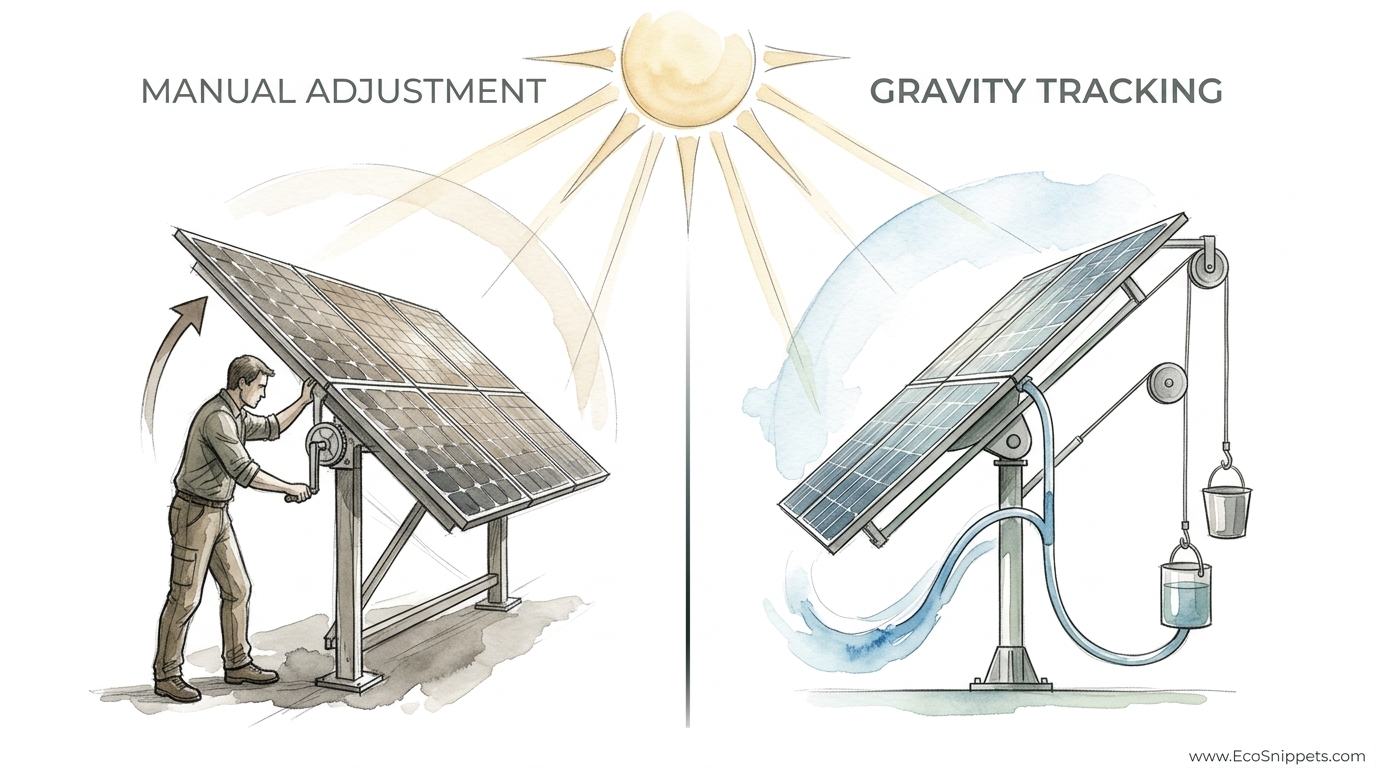
Manual Adjustment vs. Gravity Tracking
Many homesteaders start with manual adjustment, where they walk out and tilt the panels three or four times a day. While this is effective, it is rarely consistent. Gravity tracking automates this “muscle labor” into a continuous, smooth motion that captures the peak intensity of the sun more accurately than a human making occasional jumps.
| Feature | Manual Adjustment | Gravity Tracking |
|---|---|---|
| Electricity Used | Zero | Zero |
| Daily Interaction | High (3-5 times/day) | Low (1 time/day) |
| Complexity | Very Low | Moderate |
| Efficiency Gain | 15% – 20% | 25% – 35% |
| Resilience | Indestructible | Very High |
| Cost | Free | Low ($50-$100) |
As the table demonstrates, gravity tracking is the middle ground between the “lazy” reliability of a fixed mount and the high-maintenance efficiency of an electronic system. It provides the best of both worlds for someone willing to put in a little initial effort to build the frame.
Practical Tips and Best Practices
To get the most out of your setup, pay close attention to the bearings. Sealed ball bearings are preferable because they prevent dust and grit from entering the races. In a homestead environment, dust is constant. If you use open bearings, you will need to grease them weekly, which becomes a tedious chore that most people eventually ignore.
Use a “sight tube” on your bucket. A simple piece of clear vinyl tubing attached to the bottom and run up the side of the bucket acts as a fuel gauge. This allows you to see exactly how much water is left from a distance. If you see the water isn’t dropping as it should, you know your valve is clogged before your battery monitor starts showing a drop in voltage.
Paint your buckets black or wrap them in insulation. In the summer, black buckets can help prevent algae growth by blocking sunlight (though this seems counterintuitive, algae needs specific wavelengths). In the shoulder seasons of spring and fall, a black bucket will absorb solar heat, keeping the water just warm enough to prevent it from thickening or freezing during a light morning frost.
Always include a “limit stop” on your frame. This is a physical bolt or block of wood that prevents the panels from rotating too far in either direction. If the valve fails and the water dumps out all at once, you don’t want the panels slamming into the support post and shattering the glass. A simple piece of heavy rope or a chain can act as a “tether” to keep the movement within a safe 90-degree to 120-degree window.
Advanced Considerations for Serious Practitioners
For those looking to scale up, you can connect multiple panel racks to a single gravity clock. By using a “master and slave” rod system, one heavy water bucket can pull a line of three or four separate trackers. This requires significantly more weight and much larger bearings, but it ensures that your entire solar farm is perfectly synchronized without needing individual valves for every panel.
Consider a “dual-vessel” system for automatic resets. In this advanced design, the water doesn’t just drip onto the ground; it drips into a second bucket. When the sun goes down, you use a small, efficient 12V pump (powered by the day’s excess energy) to move the water back from the “West” bucket to the “East” bucket. This makes the system nearly 100% automated while still retaining the mechanical reliability of gravity tracking.
Seasonal tilt is the final frontier of efficiency. While your gravity tracker handles the East-West movement (the azimuth), the sun also moves North-South throughout the year (the declination). Adding a simple hand-crank or a threaded rod to your frame allows you to adjust the “latitude angle” once a month. This “1.5-axis” approach can bring your energy capture close to that of a full dual-axis electronic tracker with none of the complexity.
When choosing your valves, look for “pressure-compensated” flow controllers. Standard needle valves can be affected by the “head pressure” of the water—meaning they drip faster when the bucket is full and slower when it is nearly empty. A pressure-compensated valve maintains a steady drip regardless of the water level, ensuring your tracking remains linear from sunrise to sunset.
Example Scenario: The 400W Cabin Array
Imagine a small cabin with two 200-watt panels. In a fixed South-facing mount, these panels might produce 1.6 kilowatt-hours on a sunny day. However, because the cabin is in a valley, the morning sun hits the panels at a sharp angle, and the evening sun is lost behind the trees. By installing these panels on a gravity tracker, we can angle them 45 degrees East at 8:00 AM.
We use a 5-gallon bucket filled with 42 pounds (19 kg) of water. The lever arm is 24 inches (61 cm) long. We calibrate the valve to release exactly 0.8 gallons (3 liters) per hour. As the morning progresses, the panels smoothly follow the sun. By noon, the bucket is half-empty, and the panels are facing due South. By 4:00 PM, the bucket is nearly empty, and the panels are facing West, catching the last rays of the day.
Under this setup, the daily yield jumps from 1.6 kWh to 2.2 kWh. That extra 600 watt-hours is enough to run a small chest freezer or charge all the power tools for the next day’s work. The only “cost” was the 60 seconds it took to pour a bucket of water in the morning—a small price to pay for a 37% increase in energy independence.
Final Thoughts
Gravity-powered solar tracking is a testament to the power of simple solutions. We live in an era where we are taught to solve every problem with a screen and a circuit board, but nature’s laws are often more reliable than our inventions. By using the weight of water and the pull of the earth, we can harness the sun’s power with greater efficiency and less waste.
This approach isn’t for the person who wants to “set it and forget it” in a suburban backyard. It is for the tinkerer, the homesteader, and the person who finds beauty in a well-oiled machine. It encourages a daily rhythm and a closer connection to the movement of the heavens. When you fill that bucket each morning, you aren’t just maintaining a power system; you are participating in a tradition of self-reliance that spans centuries.
Do not be afraid to experiment. Your first frame might be wobbly, and your first valve might clog, but the lessons learned in fluid dynamics and structural balance will serve you well in all areas of homesteading. Build it strong, keep it simple, and let gravity do the heavy lifting for you. The sun is waiting—make sure your panels are ready to meet it.
