How To Become More Self-Sufficient Without Starting a Full-Blown Farm…
Want to start preserving your harvest, making your own soap, or building a backyard root cellar — but not sure where to begin? “Homesteading Advice” gives you instant lifetime access to 35+ practical homesteading books on food preservation, veggie gardening, DIY natural cleaning products (save over $250 per year with this skill alone), brewing, off-grid energy, and a whole lot more…
Click Here To Check It Out Now!
That tiny jar of gourmet butter is just ten cents of herbs you are currently mowing over in your backyard. The artisan label is usually just a tax on a lack of foraging knowledge. We took five minutes to gather wild herbs to turn basic butter into a high-end pantry staple for zero extra dollars.
Walking through a high-end grocery store, you might see small, aesthetic tubs of “wild ramp butter” or “spring garlic spread” retailing for nearly ten dollars. These products capitalize on the mystery of seasonal ingredients that are often free and abundant in nature. By learning to identify a few common plants and mastering the simple mechanics of compound butter, you can bypass the marketing markup and stock your kitchen with superior flavor.
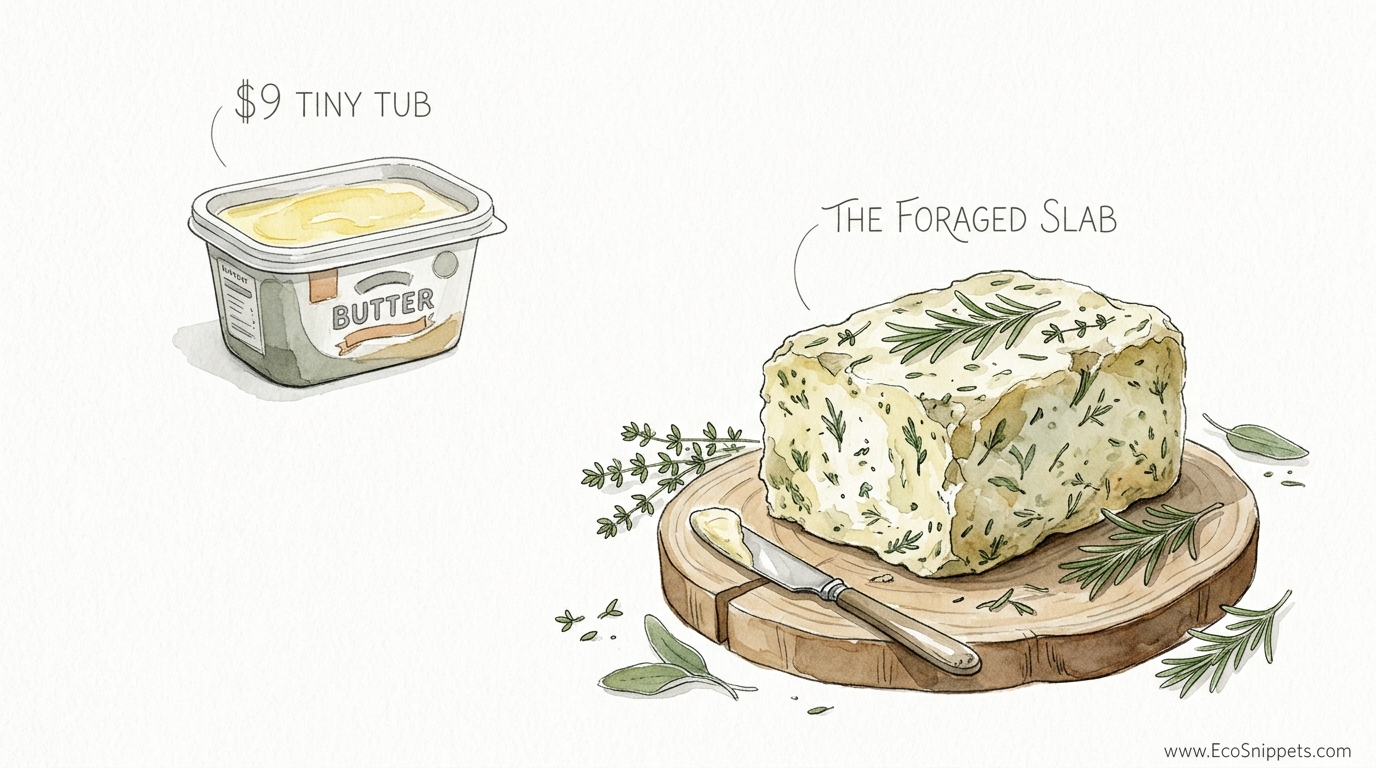
This guide explores the art and science of the $9 TINY TUB vs THE FORAGED SLAB. You will learn how to safely harvest wild greens, prepare them for preservation in fat, and create a shelf-stable, nutrient-dense pantry staple that honors ancestral wisdom. Making your own butter blends is a foundational skill in self-reliance that connects your kitchen directly to the landscape around you.
Homemade Herb Butter Recipe
Homemade herb butter, known in classical French cuisine as beurre composé, is an emulsion of butterfat mixed with aromatic herbs, spices, or other flavoring agents. It is a versatile tool used to finish steaks, glaze vegetables, or add depth to simple bread. Historically, mixing herbs into fat was a practical way for our ancestors to preserve the volatile oils and nutrients of short-lived spring greens for use later in the year.
The core of a successful herb butter is a high-quality fat base. While standard grocery store butter is approximately 80% butterfat, searching for “European-style” butter or artisanal batches with 82% to 86% fat will yield a creamier texture and better flavor. The higher fat content means less water, which is critical when you are adding fresh, moisture-rich greens into the mix.
To begin your first batch, use this foundational ratio as your guide:
- Butter: 250 grams (approx. 8.8 ounces or 2 sticks) of high-quality unsalted butter.
- Wild Herbs: 30 to 60 grams (approx. 1 to 2 ounces) of finely minced fresh wild herbs.
- Salt: 2 to 5 grams (approx. 1/2 to 1 teaspoon) of fine sea salt, adjusted to taste.
- Optional Acid: 5 milliliters (1 teaspoon) of lemon juice or a pinch of zest to brighten the fats.
This recipe serves as a canvas. Depending on the pungency of your foraged finds—such as the sharp bite of wild garlic vs. the mild crunch of chickweed—you will want to adjust the herb-to-butter ratio to ensure the fat carries the flavor without becoming overwhelming.
How to Forage and Prepare Wild Herbs
The process begins long before you reach for the mixing bowl. Successful herb butter depends on the quality and safety of your foraged ingredients. You must be 100% certain of a plant’s identity before it enters your kitchen, as many edible wild plants have toxic look-alikes.
When foraging in your backyard or local woods, follow these essential safety guidelines:
- Avoid Contamination: Never harvest near busy roads where exhaust fumes settle, or in areas treated with pesticides or heavy fertilizers.
- Harvest Sustainably: Take only what you need and leave enough for the plant to regenerate. For rare or slow-growing species, follow the “one in twenty” rule—only harvest if you see at least twenty healthy specimens.
- Clean Thoroughly: Wild herbs often harbor grit, insects, or environmental residues. Wash them in cool water and, most importantly, dry them completely. Excess water is the enemy of a stable butter emulsion and can lead to rapid spoilage.
Common wild herbs that are ideal for butter include:
Wild Garlic and Field Garlic (Allium vineale)
Found in many lawns and forest edges, these plants offer a pungent, onion-like aroma. They are significantly more potent than store-bought chives. For every 100 grams of butter, use roughly 15 to 20 grams of finely chopped wild garlic.
Wood Sorrel (Oxalis spp.)
Identifiable by its heart-shaped leaflets, wood sorrel provides a bright, lemony tang due to its oxalic acid content. It is a perfect substitute for lemon zest in seafood-focused butters. Use a higher volume (up to 1/3 cup per stick of butter) as its flavor is delicate.
Dandelion Greens (Taraxacum officinale)
Early spring dandelion leaves are nutty and slightly bitter. When minced finely and whipped into butter, they provide a complex, earthy base that pairs exceptionally well with grilled meats.
Stinging Nettles (Urtica dioica)
While they require blanching for 30 seconds to remove the “sting,” nettles are incredibly nutrient-dense, containing high levels of vitamins A and C, as well as calcium and iron. Once blanched and squeezed dry, they can be treated like spinach and folded into the fat.
The Science of Infusion and Emulsion
Creating a foraged slab is more than just mashing greens into grease. It is a study in lipid-soluble aromatics. Many of the flavor compounds in herbs are hydrophobic, meaning they dissolve in fats rather than water. When you mince herbs and incorporate them into butter, the fat acts as a delivery system, trapping those essential oils and carrying them across your palate.
To achieve a professional-grade texture, your butter must be at the correct temperature. Aim for a “pliant” state—roughly 18°C to 20°C (65°F to 68°F). If the butter is too cold, the herbs will not distribute evenly and the fat will feel grainy. If it is too warm and begins to melt, the emulsion can break, leading to a greasy finish and a shorter shelf life.
Modern culinary science suggests that for fresh leafy herbs, the ratio should stay at or below 12% by weight. Exceeding this can flood the butter with cellular water from the plants, creating micro-environments where spoilage bacteria can thrive. Precision is the difference between a high-end staple and a moldy experiment.
Benefits of Making Your Own Herb Butter
The primary advantage of the foraged slab is the depth of flavor. Commercial herb butters are often made with dried herbs or extracts to ensure a long shelf life. By using fresh, wild-harvested greens, you capture the vibrant, volatile oils that are lost during the drying process.
Practical benefits include:
- Nutrient Density: Many wild “weeds” are more nutritionally potent than cultivated varieties. For instance, stinging nettle contains significantly more calcium and magnesium than garden-variety spinach.
- Economic Self-Reliance: At a cost of nearly zero dollars beyond the base price of the butter, you are creating a product that would otherwise be a luxury item.
- Zero Waste: Herb butter is an excellent way to use the ends of bunches or the first trimmings of your garden that might otherwise go to compost.
- Preservation: Butter protects herbs from oxidation. A frozen log of herb butter can preserve the taste of spring for up to six months.
Challenges and Common Mistakes
The most frequent error in making homemade herb butter is failing to dry the herbs adequately. Any residual moisture trapped within the fat creates pockets where bacteria can grow. This results in “weeping” butter or a sour, rancid smell after only a few days in the refrigerator. Always pat your foraged greens dry with a clean tea towel or use a salad spinner before mincing.
Another pitfall involves the use of raw alliums, such as wild garlic or onions. Raw alliums contain fructans and moisture that can trigger fermentation or spoilage if stored at room temperature. To prevent this, always store your herb butter in the refrigerator or freezer. Some practitioners suggest adding a small amount of acid, like lemon juice, to lower the pH and inhibit microbial growth.
Over-processing is a final concern. While using a food processor is fast, it can generate heat that begins to melt the butter. If you use a machine, pulse in short bursts to maintain the crystalline structure of the fat. A manual approach—mashing with a fork or using a stand mixer with a paddle attachment—usually yields a superior, airy texture.
Limitations and Environmental Constraints
While foraged herb butter is a high-value skill, it has realistic boundaries. The shelf life of a compound butter with fresh herbs is significantly shorter than that of plain butter. While a standard stick of salted butter might last months, a fresh herb blend should be used within 5 to 7 days if kept in the refrigerator.
Seasonality also dictates your ingredients. You cannot forage for wild ramps in the heat of mid-summer or the depths of winter. This method requires you to work in harmony with the local ecosystem, harvesting when plants are at their peak. Furthermore, if you live in a highly urbanized area with heavy soil pollution, you may be limited to using cultivated herbs or purchasing from local farmers’ markets rather than foraging in the wild.
Comparing the Tiny Tub vs. The Foraged Slab
When deciding whether to buy or build, consider the measurable factors of cost, quality, and time.
| Factor | $9 Tiny Tub (Store Bought) | The Foraged Slab (Homemade) |
|---|---|---|
| Cost | $8.00 – $12.00 per 100g | ~$1.50 (Price of base butter) |
| Ingredient Freshness | Weeks old, often contains preservatives | Harvested same day |
| Flavor Complexity | Standardized and mild | High; unique to your local soil |
| Preparation Time | 0 minutes | 15-20 minutes |
| Customizability | None | Infinite (Tailored to your meal) |
Practical Tips and Best Practices
For the best results, always use unsalted butter. This allows you to control the exact level of seasoning. Wild herbs often have their own subtle mineral salts, and you want to enhance those flavors rather than mask them with a heavy-handed commercial salt profile.
When it comes to salt, use a high-quality sea salt or “fleur de sel” for finishing. The slight crunch of salt crystals against the creamy fat and tender herbs provides a sensory experience that pre-mixed tubs cannot replicate.
Storage is best achieved by rolling the finished butter into a log using parchment paper. This is known as a “torchon” style. Twist the ends of the paper to compress the butter into a tight cylinder. This method makes it easy to slice off perfect “coins” or “medallions” of butter as needed, while keeping the rest of the log protected from the air.
Advanced Considerations for Practitioners
Serious practitioners often look beyond basic mixing and toward culturing. Cultured butter is made by adding live bacterial cultures to cream and allowing it to ferment before churning. This adds a complex, tangy depth that mimics the traditional “farmhouse” butters of Europe. When you combine the tang of cultured fat with the earthy bite of wild foraged greens, the resulting flavor profile is vastly superior to anything found on a standard grocery shelf.
Another advanced technique is the use of dehydrated wild herb powders. By drying your foraged greens at a low temperature (below 40°C or 105°F) and grinding them into a fine powder, you can create a herb butter with a much longer refrigerated shelf life. This removes the moisture risk while concentrating the flavor, though you lose the aesthetic “flecked” look of fresh greens.
For those interested in high-heat cooking, consider making a foraged ghee. By clarifying the butter (removing the water and milk solids) and then infusing it with herbs over very low heat, you create a shelf-stable cooking fat with a high smoke point that carries the essence of the wild.
Example Scenarios for Use
Imagine a Sunday roast where you are serving a simple seared steak. Instead of a heavy sauce, you place a cold medallion of wild garlic and wood sorrel butter on top of the hot meat. As it melts, the lemon-garlic aromatics bloom, creating an instant, sophisticated glaze.
Consider a simpler scenario: toasted sourdough bread. Using a butter whipped with chickweed and a hint of lemon zest transforms a basic snack into a nutrient-dense meal that costs pennies. In these moments, the value of foraging becomes clear. You are not just saving money; you are eating with a level of quality and connection to the land that most people can only buy in a tiny, overpriced tub.
Final Thoughts
The transition from a consumer of “artisan” goods to a producer of foraged staples is a powerful shift in perspective. That tiny jar of gourmet butter in the store represents a disconnect from the natural abundance surrounding us. By taking five minutes to identify the herbs in your own backyard, you reclaim a piece of ancestral wisdom that prioritizes freshness, flavor, and self-reliance.
Mastering the foraged slab allows you to capture the fleeting flavors of the seasons and preserve them in a functional, delicious format. Whether you are finishing a professional-grade meal or simply enhancing a piece of toast, homemade herb butter proves that the best things in life—and the kitchen—are often found right under our feet.
We encourage you to start small. Identify one plant you know with certainty, grab a block of high-quality butter, and experiment. You will soon find that the “artisan tax” is a price you no longer need to pay.
