How To Become More Self-Sufficient Without Starting a Full-Blown Farm…
Want to start preserving your harvest, making your own soap, or building a backyard root cellar — but not sure where to begin? “Homesteading Advice” gives you instant lifetime access to 35+ practical homesteading books on food preservation, veggie gardening, DIY natural cleaning products (save over $250 per year with this skill alone), brewing, off-grid energy, and a whole lot more…
Click Here To Check It Out Now!
When the honeybees disappear, who is going to ensure your trees actually produce fruit? Relying on a single species for pollination is a recipe for disaster. Native mason bees are 100x more efficient than honeybees and work in colder weather – learn how to build their homes and secure your harvest forever.
You might have noticed your fruit trees blooming beautifully, only to find a disappointing harvest a few months later. This often happens because the local honeybee population is struggling with mites, disease, or simply cold spring winds. Honeybees are fair-weather workers; they prefer warm, sunny days and often stay inside the hive when temperatures drop below 13°C (55°F).
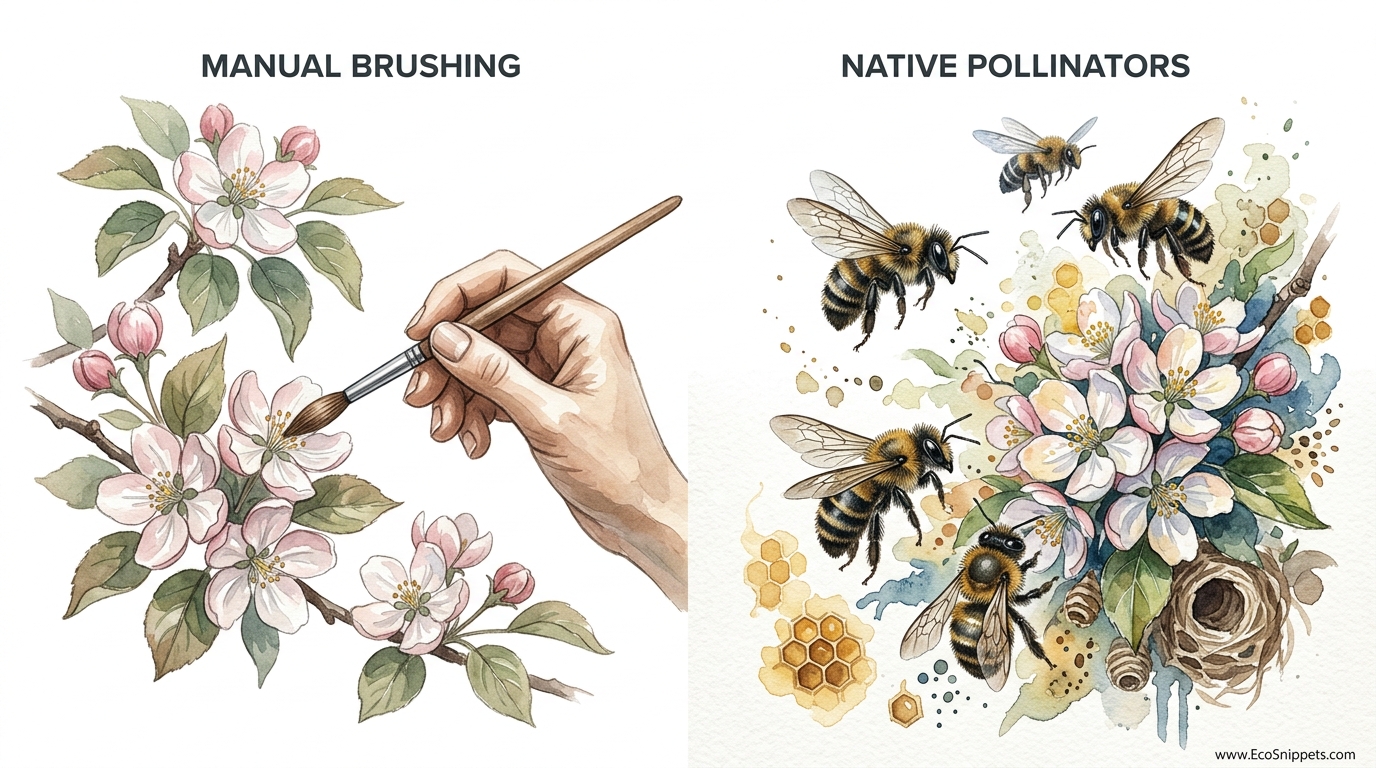
Native mason bees offer a different approach to pollination. These solitary creatures are the rugged individualists of the insect world. They do not live in hives, they do not serve a queen, and they do not make honey. Their entire existence is dedicated to two things: building a safe nest and gathering enough pollen to feed their offspring.
Watching these metallic-blue insects zip through your orchard is a masterclass in efficiency. While a honeybee daintily lands on a blossom and packs pollen into neat baskets on her legs, the mason bee performs a “belly flop” into the flower. She gets covered in loose, dry pollen, which she then spreads to every subsequent flower she touches. This article guides you through the process of bringing these power-pollinators into your backyard.
How To Attract Mason Bees To Your Orchard
Attracting mason bees is about creating a habitat that provides three essential resources: food, mud, and housing. Unlike honeybees that can fly miles for forage, mason bees generally stay within 100 yards (91 meters) of their nesting site. This means you must place their resources close together to build a successful colony.
Food is the first priority. Mason bees emerge in early spring, often coinciding with the first blossoms of fruit trees like apples, pears, and cherries. To keep them around, you need a succession of blooms. Native wildflowers, crocuses, and pieris shrubs provide critical early-season nectar before the main orchard bloom.
Mud is the second critical resource. These insects earn their name “mason” because they use mud to build partitions between their egg cells. Not just any dirt will do; they require damp clay-heavy soil. If your soil is too sandy, the mud walls will crumble, and the bee will abandon the site. Digging a small pit and keeping it moist during the nesting season is one of the most effective ways to ensure they stay.
Housing is the final piece of the puzzle. In the wild, mason bees look for pre-existing holes in dead wood or hollow plant stems. By providing “bee hotels” or nesting blocks with specific dimensions, you can concentrate their population exactly where you need the most pollination. These homes should be placed in a sunny, south-to-southeast facing location to help the bees warm up their flight muscles in the morning.
Understanding the Belly-Flopper: Why Native Pollinators Win
The secret to the mason bee’s success lies in her anatomy and her work ethic. A single female Blue Orchard Bee (*Osmia lignaria*) can pollinate as many flowers in a day as 100 honeybees. This massive disparity comes down to the way they handle pollen. Honeybees use saliva to stick pollen to their hind legs, which makes the pollen less likely to rub off on the next flower.
Mason bees carry dry pollen on a specialized brush of hairs on their abdomen called a scopa. This dry pollen is incredibly messy. As the bee moves from flower to flower, she “leaks” pollen everywhere, resulting in a 95% pollination rate per visit. In comparison, honeybees often manage a rate closer to 5% because their pollen is so well-secured for transport.
Another advantage is their tolerance for cold. Native bees have evolved to handle the fickle weather of early spring. They are active in temperatures as low as 10°C (50°F) and will even work in light rain or overcast skies. This is the exact time when your fruit trees are most vulnerable; if a cold snap hits during your cherry bloom and the honeybees stay home, the mason bees will save your crop.
Designing the Perfect Home: Materials and Dimensions
Building a home for mason bees requires precision. If the holes are too shallow, the bees are vulnerable to predators. If the diameter is wrong, you may end up with a population of only male bees, which do not pollinate nearly as much as the females.
Hole Diameter and Depth
The ideal hole diameter for the Blue Orchard Bee is 8mm (5/16 inch). This size is narrow enough to keep out larger predators but wide enough for the female to enter comfortably. The holes should be at least 15cm (6 inches) deep.
Female bees have the unique ability to choose the sex of their eggs. They typically lay female eggs at the back of the tunnel and male eggs near the front. If the tunnel is too short, the bee will lay mostly males to ensure the survival of the species, leaving you with fewer heavy-hitting pollinators for the following year.
Nesting Materials
Avoid using bamboo or logs with holes drilled directly into the wood unless you plan to use paper liners. Drilled blocks that cannot be opened are death traps for bees over several seasons because they harbor mites and fungal spores.
- Stackable Wood Trays: These are the gold standard. They can be taken apart in the fall to clean out the cocoons and scrub away parasites.
- Paper Liners: If you use wooden blocks, always use paper liners. You can pull the liners out at the end of the season to harvest the cocoons.
- Natural Reeds: Reeds like Phragmites are very attractive to bees but are usually a one-time use item because they must be split open to harvest the cocoons.
The Benefits of Managing Native Pollinators
Managing mason bees is a low-tech way to increase self-reliance on your homestead or farm. Unlike honeybees, which require expensive equipment, protective suits, and regular chemical treatments for Varroa mites, mason bees require almost zero capital.
One of the greatest benefits is safety. Mason bees are solitary, meaning they have no hive to defend. They are incredibly gentle and rarely sting. Even if a female is forced to sting, the sensation is comparable to a mosquito bite and does not carry the risk of anaphylactic shock associated with honeybee stings. This makes them ideal for gardens where children and pets play.
Furthermore, they improve the quality of the fruit. Better pollination leads to larger, more symmetrical fruit and higher seed counts. If you have ever harvested a misshapen apple, it was likely the result of poor pollination in a few of the flower’s ovules. Mason bees ensure that every blossom is thoroughly visited.
Challenges and Common Mistakes
The most frequent mistake beginners make is “set it and forget it” gardening. While you can certainly hang a bee house and see some success, failing to maintain the house will eventually lead to a population collapse.
Predator Pressure
Birds, particularly woodpeckers, love the protein-rich larvae sitting inside bee tubes. If you do not protect the front of your bee house with a layer of wire mesh (about 2.5cm or 1 inch away from the tube openings), you may find your entire colony eaten in a single afternoon.
Moisture and Mold
Hanging a bee house in a spot where it gets hit by driving rain will lead to mold growth. Fungal diseases like chalkbrood can wipe out an entire generation of bees. The house must have a significant roof overhang—at least 7cm (3 inches)—to keep the nesting tubes dry.
Incorrect Orientation
Placing a house in the deep shade or facing it north will prevent the bees from warming up early enough in the day. They are solar-powered creatures. They need that morning sun to reach a high enough body temperature to fly.
Limitations and Environmental Constraints
Mason bees are not a universal solution for all crops. Because they only fly for about 6 to 8 weeks in the spring, they are useless for summer-blooming crops like squash, tomatoes, or peppers. For those, you would need different native species like leafcutter bees or bumblebees.
Environmental toxins are another major limitation. Mason bees are highly sensitive to systemic pesticides. If you or your neighbors spray neonicotinoids, your mason bee population will likely suffer. They also require a very specific type of mud; in extremely sandy coastal areas or high-desert environments with no clay, they may struggle to find the building materials they need.
Practical Tips for Success
To maximize your results, follow these best practices for setup and maintenance.
- Release in Waves: If you buy cocoons, don’t release them all at once. Release one-third when the first blossoms appear, and the rest two weeks later. This protects you against a sudden frost killing off your active bees.
- The Mud Test: Grab a handful of your local soil, moisten it, and squeeze. If it holds its shape and leaves a ribbon when pressed between your thumb and forefinger, it has enough clay for the bees.
- Height Matters: Mount your bee house at eye level, roughly 1.5 to 2 meters (5 to 6 feet) off the ground. This keeps it away from ground predators and makes it easier for you to observe.
- Chemical Free Zone: Stop using broad-spectrum insecticides in your orchard. Even “organic” sprays like Neem oil can be harmful if applied while bees are active.
Advanced Considerations: The Cleaning Cycle
Serious practitioners do not leave their bees outside all winter. In the wild, mason bees have a high mortality rate due to parasites. By intervening, you can increase your survival rate from 10% to over 90%.
In the late fall (October or November), you should harvest the cocoons. This involves opening the nesting tubes and removing the silk-wrapped cocoons. You will likely see “frass” (bee poop) and potentially mites.
Wash the cocoons in a mild bleach solution (one teaspoon of bleach to a gallon of cool water) for no more than two minutes. This kills fungal spores like chalkbrood. Rinse them thoroughly in clean water and let them dry on a paper towel. Once dry, store them in a small container with air holes in your refrigerator. This mimics a perfect, predator-free winter.
Comparison: Mason Bees vs. Honeybees
| Feature | Mason Bees | Honeybees |
|---|---|---|
| Pollination Efficiency | 95% per visit | 5% per visit |
| Flight Temperature | Low: 10°C (50°F) | Low: 13-15°C (55-60°F) |
| Sting Risk | Extremely Low (Gentle) | Moderate (Defensive) |
| Startup Cost | $20 – $100 | $500 – $1,000+ |
| Product | Fruit/Pollination only | Honey, Wax, Propolis |
| Maintenance | Seasonal (Fall/Spring) | Year-round intensive |
Example: A Success Story in the Apple Orchard
Consider a small homestead with five mature apple trees. Typically, a single honeybee hive would be overkill, yet relying on wild pollinators might result in a “hit or miss” crop.
By installing two mason bee houses and releasing 100 cocoons, the homeowner ensures that every tree is visited by at least 20-30 females. Even if the spring is particularly wet and cold, the mason bees will work in the small windows of clear weather between rain showers.
In the first year, the gardener might notice that the apples are not only more numerous but significantly heavier. By the third year, with proper harvesting and cleaning of the cocoons, the population can grow to over 500 bees, allowing the gardener to share cocoons with neighbors and secure the local food supply for the entire block.
Final Thoughts
Securing your food supply starts with the smallest workers on the farm. While honeybees get all the headlines, it is the native mason bee that quietly does the heavy lifting in the cold, damp days of early spring. By providing them with a simple home, a patch of mud, and a chemical-free environment, you are opting into a pollination system that has worked for thousands of years.
Building these habits of observation and stewardship pays dividends far beyond a single harvest. You learn the rhythm of the seasons, the specific needs of your local soil, and the intricate dance between insects and fruit.
Start small this spring. Build a simple house, keep a patch of mud wet, and watch. The metallic-blue flash of a mason bee at work is a sign that your orchard is healthy, resilient, and ready to produce for years to come.
