How To Become More Self-Sufficient Without Starting a Full-Blown Farm…
Want to start preserving your harvest, making your own soap, or building a backyard root cellar — but not sure where to begin? “Homesteading Advice” gives you instant lifetime access to 35+ practical homesteading books on food preservation, veggie gardening, DIY natural cleaning products (save over $250 per year with this skill alone), brewing, off-grid energy, and a whole lot more…
Click Here To Check It Out Now!
Are you a slave to the sunset? It is time to let the sun manage your security detail. Every homesteader knows the 10 PM panic: ‘Did I lock the chickens?’ Stop trading your evening freedom for bird security. A strategic solar-sensing door never forgets, never gets tired, and ensures your flock is locked tight before the raccoons even wake up.
Managing a homestead requires a constant balance between vigilance and exhaustion. The sun rises and sets according to a rhythm that modern schedules often ignore, but your birds live and breathe by that solar clock. Stepping away from the manual chore of the coop door is not just about convenience; it is about aligning your management with the natural instincts of the birds and the dangerous schedules of the predators that watch them.
Integrating a solar-sensing door into your coop infrastructure provides a layer of consistent protection that human memory simply cannot match. This technology relies on the most reliable clock in existence: the sun itself. When the light fades to a specific threshold, the door seals, creating a barrier between your investment and the night.
Automatic Chicken Coop Door Benefits
Modern homesteading demands efficiency without sacrificing the welfare of the animals. An automatic chicken coop door acts as a tireless sentry, providing three primary tiers of benefit: absolute predator protection, improved flock health, and regained human autonomy.
Predators such as raccoons, foxes, and weasels are most active during the transition hours of dusk and dawn. These animals are opportunistic and highly intelligent; a raccoon can manipulate simple sliding latches or lift heavy unsecured doors with its dexterous hands. Automatic doors, particularly those with motorized worm-drive or screw-drive mechanisms, lock the door in a way that prevents it from being pried upward from the outside. This mechanical advantage turns the coop into a fortress that cannot be breached by brute force or clever paws.
Flock health is also directly tied to consistent routines. Chickens are creatures of instinct that thrive when they can follow their internal solar clocks. Foraging success often peaks at dawn when insects and worms are most active near the surface. A manual door often keeps birds trapped inside during these prime foraging hours because the owner is still asleep. Automatic systems allow birds to exit at the exact moment of sunrise, which has been shown to improve nutritional intake and can increase egg production by as much as 10 to 15 percent.
The emotional and psychological benefits for the homesteader are equally significant. The “10 PM panic” is a documented stressor for poultry owners, often leading to disrupted sleep or missed social engagements. Automation removes the mental load of constant evening vigilance. It allows you to attend a late dinner or travel for a weekend without the paralyzing fear that you left your flock vulnerable to a nocturnal massacre.
The Mechanics of Solar-Sensing Technology
Understanding how a solar-sensing door operates requires a look at the intersection of light physics and mechanical engineering. These units generally consist of three core components: a photovoltaic (solar) panel, a light sensor (often a photoresistor or lux sensor), and a motor-driven actuator.
The solar panel’s primary job is to collect photons and convert them into electrical energy, which is then stored in an onboard battery. Most high-quality systems use either sealed lead-acid (SLA) or lithium-ion batteries to provide the steady current needed to drive the motor. Even on overcast days, these panels continue to trickle-charge the system, ensuring that the door has enough reserve power to complete its cycle at sunset.
The “brain” of the unit is the light sensor. This sensor measures the intensity of light in “lux” or “lumens per square meter.” As the sun dips below the horizon, the lux level drops. The sensor detects this change and triggers the control board to activate the motor. Advanced units allow the user to calibrate this sensitivity, ensuring the door doesn’t close too early during a dark afternoon storm or stay open too long during a bright moonlit night.
Mechanical movement is typically achieved through a linear actuator or a worm-drive motor. These systems are superior to simple string-and-pulley designs because they provide positive locking. When the motor stops at the bottom of the track, the gears are physically positioned so that the door cannot be pushed or lifted from the outside. This provides a level of security that traditional manual latches often lack.
Advantages of Solar-Sensing Mechanisms
Choosing a solar-powered sensor over a standard battery-operated timer offers distinct advantages in the context of self-reliance. The most obvious is the removal of the “grid” requirement. In remote areas of the homestead where running AC power lines is cost-prohibitive, solar power is the only viable path to automation.
A sensor-based trigger is fundamentally more “set and forget” than a timer. A timer requires constant adjustment as the days grow shorter in winter and longer in summer. A timer set for 8 PM in June will leave your birds locked out in the dark by October, or trap them inside long after sunrise in July. Solar sensors automatically adjust to these seasonal shifts without any human intervention. They follow the exact rhythm that the chickens follow, closing the door only when the birds have naturally retreated to their roosts as the light fades.
Longevity is another factor. Because these systems are designed to be self-sufficient, they often feature more robust weatherproofing than indoor-rated electronics. The internal batteries are frequently rated for thousands of charge cycles, and the lack of external wires reduces the risk of rodents chewing through power lines—a common cause of failure in hardwired coop systems.
Challenges and Common Mistakes
Even the most advanced technology can fail if it is poorly understood or improperly installed. One of the most frequent mistakes is mounting the light sensor in a location that receives “false” light. If the sensor is positioned near a motion-activated porch light or a streetlamp, it may detect enough light to prevent the door from closing, even in the middle of the night.
Debris accumulation in the tracks is another common pitfall. Chicken coops are inherently dusty environments filled with feathers, bedding, and droppings. If the track for the sliding door becomes clogged with pine shavings or mud, the motor may encounter too much resistance and stop prematurely. This leaves the door partially open, creating a gap that a weasel or rat can easily squeeze through.
Calibration errors can also lead to “trapped” birds. If the sensor is set to be too sensitive, the door might close during a particularly dark thunderstorm at 4 PM. If the flock hasn’t retreated to the coop yet, they will be locked out and vulnerable when the real night falls. It is essential to observe the door’s operation for several evenings after installation to ensure the closing time aligns with the birds’ actual behavior.
Limitations and Environmental Constraints
Solar power is not a universal solution for every environment. High-latitude regions experience periods of the year with extremely limited daylight, which may not be sufficient to maintain a full battery charge for a heavy motorized door. In these cases, the system must be paired with a high-capacity battery that can store weeks of power, or the owner must occasionally supplement the charge via a USB port.
Shadows are the enemy of solar efficiency. A coop placed under a dense canopy of trees or on the north side of a large barn may not receive enough direct sunlight to operate a solar panel. While the sensor might still detect the change from day to night, the battery will eventually drain if the panel cannot see the sun. Homesteaders must ensure the solar panel is mounted on the southern-facing roof (in the Northern Hemisphere) or extended via a cable to a sunnier location.
Extreme cold can also impact performance. Cold temperatures slow down chemical reactions in batteries, reducing their effective capacity. In regions where temperatures regularly dip below -10°F (-23°C), the door’s lubricants may thicken, requiring more force to move the door than the cold battery can provide. Using high-quality synthetic lubricants and specialized cold-weather batteries is necessary for reliability in these climates.
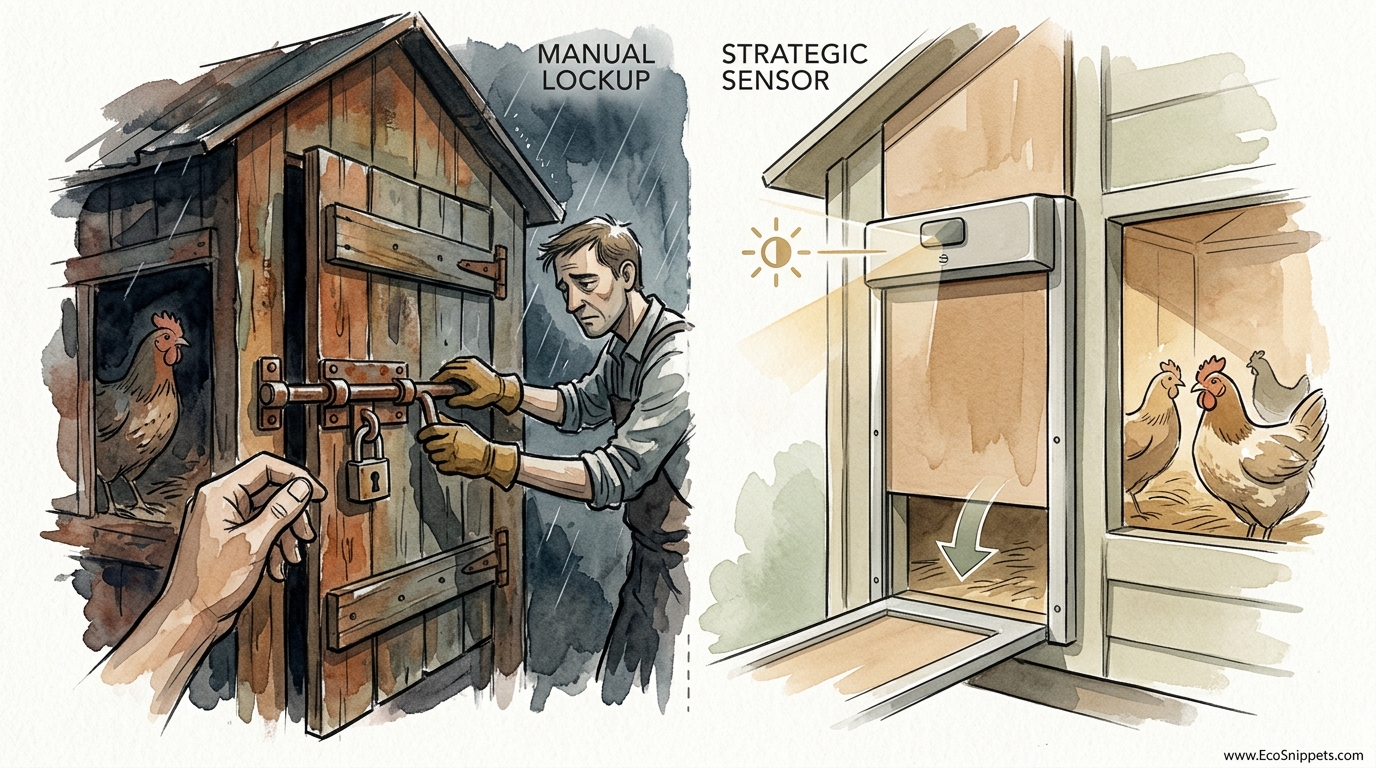
Strategic Sensor vs. Manual Lockup
Comparing the two methods reveals significant differences in long-term efficiency and cost. While a manual lockup costs nothing upfront, the hidden costs in time and livestock loss are substantial.
| Feature | Manual Lockup | Strategic Solar Sensor |
|---|---|---|
| Initial Cost | $0 | $150 – $400 |
| Daily Time Requirement | 15-20 Minutes | 0 Minutes |
| Seasonal Adjustments | None | Automatic |
| Predator Resistance | Dependent on Latch | Motor-Locked (High) |
| Reliability | Human Error Risk | Mechanical Failure Risk |
Analysis of these factors shows that a single predator attack can often exceed the cost of the door itself. A loss of six heritage breed hens can cost a homesteader between $150 and $300 in bird replacement and lost egg production. When viewed as an insurance policy, the solar door pays for itself within the first year.
Practical Tips and Best Practices
Successful implementation begins with the preparation of the coop wall. The opening must be perfectly square and level; if the frame is warped, the sliding door will bind in the tracks, leading to motor burnout or failure to close. Using a spirit level and taking diagonal measurements of the opening is a critical first step.
Predator aprons should be installed in conjunction with the door. While the door secures the entrance, predators like foxes and coyotes will often try to dig under the coop walls if they are thwarted at the door. Burying hardware cloth (1/2-inch mesh) at least 12 inches (30 cm) deep around the perimeter creates a complete security envelope.
Maintenance should be performed twice a year. This includes wiping the solar panel with a soft, damp cloth to remove dust and bird droppings, as these can significantly reduce charging efficiency. The door tracks should be cleared of debris and the moving parts lubricated with a dry-film lubricant or a light application of WD-40 on worm drives to ensure smooth operation during temperature changes.
Advanced Considerations for the Serious Homesteader
Experienced poultry keepers often look for ways to integrate their door into a larger management system. Some solar doors now feature Wi-Fi or Bluetooth connectivity, allowing you to check the door’s status from your phone. This is particularly useful for verifying that every bird made it inside before the door closed, as some apps will alert you if the door encountered an obstruction (like a late-returning hen).
Anti-pinch technology is a non-negotiable feature for advanced systems. This mechanism senses resistance as the door closes. If a bird is standing in the threshold, the door will stop and retract, preventing injury or death. After a short delay, the system will attempt to close again, giving the bird time to move into the safety of the coop.
For those in extreme climates, “hybrid” power setups are the pinnacle of reliability. These systems use a solar panel as the primary charger but include a backup AC plug or a high-capacity battery bank. This ensures that even during a week-long blizzard or an ash-filled sky from a wildfire, the door continues to function without interruption.
Real-World Application: The “Weekend Away” Scenario
Consider a homesteader who needs to travel for a wedding. Without an automatic door, they must find a neighbor to visit the coop twice a day—once at sunrise and once at sunset. This neighbor must be reliable, as a single missed evening could result in the total loss of the flock to a hungry raccoon.
With a solar-sensing door, the homesteader only needs a neighbor to check the water and food once a day at their convenience. The critical, time-sensitive task of “locking the gate” is handled by the sun. The birds wake up, forage during the cool morning hours, and retire to their roosts as the light fades, with the door sealing behind them like clockwork. This reduction in labor makes it easier to find help and provides the owner with genuine peace of mind while they are away.
Final Thoughts
The transition from manual labor to solar automation represents a significant milestone in homestead maturity. It is a shift from reactive management to a proactive system that respects the natural cycles of the land. By allowing the sun to manage your security detail, you are not being lazy; you are being strategic.
The reliability of a well-installed solar door far exceeds the reliability of a tired human at the end of a long day. It ensures that the “10 PM panic” becomes a thing of the past, replaced by the quiet confidence that your birds are sleeping safely behind a motor-locked barrier. As you continue to build out your homestead, look for these opportunities to replace repetitive chores with resilient systems.
Experiment with the settings, observe your birds’ transition to the new routine, and enjoy the freedom of a sunset that no longer demands your presence. The sun has been rising and setting for eons; it is more than capable of handling your coop door.
