How To Become More Self-Sufficient Without Starting a Full-Blown Farm…
Want to start preserving your harvest, making your own soap, or building a backyard root cellar — but not sure where to begin? “Homesteading Advice” gives you instant lifetime access to 35+ practical homesteading books on food preservation, veggie gardening, DIY natural cleaning products (save over $250 per year with this skill alone), brewing, off-grid energy, and a whole lot more…
Click Here To Check It Out Now!
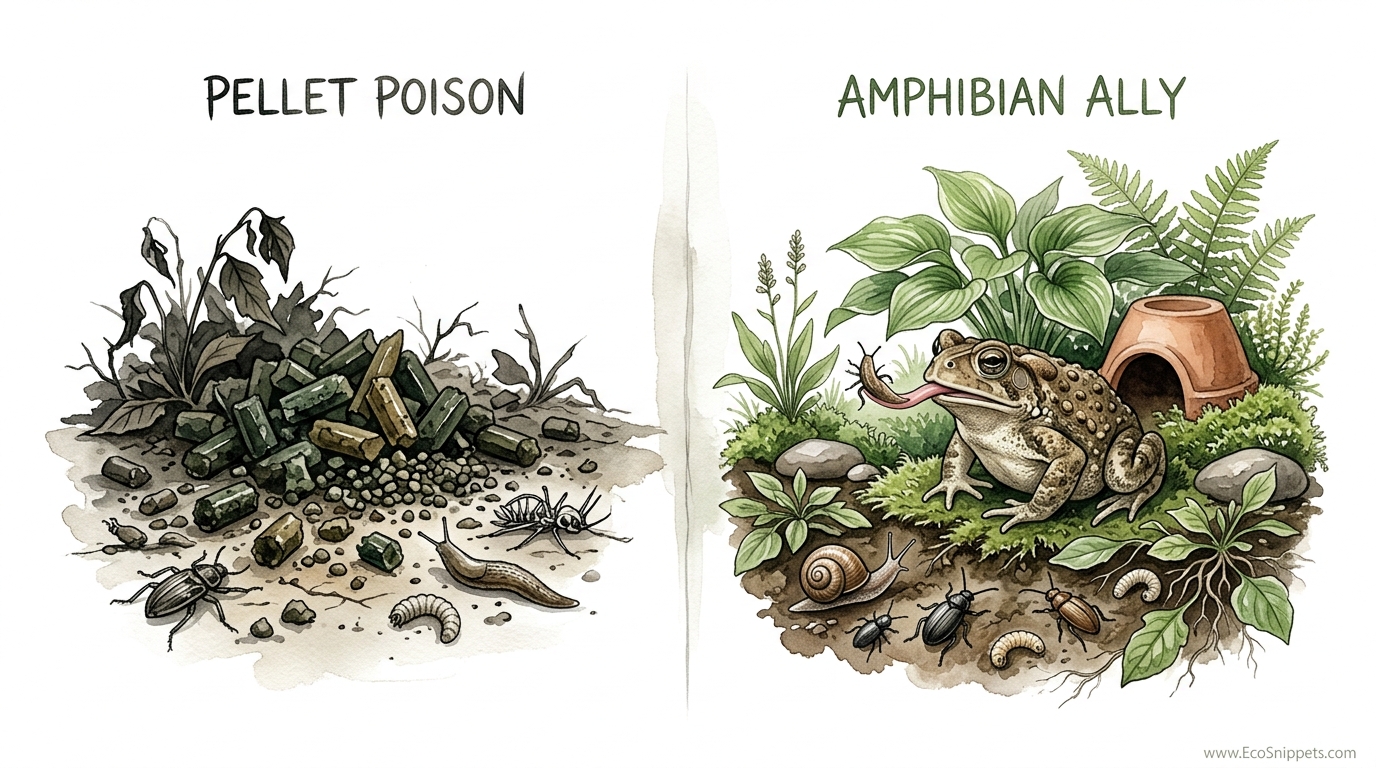
One poisons the entire soil food web to stop a single pest; the other invites a permanent, hungry hunter who works for free. Every time you scatter those blue ‘slug killers,’ you’re poisoning the very ground your food grows in. Permaculture isn’t about chemical warfare; it’s about building a habitat for the predators nature already provided. In my garden, the toads eat better than I do—and they don’t charge by the hour.
Making the shift from a chemical-dependent garden to one that relies on natural rhythms takes a bit of patience and a lot of observation. Toads are the quiet, warty sentinels of the soil, moving through the shadows to eliminate the same pests that keep you awake at night. These amphibians are not just visitors; they are indicator species that tell you exactly how healthy your land is. If you have toads, you have a functioning ecosystem. If you don’t, it is time to build them a home they cannot resist.
Living with toads means embracing a bit of the wild. It means leaving the leaf litter where it falls and rethinking that perfectly manicured lawn. The trade-off is a garden that protects itself. You stop being a weary soldier fighting a losing battle against slugs and start being a steward of a thriving habitat.
How To Attract Toads For Pest Control
Toads are specialized nocturnal predators that thrive on a diet of garden pests. To attract them, you must provide three fundamental things: moisture, shelter, and a poison-free environment. Unlike frogs, which spend most of their lives in or very near water, toads are more terrestrial, meaning they can live further from ponds as long as the ground remains damp.
In the real world, toads act as a mobile pest-control unit. They occupy the niches under low-hanging leaves, beneath wooden steps, and inside the crevices of rock walls. They are generalist insectivores, meaning they aren’t picky about what they snap up with their sticky tongues. If it crawls, wiggles, or flies near the ground, it is on the menu.
Visualizing a toad-friendly garden involves seeing the world from four inches (10 cm) off the ground. A flat, scorched lawn is a desert to a toad. A lush garden with mulch, varied plant heights, and small “toad abodes” is a lush sanctuary. Toads are creatures of habit; once they find a suitable territory that provides for their needs, they often stay there for their entire lifespan, which can reach 10 to 12 years in the wild.
The Mechanics of the Garden Guardian: How It Works
Toads operate on a “sit and wait” hunting strategy. They find a dark, cool spot during the day to conserve moisture and emerge at dusk when the humidity rises. This timing is perfect because it aligns with the peak activity of slugs, snails, and various nocturnal beetles.
Their skin is their most important tool. Toads do not drink water through their mouths like we do; instead, they absorb it through a specialized area on their belly known as a “seat patch.” This is why a moist environment is non-negotiable. If a toad’s skin dries out, it cannot breathe properly or maintain its internal balance.
When a toad spots movement, its eyes fixate on the target, and it flicks out a long, muscular tongue coated in a high-viscosity mucus. This happens in a fraction of a second. The prey is pulled into the mouth and swallowed whole. A single adult toad can consume 50 to 100 insects in a single night, which translates to nearly 3,000 pests per month or 10,000 over a single growing season.
Supporting this process requires a garden that isn’t too “tidy.” Toads need loose soil or leaf litter where they can burrow. During the heat of the day, they will dig several inches (5–10 cm) into the earth to find a stable temperature. If your soil is compacted or bare, they will have nowhere to hide from the sun or predators like crows and snakes.
Benefits of the Amphibian Ally
The primary advantage of using toads for pest control is the lack of collateral damage. When you use a chemical pesticide, you aren’t just killing the target bug; you’re often killing the beneficial insects that would have eaten it anyway. Toads provide a precision strike that leaves your soil health intact.
Another measurable benefit is the longevity of the solution. A bag of slug pellets is a temporary fix that must be reapplied after every rain. A resident toad is a permanent fixture that actually gets more efficient as it grows larger. As they age, toads become familiar with your garden’s layout, identifying the “hot spots” where pests congregate.
* Exceptional Diet: They target slugs, snails, cutworms, earwigs, crickets, and even gypsy moth caterpillars.
* Soil Aeration: Their habit of burrowing into the topsoil helps aerate the ground and mix organic matter near the surface.
* Ecological Indicator: Their presence confirms that your garden is free of heavy toxic residues, as their permeable skin makes them highly sensitive to pollutants.
* Zero Cost: Once established, they require no financial investment, no batteries, and no maintenance.
Furthermore, toads contribute to the nutrient cycle. Their waste is a natural fertilizer, small as it may be, that goes directly back into the soil where it is needed most. They are a closed-loop system of consumption and contribution.
Challenges and Common Mistakes
The biggest challenge in attracting toads is the “tidy garden syndrome.” Many gardeners feel the urge to rake away every leaf and pull every ground-cover plant. This removes the very infrastructure toads need to survive. A bare garden is a death trap where toads are exposed to desiccation and predators.
Mowers are another major hurdle. Toads often hunker down in tall grass during the day. Using a lawnmower on a low setting without checking the area first is a frequent cause of toad mortality. Setting your mower blades higher—at least 3 to 4 inches (7.5–10 cm)—gives them a much better chance of staying below the “danger zone.”
Using “safe” slug pellets is a common misunderstanding. While ferric phosphate pellets are marketed as safer than metaldehyde, they can still disrupt the soil’s mineral balance and may harm earthworms. More importantly, if you kill all the slugs with pellets, you are removing the toad’s primary food source. You cannot have the predator without the prey.
Finally, many people try to “import” toads from other locations. This is almost always a mistake. Toads have a strong homing instinct. If you move an adult toad to your garden, it will likely spend its remaining energy trying to find its way back to its original territory, often dying in the process. Your goal should be to build the habitat so they find you naturally.
Limitations of the Toad Method
Toads are not a “quick fix” for an existing infestation. If your hostas are currently being decimated by a thousand slugs, a single toad won’t solve the problem by tomorrow morning. Toads represent a long-term stabilization of the garden ecosystem, not an emergency intervention.
Environmental constraints also play a role. If you live in an extremely arid climate with no nearby water source, attracting toads will be an uphill battle. While they are hardy, they cannot survive without a way to rehydrate. Similarly, in urban areas with heavy traffic and high fences, toads may simply be unable to reach your backyard.
Another limitation is the breeding cycle. Toads need a body of water to lay their eggs. If your garden has no pond or if the neighborhood lacks a local wetland, you will never have a self-sustaining population. You might attract individual adults looking for food, but you won’t see the next generation of “toadlets” emerging in the spring.
Pellet Poison vs. Amphibian Ally
Choosing between chemical intervention and biological support is a choice between a sterile garden and a living one. Below is a comparison to help you understand the long-term impacts of each approach.
| Feature | Slug Pellets (Metaldehyde) | The Common Toad |
|---|---|---|
| Cost | Recurring (approx. $15-$30/season) | Free |
| Target Accuracy | Broad (kills beneficials/worms) | Specific (targets moving pests) |
| Safety | Toxic to pets, birds, and children | Safe (do not ingest) |
| Soil Impact | Leaves chemical residues | Enriches with waste and aeration |
| Maintenance | High (reapply after rain) | Zero (self-sustaining) |
Practical Tips for Creating a Toad Sanctuary
Building a home for toads is one of the most rewarding weekend projects you can undertake. You don’t need fancy materials; in fact, the more rustic and natural the materials, the better.
1. Constructing a “Toad Abode”: Take an old terracotta pot and gently chip a small “doorway” into the rim about 3 inches (7.5 cm) wide. Turn the pot upside down and place it in a shady, damp spot. Make sure the floor of the house is bare earth, as toads love to burrow down. You can also half-bury the pot on its side to create a “cave” effect.
2. The Shallow Soak: Since toads absorb water through their bellies, they need a “puddle” that never dries up. A large plant saucer or a shallow plastic lid buried flush with the ground works perfectly. Place a few flat rocks inside and around the edges so the toad can easily climb in and out. Change the water every few days to keep it fresh and prevent mosquito larvae from maturing.
3. Native Plant Cover: Ditch the ornamental exotics and plant native ground covers like Wild Ginger, Ferns, or Hostas. These plants create a cool, humid microclimate at the soil level. Toads especially love plants with broad leaves that act like umbrellas, shielding them from the midday sun.
4. Lighting Tactics: Install a low-voltage or solar garden light near your toad habitat. The light will attract moths, beetles, and other flying insects at night, creating a “buffet” that draws the toads into the area where they can then move on to patrol your vegetable beds.
Advanced Considerations for the Serious Practitioner
If you want to move beyond simple shelter and create a truly resilient population, you must consider the hibernaculum. In colder climates, toads must hibernate below the frost line to survive the winter. If your soil is too hard or compacted, they may freeze.
A hibernaculum is essentially a man-made winter den. Dig a hole approximately 20 inches (50 cm) deep and 3 feet (1 meter) wide. Fill it with a mixture of logs, large rocks, and broken bricks, leaving plenty of gaps and crevices. Cover the pile with the excavated soil and some leaf litter, leaving a few entrance holes at the ground level. This structure provides a stable, insulated environment where toads can safely enter a state of brumation.
Scaling your efforts also involves habitat corridors. Toads are at their most vulnerable when they have to cross open, exposed terrain to move between their hunting grounds and their water sources. By connecting different parts of your garden with “wild strips”—areas of taller grass or continuous mulch beds—you provide a safe passage that encourages them to explore the entirety of your property.
Lastly, manage your chemical runoff. Even if you don’t use pesticides, the fertilizers or herbicides used by your neighbors can leach into your soil. Creating a “buffer zone” of heavy-feeding plants or a small swale at the edge of your property can help filter these toxins before they reach your toad sanctuary.
The Transformation of a Cabbage Patch: A Scenario
Imagine a small backyard vegetable garden. For years, the owner battled the “Gray Field Slug,” a relentless consumer of young brassicas. Every spring, half the cabbage seedlings were lost. The owner used iron phosphate pellets, which worked temporarily but seemed to result in even more slugs the following month.
Last year, the gardener stopped the pellets and built three toad abodes near the cabbage patch. They added a shallow water saucer and stopped raking the mulch under the nearby hedge. By early summer, two large American Toads had taken up residence.
The result wasn’t the total eradication of slugs—that is a fantasy. Instead, the toad population reached a dynamic equilibrium with the slugs. The toads patrolled the perimeter of the patch every night at 9:00 PM. The slug damage dropped from 50% loss to less than 5%. The gardener saved money, the soil stayed clean, and the evening air was filled with the occasional trill of a happy hunter. This is the difference between fighting nature and participating in it.
Final Thoughts
Inviting toads into your garden is an act of trust. You are trusting that if you provide the habitat, nature will provide the solution. It is a slow process compared to the instant gratification of a chemical spray, but the results are deeper and more durable. You aren’t just protecting your vegetables; you are building a legacy of soil health and biodiversity.
Start small by placing a single pot in a shady corner. Observe the ground at night with a flashlight and see who comes to visit. Once you see that first pair of golden eyes reflecting in the light, you’ll realize that you aren’t gardening alone anymore.
Experiment with different types of shelters and water sources. Every garden is unique, and you will soon learn the specific preferences of your local amphibians. By moving away from “Pellet Poison” and toward the “Amphibian Ally,” you are choosing a path of self-reliance and ancestral wisdom that has sustained gardens for centuries. Let the toads do the work—they’ve been waiting for the invitation.
