How To Become More Self-Sufficient Without Starting a Full-Blown Farm…
Want to start preserving your harvest, making your own soap, or building a backyard root cellar — but not sure where to begin? “Homesteading Advice” gives you instant lifetime access to 35+ practical homesteading books on food preservation, veggie gardening, DIY natural cleaning products (save over $250 per year with this skill alone), brewing, off-grid energy, and a whole lot more…
Click Here To Check It Out Now!
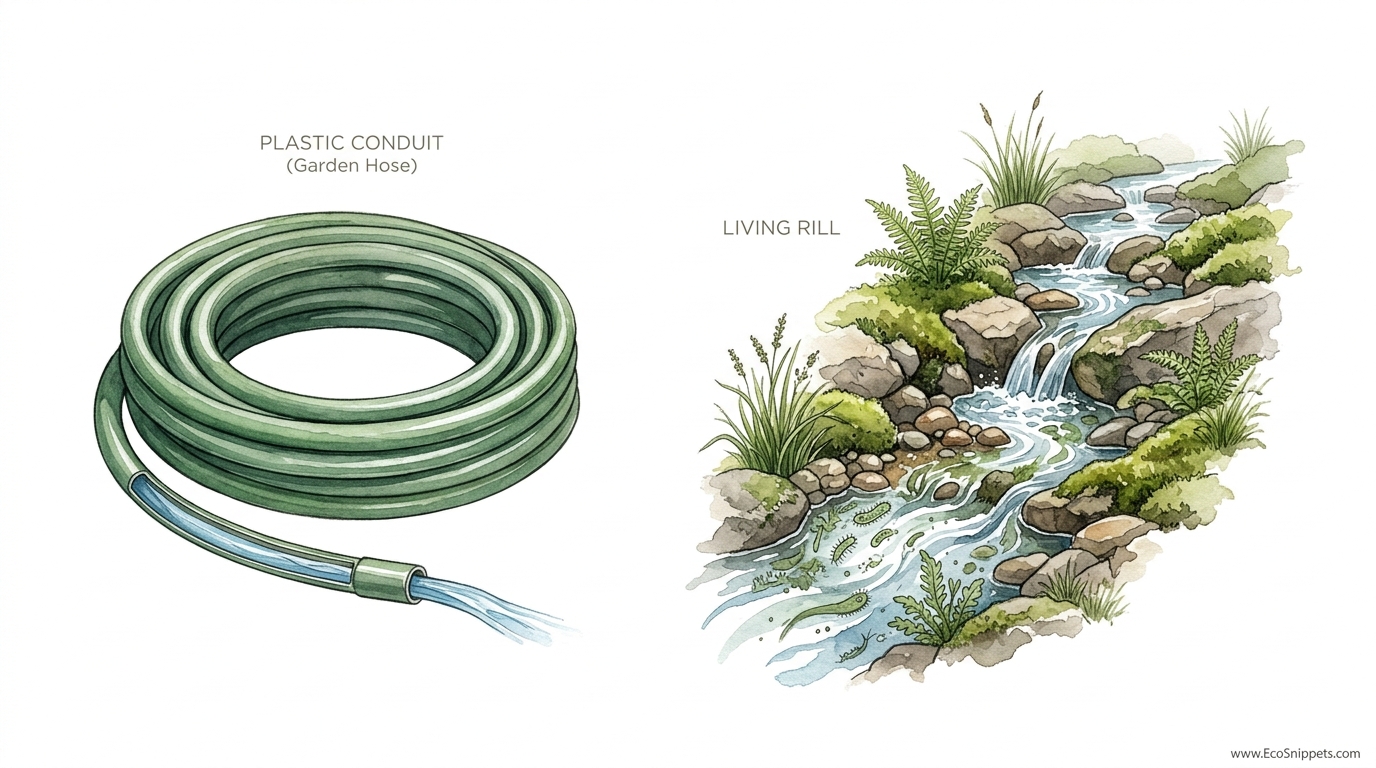
One of these will be in a landfill by next summer, while the other will be a bird’s favorite sanctuary. The average garden hose lasts five years and sheds microplastics into your soil with every drop. A living water rill builds biology, supports local wildlife, and never leaks. It is time to stop fighting the plastic and start flowing with the natural contours of your land.
Modern landscaping has conditioned us to view water as a problem to be hidden. We bury it in black plastic tubes, shove it into gutters, and whisk it away to the street as quickly as possible. This approach treats water like waste, yet we spend our weekends dragging heavy, kinked hoses across the yard to keep our gardens alive. There is a disconnect here that our ancestors would find baffling. They understood that water is the lifeblood of the land, and to move it was to invite life itself into the garden.
Building a natural water transport system is not just about moving liquid from point A to point B. It is about creating a functional ecosystem that works while you sleep. Whether you are channeling roof runoff to a backyard orchard or simply creating a recirculating stream to cool a summer patio, the methods remain the same. By looking back at traditional irrigation and combining it with modern ecological understanding, we can create systems that are beautiful, permanent, and entirely self-sustaining.
Natural Backyard Water Transport Systems
At its simplest, a natural backyard water transport system is an open-air channel designed to move water across a landscape using nothing but gravity and careful grading. These systems often take the form of “rills”—narrow, shallow rivulets that can be either formal and straight or winding and wild. Unlike a plastic conduit or a buried PVC pipe, a living rill is visible, accessible, and integrated into the soil’s own biology.
These systems have existed for millennia, from the intricate acequias of the American Southwest to the cooling water channels of the Alhambra in Spain. The word rill itself refers to a small stream, but in a garden context, it is a deliberate “water bearer” (derived from the Arabic as-s?qiya). These channels were traditionally unlined or lined with local stone and clay, allowing a portion of the water to seep into the surrounding earth, charging the groundwater and feeding the roots of nearby trees.
In a modern backyard, these systems serve as a functional alternative to the plastic garden hose. Instead of a temporary tool that degrades in the sun, a rill is a permanent feature of the land. It acts as a bio-filter, a wildlife corridor, and a thermal regulator. When you move water through a living channel, you aren’t just irrigating; you are building a “watershed” in miniature. The plants that line the banks of a rill help stabilize the soil and remove pollutants, ensuring that the water reaching your vegetables or fruit trees is cleaner than when it started its journey.
How to Design and Build a Living Rill
The success of any water transport system depends on the relationship between slope and volume. If the water moves too fast, it will tear the earth apart (erosion). If it moves too slow, it becomes a stagnant breeding ground for mosquitoes or fills with sediment. Finding the “sweet spot” is the first step in any build.
Step 1: Mapping the Contour
Before you pick up a shovel, you must understand how water naturally moves across your property. The goal is to move water at a gentle 1% to 2% grade. This means for every 100 units of length, the channel should drop only 1 unit in height. To find this line, many traditional land managers use an A-frame level—a simple wooden tool with a plumb bob that allows you to “walk” a perfectly level or slightly sloped line across even the most uneven ground.
Step 2: Excavating the Channel
Once your path is marked, begin digging. For a standard backyard rill, aim for a width of 20 to 60 centimeters (8 to 24 inches) and a depth of 15 to 40 centimeters (6 to 16 inches). Avoid vertical walls; instead, slope the sides at a 45-degree angle to prevent the banks from collapsing. This “V” or “U” shape is more stable and provides more surface area for beneficial microbes to live in the soil-water interface.
Step 3: Lining for Longevity
While ancient systems were often raw earth, modern backyard rills often benefit from a natural liner to ensure water reaches its destination. You can use a thick layer of puddled clay—a technique where you pack wet clay until it becomes impermeable—or line the channel with local flat stones. If you use stones, tuck “check dams” (small ridges of rock) every few meters. These dams slow the water down, creating small pools that allow sediment to settle and provide drinking spots for birds and beneficial insects.
Step 4: Managing the Flow
To keep the water healthy, aim for a flow velocity of 0.5 to 0.8 meters per second (approx. 1.6 to 2.6 feet per second). This speed is fast enough to prevent algae and weeds from choking the channel but slow enough to avoid scouring the bottom. If your land is steep, you can use a series of “cascades” or “steps” to drop the elevation quickly without increasing the water’s speed to dangerous levels.
Benefits of Living Water Channels
Choosing a living rill over a plastic pipe or hose offers measurable advantages for both the gardener and the local environment. These benefits extend beyond simple aesthetics and into the realm of true land stewardship.
Elimination of Microplastics: Modern plastic hoses and PVC pipes are known to shed microplastics and nanoplastics as they age, especially when exposed to UV light or fluctuating temperatures. Research has shown that these particles can accumulate in the roots of edible crops and reduce overall plant growth. A stone or clay-lined rill avoids this chemical leaching entirely, keeping your soil “clean” for generations.
Biological Filtration: As water moves through a living rill, it interacts with plants and soil microbes. This process, often called bio-filtration, helps break down organic pollutants and captures excess nutrients (like nitrogen from lawn runoff) before they reach your ponds or garden beds. In contrast, a plastic pipe simply transports dirty water to a new location without any treatment.
Passive Cooling: On a hot summer afternoon, a moving ribbon of water can lower the ambient temperature of a patio or garden by several degrees through evaporative cooling. This creates a microclimate that benefits both the gardener and heat-sensitive plants like lettuce or hydrangeas. The stones surrounding the rill also act as a heat sink, absorbing sun during the day and radiating warmth at night, which can help prevent frost in the shoulder seasons.
Wildlife Support: A buried pipe provides nothing for the local ecosystem. A living rill, however, becomes a focal point for biodiversity. Frogs, dragonflies, and birds will quickly find the water, creating a natural pest-control squad that keeps your garden’s insect population in balance without the need for chemical intervention.
Common Challenges and Pitfalls
Moving water is a powerful force, and even small mistakes in design can lead to frustration. Understanding why these failures happen is the key to avoiding them.
The most common error is improper grading. If your channel is too flat, water will sit and stagnate. In many regions, standing water for more than 48 hours is an invitation for mosquito larvae. Ensure your 1% slope is consistent throughout the entire run. If you find a “dead spot” where water pools, you may need to backfill with gravel or increase the depth of the channel further downstream.
Another pitfall is neglecting the “outfall.” Water has to go somewhere. If your rill simply ends in a corner of the yard, you will eventually create a muddy bog that can drown the roots of your trees or even damage your home’s foundation. Your rill should always terminate in a designated “sink,” such as a rain garden, a pond, or a heavily mulched orchard area designed to handle high moisture loads.
Finally, gardeners often underestimate sediment buildup. Leaves, dust, and grass clippings will naturally collect in your rill. If not managed, this material will eventually turn into a dam, causing the water to overflow the banks. Designing “sediment traps”—deeper, wider sections at the start of the rill—makes it easy to scoop out this nutrient-rich “sludge” once a year and put it directly into your compost pile.
Limitations and Environmental Constraints
While natural water transport systems are robust, they are not a “one-size-fits-all” solution. Certain landscapes and climates present unique challenges that may require adjustments to the traditional rill design.
Soil Type: In extremely sandy soils, water will disappear into the ground before it reaches its destination. If you live in a sandy region, a raw-earth rill is essentially a long, skinny soak-pit. In these cases, you must use a liner—either heavy clay, stone with mortar, or a specialized bentonite clay mat—to ensure the water keeps moving. Conversely, heavy clay soils are excellent for rills but can lead to drainage issues if the system isn’t carefully designed to overflow safely during heavy storms.
Steep Terrain: If your property has a slope greater than 5%, a simple rill will likely turn into an erosive gully. On steep land, you must use a “swale” approach—digging on the contour—or build a series of “check-dams” and “weirs” to break the water’s fall. This turns a high-energy stream into a low-energy series of ponds, protecting your topsoil from being washed away.
Climate Extremes: In cold climates where the ground freezes solid, rills will go dormant. The expansion of ice can crack rigid stone linings. Designing the rill with sloped sides allows the ice to expand “up and out” rather than pushing against the walls. In extremely arid climates, evaporation becomes a major factor. You may lose up to 30% of your water to the air if the channel is too wide and shallow. In these regions, deeper, narrower channels shaded by overhanging plants are essential.
Plastic Conduit vs. Living Water Rill
When deciding how to manage water on your land, it helps to look at the long-term costs and maintenance. While plastic is often marketed as “easier,” the reality of a five-to-ten-year horizon tells a different story.
| Factor | Plastic Conduit / Hose | Living Water Rill |
|---|---|---|
| Lifespan | 5–15 years (degrades in UV) | 50+ years (improves with age) |
| Soil Impact | Microplastic shedding; lead leaching | Builds soil biology and hydration |
| Initial Labor | Low (lay and bury) | High (digging and grading) |
| Maintenance | Replacement of cracked sections | Annual sediment clearing |
| Ecological Value | Zero | High (habitat and filtration) |
Practical Tips and Best Practices
Building a rill is a project that rewards patience and observation. Use these techniques to ensure your system functions effectively from the first rain.
- Use the “Barefoot Test”: When grading your channel, walk it barefoot. You can feel subtle changes in slope with your feet that are often invisible to the eye. If the mud feels consistently soft, your water is likely slowing down correctly.
- Plant the Banks Wisely: Choose plants that can handle “wet feet” but are also drought-tolerant. In the Northern Hemisphere, species like Carex (Sedges) and Juncus (Rushes) are excellent because their dense root systems “knit” the soil together, preventing erosion. For a food-producing rill, consider planting watercress directly in the flowing water.
- Incorporate Rocks: Place large “anchor stones” at any point where the rill turns a corner. These stones absorb the energy of the water, preventing it from blowing out the bank. Smaller smooth pebbles on the bottom of the rill create turbulence, which oxygenates the water and keeps it fresh.
- Install a Leaf Trap: At the point where your roof gutter meets the rill, install a simple wire mesh basket. This prevents large debris from entering the channel, saving you hours of maintenance later in the season.
Advanced Considerations for Serious Practitioners
Once you have mastered the basic rill, you can begin to integrate it into a larger whole-site water management plan. This is where the true “pioneer” wisdom of the land comes into play.
One advanced technique is the use of a Siphon System. If your water source is a pond or tank located higher than your garden, you can use a rill to “bleed” water off the top of the reservoir. This allows you to irrigate multiple garden beds simultaneously without any pumps or electricity. The key is to ensure the “intake” of your rill is slightly lower than the maximum fill line of your tank, creating an automatic overflow that directs excess water exactly where you want it to go.
You may also consider Keyline Design principles. This involves identifying the “keypoint” of a slope—the place where the terrain changes from convex to concave. By starting your water rill at this point and moving it outward toward the ridges, you can hydrate the driest parts of your property. This effectively “stretches” your water, making every drop of rain do twice the work it would have done otherwise.
For those in extremely cold regions, look into Thermal Mass integration. By lining your rill with dark basalt or granite stones, the water will absorb solar energy during the day. This warmed water can be channeled into a greenhouse or around cold frames, acting as a natural heater that extends your growing season by several weeks in both spring and autumn.
Scenario: The “Dry Creek” Transformation
Consider a standard suburban backyard with a slight slope toward the house. During heavy rains, the lawn becomes a swamp, and the homeowner’s instinct is to install a French drain (a buried plastic pipe). Instead, they choose a living rill.
The homeowner digs a winding 15-meter (50-foot) channel that starts at the downspout and meanders away from the house toward a new fruit tree grove. They line the channel with local fieldstones and plant Blue Flag Iris and Switchgrass along the edges. During a rainstorm, the water no longer pools against the foundation. Instead, it flows visibly through the rill, being filtered by the plants and stones. By the time it reaches the fruit trees, the “rush” of the storm has been converted into a slow, steady soak. Within two years, the area that was once a muddy nuisance is now a thriving habitat for dragonflies, and the trees are producing 20% more fruit than those on the drier side of the property.
Final Thoughts
The transition from plastic pipes to living water rills is more than a change in hardware; it is a change in philosophy. It is a commitment to working with the laws of physics and biology rather than trying to bypass them with fossil-fuel-based products. When we build systems that mimic nature, we find that the land begins to take care of itself. The birds return, the soil softens, and the “chore” of watering becomes a moment of peace as we watch the water move through the garden.
Do not be intimidated by the labor involved. While a plastic hose can be bought in minutes, it provides no lasting value to the earth. A rill, built with your own hands and the stones of your land, will still be flowing long after the plastic has turned to dust. Start small, observe how the water moves, and let the land be your guide. The ancestors knew that water was the most precious thing we could manage; it is time we remembered how to carry it with the respect it deserves.
As you experiment with these natural backyard water transport systems, you may find yourself looking at your entire landscape differently. Every roof, every path, and every slope becomes an opportunity to harvest and move life-giving moisture. You are no longer just a gardener; you are a steward of the water cycle, ensuring that every drop that falls on your land leaves it better than it arrived.
