How To Become More Self-Sufficient Without Starting a Full-Blown Farm…
Want to start preserving your harvest, making your own soap, or building a backyard root cellar — but not sure where to begin? “Homesteading Advice” gives you instant lifetime access to 35+ practical homesteading books on food preservation, veggie gardening, DIY natural cleaning products (save over $250 per year with this skill alone), brewing, off-grid energy, and a whole lot more…
Click Here To Check It Out Now!
Modern clothing is a petroleum byproduct; ancestral fiber is a living shield against the elements. We traded the thermal mastery of wool for the convenience of polyester, and we lost our independence in the process. Processing your own fleece isn’t just a hobby; it’s the ultimate path to clothing autonomy. When you hold a raw fleece in your hands, you aren’t just looking at potential yarn. You are holding the cumulative wisdom of centuries of survival.
Learning to transform a greasy, dirt-caked fleece into a soft, functional garment is a rite of passage for the self-reliant. It requires patience, physical effort, and a keen understanding of natural chemistry. This guide will walk you through the entire journey from the shearing floor to the spinning wheel. Whether you want to clothe your family or simply reconnect with the roots of human industry, this process is where you start.
How To Process Raw Wool At Home
Processing raw wool is the act of cleaning, refining, and organizing animal fibers into a state suitable for spinning or felting. In its raw form, wool is known as “in the grease.” This means it contains lanolin, a natural wax secreted by the sheep, along with dirt, sweat, and vegetable matter like hay or seeds. To the uninitiated, a raw fleece looks like a mess of tangled, smelly hair. To a practitioner, it is a raw material that offers superior insulation and weather resistance compared to any synthetic alternative.
The process exists to remove these impurities while preserving the structural integrity of the fiber. It is used by homesteaders, artisans, and those seeking to escape the cycle of fast fashion. Understanding how to handle these fibers allows you to produce high-quality textiles that can last for generations. Each step, from the first wash to the final carding stroke, is designed to align the fibers and prepare them for their ultimate purpose.
The Anatomy of the Fleece: Preparation and Skirting
Before any water touches the wool, you must perform a critical step called skirting. Lay the fleece out on a flat surface, ideally a mesh table or a clean floor. You want to see the “map” of the sheep. The center of the fleece is usually the cleanest and highest quality, while the edges—near the legs, belly, and tail—are often heavily soiled.
Remove any “tags,” which are clumps of wool matted with manure or mud. These are not worth the effort to clean and can contaminate your wash water. You also need to look for “second cuts.” These are short bits of wool created when the shearer makes a second pass over the same area. These tiny fibers will cause lumps, or “neps,” in your finished yarn if they aren’t removed now.
Assess the “staple length” and “crimp.” The staple length is the physical length of an individual lock of wool from the base to the tip. Crimp refers to the natural wave or zig-zag pattern in the fiber. High crimp usually indicates a softer, more elastic wool, like Merino. Lower crimp often belongs to hardier, lustrous fibers like Lincoln or Romney.
Scouring: The Science of the Wash
Scouring is the most intimidating step for beginners, but it is purely a matter of temperature and chemistry. Lanolin, the sheep’s natural grease, has a melting point of approximately 48.8°C to 60°C (120°F to 140°F). If your water is cooler than this, the grease will simply move around the fiber rather than being washed away.
Fill a large basin or tub with hot water. Aim for a temperature of roughly 60°C (140°F) to ensure the wax fully liquefies. Add a high-quality scouring agent. Professional products like Unicorn Power Scour or even a standard grease-cutting dish soap like Dawn are effective. The soap must be a surfactant that can suspend the oils in the water so they can be drained away.
Gently lower the wool into the water. Never pour water directly onto the wool, as the force of the stream can cause the fibers to “felt.” Felting is an irreversible process where the scales on the wool fibers interlock, turning your fleece into a solid mat of fabric. Avoid agitation at all costs. Let the wool soak for 15 to 20 minutes, then lift it out carefully or drain the tub. Repeat this process until the water runs clear.
Drying and Opening the Fiber
Once the wool is scoured and rinsed, it needs to dry thoroughly. Squeeze the excess water out gently; do not wring it. You can use a salad spinner to remove more moisture or roll the wool in a clean towel and step on it. Spread the damp wool out on a mesh drying rack in a well-ventilated area.
Keep the wool out of direct, intense sunlight, which can make the fibers brittle. Depending on the humidity in your region, this may take one to three days. Once dry, the wool should feel light, bouncy, and completely grease-free. If it still feels “tacky” or sticky, you may have left some lanolin behind, and a second scouring session may be necessary.
After drying, use your fingers to “tease” or “pick” the wool. This involves gently pulling the locks apart to open up the structure. This step helps any remaining bits of dust or grass fall out and prepares the fiber for the tools used in the next stage.
Carding vs. Combing: Choosing Your Texture
There are two primary ways to organize your clean wool: carding and combing. Each method produces a different type of yarn. Carding uses hand carders—flat paddles with fine wire teeth—to brush the wool into a fluffy cloud called a “rolag.” This preparation is used for “woolen” spinning, which results in a yarn that is airy, warm, and slightly fuzzy.
Combing involves using metal tines to pull the fibers through, removing any short bits and aligning all the long fibers in a perfectly parallel direction. This creates “combed top,” which is used for “worsted” spinning. Worsted yarn is smooth, strong, and has a beautiful drape. It is less insulating than woolen yarn but far more durable for items like suits or heavy-duty workwear.
Benefits of Home-Processed Wool
Processing your own wool offers measurable advantages over buying pre-processed fiber or synthetic substitutes. Natural wool is a bio-polymer that manages moisture and heat with far more sophistication than plastic-based materials.
- Thermal Intelligence: Wool fibers can absorb up to 30% of their weight in moisture without feeling wet. This means they can keep you warm even if you are sweating or caught in a light rain.
- Odor Resistance: Unlike polyester, which traps bacteria and develops a permanent “funk,” wool is naturally antimicrobial. You can wear a wool garment for weeks without it needing a wash.
- Durability and Longevity: A well-made wool sweater can last 20 to 50 years. Synthetic fibers break down and pill much faster, eventually ending up in a landfill.
- Ethical Transparency: When you process the wool yourself, you know exactly where it came from. You can support local farmers and ensure that no harsh industrial chemicals were used in the cleaning process.
Challenges and Common Mistakes
The learning curve for wool processing is steep, and mistakes can be costly in terms of time and material. The most common error is felting. This happens when you combine heat, moisture, and agitation. If you stir the wool while it is in the hot soapy water, you will likely ruin it.
Another frequent pitfall is “lanolin re-deposition.” If you let the wash water cool down below 48.8°C (120°F) while the wool is still in it, the melted lanolin will solidify again and stick even more stubbornly to the fibers. You must ensure you drain the water while it is still hot.
Vegetable matter (VM) can also be a source of frustration. If a sheep was fed hay over its back, the fleece might be “trashy.” Trying to pick every piece of grass out by hand is exhausting. Choosing a clean, well-skirted fleece from the beginning is the best way to avoid this headache.
Limitations of Home Processing
Home processing is not always the most efficient choice. If you have ten fleeces to process, doing it in a kitchen sink will take weeks of back-breaking labor. Large-scale processing requires significant amounts of water—often 38 to 75 liters (10 to 20 gallons) per pound of wool—which can be a limitation in drought-prone areas or homes on well systems.
Space is another constraint. You need enough room to skirt the fleece, dry it, and store it away from moths. If you live in a small apartment, the smell of wet sheep and the dust from carding can be overwhelming. In these cases, sending your fleece to a professional “mini-mill” might be a more realistic option for bulk quantities.
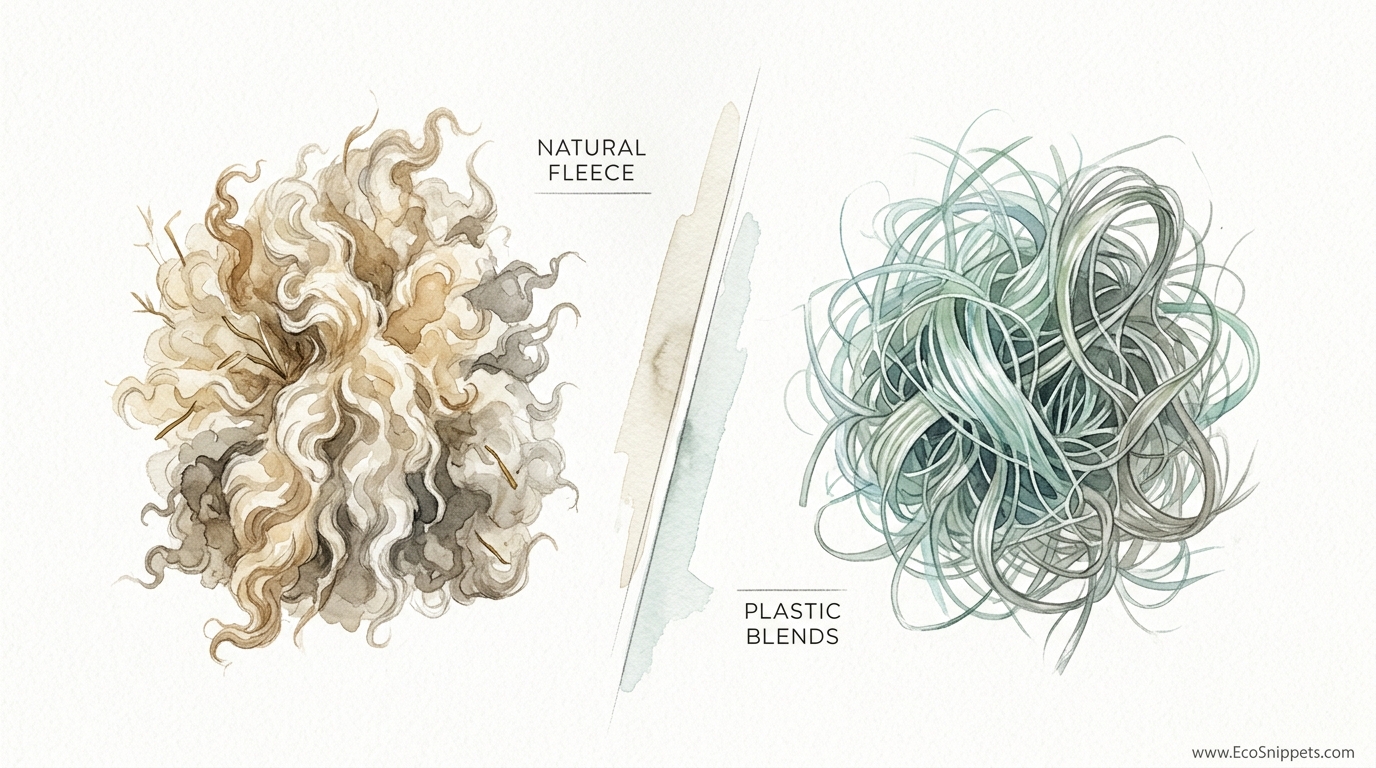
Natural Wool vs. Synthetic Blends
The choice between natural wool and petroleum-based synthetics is a choice between long-term independence and short-term convenience. Modern “fleece” jackets are almost always made of polyester, which sheds thousands of microplastics into the water supply with every wash.
| Feature | Natural Home-Processed Wool | Synthetic Polyester/Acrylic |
|---|---|---|
| Breathability | High (manages moisture vapor) | Low (traps heat and sweat) |
| Fire Resistance | Naturally flame-retardant | Melts and sticks to skin |
| Environmental Impact | Biodegradable, renewable | Petrochemical-based, persistent |
| Skill Required | Moderate to high | None (store-bought) |
| Cost | Low (material), High (time) | Low (mass-produced) |
Practical Tips and Best Practices
Success in wool processing comes down to preparation and the right tools. Using a dedicated thermometer is non-negotiable. Do not guess the water temperature; even a ten-degree drop can cause the lanolin to seize up.
Use mesh laundry bags to hold the wool during the wash. This makes it easier to lift the wool in and out of the basins without disturbing the lock structure. It also prevents small bits of wool from clogging your plumbing.
If you are dealing with a particularly dirty fleece, try a “cold soak” first. Submerge the wool in room-temperature water for 24 hours without any soap. This will loosen the dirt and “suint” (sheep sweat) before you begin the hot scouring process. This can save you several rounds of expensive detergent.
Advanced Considerations for Practitioners
Serious processors often move into the world of natural dyeing and fiber blending. Once the wool is clean but before it is spun, it is at its most receptive to dyes. Using plants like madder root, walnut hulls, or weld can provide a spectrum of colors that harmonize with the natural earthy tones of the wool.
Blending is another advanced skill. You can use a drum carder to mix your wool with other fibers. Adding silk provides strength and shine; adding alpaca increases warmth and softness; adding nylon (in small amounts) can improve the durability of socks. Experimenting with different “microns”—the measurement of fiber diameter—allows you to tailor your yarn for specific projects, from soft baby clothes to rugged outdoor rugs.
Example: Processing a Merino Fleece
Imagine you have just acquired a 2.2 kg (5 lb) raw Merino fleece. Merino is famous for its high lanolin content and fine, soft fibers. Because it is so greasy, you will likely need three or four hot soapy soaks to get it clean.
You start by skirting away the belly wool and any hay from the neck. You then wash the wool in 62°C (145°F) water with Unicorn Power Scour. After three washes and two rinses, the wool is white and fluffy. You decide to card it into rolags because you want a bouncy, warm yarn for a winter sweater. The result is a garment that feels like a second skin and provides far more warmth than any store-bought acrylic knit.
Final Thoughts
Mastering the art of wool processing is a reclaiming of ancestral power. It turns a waste product of the landscape into a high-performance material through nothing but heat, water, and hand-tools. While the process is time-consuming and requires attention to detail, the reward is a deeper connection to the clothes you wear and the environment they came from.
Every time you put on a garment made from wool you processed yourself, you are wearing hours of labor and a profound understanding of the natural world. This skill is a foundation for true clothing autonomy. Once you have seen the transformation from a dirty sheep’s coat to a refined thread, you will never look at a piece of clothing the same way again.
Experiment with different breeds and techniques. Each fleece has a story to tell, and it is up to you to listen and bring that story to life through your craft. Start small, stay patient, and let the fiber guide your hands.
