How To Become More Self-Sufficient Without Starting a Full-Blown Farm…
Want to start preserving your harvest, making your own soap, or building a backyard root cellar — but not sure where to begin? “Homesteading Advice” gives you instant lifetime access to 35+ practical homesteading books on food preservation, veggie gardening, DIY natural cleaning products (save over $250 per year with this skill alone), brewing, off-grid energy, and a whole lot more…
Click Here To Check It Out Now!
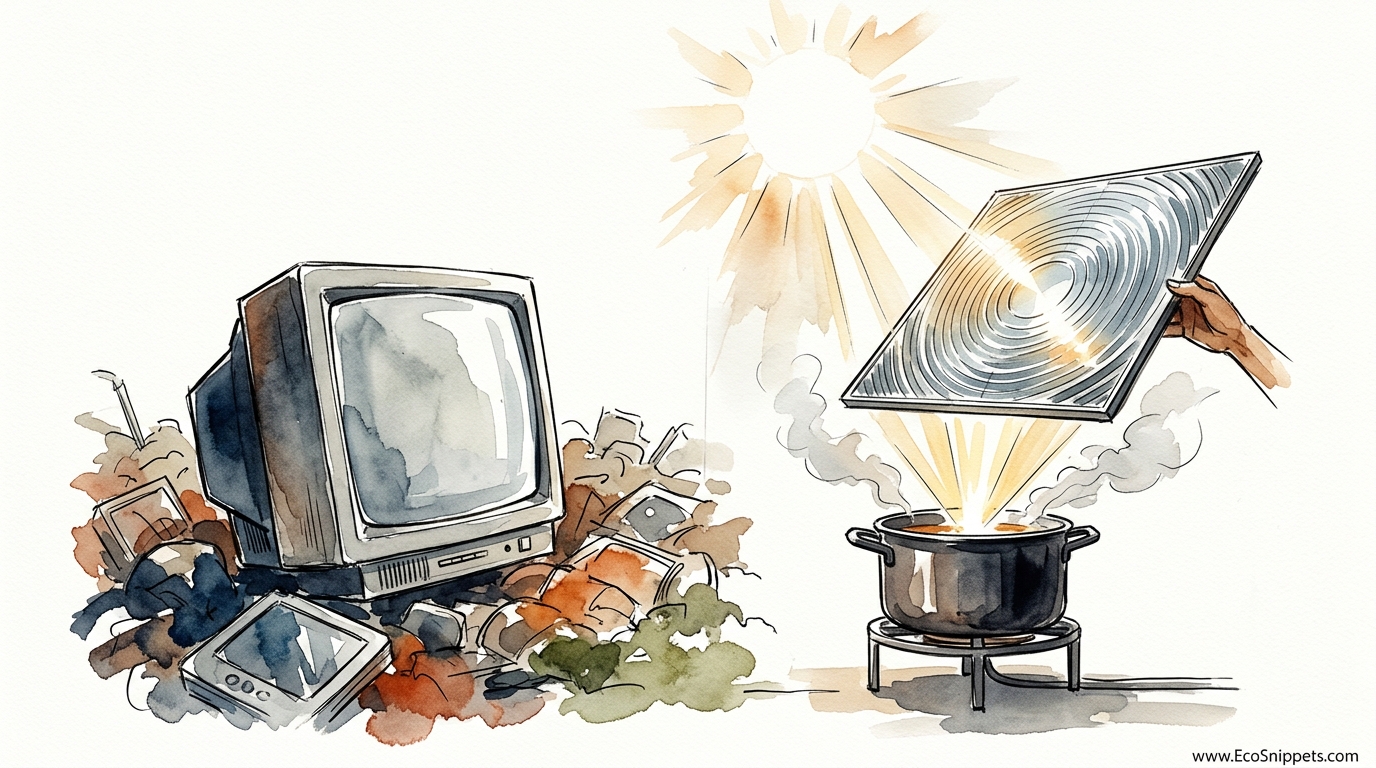
Your old television is hiding a solar furnace capable of melting steel in seconds. Most people see a bulky, outdated TV as a trip to the dump. But inside lies a Fresnel lens—a masterclass in energy concentration. By focusing the sun’s rays into a single point, you can cook, forge, or generate steam power for zero dollars.
The transition from a piece of living room furniture to a high-powered energy source is simpler than many realize. This process involves salvaging a specialized optical component that was designed to magnify light from a small projector bulb onto a large screen. In a backyard setting, this lens works in reverse, gathering a large area of sunlight and compressing it into a focal point no larger than a dime.
Tapping into this resource offers a glimpse into a more self-reliant way of living. This technology allows anyone with basic tools to harness the raw power of the sun for practical tasks without relying on expensive commercial hardware. It represents a bridge between modern waste and ancestral methods of utilizing natural energy.
Understanding the mechanics of this lens is the first step toward building a system that can provide free heat for a lifetime. Whether the goal is to pasteurize water, melt non-ferrous metals, or experiment with thermal chemistry, the Fresnel lens is a versatile tool for any modern pioneer.
How To Build A High Power Solar Concentrator
A solar concentrator is a device that gathers sunlight from a large aperture and focuses it onto a smaller area. This concentration increases the intensity of the light, producing temperatures that can exceed 2,000°F (1,093°C). In the world of DIY energy, the most accessible concentrator is the Fresnel lens harvested from an old rear-projection television.
These televisions, popular before the era of thin LED and OLED screens, use a “sandwich” of plastic layers to create the image. The Fresnel lens is the thin, grooved sheet of acrylic located just behind the outermost screen. Unlike a thick glass magnifying lens, a Fresnel lens uses a series of concentric circular ridges to bend light, allowing it to remain lightweight and flat while maintaining the power of a much larger, heavier optic.
Real-world applications for these concentrators are numerous. They are used in professional solar thermal power plants to heat oil or salt for electricity generation. At a hobbyist scale, they are excellent for wood gasification, melting lead for casting, or powering small Stirling engines. Using one is like having a permanent, fuel-free torch at your disposal whenever the sun is shining.
Finding a donor TV is usually a matter of checking local classifieds or recycling centers. Look for older, deep-bodied TVs with screen sizes ranging from 40 inches to 60 inches (101 cm to 152 cm). The larger the screen, the more sunlight it captures, and the hotter the focal point will become.
How It Works: The Physics of Concentrated Light
The Fresnel lens operates on the principle of refraction. Standard lenses use a continuous curve of glass to bend light rays toward a central point. However, a lens the size of a 50-inch (127 cm) TV screen made of solid glass would weigh hundreds of pounds and be nearly impossible to mount.
Augustin-Jean Fresnel solved this problem in the early 19th century by realizing that only the surface curvature of a lens is responsible for bending light. He “collapsed” the curve into a series of steps or ridges. Each ridge acts as a tiny prism that bends light at a specific angle. When these ridges are arranged in concentric circles, they all send light to the same focal point.
Most rear-projection TVs contain two main layers: a lenticular lens and a Fresnel lens. The lenticular layer usually has vertical ridges designed to spread light horizontally so the TV can be viewed from the side. The Fresnel layer is the one you want; it features a circular pattern of ridges that creates a “spot focus.” Some TVs may use a linear Fresnel lens, which creates a “line focus,” but the circular spot focus is much more common and effective for high-heat applications.
The focal length—the distance from the lens to the point of hottest light—varies depending on the TV model. Most 50-inch (127 cm) lenses have a focal length between 24 and 36 inches (61 cm and 91 cm). At this distance, the concentrated light becomes an intense, blinding white spot that can incinerate wood or melt pennies in seconds.
How to Build Your Solar Furnace
Extracting the lens requires patience and basic safety gear. Wear gloves and eye protection, as the plastic edges can be sharp and the internal components of old TVs often hold significant static charges or contain fragile glass projector bulbs.
Step 1: The Teardown
Start by removing the screws around the bezel of the television. Lay the TV on its back and carefully lift the front screen assembly away from the cabinet. You will likely find a “sandwich” of two or three sheets of plastic held together by a metal frame or tape. Peel these layers apart carefully.
Identify the Fresnel lens by looking for the layer with fine, circular ridges. It will feel slightly “toothy” or rough on one side. The other layers (the clear protective front and the lenticular vertical-ridge sheet) are useful for other projects but will not concentrate light into a point. Keep the Fresnel lens clean and avoid scratching the ridged surface.
Step 2: Constructing the Frame
A raw sheet of 1/8-inch (3 mm) acrylic is floppy and will not focus light properly if it sags. You must build a rigid frame to hold it flat. A common and effective method is to use 2×4 lumber (38 mm x 89 mm) or 1×2 pine strips (19 mm x 38 mm).
Cut four pieces of wood to match the dimensions of your lens. Using a table saw or a router, cut a groove or “rabbet” into one side of each piece of wood. The lens will sit inside these grooves. Assemble the frame around the lens and secure the corners with wood screws. This creates a sturdy “window” that protects the lens edges and keeps the surface tension even.
Step 3: The Stand and Pivot
To use the concentrator effectively, you need a way to track the sun. A simple “Y” frame or a tripod-style stand with a pivot point allows you to tilt the lens up and down and rotate it left to right. This ensures the lens is always perpendicular to the sun’s rays, which is critical for achieving maximum temperature.
Metal frames made of aluminum or steel offer more durability against the elements, but wood is often preferred for initial prototypes because it is easier to work with. If using wood, paint or seal it to prevent warping, as a warped frame will distort the lens and ruin the focus.
Benefits of Using a Fresnel Lens Concentrator
The primary advantage of this system is the cost-to-performance ratio. A high-quality glass lens of this size could cost thousands of dollars, yet a salvaged Fresnel lens is often free or available for the price of a trip to the dump. It turns an environmental liability (electronic waste) into a functional asset.
Another benefit is the speed of heating. Unlike a solar oven, which slowly builds heat over hours, a Fresnel concentrator provides “instant-on” energy. As soon as the lens is aligned with the sun, the focal point reaches its peak temperature. This makes it suitable for tasks like welding plastics, soldering, or flash-boiling water.
Environmentally, this is a zero-emission heat source. It requires no wood, gas, or electricity to operate. For those living off-grid or in remote areas, it provides a reliable way to process materials without consuming precious fuel supplies. It is also a silent technology, making it ideal for peaceful outdoor workspaces.
Challenges and Common Mistakes
The most significant challenge when working with a solar concentrator is safety. The focal point is not just hot; it is extremely bright. Looking at the point where the light hits a target can cause permanent retinal damage in a matter of seconds. Standard sunglasses are insufficient. Always use Shade 5 or Shade 10 welding goggles when observing the focal point.
A common mistake is leaving the lens unattended. Even on a partially cloudy day, the sun can peek out and move across the sky. If the lens is angled toward the sun and the focal point happens to land on a dry leaf, a piece of wood, or the side of a building, it will start a fire. Never leave a solar concentrator uncovered or upright when not in use.
Precision in tracking is another hurdle. The sun moves approximately 15 degrees per hour. To keep the focal point on a small target, you must adjust the lens every few minutes. Failure to do so will result in the heat drifting off the target, leading to inconsistent temperatures and longer processing times.
Limitations and Practical Constraints
While powerful, a Fresnel lens has limitations. It is highly dependent on direct, “clear-sky” solar radiation. On hazy or overcast days, the light is diffused, and the lens will fail to create a usable focal point. This makes it a seasonal or weather-dependent tool rather than a 24/7 energy solution.
The size of the target is also limited. Because the light is focused into a very small area, it is difficult to heat large volumes of material evenly. If you are trying to melt a large pot of lead, the lens will melt a hole in the top layer while the bottom remains cool unless you have a highly conductive crucible or a way to distribute the heat.
Finally, the lens itself is made of acrylic (PMMA). Over time, exposure to intense UV light and heat can cause the plastic to yellow or become brittle. While most TV lenses are UV-stabilized, they are not immortal. Storing the lens in a cool, dark place when not in use will extend its lifespan significantly.
Comparing Solar Concentrator Technologies
When choosing a solar concentrator, it helps to understand how the Fresnel lens stacks up against other DIY options like parabolic mirrors or heliostats.
| Feature | Fresnel Lens | Parabolic Mirror | Heliostat Array |
|---|---|---|---|
| Max Temp | 2,000°F+ (1,093°C) | 1,500°F+ (815°C) | 3,000°F+ (1,648°C) |
| Ease of Build | Very High (Salvaged) | Medium (Requires geometry) | Low (Requires many mirrors) |
| Weight | Very Low | High (if glass/metal) | Varies |
| Tracking Need | High (Frequent) | High (Frequent) | Very High (Automated) |
The Fresnel lens is the clear winner for beginners due to its availability and the simplicity of its focal point. Parabolic mirrors are excellent but require precise curvature and can be difficult to build from scratch without specialized materials like reflective Mylar or polished aluminum.
Practical Tips and Best Practices
Getting the most out of your solar concentrator requires a few “tricks of the trade.” First, always keep the smooth side of the lens facing the sun and the ridged side facing your target. This orientation is standard for most TV lenses to ensure the rays converge properly.
Cleanliness is vital for efficiency. Dust and fingerprints on the ridges will scatter light, reducing the intensity of the focal point. Use a soft microfiber cloth and a gentle soap solution to clean the lens. Avoid using harsh chemicals like acetone or high-strength alcohol, as these can cloud or melt the acrylic surface.
Finding the focal point can be tricky. Start with the lens perpendicular to the sun and hold a piece of scrap wood behind it. Move the wood back and forth until the circle of light shrinks to its smallest, brightest point. Mark this distance on your frame or stand. This is your “sweet spot” where the most energy is concentrated.
Advanced Considerations: Scaling and Storage
For those looking to take this project further, consider building an automated solar tracker. A simple circuit using light-dependent resistors (LDRs) and a small motor can keep the lens perfectly aligned with the sun throughout the day. This is essential if you plan to use the lens for long-duration tasks like steam generation or biochar production.
Thermal storage is another area for advancement. Instead of heating a target directly, you can focus the lens on a block of graphite or a container of molten salt. These materials can hold significant amounts of heat, which can then be used after the sun goes down to cook food or heat a small space. This bridges the gap between a “daytime-only” tool and a practical energy system.
Consider the “Linear Fresnel” approach for heating pipes. If you find a linear lens, it focuses light into a line rather than a point. This is ideal for heating a long copper tube filled with water or oil. You can create a simple solar water heater by mounting a linear lens over a blackened pipe, providing hot water for a camp or a workshop with zero electricity.
Example Scenarios: Putting the Lens to Work
Imagine you are in a situation where you need to purify a large amount of water but have no fuel for a fire. A 50-inch (127 cm) Fresnel lens can boil a quart (0.95 liters) of water in under ten minutes if focused on a blackened metal container. This “solar distillation” setup can provide safe drinking water indefinitely as long as the sun is out.
In another scenario, a hobbyist blacksmith wants to cast small aluminum parts. Using a Fresnel concentrator focused on a small ceramic crucible, the temperature can easily reach the 1,220°F (660°C) required to melt aluminum cans or scrap. This allows for backyard foundry work with no carbon footprint and no noisy blowers or expensive propane.
A third application is wood gasification. By focusing the lens on a sealed metal container filled with wood chips (with a small vent), the intense heat triggers a chemical reaction that releases flammable wood gas. This gas can be captured or burned directly as a clean fuel source, demonstrating how solar heat can be used to unlock other forms of energy.
Final Thoughts
The transition from viewing a screen to harvesting its power represents a fundamental shift in how we perceive the objects around us. A discarded television is no longer a piece of plastic waste; it is a high-tech tool for survival and self-reliance. By understanding the simple physics of light and spending an afternoon in the workshop, you can build a device that rivals industrial equipment in its heat-generating capability.
This project is a reminder that the resources for a more sustainable life are often right in front of us, hidden in the things we throw away. The ability to generate 2,000°F (1,093°C) for free is a powerful skill for any modern pioneer to possess. It encourages a deeper connection with the natural rhythms of the sun and a practical understanding of energy.
As you experiment with your solar concentrator, remember to respect the power you are wielding. Start small, prioritize safety, and enjoy the process of turning light into fire. Whether you are melting metal or simply boiling water for tea, you are participating in a tradition of ingenuity that dates back centuries, updated for the modern age.
