How To Become More Self-Sufficient Without Starting a Full-Blown Farm…
Want to start preserving your harvest, making your own soap, or building a backyard root cellar — but not sure where to begin? “Homesteading Advice” gives you instant lifetime access to 35+ practical homesteading books on food preservation, veggie gardening, DIY natural cleaning products (save over $250 per year with this skill alone), brewing, off-grid energy, and a whole lot more…
Click Here To Check It Out Now!
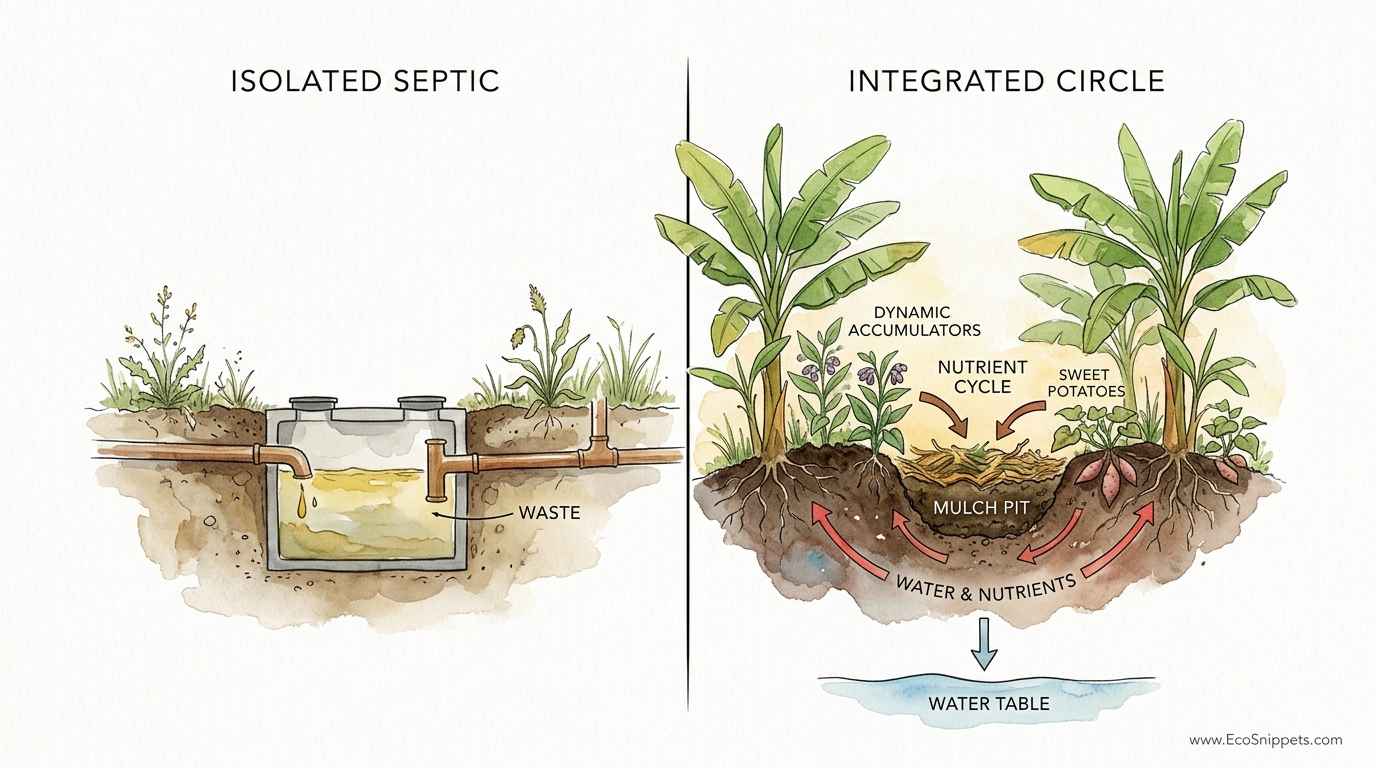
Why pay to hide your ‘waste’ in a concrete tomb when you can turn your kitchen water into a mountain of free bananas? In nature, there is no such thing as ‘waste.’ A banana circle is the ultimate permaculture hack: it captures greywater, composts organic debris, and produces hundreds of pounds of fruit all in one self-managing system. Stop flushing your fertilizer.
Living off the land requires a shift in perspective. Instead of seeing wastewater as a nuisance to be pumped away, the self-reliant grower sees it as a concentrated stream of life. Ancestral wisdom reminds us that every drop of water and every scrap of carbon is a deposit in the soil’s bank account. The banana circle is a bank that pays dividends in heavy bunches of fruit, nutrient-dense tubers, and lush biomass.
This system is a masterclass in stacking functions. It acts as a decentralized water treatment plant, a high-speed composting station, and a highly productive mini-orchard. Whether you are managing a tropical homestead or a subtropical backyard, this simple earthwork transforms a liability into your most productive asset.
How To Build A Permaculture Banana Circle
A permaculture banana circle is a specialized garden bed designed as a hollow-centered mound. It consists of a central pit—often called a “compost pit” or “infiltration trench”—surrounded by a raised berm of earth where the plants are situated. This design mimics the natural floor of a rainforest, where organic matter accumulates in hollows, retaining moisture and feeding the giants that grow around the edges.
This system is primarily used in tropical and subtropical regions where rainfall is seasonal and evaporation rates are high. However, its principles are universal. It is an “island of fertility” that concentrates resources in a specific area to support heavy-feeding plants like bananas (Musa spp.). Unlike a traditional row garden, the banana circle creates a microclimate that protects plants from wind and retains heat, ensuring a steady harvest even when conditions outside the circle are less than ideal.
Think of it as a biological sponge. The central pit is filled with carbon-rich materials—logs, branches, leaves, and kitchen scraps. When water from your sink or shower enters this pit, the organic matter absorbs it, preventing runoff and allowing the water to slowly seep into the surrounding mound where the banana roots are waiting. It is a closed-loop system where your household “waste” becomes the fuel for your next meal.
How It Works: The Mechanics of a Living Filter
Understanding the mechanics of a banana circle is essential for long-term success. The system relies on three primary components working in harmony: the pit, the mound, and the biological guild.
The central pit is typically dug to a depth of 50 centimeters to 1 meter (1.5 to 3.3 feet) and a diameter of about 2 meters (6.5 feet). This pit serves as the primary digestive organ of the system. As you fill it with organic matter, a community of bacteria, fungi, and earthworms moves in. These organisms break down the carbon and nitrogen, releasing minerals directly into the root zone of the plants on the berm.
The mound, created from the soil excavated from the pit, provides a well-drained environment for the banana trees. While bananas love water, they despise “wet feet” or stagnant water around their corm (the underground stem). The raised berm ensures that the main body of the plant stays above the saturation point while its adventurous roots reach down into the moist, nutrient-rich depths of the central pit.
Integrated greywater systems often feed directly into this center. Water from laundry, sinks, or outdoor showers is piped into the pit. The mulch layer acts as a physical filter, catching solids, while the microbiology in the soil breaks down soaps and organic residues. The plants then “evapotranspire” the water, pulling it up through their stems and releasing it into the atmosphere as pure vapor, effectively cleaning the water and cooling the local environment simultaneously.
Step-By-Step Construction Guide
Building this system requires more sweat than technology. It is a project that can be completed in a weekend with nothing more than a shovel, a mattock, and a bit of determination.
Step 1: Siting and Marking
Choose a location that receives at least six to eight hours of sunlight. Bananas are solar-powered machines; without adequate light, fruit production will be meager. Place the circle near a greywater source or in a spot where natural runoff accumulates. Use a stake and a 1-meter (3.3-foot) piece of string to scribe a 2-meter (6.5-foot) diameter circle on the ground.
Step 2: Excavation
Dig the central pit in a bowl shape. The center should be the deepest point, tapering up toward the edges. If you are working with heavy clay soil, ensure the walls of the pit are roughened with a shovel to prevent “glazing,” which can inhibit water infiltration. As you remove the soil, pile it in a ring around the outside of the hole to form the berm.
Step 3: Preparing the “Sponge”
Before planting, fill the pit with coarse organic material. Start with large logs or thick branches at the bottom to create air pockets and a long-term fungal base. This is often referred to as “hugelkultur” inside a pit. Layer smaller sticks, dry leaves, and green garden waste on top. Fill the pit until the mulch is slightly higher than the surrounding ground level, forming a convex mound of organic matter.
Step 4: Planting the Guild
Space four to six banana “pups” (suckers) evenly around the top of the berm. Position them at the 12, 3, 6, and 9 o’clock positions to allow room for growth. Between the bananas, plant secondary crops like papayas or pigeon peas. On the outer slope of the berm, plant groundcovers like sweet potatoes or lemongrass to stabilize the soil and prevent erosion.
Benefits of the Integrated Banana Circle
The advantages of this system extend far beyond the fruit. In a self-reliant homestead, the banana circle serves as a multi-tool for environmental management.
Water Conservation and Treatment: A single banana circle can process 100 to 200 liters (25 to 50 gallons) of greywater per day, depending on the climate and soil type. This eliminates the need for expensive septic leach fields for “clean” wastewater. The water is filtered by the mulch and purified by the soil’s microbial life before it ever reaches the groundwater table.
Passive Composting: Forget the chore of turning compost piles. The banana circle is a “set it and forget it” composting system. You simply toss your kitchen scraps, grass clippings, and pruned branches into the center. The heavy-feeding bananas act as a vacuum, sucking up the nutrients as they are released, which means no nutrient leaching and no foul odors.
High Yield in Small Spaces: Because the system is three-dimensional, you can grow a staggering amount of food in a 3-meter (10-foot) wide area. A well-maintained circle can provide a steady supply of bananas, papayas, sweet potatoes, and medicinal herbs like ginger or turmeric, which thrive in the humid shade of the banana leaves.
Soil Building: Over time, the banana circle turns poor, compacted soil into rich, black humus. The constant “chop and drop” maintenance—where you cut old banana stalks and toss them into the center—creates a self-perpetuating cycle of fertility. You are essentially building a forest floor in a controlled, circular format.
Challenges and Common Mistakes
Even the most robust systems can fail if the basic principles are ignored. Most failures in banana circle design stem from a lack of maintenance or a misunderstanding of the plants’ needs.
One frequent error is failing to provide enough mulch. A “naked” banana circle will quickly dry out, and the exposed soil will lose its microbial activity. The center pit must be kept full of organic matter. If you can see the dirt at the bottom of the pit, you aren’t adding enough carbon. This mulch also prevents mosquitoes from breeding in any standing water by creating a physical barrier.
Another common pitfall is over-planting. It is tempting to pack every square inch of the berm with seedlings, but bananas grow rapidly and produce many “pups.” If the circle becomes too crowded, air circulation drops, leading to fungal diseases like Sigatoka or Panama wilt. You must be ruthless in thinning the suckers, keeping only one “grandmother” (the fruiting plant), one “daughter” (the successor), and one “granddaughter” (the future) per station.
Poor drainage is a silent killer. In heavy clay soils, the pit can act like a bathtub, holding water until the roots rot. If you suspect your soil doesn’t drain well, dig a small overflow trench or “spillway” on the downhill side of the circle. This allows excess water during heavy storms to exit the system safely rather than drowning the plants.
Limitations and Environmental Constraints
The banana circle is a powerful tool, but it is not a magic bullet for every climate. Understanding its boundaries is key to professional-grade permaculture design.
Climate Limitations: Bananas are tropical plants. While they can be grown in temperate zones with significant winter protection, the banana circle system as a greywater processor works best in USDA Zones 9 and above. In colder climates, the plants will go dormant in winter, and the “biological pump” will stop, meaning the system can no longer process large volumes of water without risking soil saturation.
Space Requirements: A functional circle requires a footprint of at least 3 to 4 meters (10 to 13 feet) once you account for the walking paths around it. For urban gardeners with very small lots, this may be too large. In these cases, a “banana semi-circle” or a linear “banana swale” might be a more appropriate adaptation.
Chemical Sensitivity: Because the system relies on living biology, you cannot use harsh chemicals in your greywater. Bleach, strong disinfectants, and certain synthetic soaps will kill the very bacteria and fungi that make the system work. Transitioning to “plant-safe” or “biocompatible” soaps is a mandatory trade-off for anyone using a banana circle for water treatment.
Comparison: Integrated Circle vs. Isolated Septic
When deciding how to manage wastewater and fertility, it helps to look at the numbers. Most modern homes rely on isolated septic systems, which are designed to hide waste rather than use it.
| Feature | Isolated Septic System | Integrated Banana Circle |
|---|---|---|
| Installation Cost | $3,000 – $20,000 (standard) | $50 – $200 (labor & plants) |
| Maintenance | Professional pumping every 3-5 years | Annual “chop and drop” (free) |
| Resource Output | None (Waste is buried) | Food, biomass, and mulch |
| Lifespan | 20-30 years before failure | Indefinite with management |
| Environmental Impact | Risk of groundwater leaching | Carbon sequestration & water recharge |
While a septic system is necessary for “blackwater” (toilet waste) in many jurisdictions, the banana circle is a vastly more efficient and regenerative way to handle greywater. It turns a $5,000 liability into a $500 annual asset in the form of produce and soil health.
Practical Tips and Best Practices
Success in the garden is often found in the small details. These adjustments can double the efficiency of your system.
- Directional Growth: To prevent the bananas from “walking” into the center of the pit, always select new pups that are growing on the outside edge of the circle. This keeps the plants moving in a slow, outward spiral, maintaining the integrity of the central pit.
- Nitrogen Fixers: Plant Pigeon Pea (Cajanus cajan) on the northern side of the circle. This hardy shrub fixes nitrogen in the soil and can be heavily pruned to provide “green” mulch for the pit.
- Mosquito Control: If standing water persists in the pit, add a handful of “mosquito dunks” (BTI) or ensure the mulch layer is at least 30 centimeters (12 inches) thick above the water line. The physical barrier of the mulch prevents the mosquitoes from reaching the water to lay eggs.
- The 70/30 Rule: Aim for a mix of 70% brown material (straw, wood chips, dry leaves) and 30% green material (kitchen scraps, fresh grass) in your pit. This balance prevents the pit from becoming anaerobic and smelly.
Advanced Considerations: Scaling and Integration
For the serious practitioner, a single banana circle is just the beginning. These units can be linked together to create a larger ecosystem of water management.
Consider building a “Mandala Garden” by connecting four or five banana circles with shallow swales. In this configuration, the greywater enters the first circle, and any overflow travels through the swales to the subsequent circles. This creates a massive filtration network that can support an entire family orchard.
In areas with poor soil fertility, “brown water” systems can be integrated. This involves using the output from a well-managed composting toilet as a nutrient source for the center of the circle. While this requires careful management and adherence to local health codes, it is the ultimate expression of a closed-loop system, ensuring that every calorie harvested from the land eventually returns to it.
For those in Mediterranean or marginal climates, adding thermal mass is essential. Line the northern edge of the circle with large stones or dark-colored water barrels. These will absorb heat during the day and radiate it back to the bananas at night, helping them survive cooler evenings and extend the growing season.
Scenario: The Homestead Transformation
Imagine a small homestead in a subtropical valley. The owners were struggling with a soggy patch of ground behind their laundry room. The soil was compacted clay, and the standing water was a magnet for mosquitoes. Instead of installing a costly French drain, they dug a 2.5-meter (8-foot) banana circle.
They piped their washing machine outlet—using biodegradable detergent—directly into the center of the pit. They filled the pit with old palm fronds and cardboard. Within six months, the “boggy” spot was gone, replaced by six-foot-tall banana trees and a carpet of sweet potato vines.
By the end of the first year, they harvested their first bunch of “Lady Finger” bananas, weighing over 20 kilograms (45 pounds). The sweet potatoes provided an additional 15 kilograms (33 pounds) of tubers from the same space. Most importantly, the water that once pooled and stagnated was now being filtered through a living system, cooling their yard and building a legacy of fertility in the soil.
Final Thoughts
The permaculture banana circle is a testament to the power of working with, rather than against, natural processes. It proves that the solutions to our modern waste problems are often buried in ancestral wisdom and simple earthworks. By treating water as a sacred resource and carbon as a precious fuel, we can turn a barren patch of ground into a thriving oasis.
Every homestead, no matter how small, can benefit from the logic of the circle. It encourages us to look at our land as a living organism, where every output is an input for another part of the system. This is the essence of self-reliance—not working harder, but designing smarter.
Experiment with your own design. Add different support plants, try new mulch combinations, and watch how the land responds. Nature is eager to cooperate; she just needs a well-dug pit and a pile of mulch to get started. Apply these principles, and you will soon find that the “waste” you once tried to hide is actually the secret to your most bountiful harvest yet.
