How To Become More Self-Sufficient Without Starting a Full-Blown Farm…
Want to start preserving your harvest, making your own soap, or building a backyard root cellar — but not sure where to begin? “Homesteading Advice” gives you instant lifetime access to 35+ practical homesteading books on food preservation, veggie gardening, DIY natural cleaning products (save over $250 per year with this skill alone), brewing, off-grid energy, and a whole lot more…
Click Here To Check It Out Now!
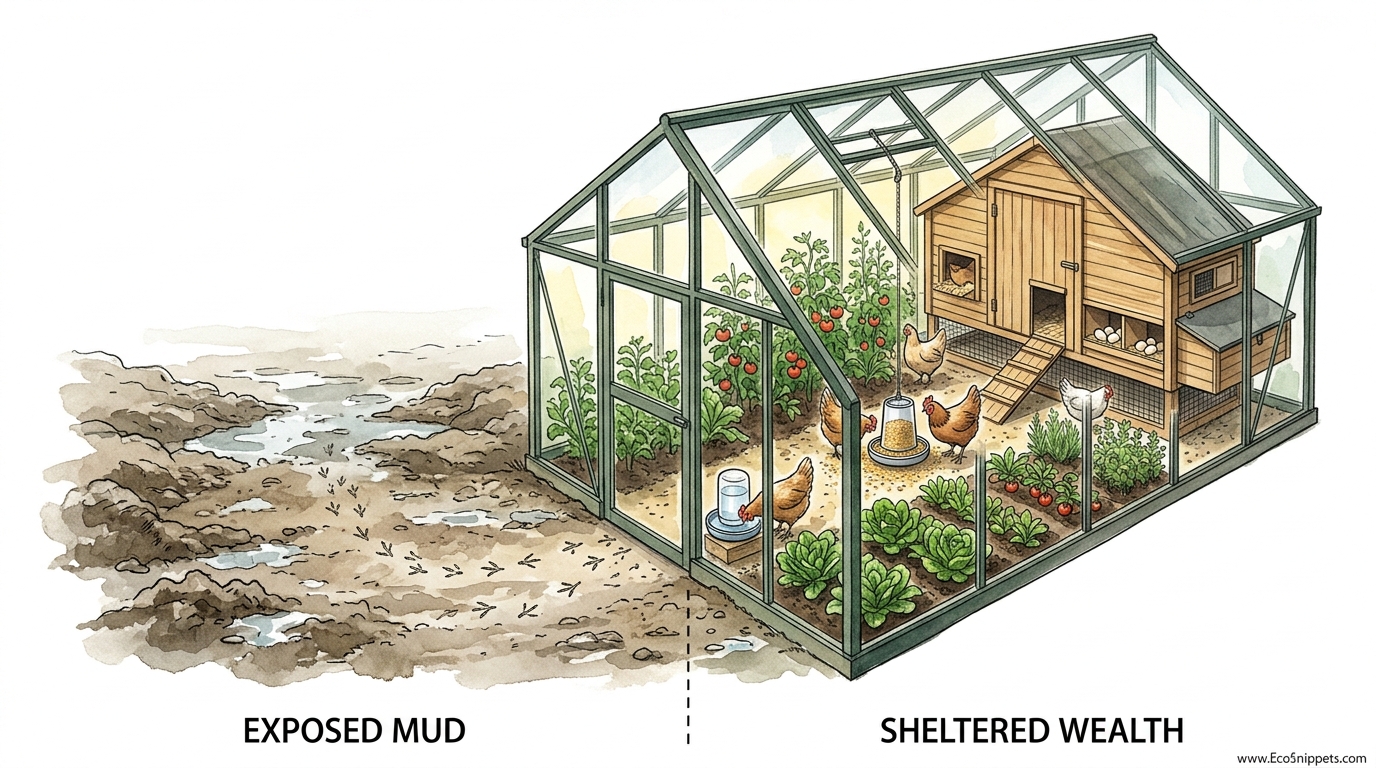
When the thermometer drops, your flock’s production shouldn’t have to follow it into the mud. Most people think chickens just stop laying when it gets cold, but the truth is they are just spending all their energy fighting the mud. Moving the flock into a sheltered “compost run” allows you to turn waste into heat and mud into garden gold.
The transition from a frozen, exposed paddock to a thriving greenhouse chicken run is more than a convenience. It represents a return to a way of life where every scrap is recycled and every animal plays a role in the farm’s metabolism. This approach relies on ancestral wisdom and the simple physics of the sun.
Greenhouse Chicken Run Benefits
A greenhouse chicken run is a translucent, sheltered enclosure designed to capture solar energy while serving as a massive composting floor for the flock. Unlike a standard coop, which is primarily for sleeping, this structure provides a covered living space where birds can remain active regardless of the wind, snow, or rain outside.
This system exists to bridge the gap between the harshness of winter and the high energy requirements of a laying hen. In the real world, it is the difference between a bird that huddles in a corner to conserve heat and one that spend its day scratching through wood chips and leaves, creating the very warmth it needs to thrive.
Imagine the greenhouse as a battery. The clear panels allow short-wave solar radiation to enter, which then hits the dark, organic floor. This energy is absorbed and re-radiated as heat. This heat is trapped by the “deep litter” or composting material on the floor, creating a micro-climate that can be 10°F to 20°F (5°C to 11°C) warmer than the ambient air.
How the Compost Run Works
The engine of this system is the biological breakdown of carbon and nitrogen. Chickens provide the nitrogen through their manure, while you provide the carbon in the form of wood chips, straw, or dried leaves. Microbial life in the floor then gets to work, generating heat as a byproduct of decomposition.
Ideally, you want to maintain a carbon-to-nitrogen (C:N) ratio of approximately 30:1. Because chicken manure is extremely high in nitrogen (around 10:1), a massive amount of carbon is required to keep the system balanced. For every 1 pound (0.45 kg) of manure, you might need 30 to 40 pounds (13 to 18 kg) of dry leaves or wood shavings to prevent the buildup of ammonia.
The birds are your primary workers in this factory. Their natural scratching behavior aerates the pile, ensuring oxygen reaches the microbes. This prevents the pile from becoming anaerobic and stinky. The result is a “living floor” that stays dry on top while cooking into rich compost underneath.
The Practical Advantages of Sheltered Wealth
One of the most immediate benefits is the stabilization of egg production. Chickens require 14 to 16 hours of light to maintain their hormonal cycles for laying. The greenhouse panels maximize every minute of winter sun, often providing enough ambient light to keep hens productive without the need for artificial lighting.
High-quality compost is another major harvest from this system. Traditional composting requires you to manually turn piles with a pitchfork. In a greenhouse run, the chickens do the heavy lifting. By the time spring arrives, the floor of the run has been transformed into “black gold” that is ready to be tilled into garden beds.
Thermal mass is the third pillar of this setup. The deep bedding acts as an insulated blanket for the earth. If you have a dirt floor, the composting activity prevents the ground from freezing, which in turn keeps the entire structure more temperate. This environment reduces the risk of frostbite on combs and wattles, protecting the health of the flock.
Common Challenges and Pitfalls
Ammonia buildup is the most frequent error in managing a greenhouse run. If the air smells like a cleaning product, the nitrogen level is too high or the moisture is out of balance. Ammonia is a gas that can burn a chicken’s respiratory lining and even cause blindness if left unchecked.
Excessive moisture is the second major challenge. While a compost pile needs some moisture to “cook,” a chicken run that is too wet will become a breeding ground for bacteria and coccidiosis. Leaky waterers or poor site drainage can turn the floor into a swamp, negating the benefits of the greenhouse.
Rodent attraction is a reality that must be managed. A warm, sheltered space filled with grain and organic matter is a palace for rats and mice. Failing to use hardware cloth (1/4 inch or 6 mm mesh) buried into the ground around the perimeter of the greenhouse is a mistake that often leads to a vermin infestation.
Limitations of the Greenhouse System
Summer heat is the primary constraint of a structure designed to trap solar energy. Without significant modifications, a greenhouse chicken run can become a “kill box” during the height of summer. Temperatures can easily soar above 100°F (38°C), leading to heat stroke and death for the birds.
Space requirements are also a factor to consider. For a deep bedding system to function without becoming a matted mess, each bird needs at least 10 square feet (0.9 square meters) of run space. Overcrowding the run will overwhelm the carbon’s ability to absorb nitrogen, leading to smells and disease.
Material availability can be a hurdle for some keepers. This system demands a constant supply of “browns”—wood chips, fall leaves, or spoiled hay. If you live in an urban area without access to free arborists’ chips or a source of dry carbon, the cost of buying bedding can quickly outweigh the benefits of the compost produced.
Comparing Exposed Mud vs. Sheltered Wealth
| Factor | Exposed Mud Run | Sheltered Greenhouse Run |
|---|---|---|
| Winter Egg Production | Low (Birds use energy for heat) | Higher (Birds stay warm and active) |
| Odor Management | High (Wet manure smells) | Low (Carbon neutralizes odors) |
| Labor Requirement | Moderate (Mud cleanup) | Low (Periodic carbon addition) |
| Fertility Harvest | Minimal (Runoff washes it away) | High (Concentrated, aged compost) |
| Initial Cost | Low (Simple fencing) | Moderate (Structure and panels) |
Practical Tips for Success
Start your deep bedding early, ideally in the late fall before the first hard freeze. Laying down a foundation of 6 to 12 inches (15 to 30 cm) of coarse wood chips provides a drainage layer that prevents the bottom of the pile from becoming waterlogged.
Adding fresh carbon whenever you see a “caking” of manure on the surface is essential. If the chickens aren’t scratching enough, throw a handful of scratch grain or cracked corn onto the floor. This incentivizes them to dig deep into the bedding, naturally aerating the pile.
Ventilation must be maintained even in the dead of winter. It is a common mistake to seal the greenhouse completely to “keep the heat in.” However, chickens exhale a massive amount of moisture. Without high-level vents to let that humid air escape, you will deal with condensation, mold, and increased frostbite risk.
Advanced Considerations for Serious Practitioners
Integrating vermicomposting into the greenhouse run can take your soil production to the next level. By introducing red wiggler worms into the lower, cooler layers of the compost, you create a dual-process system. The chickens handle the top-level shredding, while the worms refine the bottom layers into high-value castings.
Heat capture can be enhanced by using “water barrels” as thermal batteries. Placing several 55-gallon (200-liter) drums filled with water along the north wall of the greenhouse run allows them to absorb heat during the day and release it slowly throughout the night. This dampens the temperature swings that can stress a flock.
Biochar is another powerful tool for the advanced keeper. Mixing crushed charcoal into the bedding serves two purposes: it provides a “microbe hotel” that speeds up the composting process and it locks in nitrogen that would otherwise be lost to the atmosphere. This results in a more nutrient-dense finished product for the garden.
Scenario: The 10×20 Greenhouse Build
Consider a small homestead with 15 laying hens. An 8-foot by 12-foot (2.4m x 3.6m) traditional coop is attached to a 10-foot by 20-foot (3m x 6m) greenhouse run. The run is framed with pressure-treated lumber and covered in 6mm UV-resistant polyethylene or polycarbonate panels.
The floor is excavated 6 inches (15 cm) deep and lined with 1/2-inch (12mm) hardware cloth to prevent predators from digging in. The floor is then filled with 12 inches (30 cm) of a mix of wood chips and shredded fall leaves. Throughout the winter, the owner adds a fresh bale of straw every three weeks to keep the surface clean.
During a 20°F (-7°C) January morning, the thermometer inside the run reads a comfortable 42°F (5°C). The hens are busy scratching for worms in the lower layers of the warm compost, while the owner collects a dozen eggs. By the time the ground thaws in the spring, the owner harvests 2 cubic yards (1.5 cubic meters) of rich, earthy compost for the tomato beds.
Final Thoughts
Rethinking the way we house chickens during the winter allows us to move from a mindset of survival to one of abundance. The greenhouse chicken run isn’t just a place to keep birds out of the wind; it is a metabolic organ of the homestead. It processes light, waste, and animal energy into the very fertility that will feed the family in the coming year.
Success with this system requires observation and a willingness to work with natural cycles. By balancing the carbon needs of the soil with the nitrogen output of the birds, you create a self-regulating environment that honors the bird’s biology and the gardener’s goals.
Experiment with different carbon sources available in your region and pay close attention to the moisture levels of your floor. Every flock and every climate is unique, but the principles of sheltered wealth remain constant. Turning mud into gold is not magic—it is simply the result of good stewardship and a bit of winter sun.
