How To Become More Self-Sufficient Without Starting a Full-Blown Farm…
Want to start preserving your harvest, making your own soap, or building a backyard root cellar — but not sure where to begin? “Homesteading Advice” gives you instant lifetime access to 35+ practical homesteading books on food preservation, veggie gardening, DIY natural cleaning products (save over $250 per year with this skill alone), brewing, off-grid energy, and a whole lot more…
Click Here To Check It Out Now!
If your ferments are sitting on the counter, you’re just growing a science project instead of a superfood. Summer heat is the enemy of the probiotic. When your kitchen hits 80 degrees (27°C), your sauerkraut turns to mush. Learn the ‘Zeer Pot’ secret to keep your living food at a steady, sheltered 55 degrees (13°C) without using a single watt of power.
How To Store Ferments Without A Fridge
Storing fermented foods without a refrigerator is an ancient necessity that has been largely forgotten in the age of the electric kitchen. For thousands of years, civilizations across the Middle East, Africa, and India relied on the earth’s natural physics to maintain stable, cool temperatures for their food. This method is primarily known today as the Zeer Pot or the “pot-in-pot” refrigerator.
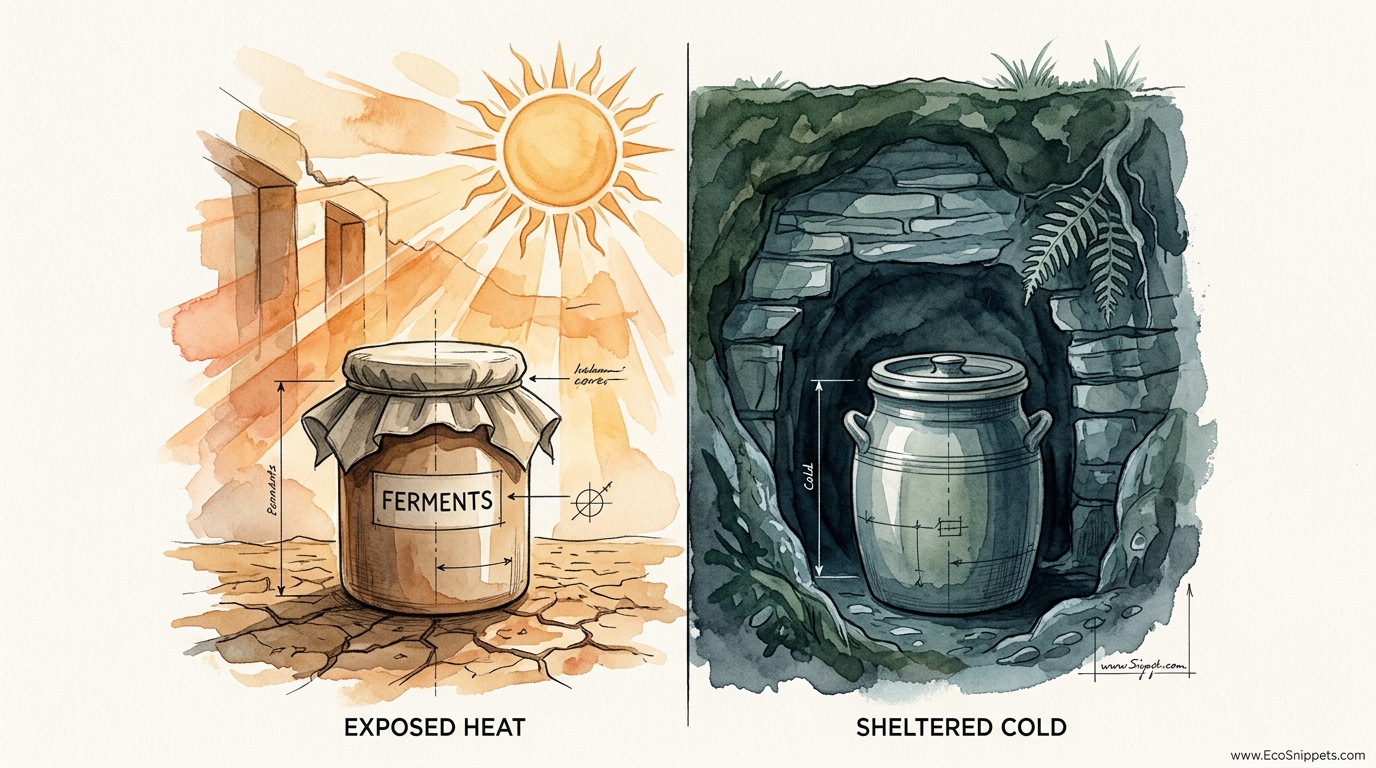
At its core, this system is a non-electrical cooling device that uses the power of evaporative cooling. It consists of two nested clay pots with a layer of wet sand between them. As water evaporates from the sand through the porous walls of the outer pot, it carries heat away from the inner chamber, effectively lowering the temperature inside. This creates a sheltered environment where the “exposed heat” of a summer kitchen is replaced by a “sheltered cold” that mimics a root cellar or a modern refrigerator’s crisper drawer.
In real-world terms, imagine the cooling sensation you feel when a breeze hits your skin after you have been sweating. That is exactly what is happening to your jars of kimchi or pickles inside a Zeer Pot. This technique was rediscovered and popularized in the 1990s by Mohammed Bah Abba, a Nigerian teacher who realized that this ancestral wisdom could solve modern food security issues in desert climates. Today, it serves as a cornerstone for off-grid living and for anyone looking to preserve the probiotic integrity of their ferments without relying on the grid.
The Mechanics of the Zeer Pot: How to Build and Use It
Building a functional evaporative cooler requires specific materials and a bit of patience. You cannot simply use any two pots; the physics depends entirely on the porosity of the clay.
Step 1: Selecting Your Materials
The most critical component is unglazed terracotta. If the pots are glazed or painted, water cannot “breathe” through the clay, and the cooling effect will fail completely. You will need:
- One large unglazed terracotta pot: This is the outer shell. An 18-inch (45 cm) diameter is common for home use.
- One smaller unglazed terracotta pot: This fits inside the larger one. Ensure there is a gap of at least 1 to 3 inches (2.5 to 7.5 cm) between the two pots.
- Clean, fine sand: Play sand or masonry sand works best as it packs tightly.
- Water: Regular tap water is fine, though filtered water prevents mineral buildup on the clay over time.
- A heavy cloth or burlap: This will serve as the “lid” to keep the cold air trapped inside.
Step 2: Preparing the Pots
Most terracotta pots come with a drainage hole at the bottom. You must seal these holes to prevent the sand and water from leaking out. Use a large cork, a handful of clay, or even heavy-duty waterproof tape. If water leaks from the bottom, the sand will dry out too quickly, and the evaporative cycle will break.
Step 3: Assembly
Begin by pouring a 2-inch (5 cm) layer of sand into the bottom of the larger pot. Level the sand and place the smaller pot on top of it. Adjust the amount of sand so that the rims of both pots are roughly even. Once centered, fill the gap between the two pots with sand all the way to the top. Pack the sand firmly but gently to ensure there are no air pockets.
Step 4: Activating the Cooler
Slowly pour water onto the sand until it is fully saturated. You will know it is ready when the sand can no longer absorb water and the outer surface of the large pot begins to feel damp. Place your jars of fermented food inside the inner pot. Finally, soak your heavy cloth in water and drape it over the top of the pots, ensuring it covers the inner opening completely.
Why Temperature Control Matters for Probiotics
The primary reason to use a Zeer Pot is to manage the life cycle of lactic acid bacteria (LAB). Fermentation is not a single event but a relay race involving different species of bacteria.
The Phases of Fermentation
When you first pack a jar of cabbage, Leuconostoc mesenteroides takes the lead. This strain thrives at cooler room temperatures, around 65°F to 72°F (18°C to 22°C). It produces the initial acids and carbon dioxide that create the “tang” and the bubbles. If your kitchen is 85°F (29°C), this stage happens too fast, often leading to off-flavors or the growth of spoilage yeasts.
As the acidity rises, Lactobacillus plantarum and Lactobacillus brevis take over. These are the workhorses that finish the ferment and provide the deep, complex flavors. These bacteria are much heartier, but they still prefer stability. Rapid temperature swings—hot days followed by cool nights—stress these microbes. Storing them at a steady 55°F to 60°F (13°C to 15°C) in an evaporative cooler allows them to enter a semi-dormant state where they continue to develop flavor slowly without the food becoming overly sour or mushy.
Preserving Texture and Enzymes
Heat accelerates the breakdown of pectin, the “glue” that keeps vegetables crunchy. This is why sauerkraut turns into a soft, unappealing mash when left in a warm environment. By maintaining a lower temperature, you preserve the structural integrity of the vegetable. Furthermore, many of the delicate enzymes and vitamins, particularly Vitamin C, are better preserved in a cool, dark environment.
Benefits of Evaporative Cooling for Fermentation
Choosing a Zeer Pot over a standard refrigerator or a warm pantry offers several distinct advantages for the serious practitioner.
- Energy Independence: This system requires zero electricity. In a grid-down scenario or for those living off-grid, it is the only reliable way to maintain a “refrigerated” environment for sensitive foods.
- Low Initial Cost: While a dedicated fermentation fridge can cost hundreds of dollars, a Zeer Pot can be constructed for $20 to $50, depending on where you source your terracotta.
- Ideal Humidity: Unlike a standard refrigerator, which pulls moisture out of the air (dehydration), a Zeer Pot maintains a high-humidity environment inside the inner chamber. This prevents the brine in your jars from evaporating too quickly.
- Scaling Potential: You can build multiple pots for different stages of fermentation. Use one for “active” ferments and another, cooler one for “long-term” storage.
Challenges and Common Mistakes
While the physics of evaporative cooling is simple, the execution requires attention to detail. Many beginners fail because they overlook the environmental requirements.
Mistake 1: Using Glazed or Painted Pots
This is the most frequent error. The cooling effect depends on the “sweating” of the clay. If the outer pot is glazed, the water is trapped in the sand and cannot evaporate. If the inner pot is glazed, it is actually a benefit as it prevents the food from becoming damp, but the outer pot must always be raw, porous terracotta.
Mistake 2: Poor Ventilation
An evaporative cooler works best when there is airflow. If you tuck the pot into a stagnant corner or a closed closet, the air around the pot will become saturated with moisture (high humidity), and evaporation will stop. The pot should be placed in a drafty hallway, near a window, or even on a porch in the shade.
Mistake 3: Letting the Sand Dry Out
The system only works as long as the sand is wet. In dry climates, you may need to add water twice a day. If the sand dries out, the temperature inside the inner pot will quickly rise to match the ambient room temperature.
Limitations: When This Method May Not Work
The Zeer Pot is a powerful tool, but it is not a magic box. It has specific environmental constraints that must be understood to avoid food spoilage.
The Humidity Threshold
Evaporative cooling is most effective when the relative humidity is low (below 40%). As humidity rises, the air’s ability to absorb more water vapor decreases. If you live in a tropical or very humid region (humidity above 70%), the temperature drop may only be a few degrees. In these cases, the Zeer Pot might only bring the temperature from 85°F down to 80°F, which is still too warm for long-term storage of ferments.
Not a Freezer Replacement
A Zeer Pot cannot reach freezing temperatures. Under ideal conditions (very dry air and a steady breeze), it can maintain a temperature of about 40°F (4°C), but more commonly, it sits around 50°F to 60°F (10°C to 15°C). This is perfect for fermented vegetables, but it is not suitable for raw meat or dairy that requires strict 40°F storage for safety.
Comparison: Exposed Heat vs. Sheltered Cold
Understanding the difference between counter storage and evaporative cooling is essential for maintaining the quality of your superfoods.
| Factor | Exposed Heat (Countertop) | Sheltered Cold (Zeer Pot) |
|---|---|---|
| Average Temperature | 70°F – 85°F (21°C – 29°C) | 50°F – 65°F (10°C – 18°C) |
| Fermentation Speed | Rapid (3 – 7 days) | Slow & Steady (2 – 6 weeks) |
| Texture Quality | Softens quickly; high risk of mush | Remains crisp and firm |
| Probiotic Density | Peaks early then declines | Stable and long-lasting |
| Shelf Life | 2 – 4 weeks | 2 – 6 months |
Practical Tips for Success
To get the most out of your evaporative cooling setup, consider these field-tested adjustments.
- Use a Thermometer: Don’t guess the temperature. Place a small analog or digital refrigerator thermometer inside the inner pot to monitor the performance.
- Water Quality Matters: If your tap water is very “hard” (high in minerals like calcium), the pores of the terracotta will eventually clog with white crusty deposits. Use distilled or rainwater to keep the pot breathing efficiently.
- Enhance Airflow: If you are in a particularly warm area, placing a small solar-powered fan to blow across the surface of the pot can significantly increase the cooling rate through “forced convection.”
- Manage the Cloth Lid: The cloth over the top should always be damp. If it dries out, heat will seep in through the top. Check it whenever you add water to the sand.
Advanced Considerations: Moving Beyond the Basics
For the dedicated practitioner, there are ways to scale and optimize the Zeer Pot concept for larger harvests.
Burying the Pot
One of the most effective ways to increase thermal stability is to bury the lower two-thirds of the Zeer Pot in the ground. The earth acts as an additional insulator, shielding the system from the sun’s radiant heat. This is particularly useful in arid regions where the ground stays significantly cooler than the air.
The Multi-Pot System
If you are fermenting large quantities, such as 5-gallon (19-liter) crocks, you can create a “cooling pit.” This involves digging a hole, lining it with heavy plastic to retain moisture, filling it with wet sand, and nesting a large ceramic crock directly into the sand. This provides the same evaporative benefit on a much larger scale.
Microbial Monitoring
In a cooler storage environment, the flavor of your ferments will change much more slowly. Advanced fermenters often use this time to “age” their products, much like a fine wine or cheese. A sauerkraut aged for three months at 55°F (13°C) has a depth of flavor and a level of lactic acid complexity that a one-week countertop ferment can never achieve.
Example Scenario: The Summer Harvest
Imagine it is mid-July, and you have just harvested 20 pounds (9 kg) of cucumbers. The ambient temperature in your kitchen is a constant 82°F (28°C). If you leave your crocks of pickles on the counter, they will be “done” in 3 days, but they will be soft and overly acidic.
Instead, you prepare your Zeer Pot on a shaded north-facing porch where there is a consistent breeze. You nest your gallon jars of pickles inside. Within four hours, the temperature inside the inner pot drops to 62°F (17°C). Because of this 20-degree difference, the fermentation slows down. The pickles take 14 days to reach peak flavor. When you finally bite into one, it has a snap that echoes in the room, and the flavor is a balanced, salty tang rather than a sharp, vinegary bite. This is the power of controlled, sheltered cold.
Final Thoughts
The transition from viewing your ferments as “science projects” to treating them as long-term food assets requires a shift in how you manage their environment. The Zeer Pot is more than just a survival tool; it is a bridge to a way of living that prioritizes natural cycles and ancestral wisdom over the flick of a switch.
By mastering the balance of clay, sand, and water, you gain the ability to preserve your living food in its most potent state. You no longer have to rush to eat your ferments before they turn to mush. Instead, you can cultivate a rhythm of preservation that lasts through the hottest months of the year, ensuring your pantry is always filled with crisp, probiotic-rich superfoods.
Experiment with your setup. Watch how the humidity of your region affects the cooling. Most importantly, trust the process. These methods have sustained human health for millennia, and they remain just as effective today for anyone willing to put in the effort to work with nature rather than against it.
