How To Become More Self-Sufficient Without Starting a Full-Blown Farm…
Want to start preserving your harvest, making your own soap, or building a backyard root cellar — but not sure where to begin? “Homesteading Advice” gives you instant lifetime access to 35+ practical homesteading books on food preservation, veggie gardening, DIY natural cleaning products (save over $250 per year with this skill alone), brewing, off-grid energy, and a whole lot more…
Click Here To Check It Out Now!
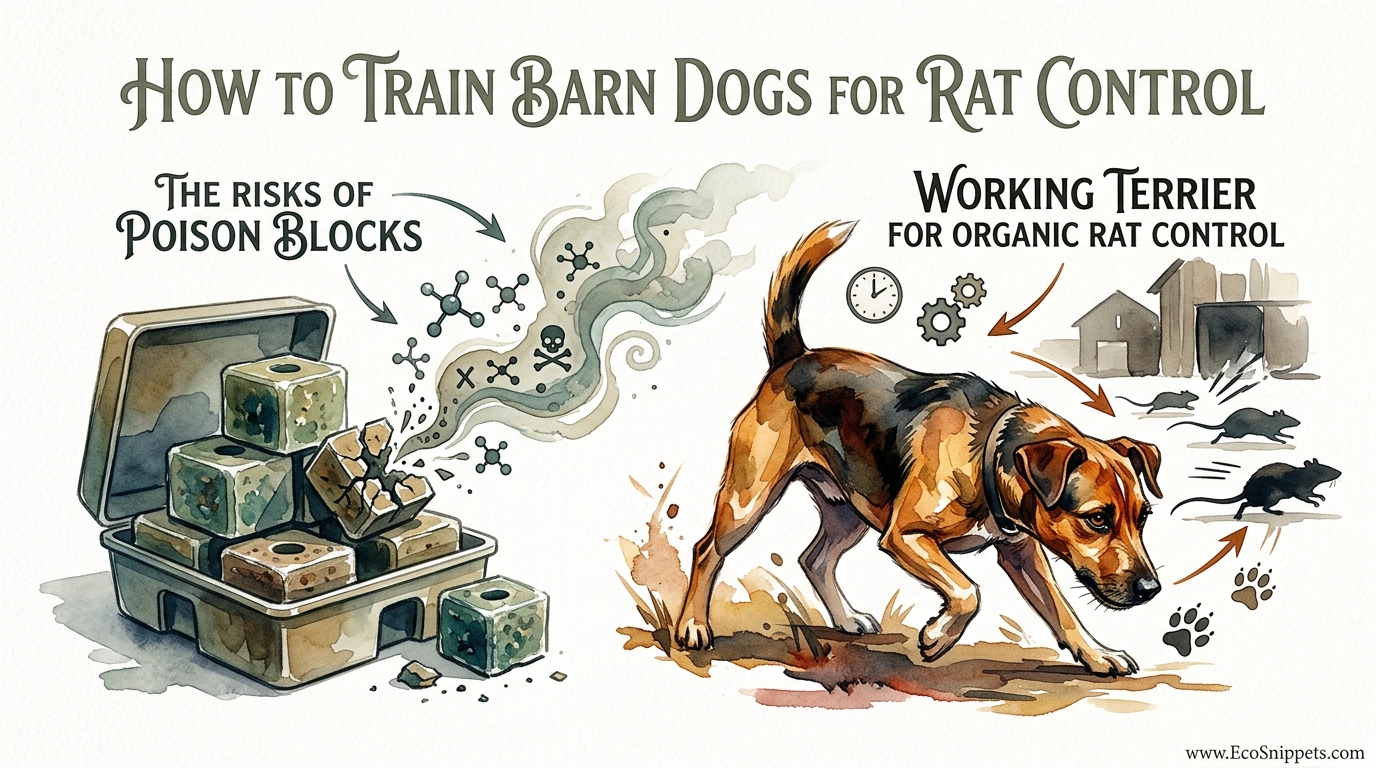
One system poisons your entire food chain; the other is a high-speed security team that works for belly rubs. Rodenticides don’t just kill rats; they kill the owls and hawks that eat them. Reclaiming natural balance on the farm means putting the work back into the hands – or paws – of specialized breeds that have been doing this for centuries.
Modern pest control often relies on “set and forget” chemical solutions that promise efficiency but deliver collateral damage. These toxins leach into the soil, contaminate the water table, and ripple through the local ecosystem, affecting everything from family pets to the majestic raptors patrolling your fields. There is a cleaner, older, and far more effective way to secure your grain stores and protect your livestock.
Barn dogs offer a surgical alternative to the blunt instrument of poison. These specialized hunters provide immediate results, removing the pest from the environment entirely rather than leaving a toxic carcass to rot in a wall or be scavenged by a barn owl. Training a dog for this task is an investment in your farm’s long-term health and a return to a more harmonious way of managing the land.
This guide explores the transition from chemical dependence to canine partnership. It covers everything from breed selection and the fundamentals of scent imprinting to the high-stakes reality of live field work. If you are ready to trade the black bait box for a wagging tail and a pair of sharp eyes, you are ready to train a true farm ratter.
How To Train Barn Dogs For Rat Control
Training a dog for rat control is the process of channeling a predator’s natural instincts into a disciplined, cooperative partnership. While many terriers are born with the “kill drive” required to dispatch a rodent, a true working barn dog must be taught to work with a human handler, ignore non-target animals like chickens or cats, and search effectively in complex environments. This training turns a chaotic chaser into a systematic hunter.
Effective ratting requires a dog to utilize its nose, ears, and eyes in unison. The rat is a master of concealment, often hiding behind double walls, deep within haystacks, or under heavy farm machinery. A trained dog doesn’t just wait for a rat to run across the floor; they “air scent” the colony’s location and “mark” the specific spot where the pests are bunkered down. This allows the farmer to flush the rodents out into the open where the dog can make a swift, humane kill.
Historically, this practice was the backbone of European and American farm management. Before the invention of synthetic anticoagulants, a farm’s viability often depended on its terriers. These dogs protected the winter grain reserves—the literal lifeblood of the homestead—from being consumed or fouled by rodent waste. Today, this tradition is seeing a massive resurgence among organic farmers and homesteaders who want to eliminate chemicals from their food production cycle.
Success in this field is built on three pillars: imprinting, instinct, and obedience. Without obedience, you have a dog that kills your neighbor’s cat; without imprinting, you have a dog that sniffs the air but can’t find the nest; and without instinct, the dog simply won’t have the heart for the hard work of the hunt. This guide details how to harmonize these elements into a working ratter.
Phase 1: Scent Imprinting and The “Find It” Cue
The foundation of all scent-based work is teaching the dog that a specific smell equals a high-value reward. For a barn dog, that smell is the pungent, musky odor of the brown rat (Rattus norvegicus). You want the dog to associate this scent with excitement and the promise of a “win.”
Start with “cold” scent. This can be obtained from used rat bedding—available from pet stores or laboratory supply houses—or from a rat-scented rag. Place a small amount of the bedding inside a ventilated tin or a PVC pipe with holes drilled into it. Ensure the dog can smell the contents but cannot reach them. This prevents the dog from trying to eat the scent source, which would ruin the training.
Introduce the container in a neutral, low-distraction environment. When the dog’s nose touches the container or they show intense interest, use a verbal marker like “Yes!” or a clicker, and immediately follow up with a high-value treat. Repeat this dozens of times until the dog starts actively seeking out the container the moment they see it. At this point, introduce your search command, such as “Find it!” or “Rat!”
Gradually increase the difficulty. Hide the scent container under a shallow layer of straw or behind a cardboard box. Your goal is to see the dog use its nose rather than its eyes. If the dog gets frustrated, go back a step. You are building confidence here. A dog that believes it can always find the “rat” will work harder when the environment gets tough.
Phase 2: Developing the “Mark” and Alert
Finding the rat is only half the battle; the handler needs to know exactly where the dog has found it. In a barn full of clutter, a dog that just wanders around sniffing is helpful, but a dog that “marks” a hole or a crevice is indispensable. You must train a clear alert behavior.
Most terriers naturally alert by scratching, biting at the substrate, or giving a specific “excited” bark. Pay close attention to your dog’s body language during scent work. You will notice a change in their tail carriage (often a high, vibrating wag) and a focused “tunnel vision.” Encourage this intensity. If the dog starts to dig or bark at the hidden scent container, reward them heavily. You are telling them: “This is the information I need from you.”
Avoid punishing “false alerts.” If the dog alerts on an empty box, simply walk away and try again. Punishment during scent work can cause a dog to shut down or become “noise shy,” where they only alert because they think you want them to, rather than because they actually smell a rat. The mark must be honest to be useful in the field.
Phase 3: Tunnels, Bales, and Agility
Rats do not live on flat, open ground. They live in three-dimensional mazes. To be effective, a barn dog must be comfortable navigating tight spaces, climbing over hay bales, and squeezed under floorboards. This requires specific physical conditioning and confidence-building exercises.
Construct a simple tunnel using plywood or large-diameter PVC pipes (at least 10 inches or 25 cm in diameter). For smaller terriers, a 6-foot (1.8-meter) tunnel is a great starting point. Toss treats through the tunnel to encourage the dog to go through. Once they are comfortable, add a turn or “L” joint. In the wild, a rat will lead a dog into a dead-end or a tight squeeze; the dog needs to know they can back out or navigate through without panic.
Practice “bale climbs.” Stack several hay or straw bales and encourage the dog to jump up and search the crevices between them. This mimics the “Barn Hunt” sport but with practical farm application. A dog that is afraid to leave the ground will miss 90% of the rats in a typical barn. Teach them to use their paws to move light debris and their nose to probe deep into the stack.
Phase 4: The Introduction to Live Quarry
Transitioning from a scented rag to a live animal is a critical step that must be handled with care. You are not just looking for a “kill”; you are looking for a focused, efficient strike. A dog that is too “hot” (overly aggressive) may injure themselves or let the rat escape in their excitement. A dog that is too “soft” might just look at the rat and bark.
The safest way to introduce live quarry is using a “quarry tube.” This is a heavy-duty PVC pipe with numerous ventilation holes and secure end caps. Place a live rat (or a “feeder” rat from a pet store) inside the tube. The rat is safe from the dog’s teeth, but the dog can see, smell, and hear the movement. This “energizes” the scent and triggers the prey drive in a controlled way.
Allow the dog to investigate the tube. You want to see “focus.” The dog should be obsessed with getting to the rat. Reward the focus, but do not let the dog spend hours obsessing over it, which can lead to neurotic behavior. Ten-minute sessions are plenty. Your goal is to keep the “fire” lit without letting it burn out of control.
Phase 5: Teamwork and Field Etiquette
True ratting is a team sport. The human handler’s job is to use tools—like a “ratting stick” or a pry bar—to move heavy objects and flush the rodents. The dog’s job is to wait for the break and intercept. This requires a rock-solid “Stay” and “Leave it” command.
Imagine you are moving a heavy wooden pallet. If the dog rushes in too early, they could get crushed by the pallet or bitten by a cornered rat before they are ready. You must be able to hold your dog back until the moment is right. Practice your “Stay” command in the presence of the quarry tube. Only when you give the release command (e.g., “Get ’em!”) should the dog engage. This discipline saves lives—both the dog’s and your livestock’s.
Establish “non-target” rules early. A barn dog that kills your prize-winning Leghorn pullet is a liability, not an asset. If the dog shows interest in livestock, use a firm “Leave it” and redirect them to their ratting tasks. Consistency is everything. Ancestral wisdom dictates that a dog knows the difference between “the family” and “the intruder,” but it is your job to define those boundaries.
Benefits of Using Barn Dogs for Rat Control
The move toward canine pest control isn’t just about nostalgia; it’s about measurable efficiency and environmental safety. When compared to traditional methods, working dogs offer several distinct advantages that make them the superior choice for the modern, self-reliant farmer.
- Precision Removal: Unlike poison, which takes days to work, a dog provides an instant kill. There is no risk of a “zombie rat” wandering around for a week, slowly dying while still being mobile enough to be eaten by a hawk or your barn cat.
- No Secondary Poisoning: Because there are no chemicals involved, there is zero risk to the owls, hawks, and foxes that provide “passive” pest control on your property. This preserves the natural predatory balance of your land.
- Psychological Deterrence: Rats are highly intelligent. They learn to avoid traps and can even develop resistance to certain poisons. However, they cannot “adapt” to a predator that actively hunts them. The constant presence and scent of a ratter often cause the colony to relocate to a “safer” (less-defended) area.
- Identification of Structural Weaknesses: A dog will show you exactly where the rats are entering your buildings. By observing where your dog alerts, you can find the holes and chew-points that need to be sealed with steel wool or concrete, providing a permanent solution rather than a temporary fix.
- Versatility: A barn dog is a multifunctional tool. When they aren’t hunting rats, many breeds double as excellent watchdogs, companion animals, and even herding assistants.
Challenges and Common Training Mistakes
Training a high-drive dog for serious work is not without its pitfalls. Most failures in barn dog programs stem from a few common errors that can be easily avoided with foresight and patience.
The most frequent mistake is over-training or “burning out” the dog. Working terriers have a massive engine, but if you drill scent work for two hours a day, they will become bored and resent the task. Keep sessions short, intense, and high-reward. You want the dog to leave every training session wanting more.
Another challenge is the “self-rewarding” dog. This is a dog that learns it can hunt on its own without you. While this might seem convenient, it leads to a dog that doesn’t listen to your commands and may begin pursuing non-target animals like chickens or rabbits because they are “easier” than rats. You must always be the “source” of the hunt. The dog works for you, and the “win” happens because you allowed it.
Ignoring basic obedience is a recipe for disaster. A dog with 100% kill drive but 0% recall is a danger to itself and others. You must be able to call your dog off a scent or stop them in their tracks if they are about to run into a dangerous situation, such as a busy road or under a moving tractor. Never prioritize “ratting” over “listening.”
Limitations and Environmental Constraints
While dogs are incredibly effective, they are not a “magic bullet” for every situation. Understanding the limitations of this method is key to maintaining a realistic pest management strategy.
First, population density matters. If you have a massive, out-of-control infestation with thousands of rats, a single dog cannot keep up. In these cases, the dog is best used as the “mopping up” crew after initial exclusion and mechanical trapping have reduced the numbers. A dog is a surgical tool, not a carpet bomb.
Second, environmental hazards can limit a dog’s effectiveness. In grain elevators with high-piling loose corn or in areas with deep standing water, the scent becomes dispersed and difficult to track. Additionally, very cold temperatures—below 14°F (-10°C)—can suppress scent molecules, making it harder for the dog to locate nests. Conversely, extreme heat—above 90°F (32°C)—puts the dog at risk of heatstroke during the high-exertion work of a hunt.
Finally, infrastructure counts. If your barn is built with narrow double-walls that a dog cannot reach and you are unwilling to “open up” for the hunt, the dog will be frustrated. A successful ratting program requires the farmer to be willing to modify the environment—moving clutter, opening panels, and creating “kill zones” where the dog has the advantage.
Comparison: Poison Blocks vs. Working Terriers
When deciding how to protect your property, it helps to look at the hard data. The following table compares the two most common methods of large-scale rodent control.
| Feature | Poison Blocks (Rodenticides) | Working Terriers (Barn Dogs) |
|---|---|---|
| Immediate Result | No (takes 3-7 days for death) | Yes (instant dispatch) |
| Environmental Impact | High (risk of secondary poisoning) | Zero (natural process) |
| Cost (Long Term) | Recurring cost for bait and stations | Initial purchase/training; then maintenance |
| Target Accuracy | Low (non-target animals may eat bait) | High (trained to ignore livestock) |
| Persistence | Rats can become “bait shy” | Rats cannot “evolve” past a predator |
| Human Safety | Toxic; requires careful handling | Safe (family companion) |
Practical Tips for a Successful Hunt
Once your dog is trained, you need to know how to manage a real-world hunt. Follow these best practices to ensure a productive and safe experience for you and your canine partner.
- The “Two-Dog” System: If possible, work two dogs together. Use a “flush dog” (often a smaller, more frantic terrier) to get into the tightest spots and a “catch dog” (a slightly larger or faster dog) to intercept the rats as they bolt across the open floor.
- Night Operations: Rats are nocturnal. While you can hunt during the day by disturbing nests, the most “active” hunts happen at dusk or night using high-powered headlamps. The rat’s eyes will reflect the light, helping you and the dog spot them.
- Maintain “Scent Hygiene”: Do not use strong-smelling cleaners or bleach in the areas where you want the dog to work. These chemicals can overwhelm the dog’s olfactory sensors and make it impossible for them to track.
- Use a “Ratting Stick”: A simple 4-foot (1.2-meter) wooden staff is invaluable. Use it to poke into haystacks or under machinery to disturb the rats. This keeps your hands away from the rats’ teeth and helps guide the dog’s focus.
- The Shake: Allow your dog to perform the “terrier shake.” This is the rapid side-to-side movement that snaps the rat’s neck instantly. It is the most humane way for a rat to die. Once the rat is limp, teach the dog to “Drop it” so they can move on to the next target.
Advanced Considerations: Health and Safety
Ratting is a “full contact” sport, and the safety of your dog must be your top priority. Rats carry diseases and can be surprisingly aggressive when cornered. A serious practitioner must have a robust veterinary protocol in place.
Leptospirosis is the single biggest threat to a ratting dog. This bacterial infection is spread through rat urine and can cause fatal liver and kidney failure. Annual vaccination for Leptospirosis is non-negotiable for any dog working in rodent control. Consult your vet to ensure you are using a vaccine that covers the most common local strains.
Manage the risk of Rat Bite Fever and other infections. Rats have powerful incisors that can deliver deep puncture wounds. After every hunt, check your dog’s muzzle, ears, and paws for bites. Clean any wounds with a chlorhexidine solution or warm saline. If a bite appears inflamed or if your dog becomes lethargic or develops a fever, seek veterinary care immediately.
Implement a strict parasite control regimen. Rats are carriers of fleas, ticks, and various internal worms (like tapeworms). Your barn dog should be on a monthly preventative for both external and internal parasites. Regularly deworming is essential to keep the dog in peak hunting condition.
Choosing the Right Breed for the Job
While many dogs can be trained to hunt, certain breeds have been refined over centuries specifically for this task. Your choice of breed should depend on your specific terrain and the type of rodents you are facing.
The Rat Terrier
As the name suggests, this American original was bred specifically for farm work. They are incredibly fast, agile, and possess a high intellect that makes them easier to train than some of the more stubborn British terriers. They come in three sizes: Toy, Miniature, and Standard (standing 13 to 18 inches or 33 to 46 cm). The Standard size is often the best choice for large farm rats.
The Jack Russell / Parson Russell Terrier
The “gold standard” of the ratting world. Developed in England by Reverend John Russell, these dogs are fearless and have a “never quit” attitude. They are particularly good at “going to ground,” meaning they will follow a rat deep into a burrow or under a building without hesitation. They require a firm hand and plenty of exercise to keep their energy focused.
The Patterdale Terrier
A “fell terrier” from Northern England, the Patterdale is a serious, no-nonsense hunter. They are often smaller and darker-colored than the Jack Russell, designed to work in the crags and tight spaces of the Lake District. They have a very high “kill drive” and are favored by professional rat-catching teams like the “Mongrol Hoard” in the United States.
The Jagdterrier
Originating in Germany, this is perhaps the most intense hunting terrier in existence. They are black and tan and were bred to be all-purpose hunters. They are exceptionally capable but require an experienced handler. For a beginner, a Jagdterrier might be “too much dog,” as their drive can be difficult to turn off once the hunt is over.
Scenario: A Typical Morning on the Farm
To understand how this all comes together, imagine a typical Saturday morning. You enter the chicken coop with your two-year-old Rat Terrier, “Buster.” You’ve noticed grain bags being chewed in the corner. You give the command: “Buster, find it!”
Buster doesn’t just run around; he begins a systematic “quartering” of the room. He ignores the chickens flapping around his head. Suddenly, he stops at a stack of empty feed sacks. His tail begins to vibrate. He gives a short, sharp “yip” and starts frantically pawing at the bottom sack. You know he’s “marked” the spot.
You use your ratting stick to lift the edge of the stack. Three large Norway rats bolt in different directions. Buster is a blur. He intercepts the first one with a single “snap-shake” and drops it instantly. He turns 180 degrees and catches the second one just as it’s about to dive under the door. The third rat escapes into a hole, but Buster stays at the opening, marking it for you. In thirty seconds, you’ve removed two primary breeders from your coop and identified the exact hole you need to patch. No poison, no mess, and a very happy dog.
Final Thoughts
Transitioning from chemical rodenticides to a working barn dog is more than just a change in pest control tactics; it is a commitment to a healthier, more resilient farm ecosystem. By training a dog to do what it was bred for, you are honoring a centuries-old tradition of partnership between humans and canines. You are replacing a system of “poison and decay” with one of “instinct and action.”
The road to a fully trained ratter requires patience, consistency, and a deep understanding of your dog’s psychology. It starts with a simple scent tin and ends with a trusted partner that can clear a barn in minutes. Along the way, you will build a bond that no chemical company can ever provide—a bond forged in the quiet hours of the morning and the shared thrill of the hunt.
If you are just starting out, don’t be afraid to seek help from local working terrier clubs or participate in “Barn Hunt” sporting events to hone your dog’s skills. The community of people reclaiming these ancestral skills is growing. Join them, put the work back into the paws of the specialists, and watch as your farm finds its natural balance once again.
