How To Become More Self-Sufficient Without Starting a Full-Blown Farm…
Want to start preserving your harvest, making your own soap, or building a backyard root cellar — but not sure where to begin? “Homesteading Advice” gives you instant lifetime access to 35+ practical homesteading books on food preservation, veggie gardening, DIY natural cleaning products (save over $250 per year with this skill alone), brewing, off-grid energy, and a whole lot more…
Click Here To Check It Out Now!
Your soil is already telling you exactly what it needs – are you listening? Nature doesn’t need a laboratory to find a balance. The ‘weeds’ popping up in your garden aren’t accidents; they are biological responses to specific soil conditions. Dandelions tell you the soil is compacted; Thistles tell you it’s deficient in minerals. Learn to read the bio-indicators and save your money.
For generations, successful farmers and stewards of the land understood that every plant carries a message. This ancestral wisdom, often called “reading the weeds,” allows you to look at a patch of ground and immediately understand its hidden chemistry. Instead of viewing these wild guests as enemies to be eradicated with chemicals, consider them as diagnostic tools. They are the first responders in nature’s emergency repair kit.
When you see a specific weed thriving where your vegetables struggle, the land is providing a free consultation. Understanding these signals is the first step toward self-reliance in the garden. This guide will walk you through the process of decoding these bio-indicators, helping you build fertile, resilient soil without relying on expensive synthetic inputs.
What Weeds Tell You About Your Garden
Bio-indicators are living organisms that provide information about the health and state of an ecosystem. In a garden context, a weed is simply a plant that is exceptionally well-adapted to the current, often suboptimal, state of your soil. These plants occupy niches that more sensitive crops cannot yet fill. They act as nature’s “bandage,” holding onto topsoil, drawing up deep minerals, and breaking through tough layers of earth.
Nature abhors a vacuum and even more so, it abhors bare, damaged soil. If your ground is too acidic, too wet, or too compacted, certain seeds from the soil’s “seed bank” will receive the signal to germinate. These seeds may have waited decades for the specific environmental trigger that tells them the soil needs their particular set of skills. For example, a field that has been heavily trampled will suddenly sprout a carpet of dandelions or plantains to address the lack of oxygen in the root zone.
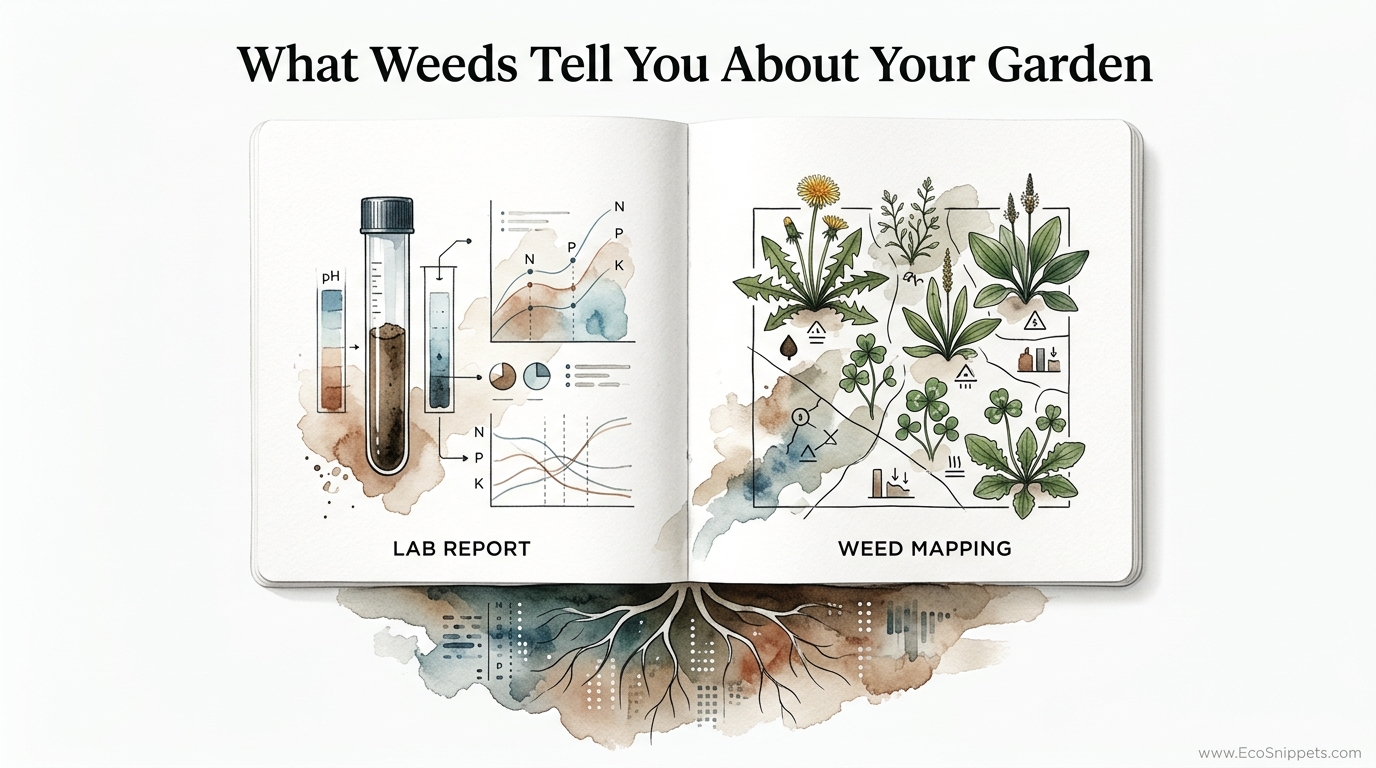
Observing which weeds dominate a specific area provides a real-time map of your soil’s strengths and weaknesses. While a laboratory report gives you a chemical snapshot of a small sample, “weed mapping” gives you a holistic view of the entire landscape. It accounts for drainage patterns, micro-climates, and physical structure that a liquid-based chemical test might miss. This method is used by regenerative farmers and permaculturists worldwide to assess land health quickly and accurately.
Consider the analogy of a fever. A fever is not the disease itself; it is the body’s response to an underlying issue. Similarly, an infestation of horsetail or bindweed is not the “disease” of your garden. It is a biological response to an underlying soil condition like poor drainage or extreme compaction. Treating the symptom with herbicides only clears the way for the same problem to return. Addressing the soil condition makes the environment inhospitable for the weed and perfect for your desired crops.
The Mechanics of Bio-Indication: How Nature Repairs Itself
Ecological succession is the process by which a biological community evolves over time. Weeds are almost always “pioneer species,” the very first stage of this succession. Their job is to prepare the ground for the more complex plants that follow. They do this through several fascinating biological mechanisms that you can leverage to improve your garden.
Deep taproots are a hallmark of many indicator weeds like dandelions (Taraxacum officinale) and burdock (Arctium). These roots can reach depths of 12 to 18 inches (30 to 45 cm) or more. As they push through the “hardpan”—the compacted layer of soil below the surface—they create channels for air and water to penetrate. When these roots eventually die and decay, they leave behind vertical tunnels filled with organic matter, effectively aerating the soil from the inside out.
Dynamic accumulation is another critical process. Many weeds are specialists at “mining” specific minerals that are locked away or deficient in the topsoil. Dandelions are famous for accumulating calcium, while thistles often bring up phosphorus and potassium from the subsoil. By growing these plants, nature is literally hauling nutrients from deep underground and depositing them on the surface when the plant dies and decomposes. This is why many traditional gardeners refer to weeds as “green manure.”
Seed bank triggers are the “on-off” switches for these repairs. Soil contains thousands of seeds per square meter, many of which can remain viable for 40 to 80 years. These seeds only germinate when they receive a specific set of environmental cues. High nitrate levels might trigger lambsquarters, while low oxygen levels in waterlogged soil might trigger docks or rushes. Learning these triggers allows you to “speak” the language of the land and predict what will grow next.
The Compaction Crew: Reading Hard and Heavy Soils
Compaction is perhaps the most common issue in modern gardens and lawns. It occurs when the air pockets between soil particles are squeezed out, usually by heavy foot traffic, machinery, or over-tilling. Without these air pockets, beneficial aerobic bacteria cannot survive, and plant roots cannot breathe.
Dandelions are the most recognizable indicator of compaction. Their presence suggests the soil is tight and likely low in available calcium. Because dandelions are “calcium accumulators,” they are trying to fix the very problem they indicate. If you have a lawn full of dandelions, the soil is crying out for aeration and perhaps a boost of organic matter or gypsum to help loosen the clay structure.
Broadleaf Plantain (Plantago major) is another clear signal of heavy, compacted ground. You will often see it growing right in the middle of a dirt path where nothing else survives. It has evolved to withstand being stepped on and thrives in low-oxygen environments. If plantain is moving into your garden beds, it means your soil has become a “highway” and needs to be loosened and protected from further traffic.
Knotweed (Polygonum aviculare) and Pineapple weed (Matricaria discoidea) are also indicators of high-traffic, compacted areas. Knotweed, in particular, forms a dense mat that can signify extremely poor soil structure. In these areas, the soil is often “crusty” on the surface, preventing water from soaking in. Instead of just pulling these weeds, consider using a broadfork or aerator to break up the hardpan and allow the soil to “inhale” again.
The Mineral Seekers: Identifying Nutrient Deficiencies
Nutrient imbalances are often harder to see with the naked eye than physical compaction, but weeds make them visible. Every plant has a preferred “diet,” and if your soil is over-rich or depleted in certain elements, the weed population will shift to reflect that.
Thistles (Cirsium) are often a sign of mineral-deficient soil that is simultaneously heavy and wet. Specifically, Canada thistle often appears in soils low in phosphorus, calcium, and copper. Because their roots can penetrate 10 to 20 feet (3 to 6 meters) deep, they are attempting to reach the mineral reserves that your shallow-rooted vegetables cannot access. An abundance of thistles suggests you may need to add rock dust or high-quality compost to replenish the mineral bank.
Redroot Pigweed (Amaranthus retroflexus) is a fascinating indicator of a mineral ratio imbalance. It often points to a soil where the iron-to-manganese ratio is out of whack, or where there is an excess of potassium and manganese paired with a deficiency in phosphorus and calcium. If pigweed is taking over, your soil might be “rich” but “unbalanced,” leading to stunted growth in your crops despite your best efforts to fertilize.
Lambsquarters (Chenopodium album) is generally a sign of very fertile soil, particularly soil high in nitrogen and potassium. However, if they are dominant, it may indicate that your phosphorus levels are lagging behind. Since lambsquarters are heavy feeders, their presence means the “table is set” with plenty of nutrients, but you might need to balance the menu if you want your fruit-bearing plants (like tomatoes) to thrive alongside them.
The pH Pioneers: Acidic vs. Alkaline Indicators
Soil pH dictates which nutrients are “available” for plants to take up. Even if your soil is full of minerals, if the pH is too high or too low, those minerals are chemically locked away. Weeds can tell you if your soil is “sour” (acidic) or “sweet” (alkaline).
Common Sorrel (Rumex acetosella) and Mullein (Verbascum thapsus) are classic indicators of acidic soil. Sorrel, in particular, thrives in low-pH environments where nutrients like calcium and magnesium are often deficient. If you see carpets of red sorrel, it is a strong signal that your soil may benefit from a light application of agricultural lime or wood ash to bring the pH back toward neutral.
Horsetail (Equisetum arvense) is a “living fossil” that indicates acidic, wet, and nutrient-poor conditions. It often grows in areas that are anaerobic—meaning they lack oxygen. This plant is a silicon accumulator, and its presence suggests the soil is “tired” and lacks the structure to support more demanding life. Improving drainage is usually the first step to discouraging horsetail.
Chickweed (Stellaria media) and Queen Anne’s Lace (Daucus carota) often lean toward the other side of the spectrum. While chickweed loves fertile, moist soil, it is frequently found in neutral to slightly alkaline environments. Queen Anne’s Lace is often a sign of “sweet” but poor soil. If these are your primary weeds, you likely don’t need lime, but you may need to increase your organic matter to help hold onto moisture and nutrients.
The Water Watchers: Reading Drainage and Moisture
Water is the lifeblood of the garden, but too much or too little in the wrong places can lead to disaster. Weeds that specialize in “wet feet” are among the most reliable indicators of drainage issues.
Curly Dock (Rumex crispus) is a primary indicator of waterlogged, heavy soil. Its deep taproot is designed to survive in saturated ground where other roots would rot. If you find dock growing in your garden beds, it means there is a “drainage bottleneck” nearby. The soil is likely compacted and holding onto water for too long, which can lead to fungal diseases in your crops.
Yellow Nutsedge (Cyperus esculentus) is another sign of persistent moisture. This weed loves areas that stay damp or are over-irrigated. Because it spreads through underground tubers (nutlets), it can be a nightmare to pull, but its presence is a clear instruction to reduce your watering frequency or install better drainage systems like French drains or raised beds.
Moss is the ultimate indicator of shade, moisture, and acidity. While beautiful in a forest, moss in a lawn or garden bed signifies that the ground is staying damp and likely lacks the fertility to support grass or vegetables. To remediate mossy areas, you usually need to increase sunlight, improve drainage, and boost the soil’s pH with lime.
The Nitrogen Fixers: Signs of Low Fertility
Nitrogen is the fuel for leafy growth, and when it is missing, nature brings in the “fixers.” These are plants in the legume family that have a symbiotic relationship with bacteria in their roots to “fix” nitrogen from the air and put it into the soil.
Clover (Trifolium) is the most famous nitrogen indicator. If your lawn or garden is being overtaken by white or red clover, your soil is likely low in nitrogen. The clover isn’t “invading”; it is responding to a vacancy. It is trying to fertilize the soil for you. Many old-school gardeners leave the clover alone, knowing that when it dies, it will release that captured nitrogen back into the earth for the grass and other plants.
Vetch (Vicia) and Black Medic (Medicago lupulina) also signal low-fertility conditions. These plants are tough and can grow in “lean” soils where other plants starve. Their presence is an invitation to add high-nitrogen organic matter like composted manure, alfalfa meal, or a liquid seaweed fertilizer to help your main crops compete.
Benefits of Reading Your Weeds
Choosing to observe your weeds instead of immediately reaching for a hoe or a spray bottle offers several practical and measurable advantages. It is a more sustainable approach that treats the cause of garden problems rather than just the symptoms.
- Cost Savings: You can save hundreds of dollars (and euros) by avoiding unnecessary fertilizers or pH amendments that your soil doesn’t actually need.
- Long-Term Soil Health: By addressing compaction or drainage issues signaled by weeds, you create a permanent improvement in soil structure rather than a temporary chemical fix.
- Reduced Chemical Exposure: Understanding why a weed is there allows you to “crowd it out” naturally, keeping your home environment and groundwater free from herbicides.
- Precision Gardening: You can match specific crops to specific areas of your yard based on the weed indicators, ensuring higher yields with less effort.
Challenges and Common Mistakes
While reading the weeds is a powerful tool, it is not without its pitfalls. Beginners often make a few common errors that can lead to a “false diagnosis” of their soil health.
One major mistake is basing a diagnosis on a “one-off” plant. A single dandelion in a 1,000-square-foot (93-square-meter) garden doesn’t necessarily mean your entire plot is compacted. You must look for dominance and patterns. Is a specific weed the primary ground cover in a certain area? That is where the message lies.
Another pitfall is ignoring the history of the site. If you have recently brought in a truckload of topsoil or mulch, the weeds you see might have been imported as seeds in that material. In this case, they are reflecting the conditions of the place they came from, not your actual garden soil. It usually takes a full growing season for the “local” weed population to establish itself and give you an accurate reading.
Misidentification is also a frequent issue. Many weeds look similar to the untrained eye. For example, “False Dandelion” (Cat’s Ear) looks nearly identical to the common dandelion but indicates dry, free-draining soil rather than heavy compaction. Always use a reliable field guide or a reputable plant-identification app to confirm exactly what you are looking at before you make soil adjustments.
Limitations: When Weed Mapping Isn’t Enough
As useful as bio-indicators are, they have realistic constraints. They should be used as a primary screening tool, but they aren’t always the final word in soil management.
Environmental factors can sometimes override soil chemistry. A weed might be present simply because a neighbor’s yard is a massive seed source, or because a specific weather event (like a flood) deposited seeds and created a temporary condition. Furthermore, extreme weather like prolonged droughts or heatwaves can cause “stress germination,” where weeds sprout in conditions they don’t actually prefer just to fill a gap.
Urban soils and heavily disturbed sites also present a challenge. If your land was a construction site where the topsoil was stripped and “fill dirt” was brought in, the natural successional clues may be scrambled. In these cases, the soil is so far from its natural state that the weeds are often just struggling to survive, rather than acting as precise indicators of mineral levels.
Finally, while weeds tell you about available nutrients, they don’t always give you the exact quantity. For example, a weed might tell you the soil is acidic, but it won’t tell you exactly how many pounds of lime per acre you need to hit a target pH of 6.5. For that level of precision, a laboratory test is still a valuable partner to your observations.
Comparison: Lab Report vs. Weed Mapping
Understanding the difference between these two methods helps you decide when to use each one. They are best used together rather than as mutually exclusive choices.
| Feature | Lab Soil Analysis | Weed Mapping (Bio-Indicators) |
|---|---|---|
| Cost | $20 – $100+ per test | Free |
| Scope | Snapshot of a small sample | Holistic view of the whole site |
| Precision | High (Exact ppm and pH numbers) | Qualitative (Identifies trends) |
| Physical Factors | Often misses compaction/drainage | Excellent at showing physical issues |
| Frequency | Once a year or every few years | Real-time, daily observation |
Practical Tips for Success
Applying this knowledge in your garden requires a shift in perspective. Start by slowing down and documenting what you see throughout the seasons.
- Keep a Weed Journal: Sketch or photograph the dominant weeds in different “zones” of your garden. Note when they appear and where they are most vigorous.
- Observe the Roots: When you pull a weed, don’t just throw it away. Look at the root system. Are the roots stunted and sideways (sign of a hardpan)? Or are they deep and straight?
- Practice “Chop and Drop”: If a weed is a dynamic accumulator (like dandelions or clover), pull it or cut it before it goes to seed and leave it on the surface or compost it. This returns the “mined” minerals back to your topsoil.
- Use Target Remediation: If your weeds signal compaction, focus on aeration and adding organic matter rather than just buying more fertilizer.
- Look for “Indicator Communities”: A group of different weeds all signaling the same thing (e.g., dock, horsetail, and moss) is a much more reliable diagnosis than a single plant.
Advanced Considerations: The Fungal-to-Bacterial Ratio
Serious practitioners of soil science look beyond just minerals and pH to the microscopic life in the soil. Weeds can also tell you about the balance between fungi and bacteria in your “soil food web.”
Most common garden weeds thrive in “bacterial-dominant” soils. These are soils that have been frequently tilled, over-fertilized with synthetic salts, or left bare. Bacteria cycle nitrogen very quickly, which “fast-growing” weeds love. This is why a freshly tilled garden often explodes with chickweed or lambsquarters.
Desired crops like perennials, fruit trees, and many berries prefer a “fungal-dominant” soil. Fungi create complex networks (mycelium) that help plants access water and minerals slowly and steadily. If you see weeds like chickweed starting to disappear and being replaced by more complex perennials or even a few mushrooms, it is a sign that your soil is maturing and becoming more fungal-rich.
Scaling your garden’s health often involves moving away from the “weed-friendly” bacterial state and toward the “crop-friendly” fungal state. You can encourage this by using woody mulches, avoiding deep tillage, and applying high-quality compost teas that are rich in fungal spores.
Example Scenario: The Tale of Two Patches
Imagine a gardener named Sarah who has two distinct areas in her backyard. In the front patch, she sees an explosion of Clover and Dandelions. In the back patch, she sees Dock and Horsetail.
In the front patch, the bio-indicators are telling Sarah that her soil is compacted and low in nitrogen. Instead of buying a generic “all-purpose” fertilizer, Sarah decides to core-aerate the lawn and apply a thin layer of compost. She leaves the clover to grow for a few weeks to fix nitrogen naturally before she mows it. Within a season, the grass becomes thicker and greener because she addressed the actual needs of the soil.
In the back patch, the dock and horsetail are shouting that the area is poorly drained and likely acidic. Sarah realizes that this spot is at the bottom of a slope. Instead of fighting the weeds, she builds a raised bed filled with well-draining soil and adds a bit of agricultural lime to balance the acidity. The weeds eventually fade away because the environment no longer favors them, and her vegetables thrive in the new, drier conditions.
Final Thoughts
Reading the bio-indicators in your garden is one of the most rewarding skills a grower can develop. It moves you from a place of “fighting nature” to a place of “working with nature.” When you understand that a dandelion is a volunteer aerator and clover is a free nitrogen factory, the stress of weeding begins to evaporate.
Your soil is a living, breathing organism that is constantly communicating its health. By learning the language of the weeds, you become a better steward of the land. You will find that as your soil health improves, the “pest” weeds naturally decline, replaced by the plants you actually want to grow.
Experiment with these observations this season. Don’t be afraid to let a few thistles grow in a corner just to see what they are mining, or leave the clover in your paths to build fertility. The more you listen to what your soil is telling you, the more abundance your garden will return. Focus on the foundation, and the rest of the garden will take care of itself.
