How To Become More Self-Sufficient Without Starting a Full-Blown Farm…
Want to start preserving your harvest, making your own soap, or building a backyard root cellar — but not sure where to begin? “Homesteading Advice” gives you instant lifetime access to 35+ practical homesteading books on food preservation, veggie gardening, DIY natural cleaning products (save over $250 per year with this skill alone), brewing, off-grid energy, and a whole lot more…
Click Here To Check It Out Now!
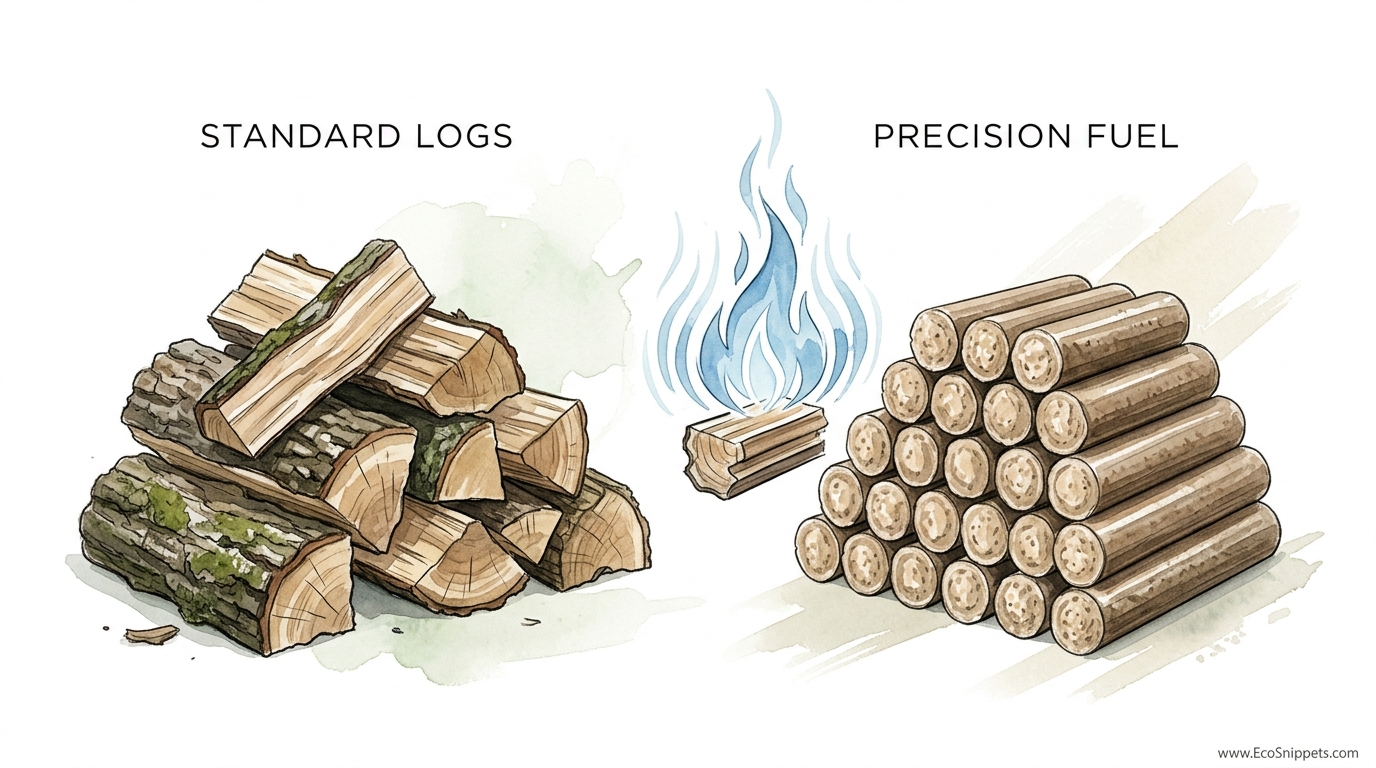
If you are still throwing big logs on the fire, you are literally watching your energy go up in smoke. Burning wood is a chemistry experiment. Traditional stoves are ‘Standard’—they take anything but waste half the energy. ‘Precision’ gasification requires fuel sized exactly for the combustion chamber. When you match the fuel geometry to the airflow, you achieve 95% efficiency and zero smoke. It’s not just a fire; it’s a high-performance engine for your home.
To truly master the art of wood gasification, you must first unlearn everything the old-timers taught you about the “roaring fire.” In a standard wood stove, you see the flames dancing on the surface of the log, but you are only seeing a fraction of the potential heat. Most of that energy is locked inside the wood gases—the smoke—that escapes up the chimney before it can be used. Gasification changes the game by forcing those gases to burn in a separate, super-heated chamber.
This process is the difference between an old steam locomotive and a modern fuel-injected engine. One is romantic but wasteful; the other is a marvel of engineering that respects the hard work you put into harvesting your fuel. If you want to heat your home with the absolute minimum amount of wood, you have to treat your woodpile like a stockpile of precision fuel.
Understanding the relationship between wood species, moisture levels, and physical dimensions is the key to unlocking this efficiency. When you get it right, you won’t see smoke coming out of your chimney. You will see a clear, shimmering heat shimmer, a sign that every carbon molecule is doing its job. This guide will walk you through exactly how to select, prepare, and utilize the best fuel for your gasification system.
Best Wood For Gasification Stoves
The term “best wood” is often debated around campfires and woodshops, but for gasification, the answer is governed by chemistry rather than preference. Gasification stoves, also known as downdraft or two-stage boilers, thrive on wood that provides a consistent, predictable release of volatile gases. Unlike a traditional fireplace where you might value the “crackle and pop” of resinous pine, a gasifier demands stability.
In real-world terms, the best wood for a gasification stove is generally a dense hardwood that has been seasoned to a specific moisture threshold. Hardwoods like Oak, Hickory, Beech, and Sugar Maple are the gold standards. These species possess a high energy density, meaning you get more British Thermal Units (BTUs) or Megajoules (MJ) per cubic foot of wood. This density translates to fewer trips to the woodpile and a steadier gasification rate.
However, the species is only half the battle. The “where and why” of wood selection also involves understanding how different woods react to the intense heat of the primary chamber. For example, Ash is often cited as a favorite because it has a naturally low moisture content even when green, though it still requires proper seasoning for gasification. In contrast, Birch provides an excellent, quick-starting fuel but can burn too fast if not mixed with denser logs, potentially leading to “bridging” where the wood hangs up in the firebox.
Think of your wood selection as choosing the octane rating for your car. Hardwoods are your premium fuel, providing the most “miles” per tank. While you can certainly run a gasifier on softwoods like Pine or Spruce, you will find yourself reloading the firebox twice as often. Furthermore, softwoods produce more initial gas which can overwhelm the secondary air supply if the stove isn’t properly tuned for it.
The Mechanics of the Burn: How Gasification Works
To prepare your fuel correctly, you must understand what happens inside the belly of the beast. Wood gasification is a three-stage process: drying, pyrolysis, and secondary combustion. When you toss a piece of precision-cut wood into the firebox, the heat of the existing coal bed first drives off any remaining moisture. This is why wet wood is the enemy; the stove wastes its energy boiling water instead of creating heat.
Once the wood is dry, it enters the pyrolysis stage. In this oxygen-deprived environment, the wood begins to break down chemically. It doesn’t “burn” in the traditional sense; it “bakes,” releasing a cocktail of hydrogen, carbon monoxide, and methane. This mixture is what we call syngas. In a standard stove, this gas would simply drift up the flue as smoke. In a gasifier, a powerful fan or natural draft pulls this gas downward through a glowing bed of charcoal and into a ceramic-lined secondary chamber.
This secondary chamber is where the “precision” comes into play. Here, fresh “secondary air” is injected into the gas stream. Because the chamber is insulated with refractory materials, temperatures soar to between 1,800°F and 2,000°F (980°C to 1,100°C). At these temperatures, the syngas ignites in a violent, torch-like flame. This is where the bulk of your heat is generated. By the time the exhaust leaves the stove, it is almost entirely water vapor and carbon dioxide.
This process requires a very specific air-to-fuel ratio. If your wood pieces are too large, the gas release is too slow, and the secondary flame dies. If they are too small or irregular, you get a “gas spike” that the secondary air cannot keep up with, leading to wasted fuel and smoke. This is why we move away from standard logs and toward precision fuel geometry.
Sizing Your Fuel: The Geometry of Efficiency
In the world of traditional wood burning, a “log” is whatever fits through the door. For precision gasification, the physical dimensions of your wood are just as important as the species. Most high-performance gasifiers operate best with wood that is split to a consistent diameter of 3 to 5 inches (7.5 to 12.5 cm). This size provides the ideal surface-area-to-volume ratio for gas release.
Uniformity is your best friend. If you fill a firebox with a chaotic mix of huge rounds and tiny kindling, the air will find the path of least resistance. It will whistle through the gaps, leaving the large logs unburnt and the small pieces exhausted. By using Precision Fuel—wood split to a uniform size—you ensure that the air flows evenly through the entire stack. This creates a “controlled descent” of the fuel as it turns to charcoal.
Length also matters. You should aim to cut your wood roughly 2 inches (5 cm) shorter than the width of your firebox. This prevents “bridging,” a common frustration where a log gets wedged against the sides as the wood below it burns away. When bridging occurs, the fire loses its connection to the gasification nozzle, the temperature drops, and the efficiency plummets. A well-sized wood stack should settle naturally under its own weight, maintaining a constant supply of gas to the secondary chamber.
If you are using a smaller, portable gasifier—like those used for camping or emergency preparedness—the principle remains the same but the scale shifts. These units often require “finger-sized” sticks or wood chips. Even here, the goal is to create a dense, uniform pack that allows the gas to be drawn through the fuel bed without creating large air pockets.
Benefits of Precision Wood Gasification
The primary benefit of moving to a precision gasification system is radical efficiency. Most owners report using 30% to 50% less wood than they did with their old-fashioned stoves or outdoor boilers. When you are the one swinging the maul or running the chainsaw, a 50% reduction in workload is a life-changing improvement. It means less time in the woods and more time enjoying the warmth.
Another undeniable advantage is the environmental impact. Because gasification burns the smoke itself, the particulate emissions are incredibly low. This makes it a viable option even in areas with strict air quality regulations. You are essentially using a carbon-neutral fuel and burning it so cleanly that the impact is negligible. It is ancestral wisdom meeting modern environmental standards.
Furthermore, gasification systems offer superior temperature control. Many modern boilers use oxygen sensors (Lambda probes) to adjust the air intake in real-time, much like the computer in a car. This allows the stove to maintain a steady output regardless of whether you are burning oak or maple. The result is a more comfortable home with fewer of the “hot and cold” cycles common with traditional wood heat.
Finally, there is the benefit of creosote reduction. Creosote is the result of unburnt gases condensing in a cool chimney. Since a gasifier burns those gases at 2,000°F, there is almost nothing left to condense. While you should still inspect your flue annually, the dangerous buildup of “black tar” is virtually eliminated when using dry, precision-sized fuel.
Challenges and Common Mistakes
The biggest challenge with gasification is fuel moisture content. You cannot simply cut a tree in October and expect it to run a gasifier in December. Gasifiers require wood with a moisture content below 20%, with 15% being the “sweet spot.” If the wood is too wet, the energy of the fire is consumed by the “drying stage,” and the stove will fail to reach the temperatures necessary for secondary combustion. You will end up with a smoldering, inefficient mess.
A common mistake is over-splitting or under-splitting the wood. Beginners often think that very small pieces will burn better. While they do ignite quickly, they release all their gas at once, which can lead to a “huffing” or “pulsing” sound as the stove struggles to process the excess gas. Conversely, leaving wood in large rounds prevents the heat from reaching the center of the log quickly enough to maintain the gas stream.
Another pitfall is neglecting the charcoal bed. For gasification to occur, the syngas must pass through a layer of glowing charcoal (the “reduction zone”). If you allow the charcoal bed to become too thin by not reloading on time, the gas will pass through without being “cracked,” leading to lower efficiency. Learning the rhythm of your specific stove is a skill that takes time to develop.
Lastly, people often ignore maintenance of the heat exchanger. A gasifier produces very little smoke, but it still produces fine fly ash. This ash coats the heat exchange tubes, acting as an insulator. If you don’t use the cleaning levers (or “turbulators”) regularly, the heat stays in the exhaust instead of entering your home. A clean gasifier is an efficient gasifier.
Limitations of the Gasification Approach
While wood gasification is a pinnacle of self-reliance technology, it is not for everyone. The most significant limitation is the requirement for preparation. You must be willing to split your wood to a uniform size and stack it in a way that allows it to dry for at least one to two years. If you are the type of person who buys “seasoned” wood from a random seller on the day the first frost hits, you will likely struggle with a gasification stove.
There is also the initial cost. A high-quality gasification boiler or stove is a precision instrument. It uses high-grade ceramics, heavy-duty steel, and often sophisticated electronics. The price tag can be two to three times higher than a standard box stove. While the fuel savings eventually pay for the unit, the “buy-in” requires a long-term commitment to wood heating.
Furthermore, gasification systems are generally less flexible regarding fuel types. A traditional “standard” stove can burn junk wood, odd-shaped branches, and even the occasional bit of construction scrap (provided it’s untreated). A gasifier will “complain” if fed irregular fuel by bridging or losing its secondary flame. It demands a level of discipline in your woodlot management that not everyone is prepared to provide.
Finally, these systems often require electricity to run the fans that drive the gasification process. While there are natural-draft gasifiers available, they are more sensitive to weather conditions and chimney height. For many, this means the system isn’t “grid-independent” unless you also have a solar or battery backup to keep the fans spinning during a power outage.
Comparison: Gasification vs. Traditional Wood Stoves
To help visualize the difference between these two worlds, consider the following comparison. We are looking at a “Standard Log” approach versus the “Precision Fuel” approach used in gasification.
| Factor | Traditional (Standard Logs) | Gasification (Precision Fuel) |
|---|---|---|
| Efficiency Rating | 40% – 60% | 85% – 95% |
| Fuel Preparation | Low (Any size fits) | High (Uniform splitting required) |
| Seasoning Required | 6 – 12 months | 12 – 24 months (below 20% MC) |
| Visible Smoke | Constant to Moderate | None (after startup) |
| Burn Time | 4 – 8 hours | 12 – 48 hours (in boilers) |
| Skill Level | Beginner | Intermediate to Advanced |
As the table shows, the “Standard” approach is easier in the short term but significantly more wasteful. The “Precision” approach requires more work upfront but pays dividends in fuel savings and environmental cleanliness. If you have a limited wood supply or a small lot, gasification is often the only way to make wood heating viable.
Practical Tips for Fuel Preparation
If you are ready to commit to the precision fuel lifestyle, start by investing in a moisture meter. This is the most important tool in your arsenal. Don’t guess. Split a log and test the center of the fresh face. If it reads 25%, that wood stays in the stack for another six months. Aim for 15-18% for the best gasification performance.
When splitting, try to create square or rectangular profiles rather than triangles. Triangular splits (the typical “pie” shape) tend to nestle into each other, choking off airflow. Square splits—often achieved by “boxing” the heart of a large log—stack more loosely, allowing syngas to escape from all four sides of the wood piece simultaneously.
Store your wood under a roof but with open sides. The key to reaching 15% moisture is airflow. A wood shed with a solid back and sides will trap moisture. A simple pole barn or a “Holz Hausen” stack with a tarp on top is much more effective. If possible, stack your precision fuel in the path of prevailing winds to accelerate the drying process.
Finally, consider mixing species. A firebox loaded entirely with dense Oak can be slow to react to changes in heat demand. Mixing in 20% “lighter” hardwoods like Birch or Ash can help maintain a more active gasification flame. Think of the lighter wood as the “spark” that keeps the dense “logs” of energy performing at their peak.
Advanced Considerations: The Role of Lignin and Cellulose
For those who want to go deeper, the performance of your gasifier is actually tied to the ratio of lignin to cellulose in your wood. Lignin is the “glue” that holds wood together, and it has a higher energy content than cellulose. This is why hardwoods, which are generally higher in lignin, perform so much better in gasification systems.
When wood is heated to the pyrolysis stage, cellulose breaks down into simpler gases relatively quickly. Lignin, however, takes more time and higher temperatures to decompose. If you use a high-performance gasifier with a well-insulated refractory chamber, you are able to “crack” these complex lignin molecules, which releases a significantly more potent syngas. This is why a gasifier can extract heat from wood that a standard stove simply leaves behind as ash or char.
Another advanced tip is to pre-heat your fuel. Many serious practitioners keep a “day box” of wood right next to the stove. By bringing the wood up to room temperature (or higher) and further reducing surface moisture before it ever touches the firebox, you minimize the “thermal shock” to the system. This leads to a faster transition from startup to full gasification mode.
Example Scenario: A Winter in the North
Let’s look at a practical application. Imagine a home in a cold climate (like the Northern US, Canada, or Northern Europe) requiring 100 million BTUs (105 GJ) of heat for the winter. In a traditional outdoor wood boiler operating at 40% efficiency, the homeowner would need roughly 10 cords of seasoned hardwood. That is a massive amount of wood to cut, split, and stack.
Now, consider the same home with a modern gasification boiler operating at 90% efficiency. Because the stove is capturing nearly double the energy per pound of wood, the homeowner only needs about 4.5 to 5 cords. By spending a little extra time ensuring the wood is split to a 4-inch precision diameter and dried to 17% moisture, they have halved their workload for the entire year.
In this scenario, the “Precision Fuel” approach saved 5 cords of wood. If you value your time at even a modest rate, or if you purchase your wood, the gasification system pays for itself in just a few seasons. More importantly, the homeowner spent less time laboring in the cold and more time enjoying a clean, smoke-free heat source that didn’t bother the neighbors.
Final Thoughts
Transitioning to wood gasification is more than just a change in hardware; it is a change in mindset. It is an acknowledgment that wood is a precious resource that deserves to be used with the highest possible level of respect and efficiency. When you stop throwing “big logs” on the fire and start preparing precision fuel, you are moving from being a mere “wood burner” to becoming a “fuel technician.”
The rewards of this transition are tangible. You will see it in the smaller size of your woodpile, the lack of smoke from your chimney, and the steady, intense warmth in your home. While the requirements for seasoning and sizing may seem daunting at first, they quickly become a rewarding part of the seasonal rhythm of self-reliance. There is a deep satisfaction in knowing that you are heating your home with 95% efficiency using a fuel you prepared with your own hands.
As you continue your journey, keep experimenting with different species and stacking techniques. Every stove and every woodlot is unique. By paying attention to the chemistry of the burn and the geometry of your fuel, you can turn your wood stove into a high-performance engine that will serve you and your family for decades. The era of watching your energy go up in smoke is over—it’s time to let the gasification begin.
