How To Become More Self-Sufficient Without Starting a Full-Blown Farm…
Want to start preserving your harvest, making your own soap, or building a backyard root cellar — but not sure where to begin? “Homesteading Advice” gives you instant lifetime access to 35+ practical homesteading books on food preservation, veggie gardening, DIY natural cleaning products (save over $250 per year with this skill alone), brewing, off-grid energy, and a whole lot more…
Click Here To Check It Out Now!
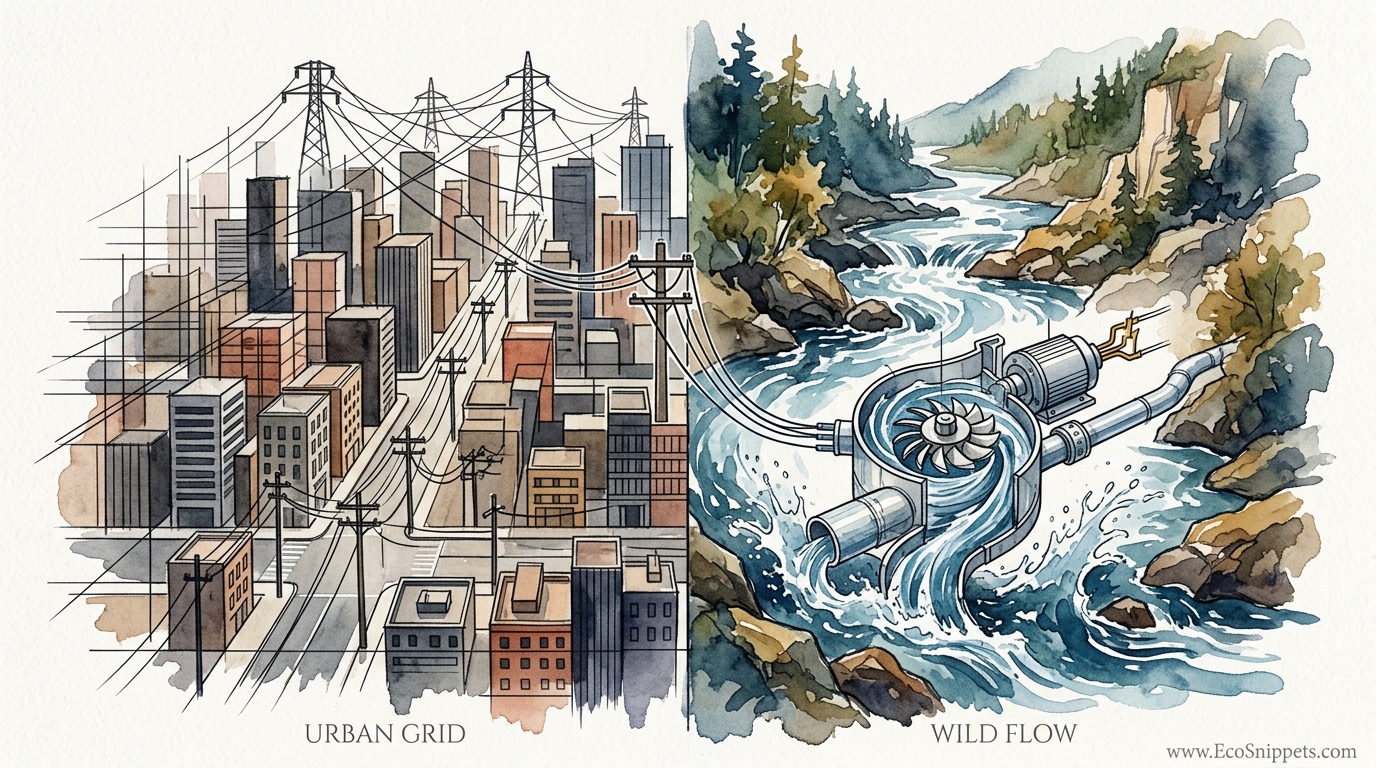
The river never sleeps – learn how a simple whirlpool can power your entire life. The ‘Urban’ grid relies on fragile wires and monthly bills. But the ‘Wild’ homesteader looks at the creek and sees a 24/7 battery. Vortex turbines don’t need high dams or high pressure; they use the natural spiraling energy of water. It’s fish-friendly, low-maintenance, and provides more consistent power than solar and wind combined. Turn the flow into your freedom.
Living off the land requires more than just a garden and a roof. Real independence is found in the steady hum of a power source that doesn’t care if the sun is shining or the wind is blowing. While traditional hydroelectric systems often demand massive concrete dams and expensive high-pressure piping, the micro-hydro vortex turbine offers a gentler, more resilient path.
This technology taps into the same spiraling geometry found throughout the natural world, from the shell of a snail to the rotation of a galaxy. By guiding a stream into a specifically designed basin, you create a controlled whirlpool that extracts energy with remarkable efficiency. This is a system designed for the “Wild” flow—the uneven, low-elevation water sources that most engineers ignore.
Micro-Hydro Vortex Turbine Guide
A micro-hydro vortex turbine, often called a Gravitational Water Vortex Power Plant (GWVPP), is a revolutionary way to generate electricity from low-head water sources. While traditional turbines might need a vertical drop of 10 meters (33 feet) or more to function, a vortex system can thrive on as little as 0.7 to 3 meters (2.3 to 9.8 feet) of “head” or vertical fall.
The system works by diverting a portion of a river or stream into a round or conical basin. As the water enters the basin tangentially, it begins to spin, forming a stable vortex over a central drain. A vertical-axis turbine is placed at the center of this whirlpool, where it captures the rotational kinetic energy of the water before it exits through the bottom and returns to the stream.
This technology gained modern prominence through the work of inventors like Franz Zotlöterer and Paul Kouris, though the principles of vortex energy have been understood for centuries. Unlike high-pressure systems that use “impulse” or “reaction” forces to spin at high speeds, the vortex turbine turns at a slower, more natural pace. This makes it a perfect fit for rural homesteads, remote farms, and eco-conscious communities that want reliable energy without destroying the local aquatic habitat.
How It Works: The Physics of the Whirlpool
The heart of the vortex turbine is the conversion of potential energy into rotational kinetic energy. In a standard dam, water is crushed under its own weight to create pressure. In a vortex basin, the water is invited to dance. As the water enters the basin from the side, the geometry of the walls forces it into a circular path.
Gravity pulls the water toward the center drain, and because of the conservation of angular momentum, the water accelerates as it moves inward. This creates a powerful suction and a high-velocity core. The turbine runner, which sits in this core, doesn’t just block the water; it absorbs the momentum of the spiral.
The Basin Geometry
There are two primary designs for the basin: cylindrical and conical. Cylindrical basins are easier to build but often suffer from turbulence at the edges. Conical basins, which narrow toward the bottom, are generally considered more efficient. The tapering shape of a cone helps maintain the velocity of the vortex even as the water loses energy to the turbine blades.
The Turbine Runner
The turbine itself is usually a vertical-axis runner with multiple blades. Because the water in a vortex moves both horizontally (spinning) and vertically (falling), the blades are often curved to capture both vectors of movement. Unlike a boat propeller that “pushes” water, these blades are designed to be “pulled” by the vortex, maximizing the torque even at low RPMs.
The Practical Benefits of Going Vortex
Choosing a vortex turbine over solar, wind, or traditional hydro comes with a unique set of advantages that appeal specifically to those looking for long-term self-reliance and environmental stewardship.
Consistent 24/7 Power: Solar panels go dark at night, and wind turbines sit idle on calm days. A river, however, flows day and night. A vortex turbine provides a “base load” of electricity, meaning you can run your refrigerator, lights, and communication equipment without relying heavily on massive battery banks.
Fish-Friendly Design: Traditional hydro turbines are often “fish blenders” because of their high-speed blades and extreme pressure changes. Vortex turbines spin slowly and do not create cavitation (exploding bubbles that harm aquatic life). Fish can actually pass through the center of the vortex and out the drain without being struck by the blades.
Oxygenating the Water: As the water spirals, it creates a large surface area that interacts with the air. This naturally aerates the stream, increasing dissolved oxygen levels. This is a rare example of a power system that actually leaves the environment in better condition than it found it.
Self-Cleaning Capability: The vortex naturally pulls floating debris and sediment toward the center and flushes it out the bottom. This significantly reduces the time spent cleaning intake screens, which is the “bane of existence” for most small-scale hydro owners.
Challenges and Common Mistakes
While the system is elegant, it is not “plug and play.” Many DIY enthusiasts fail because they underestimate the precision required in the basin’s construction.
Incorrect Inlet Velocity: If the water enters the basin too slowly, a strong vortex will never form. If it enters too fast, the basin will overflow before the energy can be captured. The inlet channel must be sized precisely to the flow rate of the stream.
Improper Turbine Placement: A common error is placing the turbine too high or too low in the basin. Research suggests that the turbine is most efficient when positioned at about 60% to 70% of the basin’s total height from the bottom. Placing it at the very top misses the acceleration of the core, while placing it at the very bottom creates too much back-pressure.
Vibration and Structural Fatigue: Because a vortex is a dynamic, moving force, the turbine assembly is subject to constant vibration. Using cheap materials or failing to secure the central shaft will lead to mechanical failure within months. Always use high-quality bearings and stainless steel or reinforced polymer for the blades.
Limitations and Realistic Expectations
It is important to understand that a vortex turbine is not a magic solution for every property. It requires a specific set of environmental conditions to be viable.
Minimum Head Requirements: If your property is completely flat, you cannot use this system. You need at least 0.7 meters (about 28 inches) of vertical drop over a reasonable distance to create the necessary gravitational pull.
Water Volume Needs: Vortex turbines are “low-head, high-flow” systems. This means they need a significant volume of water to be effective. A tiny trickle from a spring won’t have enough mass to spin a turbine. You generally need at least 0.05 cubic meters per second (50 liters per second or 13.2 gallons per second) to generate meaningful power.
Winter Operations: In extremely cold climates, the basin can freeze. While the moving water in the vortex helps prevent solid ice from forming, an “ice donut” can build up around the edges. Many users find that the ice actually acts as an insulator, allowing the vortex to continue spinning underneath, but severe freezes may require a temporary shutdown.
Comparison: Vortex vs. Traditional Hydro
When deciding on a power system, it helps to see how the vortex stacks up against the more common “Overshot Wheel” or the “Kaplan Turbine.”
| Feature | Vortex Turbine | Traditional Micro-Hydro |
|---|---|---|
| Head Required | Ultra-Low (0.7m – 3m) | Medium to High (5m – 50m+) |
| Maintenance | Low (Self-cleaning) | High (Frequent screen cleaning) |
| Fish Safety | Excellent | Poor (Needs expensive bypass) |
| Complexity | Moderate (Civil works needed) | High (Pipes, nozzles, pressure) |
Practical Tips for Site Assessment
Before you buy or build anything, you must know your numbers. The potential power (P) in Watts is calculated by the formula: P = Q × H × g × ?, where Q is the flow rate (m³/s), H is the net head (m), g is gravity (9.81), and ? is the efficiency (typically 0.5 to 0.7 for small systems).
Measuring Head: Use a transparent hose filled with water to find the vertical difference between your intake point and your discharge point. Even a small error of 10 centimeters (4 inches) can significantly change your power output.
Measuring Flow: For smaller streams, use the “Bucket Method.” Time how long it takes to fill a 20-liter (5-gallon) bucket. For larger streams, use the “Float Method.” Measure the cross-sectional area of the stream and time how long a piece of fruit takes to float 10 meters (33 feet). Multiply the area by the velocity and apply a 0.7 correction factor for the streambed friction.
Civil Works Strategy: Don’t try to dam the whole river. Use a “diversion weir” that only takes the water you need. This keeps your project legal in many jurisdictions and ensures the river can still handle flood events without washing away your turbine.
Advanced Considerations: Optimizing the Output
Serious practitioners don’t just set a turbine and forget it. They tune the system to match the seasonal “Wild” flow of the land.
Consider using a Permanent Magnet Synchronous Generator (PMSG). These generators are highly efficient at the variable speeds typically produced by a vortex. Because they don’t have brushes, they require almost zero maintenance over their decades-long lifespan.
If you have a large property with a long, shallow drop, look into cascading turbines. Instead of one large 5kW turbine, you might install five 1kW turbines in a series. This allows you to scale your power production as your needs grow and ensures that if one unit goes down for maintenance, you still have 80% of your power.
Example Scenario: The Small Homestead
Imagine a homestead with a creek that has a 1.2-meter (4-foot) drop across its property. After measuring the flow, the owner finds they have a consistent 200 liters per second (52.8 gallons per second).
Using the formula (0.2 m³/s × 1.2 m × 9.81 × 0.5 efficiency), the homesteader realizes they can generate approximately 1,177 Watts of continuous power. That is 28.2 kWh per day—more than enough to power a modern home, including an electric stove, well pump, and internet, with plenty left over to charge an electric vehicle or power a workshop.
Final Thoughts
The river never stops giving, but it requires the right vessel to receive its gifts. The micro-hydro vortex turbine is that vessel—a bridge between the ancestral wisdom of watermills and the modern need for clean, reliable electricity. By working with the natural spiraling tendencies of water rather than fighting against them with high-pressure pipes, you create a system that is as durable as it is efficient.
Building your own vortex system is a journey of observation. It forces you to learn the rhythms of your land, the volume of your spring rains, and the depth of your winter freezes. It is not just about the wires and the volts; it is about becoming a participant in the “Wild” flow of your environment.
If you have the water and the will, start small. Build a prototype basin, watch the vortex form, and feel the torque of the water. Once you see that first light bulb flicker to life from the power of a simple whirlpool, the “Urban” grid will never look the same again. Turn your flow into your freedom, and let the river power your life.
