How To Become More Self-Sufficient Without Starting a Full-Blown Farm…
Want to start preserving your harvest, making your own soap, or building a backyard root cellar — but not sure where to begin? “Homesteading Advice” gives you instant lifetime access to 35+ practical homesteading books on food preservation, veggie gardening, DIY natural cleaning products (save over $250 per year with this skill alone), brewing, off-grid energy, and a whole lot more…
Click Here To Check It Out Now!
Are you growing fruit for your family, or are you just running a high-end restaurant for the local birds?
It happens every year: you wait months for that perfect ripeness, only to find the birds beat you by an hour. Stop the ‘Exposed’ cycle and build a ‘Sheltered’ legacy for your harvest.
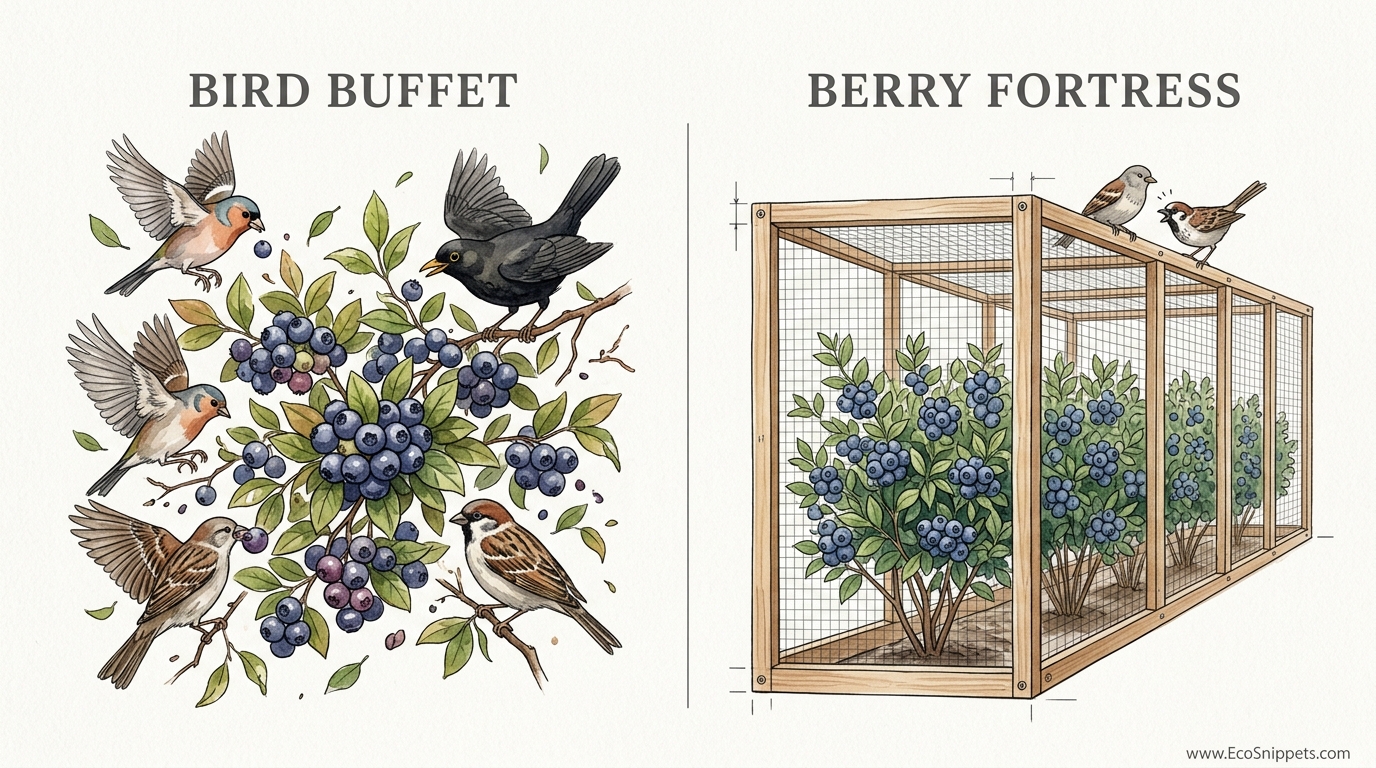
Protecting a blueberry crop is a rite of passage for any serious gardener or homesteader. While it feels like a personal affront when a flock of robins strips a bush in a single morning, it is simply nature following the path of least resistance. To secure your yield, you must transform your garden from a wide-open bird buffet into a fortified berry fortress.
This guide will walk you through the practical, time-tested methods of exclusion and deterrence. Whether you are tending to a couple of bushes in the backyard or managing a multi-row plantation, the principles of self-reliance and ancestral wisdom remain the same: build it once, build it right, and defend what is yours.
How To Protect Blueberries From Birds
Protecting blueberries from birds is the practice of using physical barriers, sensory deterrents, or environmental modifications to prevent avian species from consuming or damaging your fruit. In the real world, this is a necessity because blueberries are one of the most attractive food sources for birds like robins, starlings, finches, and cedar waxwings. Without intervention, bird predation can result in losses of 30% to 100% of the harvest.
Physical exclusion is the most reliable method. It involves creating a barrier that the bird cannot fly through, crawl under, or peck through. Think of it like a screen door for your pantry; if the door is open, the guests will help themselves. If the screen is tight and the frame is solid, the food stays safe.
Deterrents, on the other hand, are psychological. These include visual “scare” tactics or auditory signals designed to make the birds feel unsafe. While less labor-intensive than building a cage, birds are intelligent and often habituate to these methods within days. Therefore, a successful strategy usually relies on a “Berry Fortress” (physical exclusion) rather than just a “Bird Buffet” with a few shiny ornaments.
The Mechanics of Defense: How to Secure Your Harvest
Building a proper defense requires understanding both the materials and the timing. You cannot simply throw a net over a bush and hope for the best. To do it right, you need a system that supports the weight of the protection and allows you access for the harvest.
The Fruit Cage System
A fruit cage is a permanent or semi-permanent structure made of wood, PVC, or metal conduit. It creates a defined space around your plants.
- Structure: Use 4×4 inch (10×10 cm) pressure-treated posts or 1-inch (25 mm) EMT conduit. Set posts at least 2.5 feet (76 cm) into the ground to withstand wind and frost heave.
- Height: Ensure the cage is at least 6 to 7 feet (1.8 to 2.1 meters) tall. This allows you to walk inside comfortably to prune and harvest without crouching.
- Support Wires: String galvanized wire or high-tensile trellis wire across the tops of the posts. This creates a “roof” that prevents the netting from sagging into the plants.
Strategic Netting Selection
The mesh size of your netting is the most critical decision. If the holes are too large, small birds like finches will slip through. If they are too small, you might accidentally block essential pollinators or trap beneficial insects.
- 1/4 inch (6 mm) Mesh: Best for keeping out the smallest birds and even some larger insects like cicadas. It provides a slight microclimate benefit by breaking the wind.
- 1/2 inch (12 mm) Mesh: The “gold standard” for most songbirds. It is small enough to exclude robins and starlings while still being relatively easy to handle.
- 3/4 inch (19 mm) Mesh: Common in commercial settings. It is lightweight and allows maximum light but may permit very small, determined birds to squeeze through if not kept taut.
The Ground Anchor
Birds are notorious for hopping along the ground and finding gaps at the base of your protection. Secure the bottom of your netting using sod staples, heavy bricks, or lengths of timber. A gap of just 2 inches (5 cm) is enough for a robin to walk right into your fortress.
The Advantages of a Fortified Approach
Choosing a robust, physical barrier over temporary “quick fixes” offers measurable benefits for the long-term health of your homestead.
Guaranteed Yield
Exclusion is the only “foolproof” way to ensure you actually get to eat the fruit you grew. While scare tactics might work for a day or two, a well-built cage or a properly tensioned net provides 24/7 protection. This reliability is essential if you are growing fruit to preserve for the winter months.
Protection from Other Pests
A sturdy enclosure often serves a dual purpose. By using chicken wire or a heavier gauge mesh at the bottom 2 feet (60 cm) of your cage, you can simultaneously deter rabbits, squirrels, and even deer. This “multi-threat” defense saves you from having to build separate systems for different animals.
Microclimate Benefits
Fine mesh netting acts as a windbreak. In regions with harsh sun or late-spring frosts, the netting can provide a few degrees of temperature buffer. It reduces transpirational stress on the plants during high-heat days, often leading to juicier, more succulent berries.
Common Pitfalls and Mistakes
Many gardeners fail because they treat bird protection as an afterthought. Avoiding these common errors will save you time, money, and frustration.
Draping Directly on the Bush
Tossing a net directly over a blueberry bush is a recipe for disaster. Birds will simply land on the net and peck through the holes to reach the fruit. Even worse, the net often becomes entangled in the new growth. When you try to remove it for harvest, you end up tearing off branches and stripping unripe berries. Always use a frame to keep the net at least 4 to 6 inches (10 to 15 cm) away from the foliage.
Incorrect Timing
Wait until the flowers have dropped and the “green” berries have formed before you seal your cage. If you enclose the plants while they are in full bloom, you may prevent bees and other pollinators from reaching the flowers. This results in poor fruit set and small, shriveled berries. Conversely, do not wait until the berries start to turn blue. Birds recognize the change in color early and will begin their “scouting” flights long before you think the fruit is ready.
Using Low-Visibility “Invisible” Netting
While aesthetically pleasing, very thin monofilament netting is a death trap for wildlife. Birds and small snakes can become hopelessly entangled, leading to a slow and unnecessary death. Use a high-visibility, UV-protected knitted or extruded plastic mesh. It is safer for the environment and much easier to work with year after year.
Limitations of Bird Protection Methods
No system is without its trade-offs. Understanding the constraints helps you choose the right level of defense for your specific situation.
Initial Cost and Labor
Building a walk-in fruit cage is an investment. High-quality cedar posts, galvanized wire, and UV-stabilized netting can cost hundreds of dollars for a large patch. For a casual gardener with only one or two bushes, the cost might not justify the output. In those cases, temporary PVC “teepees” or localized netting may be more practical.
Maintenance Requirements
Physical structures require upkeep. Heavy snow can collapse a flat-topped cage if the netting is left on over winter. Wind can tear unsecured mesh, and wooden posts eventually rot if not properly treated. You must be prepared to inspect your fortress every spring and make necessary repairs before the ripening season begins.
Pollination Trade-offs
If you use a very fine mesh (less than 1/4 inch or 6 mm) to keep out smaller pests like spotted wing drosophila (SWD), you essentially lock out most bees. This requires you to either use a wider mesh during the bloom or manually introduce pollinators—a task far beyond the needs of most home growers.
Berry Fortress vs. Bird Buffet: A Comparison
Choosing between a temporary “scare” strategy and a permanent “exclusion” strategy depends on your goals for self-reliance.
| Feature | Bird Buffet (Deterrents) | Berry Fortress (Exclusion) |
|---|---|---|
| Setup Cost | Low (Tape, Owls, CDs) | Moderate to High (Posts, Mesh) |
| Effectiveness | Low (Temporary) | Very High (Permanent) |
| Maintenance | High (Must move decoys daily) | Low (Annual inspection) |
| Bird Safety | Safe | Safe (if using visible mesh) |
Best Practices for a Secure Harvest
Applying these optimization techniques will elevate your protection from a simple net to a professional-grade exclusion system.
- The “Kool-Aid” Trick: If you are using deterrents in addition to netting, many growers swear by a grape-flavored spray. Dissolving four packets of grape-flavored drink mix (containing methyl anthranilate) in 1 gallon (3.8 liters) of water and spraying it on the fruit makes the berries taste “yucky” to birds without affecting the human palate.
- Add a Door: For walk-in cages, build a simple wooden door frame covered in the same netting. Avoid “overlapping flaps” as birds eventually find their way through the folds. A solid door with a latch ensures the fortress remains sealed.
- Post Caps: Protect your netting from the rough edges of wooden or metal posts. Placing an old tennis ball or a 2-liter plastic bottle over the top of each post creates a smooth surface that prevents the mesh from snagging and tearing.
- Vary Your Deterrents: If you use visual deterrents like plastic owls or hawk kites, move them every 48 hours. If the “predator” stays in the same spot for a week, the birds will eventually use it as a perch while they eat your berries.
Advanced Considerations for the Serious Practitioner
For those looking to scale their production or optimize their homestead for maximum efficiency, consider these deeper insights.
Pollinator Access and Cross-Pollination
While blueberries are somewhat self-fertile, cross-pollination between different varieties leads to significantly larger fruit and higher yields. If you have multiple varieties inside a large cage, ensure your mesh is at least 1/2 inch (12 mm) to allow bumblebees—the primary pollinators for blueberries—to enter and exit freely. If you must use finer mesh for insect control, consider “timing the enclosure” so the nets only go up after 90% of the petals have fallen.
Soil and Water Management Under Covers
Enclosing an area can change how water reaches the soil. Fine mesh can cause rain to “mist” rather than soak the ground, or it can trap fallen leaves that would otherwise blow away, potentially harboring fungal spores. Monitor the soil moisture levels inside your cage more closely than you would in the open field. Drip irrigation is highly recommended for berry fortresses to ensure water reaches the roots without being intercepted by the netting canopy.
Real-World Scenario: The 10-Bush Homestead
Imagine you have a row of 10 mature Highbush blueberries. Each bush is 5 feet (1.5 meters) wide and 6 feet (1.8 meters) tall.
To protect this harvest, a simple “drape” method would require a massive 20×60 foot (6×18 meter) net that would be nearly impossible to manage. Instead, you build a “tunnel” frame using 1/2-inch (12 mm) PVC conduit bent into hoops. Space the hoops every 4 feet (1.2 meters) and secure them to rebar stakes driven into the ground.
By tensioning the netting over these hoops and securing the bottom with 6-inch (15 cm) sod staples, you create a structured environment. You can lift one side of the netting to harvest and drop it back down immediately. This system costs roughly $150 in materials but saves an estimated $400 worth of fruit in the first season alone.
Final Thoughts
Securing a blueberry harvest is about more than just keeping birds away; it is about respecting the labor you have put into the land. A “Bird Buffet” might be the path of least resistance, but a “Berry Fortress” is the hallmark of a resilient and successful homestead. By focusing on physical exclusion, proper timing, and durable materials, you ensure that the bounty of the summer ends up in your pantry rather than on a robin’s menu.
Start by assessing the size of your planting and the specific bird pressure in your region. Build a structure that serves your needs, whether it is a permanent walk-in cage or a seasonal PVC tunnel. Remember that consistency is key—a single gap in your defense can undo weeks of vigilance.
Apply what you have learned this season, and do not be afraid to experiment with different mesh sizes or frame designs. The goal is to create a sustainable system that grows with your garden. With a little grit and the right strategy, you can finally enjoy the sweet, sun-ripened berries you have worked so hard to grow.
