How To Become More Self-Sufficient Without Starting a Full-Blown Farm…
Want to start preserving your harvest, making your own soap, or building a backyard root cellar — but not sure where to begin? “Homesteading Advice” gives you instant lifetime access to 35+ practical homesteading books on food preservation, veggie gardening, DIY natural cleaning products (save over $250 per year with this skill alone), brewing, off-grid energy, and a whole lot more…
Click Here To Check It Out Now!
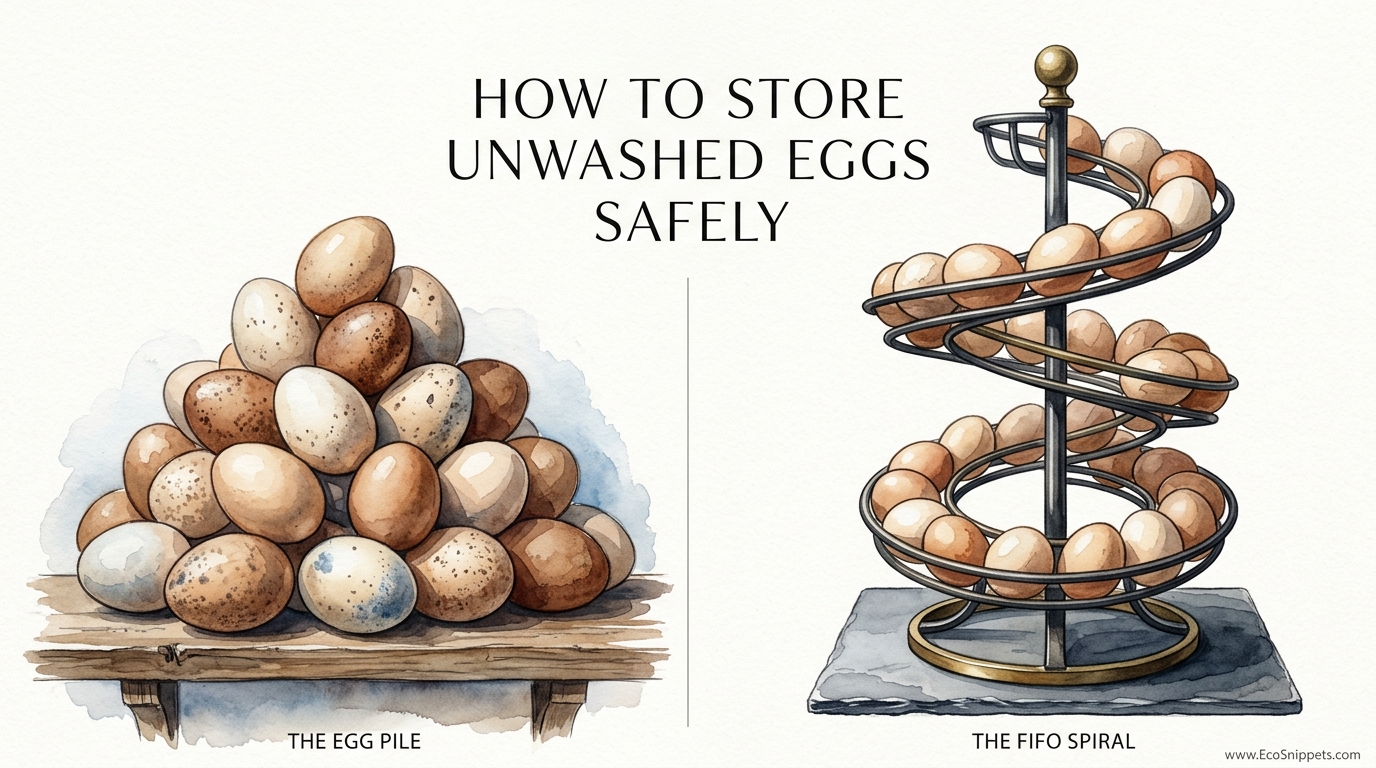
Stop playing ‘egg roulette’ every morning and start using the logic of the spiral. Is that egg from Tuesday or last Sunday? A pile of eggs is a recipe for a kitchen disaster. This simple shift to a First-In-First-Out (FIFO) skelter ensures you always eat the oldest eggs first, maintaining peak freshness without a single Sharpie mark.
When you gather eggs from the coop, the excitement of a full basket often masks the logistical nightmare of organization. Throwing them into a ceramic bowl looks charming on a countertop, but it hides the oldest eggs at the bottom where they slowly lose their quality. By adopting the spiral logic of a dedicated egg skelter, you transform your kitchen into an efficient homesteading hub that honors the hen’s hard work.
Managing a backyard flock requires a balance of ancestral wisdom and modern practicality. Understanding why an egg stays fresh and how to cycle through your supply is the foundation of food self-reliance. This guide will walk you through the science of the bloom, the mechanics of the spiral, and the time-tested methods for keeping your eggs safe without a refrigerator.
How To Store Unwashed Eggs Safely
Storing unwashed eggs safely centers entirely on a biological marvel known as the bloom. This thin, proteinaceous layer is the egg’s first line of defense against the outside world. When a hen lays an egg, she coats it in this waxy secretion, also called the cuticle, which dries within seconds to seal approximately 17,000 tiny pores.
These pores are necessary for a developing chick to breathe, but they also act as open doors for bacteria like Salmonella or Pseudomonas. The bloom effectively “locks” these doors, preventing microscopic invaders from reaching the nutrient-rich interior. As long as this layer remains intact, the egg is structurally sound and biologically protected from rapid spoilage.
In real-world homesteading, “unwashed” means the egg has gone straight from the nesting box to your storage area with no water contact. If you wash an egg, you strip away the bloom and leave the shell vulnerable. Once the cuticle is gone, the egg must be refrigerated immediately to prevent bacterial growth. However, for those with clean nesting boxes and healthy hens, room-temperature storage is a viable, traditional alternative.
Safely storing these eggs requires a cool, dry environment with a stable temperature. Ideally, this is a pantry or a countertop away from direct sunlight and heat sources like the oven. In most climates, a room temperature of around 20°C (68°F) is sufficient for a shelf life of approximately two to four weeks. If your kitchen routinely hits 25°C (77°F) or higher, the interior quality of the egg will degrade much faster, and moving them to a cooler location or the refrigerator becomes necessary.
The Logic of the Spiral: How the FIFO Skelter Works
An egg skelter is more than a decorative rack; it is a gravity-fed inventory management system. The design is usually a continuous metal or plastic spiral that holds between 12 and 36 eggs. The simplicity of its operation is its greatest strength, relying on the First-In-First-Out (FIFO) principle used in professional kitchens and warehouses.
The Loading Process
When you return from the coop with your daily harvest, you load the new eggs into the top of the spiral. As you place an egg at the highest point, gravity gently guides it down the track. If the skelter is already partially full, the new eggs sit behind the existing ones. This ensures that the eggs at the very bottom or “front” of the track are the ones that have been there the longest.
The Retrieval System
When it is time to cook, you simply take an egg from the bottom opening. The remaining eggs roll forward one position, filling the gap. This automatic rotation means you never have to wonder which egg was laid first. The system does the thinking for you, keeping your oldest inventory at the ready while the newest eggs wait their turn at the top of the line.
Maintaining the Flow
The angle of the skelter is precision-engineered to allow movement without causing cracks. However, because eggs are naturally irregular in shape, they occasionally need a gentle nudge. Larger eggs or those with slightly rougher shell textures might sit stationary. A quick tap on the wire frame is usually enough to keep the line moving, ensuring the FIFO logic remains uninterrupted.
The Practical Benefits of the FIFO Spiral
Choosing a spiral dispenser over traditional bowls or cartons offers several measurable advantages for the daily homesteading routine. The primary benefit is the preservation of internal quality. As eggs age, the air cell at the blunt end expands and the albumen (egg white) thins. By ensuring you use the oldest eggs first, you are always using the product at its most appropriate stage—whether that is a firm-white egg for poaching or a slightly older one for easier peeling after boiling.
Visual Inventory Management
A skelter provides an immediate visual cue of your production levels. At a glance, you can see if your hens are slowing down or if you have a surplus that needs to be preserved through other methods. This is far more efficient than digging through stacked cartons in a dark refrigerator or guessing the age of eggs at the bottom of a basket.
Space Efficiency and Display
Most skelters occupy a vertical footprint, making them ideal for smaller kitchens or crowded countertops. They also serve as a point of pride. Farm-fresh eggs come in a variety of colors—from deep copper and olive green to sky blue and creamy white. Displaying them in a spiral turns your food storage into a natural piece of art that celebrates the diversity of your flock.
Hygiene and Airflow
Unlike closed cartons, a wire skelter allows for 360-degree airflow around the shell. This helps maintain a stable temperature and prevents the buildup of moisture or “sweat” that can occur in humid environments. Proper ventilation is a key factor in preventing the growth of surface mold, which can sometimes plague eggs stored in damp, poorly ventilated containers.
Challenges and Common Mistakes to Avoid
Even a system as simple as a spiral can fail if the basic rules of egg safety are ignored. One of the most frequent mistakes is mixing washed and unwashed eggs on the same rack. If you have a particularly dirty egg that requires washing, it must never go into the skelter. The water used in washing can leave residual moisture that promotes bacterial transfer to the neighboring unwashed eggs.
The Danger of Condensation
Moving eggs from a cold environment to a warm one causes them to “sweat.” This condensation is dangerous because moisture can act as a vehicle for bacteria to travel through the pores of the shell. Never take eggs out of the refrigerator and place them back into a room-temperature skelter. If an egg has been chilled, it must stay chilled until use.
Ignoring Nesting Box Hygiene
The success of unwashed storage depends on the cleanliness of the coop. If your nesting boxes are full of manure or broken eggs, the “unwashed” eggs you collect will be heavily contaminated. While the bloom protects the interior, a shell caked in waste is a health hazard for the person handling the egg. Maintaining deep, clean bedding is a prerequisite for using a countertop skelter safely.
Overloading the Track
Forcefully stuffing too many eggs into a skelter can lead to “the jam.” When eggs are packed too tightly, they lose their ability to roll. More importantly, the pressure can cause hairline fractures that are invisible to the naked eye but large enough to let in air and bacteria. Always leave a small amount of breathing room at the top of the spiral.
Limitations: When the Spiral Isn’t Enough
The egg skelter is an excellent tool for daily use, but it has practical boundaries. In regions with extreme seasonal heat, countertop storage may not be viable. If your kitchen temperature consistently exceeds 27°C (80°F), the rate of degradation increases exponentially. In these cases, the skelter might be better used inside a large refrigerator or replaced with refrigerated carton storage.
High-Production Flocks
If you have a large flock producing 20 to 30 eggs a day, a single skelter will be overwhelmed within 48 hours. The spiral logic is designed for household consumption where eggs are used as quickly as they are produced. For high-yield homesteads, the skelter should only hold the “working stock” for the week, while the surplus is moved to long-term storage or sold.
Egg Size Variability
Not all eggs are created equal. Jumbo eggs from certain breeds or “double-yolkers” may be too wide for the standard wire tracks of many skelters. Conversely, tiny pullet eggs or bantam eggs may slip through the gaps or sit awkwardly. If your flock has a high degree of size variability, you may find the automated rolling feature less reliable.
Comparison: Egg Storage Methods
To understand why the FIFO spiral is favored by many, it helps to compare it against other common homesteading storage methods.
| Method | Shelf Life | Rotation Logic | Best Use Case |
|---|---|---|---|
| Egg Skelter (Skelter) | 2–4 Weeks | Automatic (Gravity) | Daily cooking and countertop display. |
| Refrigerated Cartons | 3–4 Months | Manual (Date Marking) | Long-term storage of washed or unwashed eggs. |
| Water Glassing | 12–18 Months | Batch (Long Term) | Preserving spring glut for winter months. |
| Freezing (Scrambled) | 6–12 Months | Batch (Bulk) | Baking and large breakfasts where texture is less critical. |
Practical Tips for Maintaining Freshness
Managing unwashed eggs in a skelter requires a few best practices to ensure every meal is as fresh as possible. First, always store eggs pointy-end down. This isn’t just an old wive’s tale; there is sound physics behind it. The blunt end of the egg contains an air cell. By keeping this end up, the air cell stays away from the yolk, reducing the rate of moisture loss and keeping the yolk centered.
The Dry-Cleaning Technique
If an egg has a small speck of dirt or a feather attached, resist the urge to use water. Instead, use a piece of fine-grit sandpaper or a dry, abrasive sponge to gently buff the spot away. This “dry cleaning” preserves the bloom while maintaining aesthetic standards. Only use this for minor spots; heavily soiled eggs should be washed and moved to the refrigerator for immediate use.
The Freshness Float Test
If you ever lose track of an egg’s age, use the float test before cracking it. Fill a glass with water. A very fresh egg will sink to the bottom and lay flat on its side. An egg that is a week or two old will sink but stand up on its point. If an egg floats to the surface, it has developed a large air sac due to evaporation and should be discarded.
Temperature Stability
Consistency is more important than the absolute temperature. Avoid placing your skelter near a window where the morning sun might bake it, or near a dishwasher that releases bursts of steam and heat. A stable, cool corner of the kitchen is the best “anchor” for your spiral system.
Advanced Considerations for the Serious Practitioner
For those who have mastered basic storage, understanding the nuances of eggshell porosity can take your management to the next level. Different breeds produce shells with varying thicknesses and cuticle qualities. For example, some heritage breeds may have thicker blooms that allow for slightly longer countertop storage compared to high-production hybrids.
Seasonal Adjustments
In the spring, when production is at its peak, your skelter will likely be full and rotating quickly. However, as the light fades in autumn and hens begin their molt, your “spiral inventory” will drop. Serious practitioners often use this transition to shift from countertop storage to water glassing, ensuring a steady supply of eggs when the nesting boxes go empty in the winter.
Porosity and Odor Absorption
Remember that eggshells are semi-permeable. Even with the bloom intact, they can absorb strong odors from the environment. Do not place your egg skelter near pungent items like onions, garlic, or harsh cleaning chemicals. The fats in the yolk are particularly susceptible to picking up these ambient scents, which can ruin the delicate flavor of a fresh egg.
Example Scenario: The Weekend Baker
Consider a homestead that collects six eggs a day. By Saturday morning, the skelter is full with 36 eggs. The baker knows that the 12 eggs at the bottom of the spiral are exactly six days old. This is the perfect age for making hard-boiled eggs for the week’s salads, as the slightly larger air sac makes the shells easier to remove.
The middle 12 eggs, three to four days old, are used for an omelet, where the whites are still firm enough to hold structure. The newest eggs at the top, laid just that morning, are saved for poaching or frying, where the high, centered yolk and thick albumen provide the best visual and culinary results. This tiered usage is only possible because the skelter maintains a perfect chronological order.
Final Thoughts
The transition from a random pile of eggs to a structured FIFO spiral is a significant step in homesteading maturity. It acknowledges that food safety is not just about refrigeration, but about understanding the biological defenses nature has already provided. By respecting the bloom and utilizing the logic of the spiral, you eliminate the guesswork and waste that often plague backyard poultry owners.
Experiment with your storage and get to know the rhythm of your flock. Whether you are a beginner with three hens or an experienced keeper with a dozen, the principles of First-In-First-Out management remain the same. The peace of mind that comes from knowing exactly which egg is the freshest is worth every inch of counter space.
Embrace the simplicity of ancestral wisdom combined with functional design. As you pull that bottom egg for your morning meal, you are participating in a cycle of self-reliance that has sustained households for generations. No more egg roulette—just perfectly timed, farm-fresh nutrition every single day.
