How To Become More Self-Sufficient Without Starting a Full-Blown Farm…
Want to start preserving your harvest, making your own soap, or building a backyard root cellar — but not sure where to begin? “Homesteading Advice” gives you instant lifetime access to 35+ practical homesteading books on food preservation, veggie gardening, DIY natural cleaning products (save over $250 per year with this skill alone), brewing, off-grid energy, and a whole lot more…
Click Here To Check It Out Now!
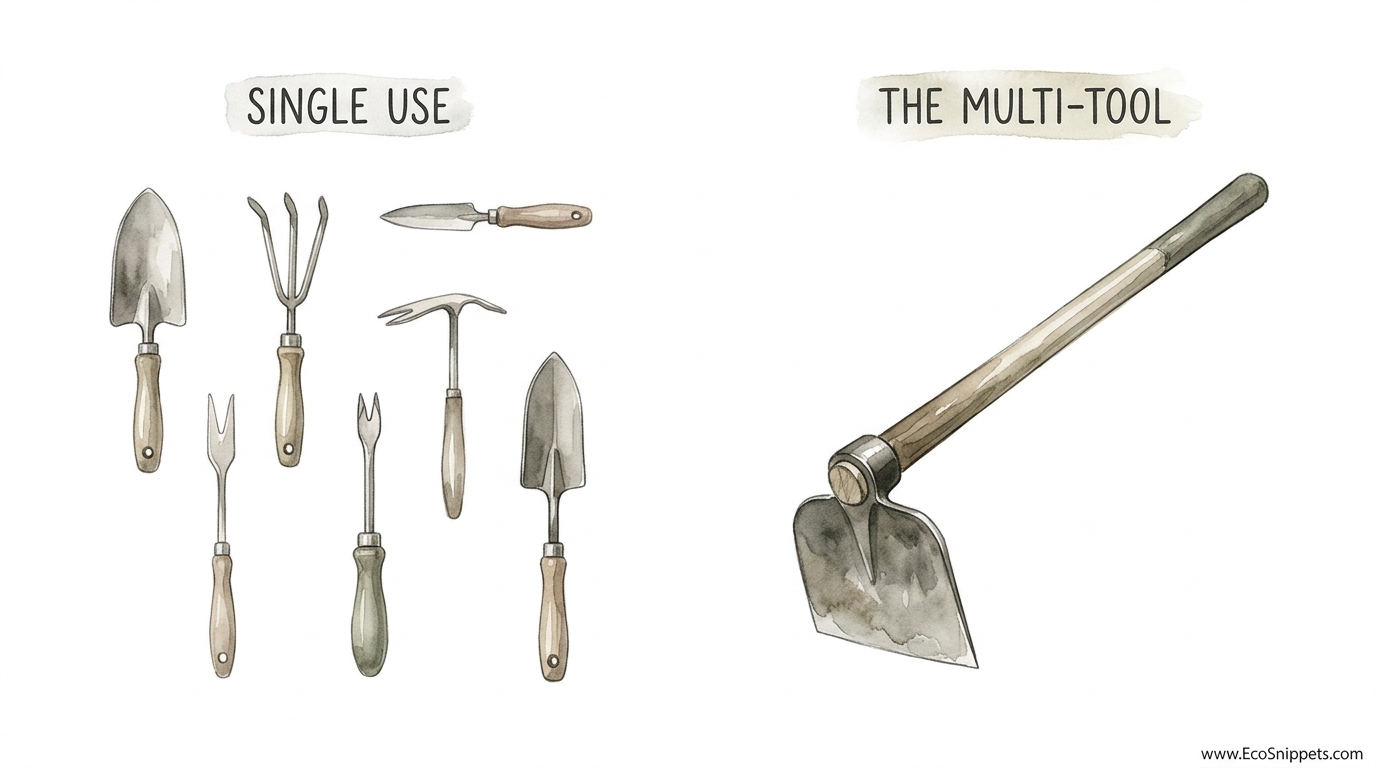
Why one piece of forged steel has done the work of 15 plastic gadgets for over three thousand years across the globe. We’ve been sold a lie that every garden task needs a specific plastic-handled gadget. The Azada, an ancient digging hoe, can trench, weed, chop, till, and level with a simple shift in grip. It’s the original permaculture multi-tool—built once and used for a lifetime, unlike the disposable ‘solutions’ in your local big-box store.
When you step into a modern garden center, you are greeted by rows of specialized tools. There are transplanters, cultivators, hand-weeders, and edge-trimmers, most of them featuring neon plastic grips and thin metal that will likely snap at the first encounter with a stubborn root. This fragmentation of labor is a modern invention designed more for retail sales than for soil health.
For thousands of years, the world relied on a different philosophy: one tool, forged correctly, used with rhythm and gravity. This tool is the Azada. Whether you call it a grub hoe, a jembe, or a mammoty, its form has remained virtually unchanged since Egyptian farmers first etched its likeness into stone. It is a tool for those who value efficiency, durability, and a direct connection to the land.
Benefits Of Using An Azada Hoe
The Azada is a heavy-duty digging hoe where the blade is set at approximately a 90-degree angle to the handle. Unlike the standard garden hoe found in most suburban sheds—which is designed for light scraping—the Azada is a primary tillage tool. It is designed to move earth, break through sod, and chop through thick woody roots with a single swing.
In many parts of the world, including Southern Europe, Africa, and Asia, the Azada is the only tool a farmer needs. It serves as a plow for preparing beds, a spade for digging holes, and a leveler for maintaining irrigation paths. Its weight, typically ranging from 1.2 kg to 2.2 kg (2.6 lbs to 4.8 lbs), provides the momentum necessary to penetrate compacted soil that would cause a standard spade to bounce off the surface.
Think of the Azada as the “swinging spade.” Because the action is a downward chop rather than a “stomp-and-lift” motion, the physics of the tool do most of the hard work. This makes it particularly effective in stony or heavy clay soils where a traditional digging fork might struggle to find a purchase. By allowing gravity to pull the heavy head into the ground, the gardener saves significant energy over a long day of work.
Global Heritage and Regional Variations
The beauty of this tool lies in its universality. In Spain, the Azada is a staple for cleaning between grapevines and digging irrigation ditches. In East Africa, the “jembe” is used to hill up crops like maize and beans. Across India, the “powrah” or “mammoty” is the primary implement for everything from small-scale horticulture to large-scale construction mixing.
Each region has tweaked the design slightly. Some feature a broad, flat blade for sandy soils, while others utilize a narrow, pointed head—resembling a mattock—for tackling the sun-baked, rocky terrain of the Mediterranean. Despite these variations, the core principle remains: a forged steel eye that slides onto a wooden handle, relying on a friction fit that only gets tighter as you work.
How to Use an Azada Without Wrecking Your Back
The most common mistake new users make is trying to use the Azada like a pickaxe, swinging it high over their head and slamming it into the ground with all their might. This is the fastest way to exhaust yourself and risk injury. To use the tool correctly, you must adopt an upright stance and let the weight of the forged head provide the power.
Stand with your feet shoulder-width apart in a “fencer’s stance,” with one foot slightly ahead of the other. Grasp the end of the handle with one hand and place your other hand about midway down the shaft. Instead of lifting the tool with your back, use your arms to guide the head upward and then let it drop. As the blade strikes the soil, pull the handle slightly toward you. This “chop and pull” motion creates a leverage effect that effortlessly lifts the soil.
One of the greatest ergonomic advantages of the Azada is that you rarely have to bend your back. By choosing a handle length of 120 cm to 140 cm (47 to 55 inches), you can maintain a nearly vertical posture. If the soil is particularly hard, you can increase the angle of the strike, but for general weeding or leveling, a shallow, rhythmic “skating” motion just under the surface is sufficient.
- The Strike: Aim to hit the ground about 30 cm to 50 cm (12 to 20 inches) in front of your feet.
- The Lever: Once the blade is buried, push the handle down slightly to pop the soil loose before pulling the tool back toward your body.
- The Rhythm: Work in a steady cadence. It is better to take fifty small, easy swings than ten heavy, exhausting ones.
Advantages of Forged Steel Over Plastic Solutions
Traditional Azada heads are forged from high-carbon steel. Unlike the stamped sheet metal used in “big-box” garden tools, forged steel undergoes a process of heating and hammering that aligns the molecular structure of the metal. This makes the blade incredibly tough and capable of holding a razor-sharp edge for years.
A primary advantage of the Azada is its modularity. The head is usually attached to the handle using an “eye” system. The handle tapers at one end, and the head is slipped on from the bottom. Centrifugal force and the resistance of the soil keep the head firmly in place. If the handle eventually breaks—which can take decades with proper care—you simply knock the head off and fit a new piece of ash or hickory. There are no plastic collars to crack or specialized bolts to lose.
This simplicity is the hallmark of a “forever tool.” While modern gadgets are built to be replaced, the Azada is built to be inherited. The more you use a forged steel blade, the more it polishes itself against the soil, becoming “self-cleaning” and easier to pull through the earth over time. This reduces the friction that makes digging with a rusty, stamped-metal spade so frustrating.
Common Mistakes and How to Avoid Them
Beginners often find themselves fighting the tool rather than working with it. The most frequent error is gripping the handle too tightly. A white-knuckle grip transmits the vibration of every strike directly into your wrists and elbows. Instead, keep a firm but relaxed hold, allowing the handle to rotate slightly in your lower hand as you swing.
Another pitfall is trying to move too much earth at once. If you bury the entire blade in heavy clay and try to lift it like a shovel, you will likely strain your lower back. The Azada is a “drawing” tool; it is designed to slice and pull. Use the corners of the blade for precision work or to break up clods, rather than trying to lever up a 20 kg (45 lb) slab of wet earth.
Safety is also a critical consideration. Because the Azada uses a swinging motion, you must always be aware of your feet. Ensure your stance is wide enough that if the tool glances off a buried rock, the blade will fall into the empty space between your legs rather than striking your shin or boot. Wearing sturdy, closed-toe footwear is non-negotiable when working with any heavy-headed swinging tool.
Limitations: When the Azada May Not Be Ideal
While the Azada is remarkably versatile, it is not a magic wand for every possible garden scenario. One of its main constraints is precision. If you are trying to weed a dense row of tiny carrot seedlings spaced only 5 cm (2 inches) apart, the heavy-duty Azada is likely too blunt an instrument. In these cases, a lighter “collinear hoe” or a hand-trowel is a better choice.
The Azada also requires a certain amount of space to operate. In a very small raised bed or a cramped greenhouse, the long handle and the required swing arc can be cumbersome. It is a tool designed for the open field, the allotment, and the broad-scale market garden. If you find yourself in tight quarters, you might consider the “hand-azada” or “ho-mi,” which offers the same 90-degree efficiency in a smaller, one-handed format.
Finally, there is a learning curve associated with the rhythm of the swing. If you are used to the “stomp-and-push” mechanics of a spade, the Azada will feel alien for the first hour. It requires a level of coordination and body awareness that modern “point-and-click” tools have conditioned us to forget. However, once that rhythm is found, most gardeners find it difficult to return to a spade.
Optional Comparison: Azada vs. The Standard Spade
To truly understand the value of this tool, it helps to compare it to the most common digging implement in the West: the long-handled spade. While both tools can technically achieve the same result—a hole in the ground—the physical cost to the gardener is very different.
| Feature | Traditional Spade | Forged Azada Hoe |
|---|---|---|
| Primary Force | Leg power (stomping) | Gravity and momentum (swinging) |
| Back Strain | High (frequent bending/lifting) | Low (upright posture) |
| Versatility | Low (mostly digging/edging) | High (tills, weeds, trenches, levels) |
| Soil Type | Soft to medium | Any (excellent for stony/compacted) |
| Durability | Moderate (stamped metal wears) | Extreme (forged steel lasts decades) |
Practical Tips and Best Practices
To get the most out of your Azada, you need to treat it like the professional instrument it is. Start by checking the edge. Most Azadas are sold with a “factory edge,” which is intentionally blunt for safety during shipping. Use a flat mill file to sharpen the leading edge. You don’t need a razor edge that could shave hair, but it should be sharp enough to easily slice through a dandelion root.
When working in heavy clay, keep a bucket of water or a “sand-and-oil” bucket nearby. Dipping the blade into a mixture of sand and old motor oil (or linseed oil for an eco-friendly version) every few minutes will prevent soil from sticking to the blade. This keeps the tool heavy only in its steel, not with 5 kg (11 lbs) of clinging mud.
- Soil Moisture: The best time to use an Azada is when the soil is “moist-but-crumbly.” If the ground is bone-dry and hard as concrete, you will exert too much effort. If it is soaking wet, you risk damaging the soil structure.
- Handle Care: If your wooden handle feels rough, sand it down and rub in a few coats of boiled linseed oil. This prevents splinters and keeps the wood from becoming brittle in dry weather.
- Storage: Never leave your Azada lying in the dirt overnight. Moisture from the soil will quickly cause the forged head to rust and the wood to swell, which can eventually loosen the eye-fit.
Advanced Considerations for Serious Practitioners
For those moving toward a permaculture or “no-dig” (or low-dig) system, the Azada is an essential path-maintenance tool. In a no-dig garden, you aren’t tilling the beds themselves, but you are constantly managing the transitions between paths and planting areas. The Azada allows you to quickly “scrape” a path flat or clear back encroaching grass without the need for noisy, gas-powered string trimmers.
If you are managing a larger market garden, consider having two different Azada heads. A broad-bladed “Planter Hoe” is ideal for hilling up potatoes or leeks, while a narrower “Grubbing Hoe” is better for clearing out new ground or digging deep irrigation furrows. Because the handles are interchangeable, you can carry one handle and a couple of heads into the field to switch between tasks as needed.
The “Eye Hoe” design also allows for easy transport. If you are working on a remote allotment or a community garden, you can simply knock the head off the handle and stick it in a backpack. This modularity is why the tool has been favored by nomadic farmers and rural laborers for millennia; it is the ultimate portable agricultural system.
Example Scenario: Clearing a Neglected Allotment
Imagine you have just taken over a 250-square-meter (about 2,700 sq ft) allotment that has been neglected for three years. It is covered in a thick mat of couch grass, docks, and thistles. A standard spade would take weeks of back-breaking effort to “double-dig” this area, and a rototiller would simply chop the couch grass roots into a thousand new plants.
With an Azada, you can clear this ground systematically. Using the sharp corner of the blade, you chop into the sod at a 45-degree angle, slicing the roots just below the crown. With a quick pull-back motion, you “roll” the sod over, exposing the roots to the sun to dry out. You can clear a 10-meter (33-foot) row of heavy sod in less than twenty minutes once you find your rhythm.
Once the sod is cleared, you don’t need to switch tools to make your planting furrows. By turning the Azada on its side or using the full width of the blade, you can draw a perfectly straight trench for your first crop of potatoes. By the end of the day, you have cleared, tilled, and planted a significant portion of your garden using a single piece of steel and your own steady heartbeat.
Final Thoughts
The Azada is more than just a garden tool; it is a rejection of the “throwaway” culture that has permeated modern horticulture. It represents a return to a time when a man or woman’s primary implement was a source of pride, maintained with care and used with a level of skill that turned labor into a rhythmic, almost meditative practice. By choosing a forged steel multi-tool, you are opting for a lifetime of service over a season of convenience.
Applying the wisdom of the Azada to your gardening life will likely change how you view “work.” Instead of a series of disconnected chores requiring a different gadget for each, your time in the garden becomes a fluid process of observation and adjustment. You learn to listen to the soil and respond with the weight and angle of your blade. It is a more honest way to grow food, and your body will thank you for the upright posture and the efficient use of momentum.
If you are tired of plastic handles snapping and the clutter of specialized tools, seek out a genuine forged Azada. It may be the last digging tool you ever need to buy. Experiment with the grip, find your rhythm, and discover why this simple piece of steel has remained the world’s most trusted agricultural implement for over three thousand years.
