How To Become More Self-Sufficient Without Starting a Full-Blown Farm…
Want to start preserving your harvest, making your own soap, or building a backyard root cellar — but not sure where to begin? “Homesteading Advice” gives you instant lifetime access to 35+ practical homesteading books on food preservation, veggie gardening, DIY natural cleaning products (save over $250 per year with this skill alone), brewing, off-grid energy, and a whole lot more…
Click Here To Check It Out Now!
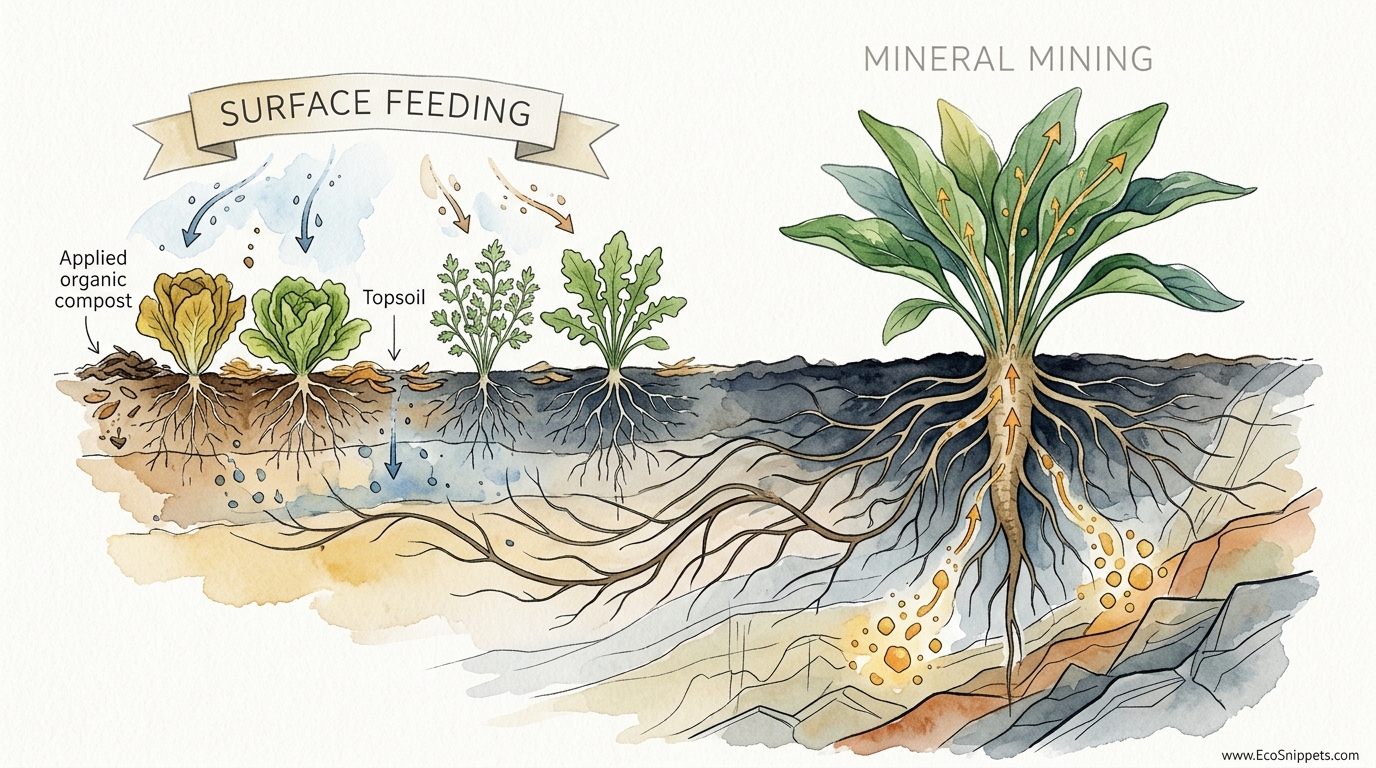
Your garden is starving on the surface while a goldmine of minerals sits just three feet (0.9 meters) below. Most gardens are ‘Isolated’ from the deep nutrient wealth of the earth. Integrating ‘Dynamic Accumulators’—plants with deep taproots—creates a biological elevator that brings potassium, calcium, and minerals up to your vegetables for free. It’s the ultimate integrated loop.
The modern gardener often relies on bags of fertilizer shipped from across the globe to keep their soil productive. This creates a dependency on external inputs that the old-timers would find baffling. Nature has its own delivery system already buried in the ground, waiting for the right roots to tap into the reservoir.
Understanding how to bridge the gap between the exhausted topsoil and the mineral-rich subsoil is a fundamental skill for any self-reliant grower. It requires shifting your perspective from merely ‘Surface Feeding’ to a philosophy of ‘Mineral Mining.’ You are not just growing food; you are managing a living cycle of nutrient transport.
This guide explores the mechanics of this biological elevator and the specific plants that make it possible. You will learn to identify, grow, and utilize these powerhouses to build a garden that feeds itself from the bottom up.
Dynamic Accumulator Plants For Soil Health
Dynamic accumulator plants are species that possess an extraordinary ability to absorb specific minerals from the soil and concentrate them in their leaves and stems at levels far higher than average vegetation. These plants serve as the workhorses of a regenerative landscape. They don’t just grow; they act as biological pumps that redistribute wealth within the soil profile.
The concept originates from observations in permaculture and traditional land management where certain ‘weeds’ were noticed to thrive in depleted soils while simultaneously improving the health of neighboring crops. Scientists and researchers have recently begun to codify these observations, identifying the specific ‘Thresholds’ that define a true accumulator. A plant is generally considered a dynamic accumulator if it stores a specific nutrient at concentrations significantly higher—sometimes ten times higher—than the median for other plants.
In the real world, these plants are the pioneers of the forest floor and the edges of the meadow. They are often the first to arrive after a disturbance, using their aggressive root systems to stabilize the earth and begin the process of rebuilding fertility. When you see a vigorous patch of comfrey or a field of dandelions, you are looking at a localized restoration project in full swing.
These plants are used in diverse settings, from small-scale kitchen gardens to large-scale pasture restoration. They are particularly valuable in ‘Fruit Tree Guilds,’ where they are planted around the drip line of a tree to mine nutrients that the tree’s own roots might miss. They act as a living mulch, capturing nutrients that have leached down through the soil and returning them to the surface where the shallow-feeding roots of vegetables and fruit trees can reach them.
The Biological Elevator: How Nutrient Mining Works
The process of nutrient mining is a sophisticated interaction between plant biology and soil chemistry. Most garden vegetables have relatively shallow root systems, rarely penetrating deeper than 12 to 18 inches (30 to 45 centimeters). This upper layer of soil, known as the A-horizon, is where most of the biological activity and nutrient depletion occur.
Beneath this layer sits the B-horizon or subsoil. This area often contains a vast reserve of minerals—potassium, phosphorus, calcium, and magnesium—that have leached downward over decades or centuries of rainfall. Traditional gardening leaves this wealth untouched. Dynamic accumulators solve this by sending taproots deep into the earth, sometimes reaching depths of 10 feet (3 meters) or more.
The roots of these plants do more than just reach deep; they actively interact with the soil’s mineral matrix. Roots release ‘Exudates,’ which are complex sugars and acids that feed specialized bacteria and fungi in the rhizosphere. These microbes, in turn, help dissolve tightly bound minerals from rock particles, making them bioavailable for the plant to absorb.
Once the minerals are pulled into the plant’s vascular system, they are transported to the foliage and stored in the cellular structure. As the seasons turn, these leaves eventually die back and fall to the ground. This ‘Chop and Drop’ cycle allows the accumulated minerals to decompose on the surface, effectively ‘Top-Dressing’ the garden with a concentrated dose of deep-earth nutrition. It is a slow, steady, and entirely free way to maintain soil health.
The Heavy Hitters: Profiles of Key Accumulator Plants
Successfully mining your soil requires choosing the right tools for the job. Different plants specialize in different minerals. Building a diverse community of accumulators ensures a balanced nutrient profile in your topsoil.
Comfrey (Symphytum officinale / Symphytum x uplandicum)
Comfrey is widely regarded as the ‘King’ of dynamic accumulators. Its taproot is a marvel of engineering, capable of penetrating the toughest clay to reach depths of 3 meters (10 feet). Comfrey is a powerhouse for accumulating **Potassium (K)** and **Silicon (Si)**, both of which are critical for fruit production and plant immunity.
The ‘Bocking 14’ cultivar is the standard for most gardeners because it is sterile and will not take over the garden via seeds. However, it can still spread through root fragments, so placement must be intentional. Use comfrey as a permanent border or as a companion to heavy-feeding fruit trees.
Stinging Nettle (Urtica dioica)
While many view the stinging nettle as a nuisance, the self-reliant gardener sees a high-octane fertilizer source. Nettles are exceptional at accumulating **Calcium (Ca)**, **Magnesium (Mg)**, and **Iron (Fe)**. They also boast a high nitrogen content in their foliage, making them one of the few accumulators that provides a complete ‘Green Manure’ effect.
Nettles thrive in nitrogen-rich environments and are often found near old compost piles or livestock pens. Harvesting them for mulch or liquid tea requires gloves, but the reward is a potent, mineral-rich amendment that strengthens the cell walls of your vegetables.
Dandelion (Taraxacum officinale)
The common dandelion is perhaps the most underrated soil builder in the world. Its yellow blooms are a signal that the biological elevator is working. Dandelion roots are excellent at mining **Calcium (Ca)** and **Potassium (K)** from the subsoil.
Because dandelions are smaller than comfrey, they can be integrated directly into vegetable beds or along pathways without shading out other crops. They also play a crucial role in the early spring, providing one of the first sources of nectar for pollinators while simultaneously loosening compacted soil with their strong taproots.
Yarrow (Achillea millefolium)
Yarrow is a delicate-looking plant with a rugged constitution. It is a known accumulator of **Potassium (K)**, **Phosphorus (P)**, and **Copper (Cu)**. Beyond its nutrient-mining capabilities, yarrow is a champion of ‘Integrated Pest Management.’
Its umbrella-like flower clusters attract hoverflies, lacewings, and parasitic wasps—insects that prey on common garden pests like aphids. Planting yarrow in and around your garden beds creates a multi-functional system that feeds the soil and protects the crop simultaneously.
Benefits of Mineral Mining vs. Surface Feeding
Choosing to utilize dynamic accumulators offers several measurable advantages over traditional surface feeding with synthetic or bagged fertilizers. The primary benefit is the **Reduction of Inputs**. By growing your own fertility, you bypass the cost and environmental footprint of manufactured fertilizers.
Another significant advantage is **Nutrient Bioavailability**. Synthetic fertilizers often provide minerals in a salt form that can be harsh on soil microbes. In contrast, the minerals delivered via decomposing accumulator leaves are bound in organic matter. This allows for a ‘Slow-Release’ effect that mimics the natural forest floor, feeding the soil life and the plants in a balanced, sustainable way.
The physical structure of the soil also benefits. Deep-rooting plants act as ‘Biological Drills,’ breaking up compacted layers and creating channels for water and air to penetrate deep into the profile. This improves **Water Retention** and drainage, making your garden more resilient to both droughts and heavy rains.
Finally, there is the benefit of **Closed-Loop Sustainability**. In a mineral mining system, nutrients that might have been lost to leaching are recaptured and recycled. This prevents groundwater contamination and ensures that the inherent wealth of your land stays on your land.
Challenges and Common Mistakes
Working with dynamic accumulators is not without its hurdles. One of the most frequent errors is **Improper Placement**. Many of these plants, especially comfrey and nettles, are incredibly vigorous. If you plant them in the middle of a delicate vegetable bed, they may shade out your crops or compete too aggressively for space.
Another pitfall is **Invasive Spread**. Comfrey, in particular, can grow from even a tiny fragment of a root. If you decide to move a comfrey plant and leave a sliver behind, you will likely have a new plant there for decades. Always plan for the long term when installing these perennials.
Some gardeners also make the mistake of **Over-Harvesting**. While ‘Chop and Drop’ is the goal, taking too much foliage too frequently can exhaust the plant’s energy reserves. A good rule of thumb is to allow the plant to establish itself for at least one full season before the first major harvest, and never remove more than 50% of the foliage at once.
Failure to recognize the **Specific Needs** of each plant is another issue. While these are ‘hardy’ plants, they still require specific conditions to function as efficient miners. If the soil is excessively dry or lacks any mineral content to begin with, the accumulator cannot ‘create’ nutrients out of thin air. It can only move what is already there.
Limitations: When This Method May Not Work
Dynamic accumulation is a powerful tool, but it is not a magic wand for every situation. One significant limitation is **Soil Contamination**. Because these plants are so efficient at drawing up minerals, they will also pull up heavy metals like lead, cadmium, or arsenic if they are present in the soil.
If you are gardening in an urban area with a history of industrial use, you must be cautious. Using accumulators to ‘remediate’ the soil is a valid technique, but you cannot then use those leaves as mulch for your food crops. The metals will simply be cycled back into the edible parts of your garden.
**Environmental constraints** also play a role. In extremely arid regions, deep-rooting plants may compete with your main crops for limited deep-water reserves. In these cases, the ‘Integrated Loop’ might actually stress your vegetables more than it helps them.
Furthermore, the **Time Horizon** for results is much longer than with synthetic fertilizers. If you have a severe, immediate nutrient deficiency, waiting for a comfrey plant to grow, be harvested, and decompose will not save your current crop. This is a strategy for building long-term, generational fertility, not a quick fix for an emergency.
Surface Fertilizing vs. Deep Mineral Mining
To better understand the value of dynamic accumulators, it helps to compare them directly with traditional surface fertilization methods.
| Feature | Surface Fertilizing (Synthetic/Bagged) | Deep Mineral Mining (Accumulators) |
|---|---|---|
| **Cost** | High (Recurring purchase) | Low (One-time plant purchase) |
| **Speed of Action** | Fast (Immediate uptake) | Slow (Seasonal cycling) |
| **Soil Structure** | Negligible (May damage microbes) | High (Aerates and builds humus) |
| **Sustainability** | Low (Linear dependency) | High (Closed-loop system) |
| **Labor Requirement** | Low (Spreading granules) | Moderate (Planting and harvesting) |
Practical Tips and Best Practices
Implementing a mineral mining system requires a blend of strategy and manual labor. Here are actionable tips to get started:
- Establish Fertilizer ‘Stations’: Rather than scattering accumulators randomly, create dedicated patches near your compost pile or water source. This makes harvesting much easier.
- Master the ‘Chop and Drop’: Cut the foliage just before the plant flowers, as this is when nutrient levels in the leaves are at their peak. Lay the leaves directly on the soil surface around your target crops.
- Brew Liquid Fertilizers: For a faster nutrient boost, place harvested leaves in a bucket of water and let them ferment for 2-4 weeks. Dilute the resulting liquid (which will be pungent) at a 1:10 ratio and use it as a soil drench or foliar spray.
- Mulch Heavily: Accumulator leaves decompose quickly. If you are using them as your primary mulch, be prepared to add a layer of straw or wood chips on top to maintain soil moisture and suppress weeds.
- Use as a Compost Activator: The high nitrogen and mineral content in nettles and comfrey makes them excellent ‘Accelerants’ for a cold compost pile. Layer them in with brown materials like dried leaves to speed up the decomposition process.
Advanced Considerations: Tuning Your System
For the serious practitioner, optimizing the mineral loop involves deeper insights into soil biology. One such consideration is the role of **Mycorrhizal Fungi**. Many dynamic accumulators form symbiotic relationships with these fungi, which essentially extend the root system’s reach by an order of magnitude. Supporting a healthy fungal network through ‘No-Till’ practices ensures that your accumulators are mining as efficiently as possible.
You should also consider **Soil Testing**. While accumulators bring up minerals, they cannot fix a fundamental imbalance in your soil’s pH or a total absence of a specific element. A professional soil test can help you identify which accumulators are most needed. For instance, if your soil is chronically low in calcium, prioritizing stinging nettle and dandelion would be a logical strategy.
**Scaling** the system is another advanced topic. On larger properties, dynamic accumulators can be integrated into ‘Alley Cropping’ systems or used as ‘Hedgerows.’ This allows you to produce massive amounts of biomass that can be harvested with machinery and redistributed across wider acreages.
Finally, pay attention to **Genetics**. Not all comfrey or nettle is created equal. Seek out regional varieties or specific cultivars that have been proven to thrive in your local climate. A plant that is under stress will never be an effective mineral miner.
Examples of Successful Integration
Translating this theory into practice often looks like a well-managed ‘Fruit Tree Guild.’ Imagine a young apple tree planted in a clearing. Around the base of the tree, you plant a circle of ‘Bocking 14’ Comfrey. Beyond that, a scattered ring of Yarrow and Dandelions.
Each year, you chop the comfrey back three times, laying the leaves under the apple tree’s canopy. The comfrey pulls potassium from 2.5 meters (8 feet) deep, providing the tree with the nutrients it needs to produce large, sweet fruit. The yarrow attracts predatory insects that keep apple aphids in check. The dandelions loosen the soil around the apple tree’s drip line, allowing rainwater to reach the roots more effectively.
In another scenario, a gardener with ‘Tired’ soil—perhaps a plot that has been over-farmed for years—might plant a cover crop of **Alfalfa (Medicago sativa)**. Alfalfa is a legendary deep-miner, with roots that have been recorded reaching nearly 20 meters (60 feet) in ideal conditions. After two seasons of alfalfa, the soil is significantly enriched with both nitrogen and deep-earth minerals, ready for a rotation of demanding vegetables.
Final Thoughts
The transition from surface feeding to mineral mining is more than just a change in gardening technique; it is an act of reclaiming self-reliance. It acknowledges that the earth beneath our feet is not a static medium, but a dynamic, vertical world of potential. By partnering with the right plants, you can tap into the deep heritage of the soil and build a garden that is truly resilient.
This approach requires patience and a willingness to work with the natural rhythms of the land. It asks you to observe the ‘weeds’ not as enemies, but as indicators and allies. When you successfully integrate dynamic accumulators into your landscape, you are doing more than just fertilizing your vegetables. You are repairing the broken links in the nutrient cycle and ensuring the long-term health of your ecosystem.
Experiment with these plants. Start with a few comfrey crowns or a patch of nettles in a far corner. Watch how the soil changes over the seasons. In time, you will find that the ‘goldmine’ beneath your garden is no longer a hidden secret, but the very foundation of your success. Encouraging this integrated loop is the highest form of stewardship, a gift to both the soil and the generations of gardeners who will follow you.
