How To Become More Self-Sufficient Without Starting a Full-Blown Farm…
Want to start preserving your harvest, making your own soap, or building a backyard root cellar — but not sure where to begin? “Homesteading Advice” gives you instant lifetime access to 35+ practical homesteading books on food preservation, veggie gardening, DIY natural cleaning products (save over $250 per year with this skill alone), brewing, off-grid energy, and a whole lot more…
Click Here To Check It Out Now!
Nature never uses straight lines, and your ‘tidy’ garden edges are secretly killing your productivity. Straight lines are an industrial invention, not a biological one. By simply ‘waving’ your garden borders, you create the Edge Effect—a pro-level permaculture trick that triples your planting space and doubles your beneficial insect habitat without adding a single square inch of land.
Modern gardening often mimics the factory floor, prioritizing straight rows and rectangular beds for the sake of machine efficiency. While this makes sense for a tractor, it fails the ecology of a living backyard. In the wild, the most life-dense areas are never in the middle of a uniform forest or the center of a barren field. Life thrives at the boundaries. The transition where the forest meets the meadow, or where the pond meets the shore, is where biodiversity explodes.
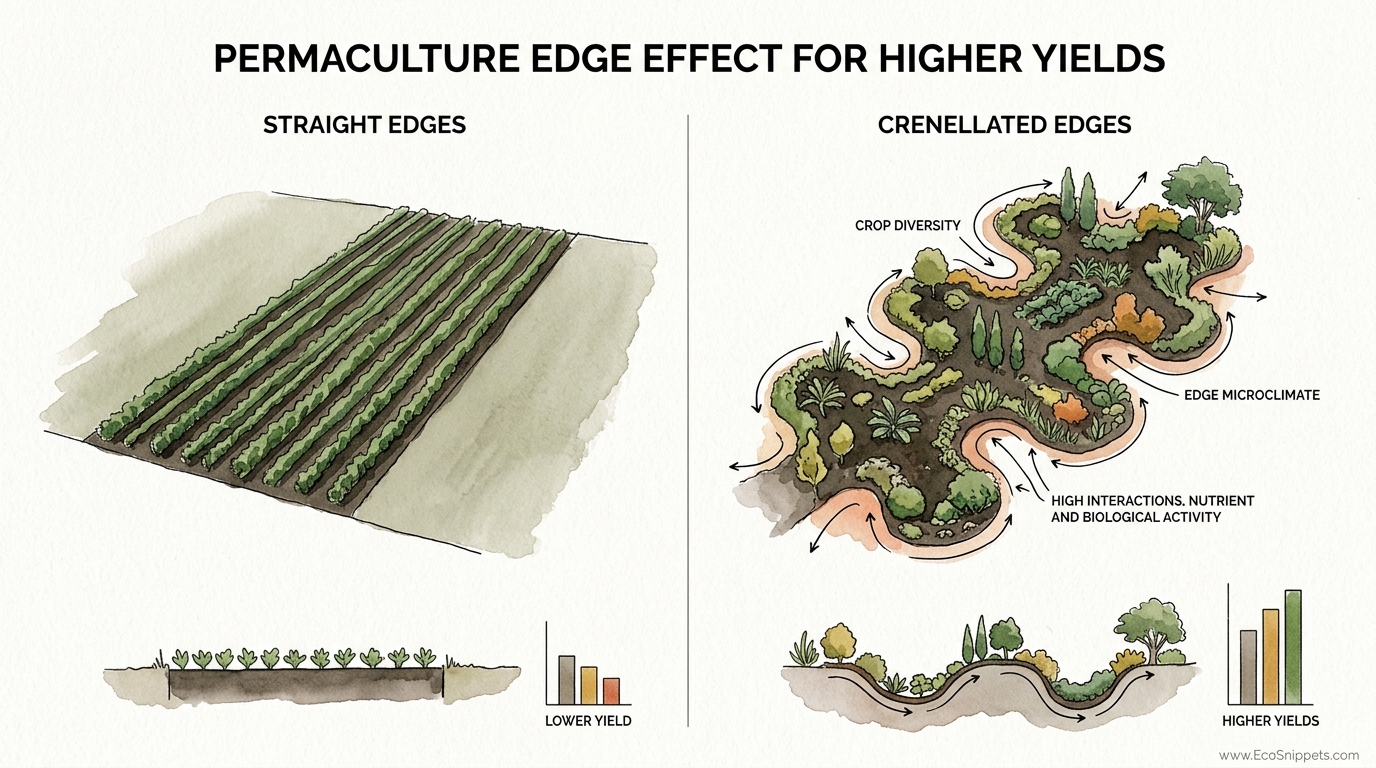
Ecologists call these transition zones ecotones. In permaculture, we call this the Edge Effect. When you replace a straight garden border with a crenelated or wavy one, you are not just making a stylistic choice. You are physically increasing the length of the interface between two environments—such as your garden bed and your path—which creates more room for life to settle, feed, and protect your crops.
Understanding this principle allows you to work with the inherent geometry of nature rather than fighting against it. You can turn a standard 10-foot (3-meter) straight border into a 30-foot (9-meter) undulating edge within the same footprint. This simple shift in shape changes the thermal dynamics, moisture retention, and biological activity of your entire growing space.
Permaculture Edge Effect For Higher Yields
The Edge Effect is a fundamental ecological phenomenon where the junction of two different ecosystems—like a forest and a grassland—results in greater species diversity and higher biological productivity than either ecosystem provides on its own. In these zones, you find “edge species” that utilize the resources of both habitats. For example, a bird might nest in the safety of the dense forest but forage for insects in the open meadow.
In a garden context, the edge is the boundary where your cultivated soil meets a path, a lawn, or a pond. A straight edge is the shortest distance between two points, providing the absolute minimum amount of interface. Conversely, a “wavy” or crenelated edge increases this interface significantly. Imagine two identical 100-square-foot (9.3-square-meter) gardens. One is a perfect square; the other is a complex fractal shape with deep indentations. The fractal garden will have significantly more “edge” length, even though the total area remains the same.
This increased edge serves as an “energy net.” Nature is a constant flow of energy in the form of wind, water, sunlight, and moving organisms. When these flows hit a complex edge, they are slowed down and captured. Wind-blown leaves and organic debris get trapped in the curves of a wavy border, naturally mulching the soil. Beneficial insects, such as ground beetles and predatory wasps, use these edges as highways and hunting grounds.
Real-world applications of this concept are seen in the design of keyhole beds and mandala gardens. By curving the path into the bed (the keyhole), a gardener can reach every corner of the planting area from a single standing point while maximizing the perimeter available for high-density planting. This logic is used at scale in chinampas (floating gardens) or swale systems, where the zigzagging of water and land creates a massive amount of highly productive riparian edge.
How It Works: The Geometry of Yield
To implement the edge effect effectively, you must understand the relationship between perimeter and area. If you have a square bed that is 4 feet by 4 feet (1.2 meters by 1.2 meters), you have 16 square feet (1.5 square meters) of growing space and 16 linear feet (4.8 meters) of edge. If you stretch that same area into a long, thin rectangle that is 1 foot by 16 feet (0.3 meters by 4.8 meters), your edge increases to 34 feet (10.3 meters).
Permaculture takes this further by using crenelation—a pattern of “teeth” or deep waves. By “waving” the border of your garden bed, you create micro-climates within the curves. The “insies” (the parts of the bed that curve inward) act as sun traps, sheltered from the wind and holding more heat. The “outsies” (the points that stick out) are more exposed, which might be ideal for hardy herbs or plants that require high airflow to prevent fungal issues.
Layout begins with observation. Instead of reaching for a ruler, reach for a garden hose or a long rope. Lay the hose out in a series of deep, sinuous curves across your designated plot. Aim for “keyholes”—circles of garden bed with a narrow path leading into the center. This allows you to stand in one spot and reach 360 degrees of plants without ever stepping on the soil. Stepping on soil causes compaction, which destroys the delicate fungal networks (mycelium) and air pockets roots need to breathe.
Once the curves are marked, the “V-trench” method is often the most reliable way to define the edge. You use a sharp spade to cut a 6-inch (15-cm) deep trench at a 45-degree angle. This creates a physical barrier that prevents grass runners from invading the bed while providing a visible “wave” that catches water runoff. This trench acts as a miniature swale, holding moisture exactly where the most intensive planting occurs.
Benefits of the Crenelated Edge
The primary advantage of a wavy border is the sheer increase in planting density. Most gardeners plant in the center of their beds, leaving the edges underutilized. With a crenelated edge, the “edge” essentially becomes the whole bed. You can plant intensive “border” crops like strawberries, chives, and marigolds along the entire winding perimeter, while taller crops like kale or peppers sit in the slightly deeper pockets of the curves.
Biological pest control is the second major benefit. Beneficial insects like ladybugs, lacewings, and parasitic wasps prefer diverse environments with plenty of cover. A straight line offers no protection from the elements or predators. A wavy edge, especially one with varying plant heights, creates a “pollinator highway.” These insects move along the edge, moving from one micro-climate to another, keeping aphid populations in check without the need for chemical intervention.
Thermal mass and moisture retention also improve. In a straight-edged bed, the soil is uniformly exposed to the sun and wind, leading to rapid evaporation. In a wavy bed, the indentations (the “keyholes”) trap air, creating pockets of humidity and warmth. In the winter, these pockets can stay several degrees warmer than the surrounding area, potentially extending your growing season by a few weeks.
Finally, the edge effect improves accessibility and reduces labor. When you design with keyholes and waves, you eliminate the need for wide, industrial-style paths. You only need enough path space to stand or move a wheelbarrow. Because you can reach more of the bed from fewer points, you spend less time walking and more time tending to the plants. This is the hallmark of a high-efficiency permaculture system.
Challenges and Common Mistakes
The most common mistake when moving away from straight lines is making the curves too shallow. If the “waves” in your border are only a few inches deep, you won’t gain enough linear edge to make a biological difference. For the edge effect to truly kick in, curves should be deep enough to create distinct micro-climates—at least 12 to 18 inches (30 to 45 cm) of indentation.
Maintenance can also be a hurdle if you aren’t prepared. Mowing a lawn against a wavy garden bed is more difficult than following a straight line. If you use a standard lawnmower, you may find yourself leaving patches of uncut grass in the “insies” of the waves. To solve this, many permaculture practitioners use a wide “buffer zone” of mulch or gravel between the grass and the wavy garden bed, or they replace the lawn entirely with groundcover that doesn’t require mowing.
Structural integrity is another consideration. Soil has a “natural angle of repose”—the steepest angle at which it can be piled without sliding. When you create deep curves and mounds, the soil may want to wash away during heavy rains. This is why the V-trench or physical edging is critical. Using flexible steel edging or “weaving” a low wattle fence from willow branches can help hold the shape of the curves while maintaining the biological benefits of the edge.
Over-planting the edges is a final pitfall. Because you suddenly have three times the planting space along the perimeter, it is easy to crowd the plants. Remember that while the edge increases, the root space below ground is still shared. Give your “edge” plants enough room to breathe, or you will end up with a tangled mess that limits airflow and encourages disease.
Limitations: When Straight Lines Might Be Better
Despite the brilliance of the edge effect, it is not a universal solution for every corner of the homestead. In very small, restricted urban plots—such as a 4-foot by 8-foot (1.2-meter by 2.4-meter) balcony or a narrow side-yard—the complexity of a wavy border can actually waste space. In these scenarios, every square inch is precious, and the “dead space” created by paths within a complex fractal might outweigh the benefits of the extra edge.
Large-scale mechanical farming also struggles with curves. If you rely on a tractor-pulled tiller or a mechanical seeder, straight rows are a necessity. While some advanced agricultural systems are experimenting with “contour farming” (planting along the curves of the land), the equipment is specialized and expensive. For a mid-sized garden that relies on hand tools, curves are a blessing; for a 50-acre (20-hectare) monocrop field, they are a logistical nightmare.
Aesthetic constraints can also play a role. Some homeowners associations (HOAs) or historical districts have strict rules regarding “neatness.” A wavy, biodiverse permaculture edge can look “wild” or “unkept” to the untrained eye. In these cases, you might need to use “cues to care”—such as a clean, high-quality stone border or a very clearly defined mulch path—to signal that the wavy garden is an intentional design rather than a neglected patch of weeds.
Finally, certain irrigation systems are designed for straight lines. Traditional drip tape, which is rigid and made for long rows, does not bend easily around tight “keyhole” curves. If you use drip irrigation, you will need to switch to flexible “soaker hoses” or “point-source emitters” that can follow the sinuous path of your new borders.
STRAIGHT EDGES vs CRENELATED EDGES
| Feature | Straight Edges | Crenelated (Wavy) Edges |
|---|---|---|
| Planting Space | Minimal perimeter for the area. | Up to 3x more perimeter space. |
| Micro-climates | Uniform exposure; no shelter. | Multiple sun traps and windbreaks. |
| Insect Habitat | Low diversity; few hiding spots. | High diversity; complex “highway” for predators. |
| Maintenance | Easy for mowers and machines. | Requires hand-edging or buffer zones. |
| Water Retention | Water runs off straight lines. | Curves act as mini-swales to trap runoff. |
Practical Tips for Implementation
Start small by converting just one bed. If you have a standard rectangular raised bed, you don’t have to tear it down. You can “scallop” the soil inside the frame or add “bump-outs” to the exterior using rocks or logs. This allows you to observe the difference in plant health and insect activity before committing your entire yard to sinuous curves.
Use the “Garden Hose Trick” for perfect layouts. A garden hose is heavy enough to hold its shape but flexible enough to form beautiful, organic curves. Lay it out and walk around it. Make sure you can reach the center of the bed from the path. If you have to step into the bed to reach a plant, your curve isn’t deep enough.
Consider the “Vertical Edge” as well. Edge effect isn’t just about horizontal space. Adding a trellis, a fence, or even a tall row of sunflowers creates a vertical edge where the “sky” ecosystem meets the “ground” ecosystem. This “stacking” of functions allows you to utilize the edge effect in three dimensions, further increasing your yield per square inch.
Choose your edging material based on the curve’s radius. For tight keyholes, thin steel or aluminum edging works best because it can bend without kinking. For larger, sweeping waves, you can use recycled bricks set on their ends, “wattle” (woven sticks), or even a thick “living edge” of creeping thyme or clover.
Advanced Considerations: Fractals and Hydrology
Serious practitioners often look to fractal geometry—the repeating patterns found in ferns, river deltas, and coastlines—to maximize their edges. A “Mandelbrot” garden uses recursive curves (curves within curves) to create an almost infinite amount of edge. While this may sound overly mathematical, it is simply the logical conclusion of the edge effect. By creating a main “wavy” bed and then adding smaller “scallops” to the plants themselves, you create a hyper-productive ecosystem.
Hydrological edges are perhaps the most powerful of all. If you can incorporate water into your wavy design—such as a sinuous pond border or a series of interconnected “pockets” that hold water—you create a riparian ecotone. This is where the highest diversity of life exists on Earth. The interface between moist soil and standing water allows for the cultivation of high-value crops like watercress, taro, and specialized medicinal herbs that wouldn’t survive in a standard garden bed.
Think about “Energy Nets” on a seasonal scale. In the spring, the “insies” of your curves will warm up faster, allowing you to plant heat-loving crops like tomatoes earlier. In the autumn, these same pockets will hold the day’s heat longer, protecting your peppers from an early frost. By strategically placing stones or dark-colored mulch in these pockets, you can amplify the thermal mass of the edge effect even further.
Example Scenario: The 20-Foot Garden Transformation
Imagine a gardener with a standard 20-foot (6-meter) long by 4-foot (1.2-meter) wide straight garden bed running along a fence. In its current state, the gardener has 48 linear feet (14.6 meters) of edge (20+20+4+4). They plant a single row of tomatoes in the middle and a row of marigolds on the long edge.
The gardener decides to “wave” the front edge. They create three deep “keyholes” that reach halfway into the bed. This transformation changes the front 20-foot straight line into a sinuous path that now measures nearly 55 linear feet (16.7 meters). The total edge of the bed has jumped from 48 feet to 83 feet (25.3 meters).
With this 72% increase in edge length, the gardener now has space to plant 30% more crops without expanding the garden’s footprint. They use the deep “insies” of the keyholes for moisture-loving lettuce that benefits from the humidity of the pocket. They use the “outsies” for rosemary and thyme, which enjoy the extra drainage and airflow. By mid-summer, the beneficial insect population has tripled, and the gardener notices they haven’t had to hand-water the lettuce once, thanks to the moisture trapped by the new geometry.
Final Thoughts
Embracing the edge effect is about more than just “wavy” gardens; it is about reclaiming the ancestral wisdom that understands nature as a series of interconnected, living boundaries. When we stop trying to force our landscapes into the rigid, linear boxes of the industrial age, we unlock a level of productivity that seems almost magical. We aren’t just growing food; we are building an ecosystem that works on our behalf.
The transition from straight to curved may feel inefficient at first, especially when you are out there with a spade defining those first sinuous trenches. However, the long-term payoff in reduced pest pressure, increased soil health, and higher yields is undeniable. A garden that mimics the fractal beauty of a forest edge is a garden that requires less work and provides more abundance.
Start by looking at your current garden with fresh eyes. Where is the most “wasted” space? Where does the grass meet the soil in a boring, straight line? Pick one spot, grab a hose, and start waving. You will find that as soon as you stop fighting nature’s curves, nature starts doing the heavy lifting for you. This is the true power of the edge—the place where the most interesting things always happen.
