How To Become More Self-Sufficient Without Starting a Full-Blown Farm…
Want to start preserving your harvest, making your own soap, or building a backyard root cellar — but not sure where to begin? “Homesteading Advice” gives you instant lifetime access to 35+ practical homesteading books on food preservation, veggie gardening, DIY natural cleaning products (save over $250 per year with this skill alone), brewing, off-grid energy, and a whole lot more…
Click Here To Check It Out Now!
What if your neighborhood wasn’t just a place to live, but a place to eat? We have traded our food security for green carpets that offer nothing to the birds or our bellies. Urban permaculture turns ‘dead space’ into high-yield foraging hubs. Reclaim your verge and turn your morning walk into a grocery run.
Modern city living often feels disconnected from the cycles of the earth. We walk over concrete and manicured grass, rarely considering that the ground beneath us is a dormant pantry waiting to be awakened. Urban permaculture is the art of redesigning these sterile environments into productive, self-sustaining ecosystems that feed both people and the planet.
This approach is not just about gardening; it is about resilience. It is about looking at a tiny balcony, a neglected alleyway, or a suburban front yard and seeing the potential for a “food forest.” By mimicking the patterns of nature, we can grow an abundance of food with fewer inputs and less labor than traditional gardening requires.
Stepping into this world means shifting your mindset from a consumer to a producer. It involves understanding how water moves, how soil breathes, and how plants support one another. Whether you have a sprawling estate or a window box, the principles of edible landscaping allow you to build a legacy of self-reliance right where you stand.
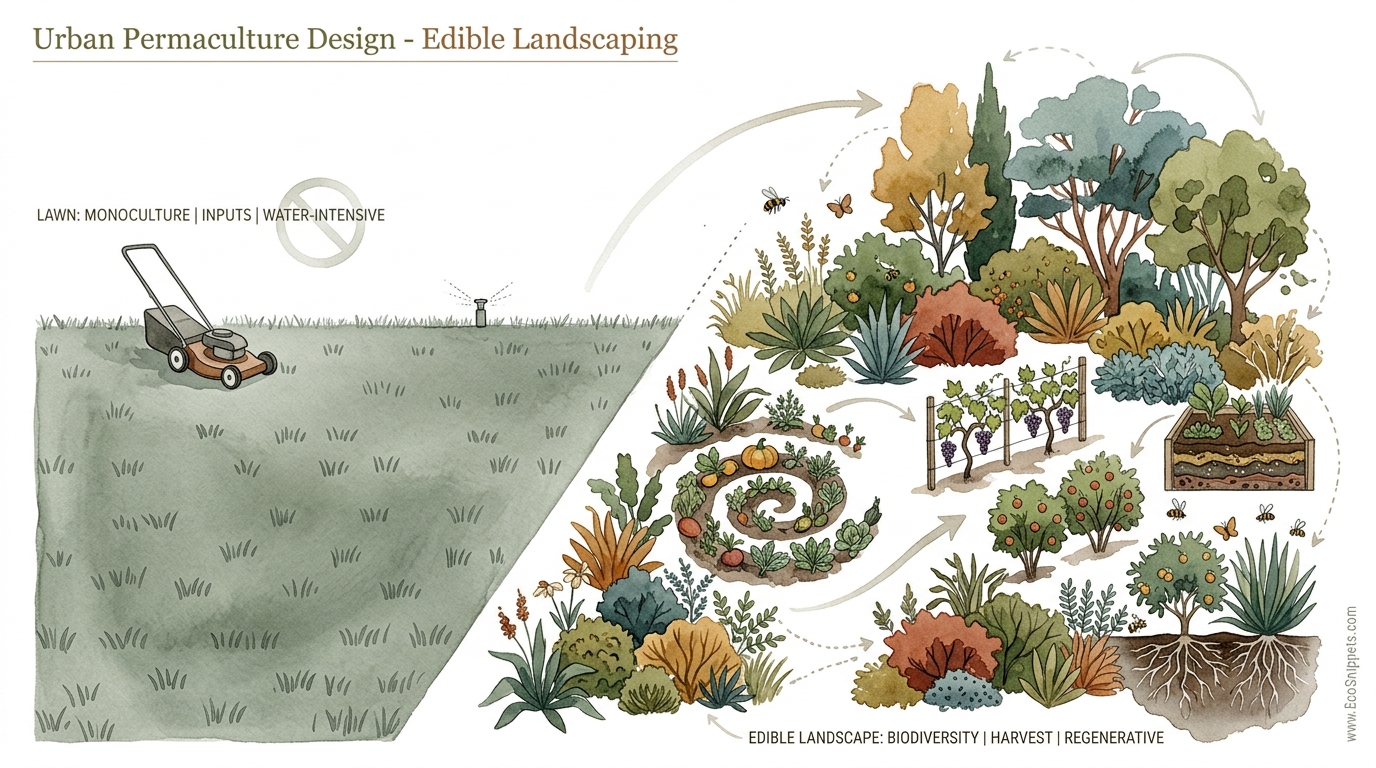
Urban Permaculture Design – Edible Landscaping
Urban permaculture design is the strategic integration of food-producing plants into the human-built environment. It is a philosophy that views every square inch of a city as a potential site for ecological restoration and food production. Instead of fighting nature with lawnmowers and synthetic fertilizers, practitioners work with natural systems to create “edible landscapes” that are as beautiful as they are functional.
In the real world, this manifests as fruit trees shading a sidewalk, berry bushes serving as privacy hedges, and perennial herbs acting as groundcover. It exists in the “jardin de curé” tradition of France, where flowers and vegetables grow in a dense, productive tangle, and in modern “foodscaping” projects that replace ornamental shrubs with blueberries and kale. These systems are designed to be permanent, meaning they rely on perennial plants that return year after year, building soil and biodiversity over time.
The core of this design is the “forest garden” model. Even in a small urban lot, you can “stack” your crops in layers. A dwarf apple tree provides the canopy; a currant bush sits in its shade as the shrub layer; beneath them, strawberries act as a groundcover, while climbing beans use the tree trunk as a trellis. This three-dimensional use of space allows an urban dweller to harvest hundreds of pounds (kilograms) of food from a space that used to hold only grass.
How to Design Your Edible Ecosystem
Creating a permaculture landscape begins with observation. Spend a full season watching how the sun hits your land, where the wind whistles through, and where the water pools after a heavy rain. This “Sector Analysis” prevents you from planting a sun-loving peach tree in a cold, damp corner. Once you understand your site’s unique microclimates, you can begin the design process using these steps:
1. Map Your Zones: In permaculture, “Zone 0” is your home. “Zone 1” is the area you visit daily, such as the path to your car or the back door. Place your most labor-intensive plants, like salad greens and culinary herbs, in Zone 1. “Zone 2” might contain your fruit bushes and perennial vegetables, while “Zone 5” is left wild to attract beneficial insects and birds.
2. Build the Soil from the Top Down: Most urban soil is compacted or stripped of nutrients. Avoid tilling, which destroys the delicate fungal networks in the earth. Instead, use “sheet mulching” or “lasagna gardening.” Lay down a layer of plain brown cardboard to smother weeds, followed by 15 centimeters (6 inches) of compost, and a final 10 centimeters (4 inches) of wood chips or straw. Over time, worms will turn this into rich, dark loam.
3. Plant in Guilds: Never plant a tree alone. Surround it with a “guild” of supporting plants. A classic fruit tree guild includes nitrogen-fixers like clover or lupines to fertilize the soil, dynamic accumulators like comfrey to pull minerals from deep underground, and aromatic herbs like lavender or chives to confuse pests and attract pollinators.
4. Vertical Stacking and Espalier: Space is the biggest constraint in the city. Use fences and walls to grow food. Espalier is an ancient technique of training fruit trees to grow flat against a wall. This saves space and uses the thermal mass of the wall to keep the tree warm during cool nights, often extending the growing season for sensitive fruits like figs or apricots.
Benefits of the Edible Landscape
The transition from a sterile lawn to an edible ecosystem offers measurable rewards that go far beyond a lower grocery bill. It creates a “buffer” between your family and the fragile global supply chain. When you can step out your front door and pick a handful of greens or a basket of berries, you are participating in an ancestral form of security that no supermarket can match.
- Water Conservation: By using mulch and deep-rooted perennials, an edible landscape requires significantly less irrigation than a traditional lawn. Rain gardens and swales—small trenches on contour—capture runoff and “plant the rain” directly into the soil.
- Biodiversity and Pest Control: A diverse garden attracts predatory insects like ladybugs and lacewings. These natural defenders keep pests in check, eliminating the need for toxic sprays that harm the environment and your health.
- Climate Regulation: Urban areas suffer from the “heat island effect.” Adding layers of trees and shrubs cools the air through transpiration and provides shade, potentially reducing your home’s cooling costs in the summer.
- Mental and Physical Well-being: Tending to a living system provides a sense of purpose and connection. The physical labor of mulching and harvesting is a “productive workout,” and the nutrition from sun-ripened, organic produce is vastly superior to store-bought alternatives.
Challenges and Common Mistakes
Transitioning to urban permaculture is not without its hurdles. One of the most frequent errors is “over-planting.” In the excitement of a new project, it is easy to plant 20 trees in a space that can only support five. When those trees reach maturity, they will compete for light and nutrients, leading to poor yields and disease. Always research the “mature spread” of a plant before putting it in the ground.
Another pitfall is the “messy” appearance of permaculture. Natural systems do not look like golf courses. To a neighbor, your thriving ecosystem might look like a weed patch. Avoid conflict by using “cues to care.” Neat edges, a coat of fresh wood chips on paths, or a small decorative fence tell the world that the “wildness” is intentional. Signage explaining that the area is a “Community Food Forest” can also turn skeptical neighbors into curious allies.
Many urbanites also fail to consider the legal landscape. Some municipalities have strict ordinances regarding the height of plants on the “verge” (the strip between the sidewalk and the street). Planting a tall hazelnut bush that blocks a driver’s line of sight could result in a fine or the forced removal of your garden. Check local bylaws and zoning regulations before making permanent changes to public-facing areas.
Limitations and Practical Boundaries
While permaculture is a powerful tool, it is not a magic wand. Environmental limitations are a reality in city centers. Lack of sunlight is the most common constraint; tall buildings can create deep shade that prevents fruiting plants from ripening. In these “canyons,” you may be limited to shade-tolerant greens like kale, chard, or mushrooms rather than sun-loving tomatoes and peaches.
Contamination is another serious boundary. Urban soils often contain “legacy pollutants” like lead from old paint or hydrocarbons from traffic. Planting directly into the ground without testing is a risk to your health. If your soil tests high for heavy metals, you must pivot to raised beds with a barrier at the bottom, or focus on plants like sunflowers and mustards that can help with “bioremediation”—though these specific plants should never be eaten if they are being used to “clean” the soil.
Comparison: Sterile Lawn vs. Edible Ecosystem
To understand why this shift matters, we must compare the traditional ornamental landscape with the permaculture model. The differences in maintenance, cost, and output are stark.
| Feature | Sterile Lawn (Ornamental) | Edible Ecosystem (Permaculture) |
|---|---|---|
| Main Inputs | Synthetic fertilizer, high water, gasoline (mowers). | Organic mulch, compost, harvested rainwater. |
| Maintenance | Weekly mowing and weeding (endless cycle). | Seasonal pruning and mulching (decreases over time). |
| Biodiversity | Monoculture; provides no habitat for pollinators. | Polyculture; supports birds, bees, and soil life. |
| Output | Grass clippings (waste). | Fruit, vegetables, herbs, and medicinal plants. |
| Resilience | Low; dies quickly during drought or heatwaves. | High; builds deep roots and retains moisture. |
Practical Tips for Immediate Application
You do not need to overhaul your entire property in a weekend. Start where you are with what you have. If you live in an apartment, a few pots of Mediterranean herbs like rosemary and thyme on a sunny balcony provide a “mini-permaculture” yield. These plants are drought-tolerant and thrive in the heat reflected off city buildings.
For those with a yard, start by “killing your lawn” one section at a time. Pick a 2-meter by 2-meter (6-foot by 6-foot) patch and apply the sheet mulching technique mentioned earlier. Plant a single “guild” in this area—perhaps a dwarf plum tree surrounded by strawberries and chives. By focusing on a small area, you can ensure it thrives before expanding the system next year.
Focus on “multi-functional” plants. A blueberry bush is a perfect example: it produces delicious fruit, has beautiful white flowers for bees in the spring, and turns a stunning crimson in the autumn. It serves as an ornamental shrub and a food source simultaneously. Choosing plants that perform at least three functions (e.g., food, beauty, and pollinator support) is the hallmark of a smart permaculture design.
Advanced Considerations: Bioremediation and Soil Health
Serious practitioners must address the “invisible” history of urban land. Soil testing is non-negotiable. If you discover lead or arsenic, do not lose hope. Research indicates that adding high amounts of high-quality compost—aiming for at least 10% organic matter—can significantly reduce the “bioavailability” of lead. The organic matter binds to the lead, making it less likely to be absorbed by your vegetables or your body.
Mycoremediation is another advanced technique. Using specific fungi, such as oyster mushrooms (Pleurotus ostreatus), can help break down certain petroleum-based contaminants in the soil. While this is a complex field that requires careful study, it represents the “pioneer spirit” of permaculture: the belief that we can heal the land we have inherited. Always consult with a soil specialist if you are dealing with high levels of industrial toxins.
Example Scenario: The 400-Square-Foot (37 sq meter) Back Lot
Consider a typical small city backyard measuring roughly 6 meters by 6 meters (20 feet by 20 feet). In a traditional setting, this is a patch of patchy grass and a fence. In an urban permaculture design, this space can become a powerhouse of production.
Along the sunniest north-facing fence (in the northern hemisphere), we plant three espaliered pear trees, spaced 1.5 meters (5 feet) apart. Below them, we install a “soft” groundcover of woodland strawberries. In the center of the lot, we place two “keyhole” raised beds, which allow you to reach all your plants from one standing position, maximizing growing space. These beds are filled with perennial kale, asparagus, and rhubarb—crops that provide food for 10-20 years with minimal replanting.
In the corners where water naturally collects, we dig a small “basin” and plant elderberries. These shrubs love the extra moisture and provide medicinal berries for winter syrups. A small 200-liter (55-gallon) rain barrel attached to the garage downspout provides gravity-fed irrigation for the raised beds. In just one season, this “dead space” is transformed into a system that yields 45 kilograms (100 pounds) of produce annually, while requiring less than an hour of work per week once established.
Final Thoughts
Reclaiming your space through urban permaculture is a quiet act of rebellion against a system that prefers us to be dependent. It is a return to the wisdom of our ancestors, who understood that a home was not complete without a garden. By turning our lawns into edible ecosystems, we are not just growing food; we are growing resilience, community, and a deeper connection to the living world.
The beauty of this approach is its scalability. Whether you are planting a single pot of mint or an entire neighborhood food forest, you are contributing to a greener, more secure future. The best time to plant a fruit tree was twenty years ago; the second best time is today. Take that first step, lay down your first layer of mulch, and watch as your neighborhood transforms from a place you simply live into a place that truly sustains you.
As you move forward, remember to stay curious and observant. Every garden is a conversation with nature, and the earth has much to teach those who are willing to listen. Experiment with new varieties, share your surplus with neighbors, and never stop looking for the “edible potential” in the cracks of the sidewalk.
