How To Become More Self-Sufficient Without Starting a Full-Blown Farm…
Want to start preserving your harvest, making your own soap, or building a backyard root cellar — but not sure where to begin? “Homesteading Advice” gives you instant lifetime access to 35+ practical homesteading books on food preservation, veggie gardening, DIY natural cleaning products (save over $250 per year with this skill alone), brewing, off-grid energy, and a whole lot more…
Click Here To Check It Out Now!
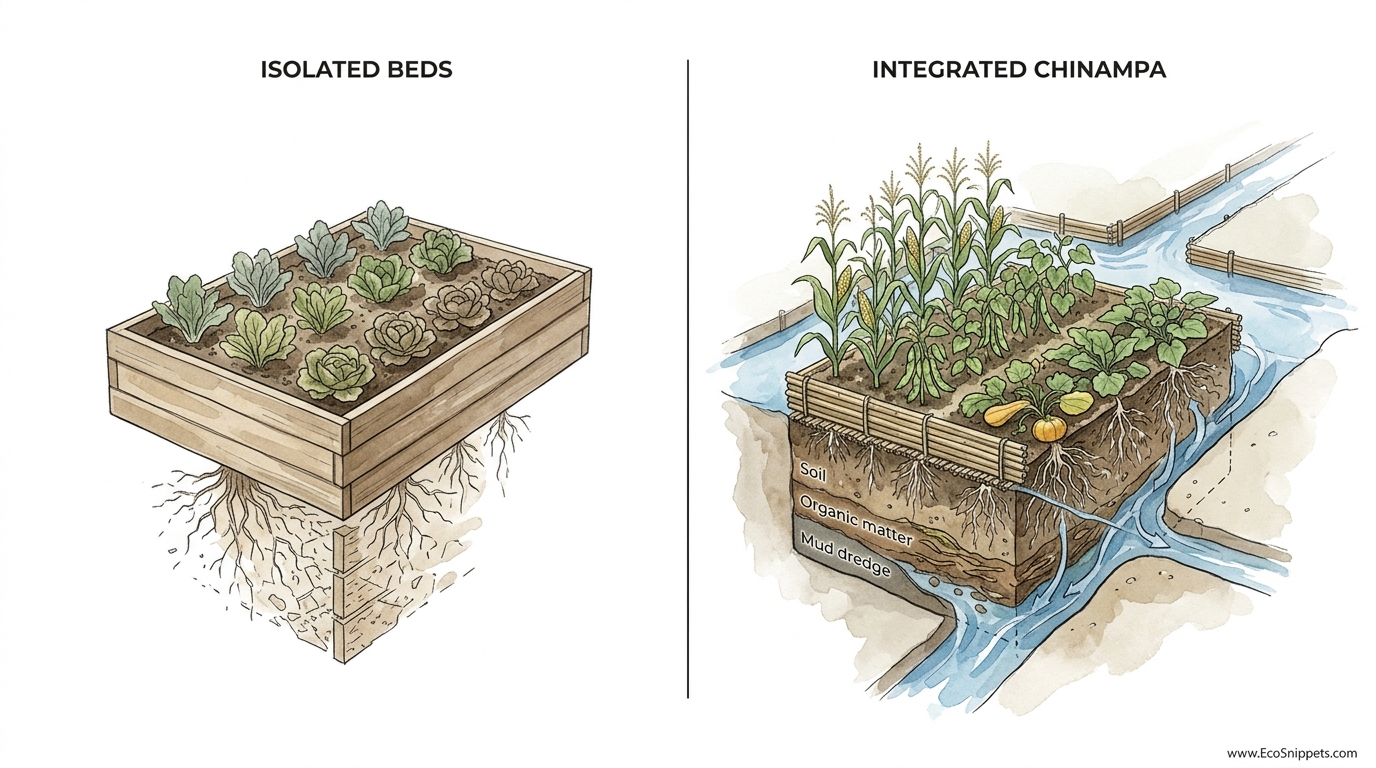
This 700-year-old system produced seven harvests a year without a single drop of synthetic fertilizer or city water. Modern gardening isolates the garden from the water, forcing us to haul nutrients and irrigation. The Aztec ‘Chinampa’ system integrated them into a closed loop. The canal muck fertilized the plants, the plants shaded the fish, and the water provided constant sub-irrigation. It’s the highest-yielding food system ever designed by humans.
For the modern grower seeking self-reliance, the chinampa offers more than just a history lesson. It provides a blueprint for a garden that feeds itself. By understanding how these “floating gardens” functioned, you can stop fighting against nature and start partnering with the water on your own land.
Whether you have a low-lying swampy patch or a small backyard pond, the principles of the chinampa can be adapted to create a resilient, high-output food source. This guide will walk you through the mechanics, the biology, and the practical steps to bringing this ancestral wisdom into the 21st century.
How Chinampas Work
A chinampa is an artificial island built in shallow freshwater lakes or marshes. While they are often called “floating gardens,” they do not actually float; they are stationary platforms anchored to the lake bed. This system was perfected in the Valley of Mexico, particularly in Lake Xochimilco and Lake Chalco, where it sustained the massive population of the Aztec capital, Tenochtitlán.
The genius of the chinampa lies in its geometry. These beds were typically long, narrow rectangles, often measuring about 2 to 10 meters (6 to 33 feet) wide and up to 90 meters (300 feet) long. This narrow shape ensured that every plant on the island was within reach of the water table.
The water does the heavy lifting through a process called capillary action. Because the soil is porous and sits just inches above the water level, moisture “wicks” upward through the soil profile. This provides a constant, gentle sub-irrigation that keeps the root zone perfectly hydrated regardless of rainfall.
Beyond irrigation, the canals surrounding the beds act as a biological engine. Fish, waterfowl, and aquatic plants live in these channels, creating a rich slurry of organic waste. When the canals naturally silt up, the farmer dredges that nutrient-dense “muck” and spreads it back onto the planting beds, effectively renewing the soil’s fertility with every cycle.
The Engineering of a Living Island
Building a chinampa was a feat of community engineering that used nothing but local, biodegradable materials. The process began by identifying a shallow area in a freshwater body, usually no more than 1 to 2 meters (3 to 6 feet) deep.
Farmers would stake out a rectangular perimeter using heavy wooden posts driven into the lake bed. Between these stakes, they wove a “wattle” fence of reeds, vines, and branches. This created a submerged cage that would hold the island’s structural material in place.
Inside this cage, layers were added with precision. First came a foundation of heavy aquatic vegetation and reeds. On top of that, farmers piled mud and sediment dredged from the bottom of the lake. This was topped with a final layer of rich topsoil and decaying organic matter.
To prevent the island from eroding back into the lake, the Aztecs planted a specific willow tree called the ahuejote (Salix bonplandiana) at the corners and along the edges. These trees are water-loving and grow deep, fibrous root systems that literally knit the island to the lake bed. They also provided shade, windbreaks, and a habitat for beneficial insects.
The Seven-Harvest Secret: Nutrient Cycling
In a standard modern garden, you might get one or two harvests a year before the soil is exhausted or the weather turns. The chinampa system achieved up to seven harvests by eliminating the downtime and the nutrient “leakage” that plagues industrial farming.
The secret was a continuous cycle of succession planting. Because the water buffered the temperature of the soil, the beds remained warmer in the winter and cooler in the summer, effectively extending the growing season year-round. While one crop was maturing, the next was often already starting in a separate seedling nursery on the same bed.
Nutrient management was equally sophisticated. The Aztecs didn’t wait for the soil to “rest.” They replenished it constantly using four main sources:
- Canal Muck: Rich in nitrogen from fish waste and decomposed plants.
- Aquatic Plants: Faster-growing weeds like azolla or duckweed were harvested and used as green mulch.
- Human Waste: In the city of Tenochtitlán, waste was collected and transported to the gardens, where it was composted to provide essential phosphorus and potassium.
- Crop Residues: Every leaf and stem that wasn’t eaten went right back into the soil or into the canals to feed the fish.
This closed loop meant that the more the system was used, the more fertile it became. It was a “permanent agriculture” that grew stronger over seven centuries rather than depleting the earth.
Benefits of the Chinampa System
Choosing an integrated water-based system over isolated garden beds offers several measurable advantages for the serious practitioner.
Unmatched Yield Density: Research suggests that one hectare (2.47 acres) of well-managed chinampas could feed 15 to 20 people. In modern terms, that is significantly more productive than almost any other non-chemical agricultural method.
Drought Resilience: Because the system relies on sub-irrigation from a permanent water body, it is largely immune to short-term droughts. While neighbors are hauling hoses, the chinampa is wicking up exactly what it needs from below.
Biodiversity and Pest Control: The canals create an “edge effect” where land and water meet. This attracts a massive variety of birds, dragonflies, and predatory insects that act as natural pest control. Modern studies in Xochimilco have shown that chinampas harbor up to 2% of the world’s biodiversity in a tiny geographical footprint.
Temperature Regulation: The thermal mass of the surrounding water protects plants from light frosts. This microclimate regulation allows for the cultivation of sensitive crops even when the surrounding mainland is too cold.
Challenges and Common Mistakes
While the system is highly efficient, it is not “set it and forget it.” The most common mistakes involve neglecting the physical maintenance of the island’s edges.
Erosion of the Banks: If the anchoring trees are not maintained or if the wattle fencing rots without replacement, the soil will eventually slump back into the canal. This is why the ahuejote willow is so critical; its roots must be healthy to hold the island together.
Water Quality Issues: In the modern world, water pollution is the greatest threat. If the surrounding water is contaminated with heavy metals or industrial runoff, those toxins can be absorbed into the crops via the wicking process. Always test your water source before building a system that relies on sub-irrigation.
Over-Saturation: If the bed is built too low, the soil stays “soggy” rather than “moist,” leading to root rot and anaerobic conditions. The surface of a productive chinampa should sit roughly 20 to 50 centimeters (8 to 20 inches) above the water line for most vegetables.
Limitations: When This System May Not Work
The chinampa is a specialized tool for a specific environment. It is not a universal solution for every backyard.
Water Access: You must have access to a permanent, non-stagnant body of freshwater. Saline or brackish water will kill the crops through salt buildup as the water evaporates from the soil surface.
Topography: These systems are designed for flat, low-lying areas. Attempting to build them on a slope or in a fast-moving river is usually a recipe for failure. The water must be “placid”—slow-moving or still.
Labor Intensity: Building a traditional chinampa requires significant initial labor. Dredging muck and maintaining willow trees is a physical task that doesn’t easily lend itself to heavy machinery. It is a system built for human hands and communal effort.
Comparison: Integrated Chinampa vs. Isolated Beds
To understand the value of this system, we have to look at how it differs from the way most people garden today.
| Feature | Isolated Raised Beds | Integrated Chinampa |
|---|---|---|
| Irrigation | Manual or automated surface watering | Self-watering via capillary action |
| Fertilization | Imported compost or synthetic inputs | Closed-loop dredging and aquatic biomass |
| Yield Potential | 1-3 harvests per year | Up to 7 harvests per year |
| Maintenance | Weeding, tilling, hauling water | Dredging, pruning, bank stabilization |
| Ecosystem Service | Minimal (localized to bed) | High (fish habitat, carbon capture) |
Practical Tips for the Modern Pioneer
You don’t need a 10-hectare lake to use these principles. Here is how to apply chinampa logic on a smaller scale.
- Wicking Beds: If you don’t have a pond, a wicking bed is essentially a miniature, self-contained chinampa. By creating a water reservoir at the bottom of a raised bed and filling it with gravel and soil, you can mimic the sub-irrigation and water-saving benefits.
- Pond-Edge Mounding: If you have a backyard pond, don’t just let the edges be grass. Build small peninsulas of soil into the water, secured with stones or water-loving plants like dwarf willows or elderberries. These “marginal” zones will be your most productive garden spots.
- Duckweed Mulching: Even in a standard garden, you can “borrow” the nutrient cycling. Grow duckweed or azolla in a water barrel or pond. These plants fix nitrogen and grow incredibly fast. Scoop them out and use them as a wet mulch around your tomatoes; it’s like a slow-release fertilizer from the Aztec era.
- Succession is Key: Never leave a chinampa-style bed empty. As soon as you harvest one plant, have a seedling ready to go in its place. The moisture-rich soil can handle the constant demand.
Advanced Considerations: The Role of the Axolotl
For those looking to fully restore a chinampa-style ecosystem, the biology goes deeper than just plants and mud. The chinampas of Xochimilco were the primary habitat for the axolotl (Ambystoma mexicanum).
This unique salamander is more than just a cultural icon; it is an apex predator in the canal system. By keeping the population of insects and small crustaceans in check, the axolotl helps maintain the balance of the water’s microbial life.
Modern practitioners are beginning to realize that the health of the soil on top of the island is inextricably linked to the health of the water below it. A diverse community of bacteria and fungi in the “muck” helps break down organic matter into forms that the plants can actually absorb. When you build a chinampa, you aren’t just building a garden; you are building a biological engine that requires every part—from the trees to the salamanders—to run at peak efficiency.
Example Scenario: The “Wetland Restoration” Garden
Imagine a small community with a neglected, swampy area that floods every spring. Conventional wisdom would say to drain it, fill it with gravel, and build a parking lot.
Instead, a chinampa-inspired approach involves digging out narrow channels and using that earth to build up long, raised planting rows. The channels now manage the floodwater, preventing it from reaching homes. The rows are planted with corn, beans, and squash (the classic “Three Sisters”).
Because the soil was built from the existing wetland muck, it is already rich in life. Within two years, the area isn’t just a garden; it’s a sanctuary for local frogs, birds, and fish. The community harvests food year-round, and the maintenance involves a weekend once a quarter where the youth help dredge the channels to keep the water flowing. This isn’t theory—this is a practical application of a 700-year-old solution to a modern land-management problem.
Final Thoughts
The Aztec chinampa system serves as a powerful reminder that “primitive” does not mean “simple.” These farmers were master engineers and ecologists who solved the most fundamental problems of human survival—water, food, and waste—with a single integrated design. They didn’t see the lake as a barrier to be overcome, but as a partner to be embraced.
In a world of increasing water scarcity and soil depletion, the chinampa offers a path back to sanity. It challenges the idea that we must haul chemicals across the globe to grow a head of lettuce. It proves that a closed-loop, high-output system is not only possible but has already been done successfully for centuries.
Whether you choose to build a full-scale island or simply adopt the practice of using pond muck as fertilizer, you are participating in a lineage of resilience. Experiment with the water. Watch how it wicks. Observe the life that returns to your land. The wisdom of the Aztecs is still there, waiting just beneath the surface of the water.
